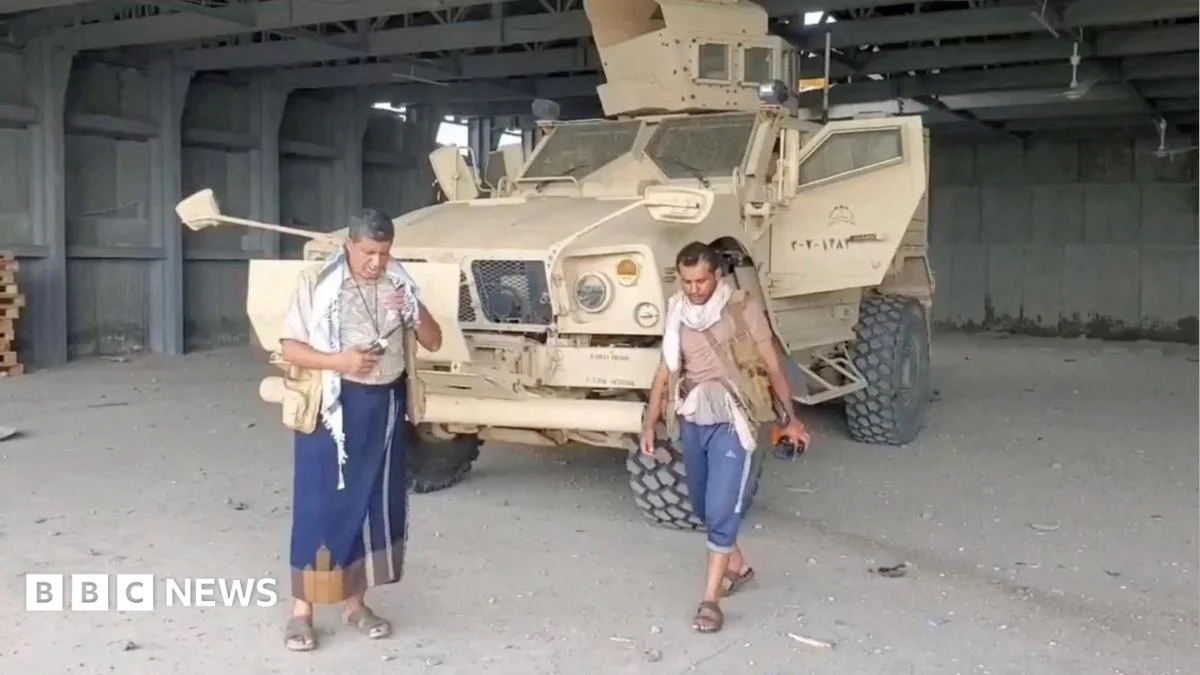
The Iran-backed Houthi movement has successfully seized control of Mokha, a pivotal Red Sea port city, from Saudi-backed pro-government forces, according to confirmations from military sources and witnesses on the ground. This strategic capture places the Houthi forces a mere 75 kilometers (approximately 46 miles) from the Bab al-Mandab Strait, a critical maritime choke point that serves as the southern gateway for a vast trade route connecting Asia and Europe. The escalating conflict, marked by this significant territorial gain, has immediately fueled concerns over regional stability, global shipping security, and the trajectory of international oil prices.
Immediate Fallout and Strategic Implications
The fall of Mokha represents a substantial shift in the ongoing Yemeni civil war, granting the Houthis a firmer foothold on Yemen’s western coastline. This advancement brings them alarmingly close to the Bab al-Mandab Strait, through which an estimated 12% of global trade and a significant portion of the world’s oil supply traverses annually. While the Houthis have publicly stated that their actions pose no direct threat to international shipping, they simultaneously reiterated their intention to target vessels associated with Saudi Arabia. This declaration is particularly pertinent given Saudi Arabia’s long-standing reliance on the Red Sea for its oil exports, a reliance that could intensify should traditional routes through the Arabian Gulf face disruption.
The immediate humanitarian toll of this latest offensive has been severe. Reports indicate hundreds of casualties and thousands of individuals displaced since the Houthi movement launched its south-western offensive just a week prior. These numbers add to an already catastrophic humanitarian crisis in Yemen, which the United Nations has repeatedly labeled the world’s worst. The Saudi-led coalition, a key supporter of the internationally recognized Yemeni government, has retaliated with intensified airstrikes on Houthi-controlled territories in western Yemen. Concurrently, the Houthis have escalated their own long-range attacks, launching missiles and drones at cities and vital oil facilities in southern Saudi Arabia, further illustrating the spiraling nature of the conflict.
Background of the Protracted Conflict
The Yemeni civil war, now in its ninth year, is a complex tapestry of internal grievances and regional proxy rivalries. It began in late 2014 when the Houthi movement, formally known as Ansar Allah, capitalized on widespread discontent to seize the capital, Sanaa, and subsequently ousted the government of President Abdrabbuh Mansur Hadi. This move prompted the intervention of a Saudi-led military coalition in March 2015, with the stated aim of restoring Hadi’s government and countering what it perceives as Iranian expansionism in the Arabian Peninsula.
The conflict has since evolved into a devastating proxy war between regional rivals Saudi Arabia and Iran, with profound humanitarian consequences. Millions of Yemenis face acute food insecurity, and the healthcare system has largely collapsed. The warring parties include the Houthis, the internationally recognized government (now represented by the Presidential Leadership Council or PLC), the Southern Transitional Council (STC), and various other local militias, each with shifting alliances and objectives. The strategic importance of Yemen’s Red Sea coast, particularly its proximity to the Bab al-Mandab, has always been a flashpoint, making the capture of Mokha a highly significant development.
Chronology of Recent Escalations
The informal four-year ceasefire, which had brought a fragile calm to parts of Yemen, began to unravel dramatically in July of the previous year. This breakdown was largely precipitated by the Houthis’ announcement of a "maritime embargo" against Saudi Arabia. They cited what they described as a Saudi blockade of ports and airports within their territory, along with an alleged Saudi airstrike on Sanaa airport, as justification for their renewed offensive.
- July (Previous Year): Houthi "maritime embargo" announced, marking the effective end of the informal ceasefire.
- Ongoing (Previous Months): Houthis initiate a series of missile and drone attacks targeting Saudi airports, oil facilities, and tankers in the Red Sea, claiming retaliation for coalition actions.
- Early Week (Current Offensive): Houthis launch a significant offensive in Yemen’s southwest, leading to fierce clashes with pro-government forces.
- Tuesday (Current Week): Houthis unleash a barrage of dozens of drones and missiles on southern Saudi Arabia. Saudi authorities report 73 civilian injuries and fires at multiple oil facilities, causing temporary operational halts.
- Monday (Current Week): Houthis claim a Saudi airstrike on a prison in Hazm, Jawf province, killed at least 23 civilians, further fueling their retaliatory narrative.
- Wednesday Night (Current Week): Houthi fighters engage in intense clashes with pro-government forces in Mokha, ultimately breaching defenses and entering the city.
- Thursday Morning (Current Week): Houthi forces consolidate control over Mokha. Simultaneously, a Yemeni military source reports the Houthi seizure of Zuqar Island in the Red Sea, approximately 80 km northwest of Mokha, following a rocket barrage and ground assault via boats.
- Over Past 24 Hours (Prior to Capture): Houthi military spokesman Yahya Sarea reports 64 Saudi warplane strikes across western provinces including Taiz, Hudaydah, Marib, and Jawf, underscoring the intensity of coalition air operations.
Eyewitness Accounts and Humanitarian Crisis
The capture of Mokha unfolded rapidly, catching many residents by surprise and triggering widespread panic. Witnesses describe a chaotic scene as Houthi fighters moved into the city after intense overnight clashes with pro-government forces. "The takeover came without warning. Panic spread throughout the area, forcing people to flee amid distressing scenes of injured people lying in the streets with no-one there to help them," one resident recounted to BBC Arabic’s Middle East Lifeline programme, painting a grim picture of the immediate aftermath.
Another resident confirmed the presence of Houthi fighters patrolling Mokha’s streets on Thursday, with government offices and shops remaining shuttered. "At the moment, we don’t know what Ansar Allah will do," he added, referring to the Houthi group by its formal name. "Everyone is afraid for their safety." The sudden displacement has left countless families vulnerable, with many seeking refuge eastward towards Aden, the temporary seat of Yemen’s internationally recognized Presidential Leadership Council and government. "We fled with our children and kept running. We have no bedding, no home, nothing with us. Everything was destroyed within an hour. They didn’t even give us a chance or warn us beforehand," an emotional woman told BBC Arabic, highlighting the desperation of those uprooted. "We are women with no means of defending ourselves, and we have innocent children with us."
Official Responses and Conflicting Narratives
While there was no immediate, direct confirmation of Mokha’s capture from the Houthis themselves, their Supreme Political Council issued a statement via Houthi-run Al Masirah TV on Thursday, asserting that clashes had "ceased in the western coast districts after the expulsion of Saudi enemy mobilizations." This indirect acknowledgment served as de facto confirmation of their territorial gains.
Conversely, Tarek Salah, the leader of the pro-government National Resistance Forces, directly addressed the situation, confirming the gravity of the Houthi offensive. He announced the relocation of his command center on the west coast to a "safe location," stating that his forces had paid "a heavy price in recent days in the face of a Houthi offensive that was planned and supported by Iran." This statement underscores the pro-government narrative of Iranian backing for the Houthi advances.
In response to the escalating crisis, Rashad al-Alimi, head of the Presidential Leadership Council, issued an urgent appeal to Arab states and the broader international community, imploring them to provide assistance in protecting Yemen’s coasts and restoring state control. This plea highlights the dire straits of the internationally recognized government and its reliance on external support.
The Houthi Supreme Political Council, while asserting its "right to defend [Yemen’s] sovereignty and territorial waters," simultaneously sought to reassure the international community that "navigation in the Red Sea remains safe." This dual message attempts to balance claims of self-defense with an effort to mitigate fears of global maritime disruption. However, in a seemingly contradictory move, the Houthi-run humanitarian operations co-ordination centre stressed that the embargo on Saudi ships remained firmly in place, signaling a continued threat to Saudi maritime interests in the Red Sea. The Saudi military has yet to issue an immediate comment on these latest developments, although a spokesman for the Saudi-led coalition had previously vowed a strong response to recent Houthi missile and drone attacks on Saudi territory.
Broader Impact and Geopolitical Implications
The Houthi seizure of Mokha and the intensified conflict carry profound implications across several fronts:
Geopolitical Dynamics:
- Red Sea Security: The proximity of Houthi forces to Bab al-Mandab raises serious questions about the security of one of the world’s most vital shipping lanes. Any sustained threat to this strait could trigger international intervention and lead to a significant naval presence from global powers seeking to safeguard their trade interests. The potential for naval skirmishes or even isolated incidents could lead to a severe disruption of global maritime commerce.
- Regional Power Balance: This Houthi advance is perceived as a significant victory for the Iran-backed axis in the broader regional struggle against Saudi Arabia and its allies. It could embolden Iran and its proxies while weakening the position of the Saudi-led coalition, further complicating peace efforts.
- International Diplomacy: The escalation puts immense pressure on international mediators, including the United Nations and various national envoys, who have struggled to broker a lasting peace agreement. The Houthi’s newfound strategic leverage might make them less inclined to compromise in future negotiations.
Economic Ramifications:
- Oil Prices: The immediate impact on global oil markets has been an upward surge in prices. Traders react to fears of supply chain disruptions, particularly given the Red Sea’s role in transporting oil from the Middle East to Europe and beyond. Benchmark crude prices like Brent and WTI are highly sensitive to instability in this region.
- Global Trade and Shipping Costs: Increased insecurity in the Red Sea will inevitably lead to higher maritime insurance premiums and potentially re-routing of vessels, which translates to increased shipping costs for goods transiting between Asia and Europe. This could have a ripple effect on consumer prices globally.
- Yemen’s Economy: The conflict continues to decimate Yemen’s already fragile economy. The displacement of populations and the destruction of infrastructure further erode livelihoods and perpetuate extreme poverty, exacerbating the humanitarian crisis.
Humanitarian Crisis:
- Mass Displacement: The latest offensive has triggered another wave of internal displacement, putting immense strain on already overstretched humanitarian aid agencies and host communities. Providing shelter, food, and medical care to thousands of newly displaced individuals is a monumental challenge.
- Access to Aid: Any disruption to port operations or increased insecurity along the Red Sea coast could impede the delivery of critical humanitarian aid, including food, medicine, and fuel, which Yemen desperately relies on.
- Civilian Casualties: The intensified fighting, including airstrikes and ground assaults, inevitably leads to more civilian casualties and injuries, overwhelming the country’s devastated healthcare infrastructure.
The seizure of Mokha represents a critical juncture in the Yemen conflict, underscoring the persistent challenges to peace and stability in the region. As the conflict intensifies, the international community faces growing pressure to address not only the immediate humanitarian catastrophe but also the broader geopolitical and economic implications of a war that continues to destabilize a crucial global artery. The coming days will likely see further military maneuvers and diplomatic efforts as regional and international actors grapple with the fallout of this significant Houthi advance.