US President Donald Trump concluded his two-day visit to Ireland with a significant economic announcement, declaring the immediate lifting of all tariffs on Irish whiskey. The declaration, made during the trophy presentation at the Trump International Golf Links in Doonbeg, County Clare, where he awarded the Irish Open title to Shane Lowry, marks a notable development in transatlantic trade relations. The visit also saw President Trump reiterate his personal conviction that a united Ireland was "one of the naturals of all time," adding a layer of political intrigue to his brief stay on the island.
The Tariff Reversal: A Boost for Irish Whiskey Exports
The decision to remove the 15% tariff on Irish whiskey, which had previously applied to goods distilled in the Republic of Ireland, is expected to provide a considerable boost to a burgeoning industry. Prior to this announcement, Irish whiskey produced in the Republic faced a competitive disadvantage in the American market compared to its counterparts from Northern Ireland and the wider United Kingdom, which had seen their tariffs removed in May as part of a separate trade concession. This disparity had created complexities, particularly for distilleries in Northern Ireland that relied on all-island supply chains, often bottling whiskey produced under licence by facilities in the Republic, thereby classifying their product as EU-origin and subject to the tariff.

The imposition of these tariffs was largely a consequence of broader trade disputes between the United States and the European Union, most notably stemming from disagreements over aircraft subsidies involving Boeing and Airbus. While the specific tariffs on Irish whiskey were part of a wider package affecting various European goods, their impact on a culturally significant and economically vital Irish export was keenly felt. In 2023, the United States represented the largest market for Irish whiskey by value, with exports exceeding €1.5 billion annually, a figure that underscores the strategic importance of tariff-free access. The Irish Whiskey Association has consistently advocated for the removal of these trade barriers, highlighting their detrimental effect on growth and market competitiveness. The sector has experienced robust growth over the past decade, with new distilleries opening and global demand for premium Irish spirits soaring. This tariff removal is anticipated to further fuel this expansion, allowing Irish producers to compete on a more level playing field and potentially reduce consumer prices in the US, thereby increasing demand.
President Trump, addressing the crowd at the Doonbeg golf resort, indicated that the decision followed discussions with Irish Taoiseach (Prime Minister) Micheál Martin and even Irish Open winner Shane Lowry, stating, "Everybody’s been bugging me… Could you possibly take the tariffs off of Irish whiskey and I said, on behalf of the United States of America, I am going to take the tariffs off Irish whiskey." This anecdotal account highlights the direct, often unconventional, manner in which Trump approached trade negotiations. The move is widely seen as a diplomatic gesture aimed at fostering goodwill during his visit, while also addressing a specific concern of a key trading partner.
Trump’s Stance on Irish Unity: A ‘Natural’ Progression
Beyond trade, President Trump’s remarks on a united Ireland garnered significant attention. During a meeting with Taoiseach Micheál Martin in Dublin on Saturday, and subsequently reiterated at Doonbeg, Trump stated his belief that joining Northern Ireland and the Republic of Ireland was "one of the naturals of all time." He expanded on this on Sunday, commenting, "I’ve always loved the people of Ireland. It just seems to me you have Northern Ireland and Ireland. It seems that one of the naturals of all time is to put them together. That’s only my opinion, and by the way many people agree."

These comments, while framed as a personal opinion, carry weight given his presidential stature and come at a sensitive time for Anglo-Irish relations and the delicate political balance in Northern Ireland. The prospect of a united Ireland is a highly emotive and complex issue, deeply rooted in centuries of history and the more recent conflict known as The Troubles. The Good Friday Agreement (Belfast Agreement) of 1998, which largely brought an end to the conflict, includes provisions for a border poll on Irish unity, to be called if it appears likely that a majority in Northern Ireland would vote in favour. However, both the Irish and UK governments have maintained that such a poll should only be held when conditions are demonstrably right and there is clear evidence of broad support.
Taoiseach Micheál Martin, responding to Trump’s remarks, acknowledged that they did not come as a "surprise" to him. "He would make the point this is his view. He believes unity is the logical way for the island to be configured and organised," Martin stated, adding that "some of the reaction is an overreaction. It shouldn’t be a surprise. He takes a different sort of perspective on things." This nuanced response reflects the Irish government’s cautious approach to the issue, seeking to manage expectations and avoid any perception of prematurely pushing for a border poll. The UK Prime Minister Andy Burnham had previously stated there would be no poll on Irish unity until a majority in Northern Ireland were likely to vote in favour, a position Trump dismissed by saying, "Everybody says that and then things happen." His sidestepping of a question regarding Scottish independence – "I won’t talk about Scotland yet I will save that" – further underscored his willingness to comment on the internal affairs of sovereign nations.
A Presidential Golf Outing and Departure
The second day of President Trump’s visit was largely spent at his Trump International Golf Links in Doonbeg, County Clare, where he watched the final day of the Irish Open. The visual of a sitting US President attending a golf tournament at his own property, culminating in the presentation of a trophy, provided a unique backdrop to his diplomatic engagements. The event highlighted his personal connection to Ireland through his business investments, which include the Doonbeg resort. After the trophy presentation to Shane Lowry, President Trump boarded Air Force One at Shannon Airport, concluding his two-day trip and departing for Washington.

His visit, though brief, was carefully orchestrated to balance official meetings with personal interests, a hallmark of his foreign travel. The choice of Doonbeg as a central location for the second day not only allowed him to oversee a significant sporting event but also to interact with the local community, albeit under tight security.
Protests and Local Sentiment
President Trump’s visit, while welcomed by some, was met with significant public opposition in other quarters. On Saturday, an estimated 10,000 people marched through Dublin to demonstrate their disapproval of the US president and his policies. The protests, organized by various civil society groups, highlighted concerns ranging from climate change and immigration policies to broader criticisms of his political rhetoric.
On Sunday, the focus of the protests shifted to Doonbeg, where approximately 100 protesters gathered. While smaller in scale than the Dublin demonstration, the presence of demonstrators outside the president’s golf resort underscored the divided public opinion regarding his visit. Irish broadcaster RTÉ reported that a small crowd was moved from the vicinity of the president’s hotel by An Garda Síochána (Irish police). Notably, three women were arrested on Saturday evening for trespassing on the golf links at Doonbeg and subsequently appeared at a special sitting of Ennis District Court.

Among the protesters in Doonbeg was Rev Steven Foster, a Methodist minister from Galway, who told BBC News NI: "I’m here because Trump is the exact opposite of everything I stand for as a follower of Jesus." He emphasized the importance of visible church leadership in such matters, stating that the "type of welcome he has been given sends out a terrible message." These sentiments reflect a segment of Irish society that views President Trump’s policies and persona as incompatible with Irish values.
Conversely, many local residents and business owners in Doonbeg expressed strong support for President Trump and his investment in the area. Martin Kelly, a local businessman, described the Trump International Golf Course as a "massive employer" and a significant asset for the village. "There’s nothing else about here at that scale; they’re very decent people to work for, they’re very fair," he told BBC News NI, adding that local people were "very proud" to host the Irish Open.
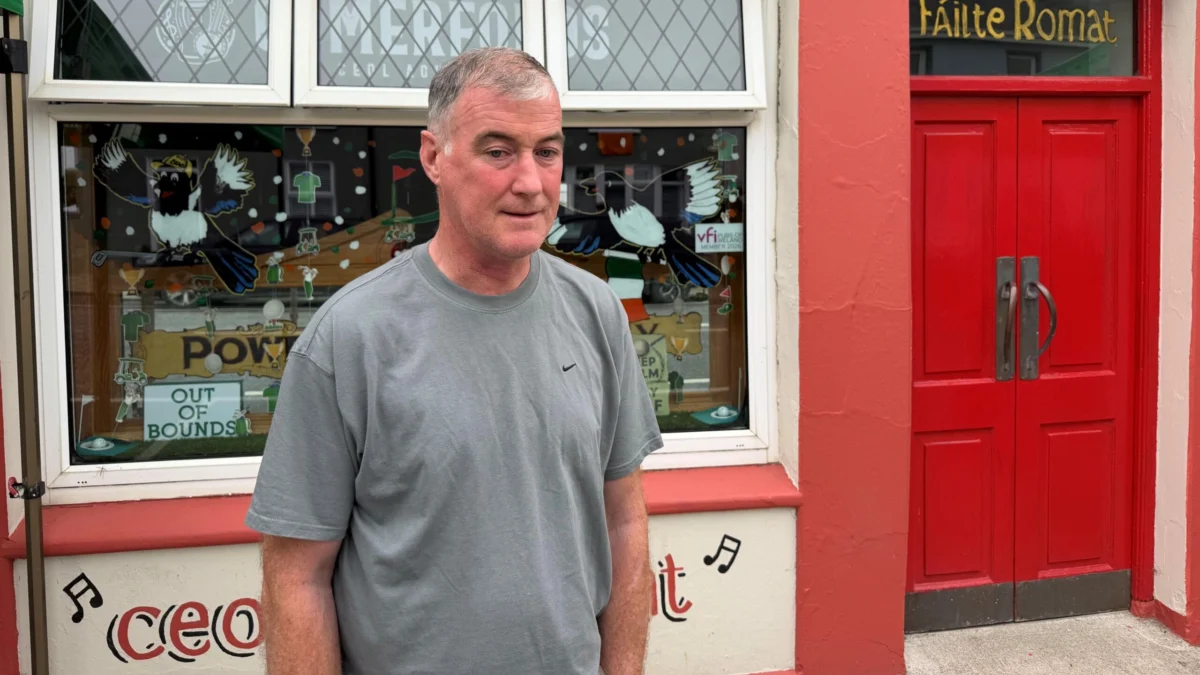
Seoirse Comerford, who owns Comerford’s bar in Doonbeg, echoed these sentiments, describing the tournament as "unbelievable" and emphasizing the golf course’s role in keeping Doonbeg "alive." He highlighted the economic impact: "Most rural villages in west Clare are all dying a death, young people going away to college, they don’t come back. Like there’s over 300 people employed up there at the golf course, it’s a big boost to the local economy. You’ve got big companies in Dublin, like Intel, the golf course is our Intel down here." These statements underscore the direct economic benefits perceived by many in the immediate vicinity of the resort, illustrating a clear division between those prioritizing economic opportunities and those motivated by broader political and ethical concerns.

Broader Impact and Implications
President Trump’s visit to Ireland, though brief, carried both economic and political weight. The removal of tariffs on Irish whiskey is a tangible victory for the industry, promising enhanced competitiveness and growth in the crucial US market. This decision could also serve as a precedent for resolving other trade disputes between the US and EU, demonstrating a willingness to address specific industry concerns.
On the political front, Trump’s pronouncements on Irish unity, while framed as personal opinions, inject an unpredictable element into an already sensitive issue. His comments could be interpreted in various ways: as a simple reflection of a viewpoint, as an attempt to appeal to Irish-American voters, or as a deliberate, if informal, intervention in a complex geopolitical debate. While the immediate impact on the prospect of a border poll is likely minimal, such high-profile commentary from a US president adds another voice to the ongoing discussion about the island’s future, potentially emboldening proponents of unity while unsettling unionists in Northern Ireland. The Taoiseach’s measured response suggests a desire to maintain stability and adherence to the established mechanisms of the Good Friday Agreement.
Overall, the visit showcased President Trump’s unique blend of diplomacy, personal business interests, and candid political commentary. It reaffirmed the enduring cultural and economic ties between the United States and Ireland, while also highlighting the distinct challenges and opportunities that arise when a leader like Trump engages on the international stage. As Ireland continues to navigate its relationship with the UK post-Brexit and the broader European Union, the dynamics of its relationship with the US remain a critical factor, shaped by both formal agreements and the personal inclinations of its leaders.