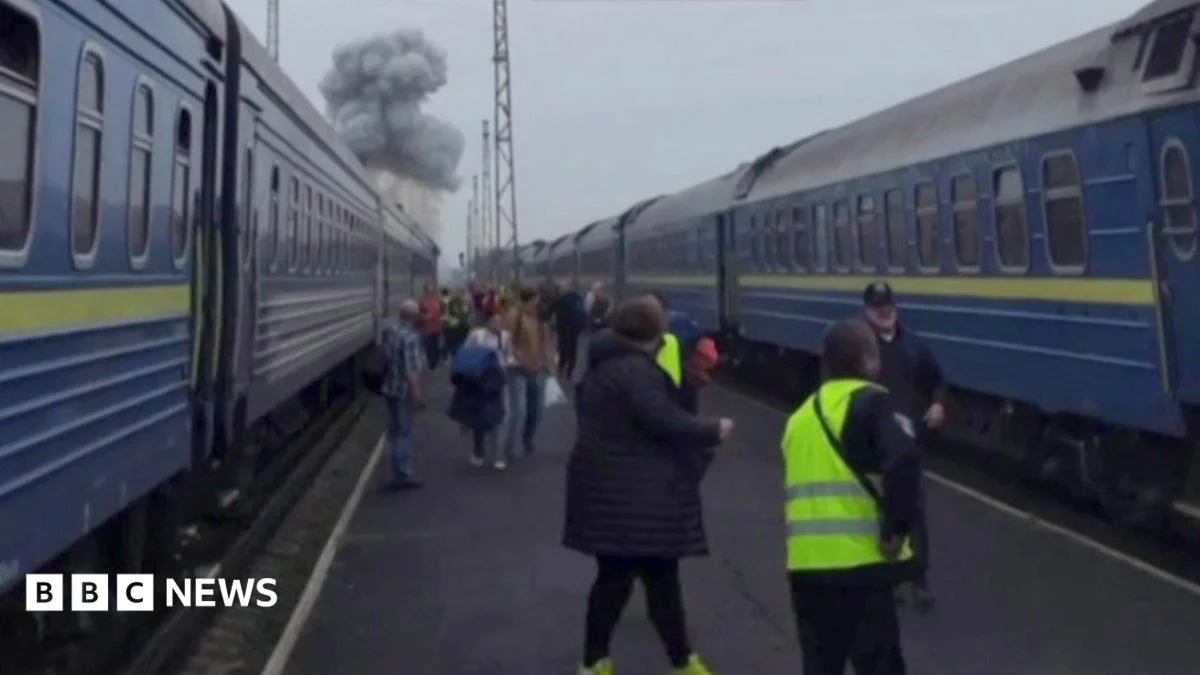
A Russian drone launched a strike on a train near the Ukraine-Poland border at Yahodyn, hitting the locomotive just hours after former UK Prime Minister Boris Johnson and a delegation of high-ranking European and American security officials had traversed the same railway line. The incident, which occurred approximately two kilometers from the Polish frontier, prompted an immediate evacuation of passengers but thankfully resulted in no reported casualties. Ukrainian authorities are investigating the possibility that the "diplomatic train" carrying the foreign dignitaries was the intended target, an assertion that underscores the escalating risks faced by international delegations visiting Ukraine.
The strike unfolded on a critical rail artery connecting Ukraine with its Western allies, a lifeline for both civilian travel and vital logistical support since the closure of Ukrainian airspace following Russia’s full-scale invasion in February 2022. While no lives were lost in this particular incident, it highlights Russia’s sustained and increasingly brazen campaign against Ukraine’s civilian infrastructure, including its extensive railway network.
The Near Miss: A High-Stakes Journey
The train, a standard passenger service, was struck in its engine compartment near the Yahodyn station, a crucial border crossing point for both freight and passenger traffic into Poland. Ukrainian authorities confirmed that all passengers had been safely evacuated prior to the impact. The timing of the attack has drawn significant international attention due to the recent passage of a distinguished group of foreign officials.
Among those who had traveled along the same line, albeit on a different train, were former UK Prime Minister Boris Johnson and former UK National Security Adviser Jonathan Powell. They were returning from a conference in Kyiv, where they had engaged in discussions critical to Ukraine’s security and future. Adding to the gravity of the situation, former CIA chief General David Petraeus was reportedly on board another train at Yahodyn station at the time of the drone strike. Former Swedish Prime Minister Carl Bildt, who had also attended the Kyiv conference, confirmed to the BBC that passengers on his train were instructed to prepare for evacuation after an unscheduled stop, before being allowed to proceed safely to the Polish border station in Dorohusk. While some reports suggested Bildt was on the same train as Johnson, specific details regarding the former UK prime minister’s travel arrangements remain unconfirmed by his office.
Ukrainian state railway company Ukrzaliznytsia stated that the train carrying the diplomatic delegation had departed from the station earlier than its revised schedule, a change made "due to constant threats of Russian strikes." This proactive measure, combined with an evacuation order for passengers on the subsequently hit train just 15 minutes before the drone’s impact, suggests a heightened state of alert and a potential awareness of imminent danger by Ukrainian railway operators.
Official Reactions and Accusations
Following the incident, Russia’s Ministry of Defence issued a statement claiming to have struck "railway infrastructure" in western Ukraine, a broad declaration that offered no specific details about the target or the nature of the strike. This contrasts sharply with Ukrzaliznytsia’s strong suspicion that the "diplomatic train" was the intended target, an accusation that, if proven, would represent a significant escalation in Russia’s targeting strategy, directly endangering high-level international figures.
Boris Johnson, reacting to the strike, posted on X (formerly Twitter): "I don’t know what warped logic drove Putin to blow up a stationary Ukrainian locomotive on the Polish border this morning." He condemned the incident as "the kind of random and senseless attack Ukrainians are enduring every day – even on civilian railways" and used the opportunity to reiterate an urgent plea to Kyiv’s allies to provide Ukraine with "the air defences they need." Johnson’s statement underscores the prevailing sentiment among many international observers that Russia’s actions are often indiscriminate and aimed at terrorizing the civilian population and disrupting vital logistical arteries.
Ukraine’s Rail Network: A Lifeline Under Constant Threat
Since the onset of Russia’s full-scale invasion, Ukraine’s vast and resilient railway network has transformed into the country’s undisputed transportation backbone. With all civilian air travel suspended indefinitely, trains have become the primary mode of transport for millions of Ukrainians, facilitating internal displacement, humanitarian aid delivery, and the movement of goods and military supplies. Crucially, the railway also serves as the sole secure conduit for international delegations, foreign leaders, and humanitarian organizations traveling to and from Kyiv.
The strategic importance of this network has made it a prime target for Russian forces, which have repeatedly sought to cripple Ukraine’s logistical capabilities and instill fear. The Yahodyn strike is not an isolated incident but rather the latest in a series of calculated attacks against railway infrastructure.
A Chronology of Railway Warfare:
- Early March: Six Ukrzaliznytsia employees were killed after a depot was struck in Kyiv.
- Earlier this Week: A female conductor died in a Russian drone attack on a passenger train in southern Ukraine.
- Earlier this Week: Two people were killed when Russian drones hit a border crossing between Ukraine and Moldova, as reported by Ukrainian President Volodymyr Zelensky. This attack, also targeting border infrastructure, indicates a broader pattern of disrupting critical transit points.
- January: Five people were killed when a Russian strike hit a crowded passenger train in the north-eastern Kharkiv region. President Zelensky condemned this incident as "terrorism."
- 2022-2023: Numerous attacks have targeted railway stations, tracks, and depots across Ukraine, including significant strikes in Odesa, Dnipro, and Lviv, often leading to civilian casualties and widespread disruptions. These attacks have consistently aimed to degrade Ukraine’s ability to move troops, supplies, and civilians, illustrating Russia’s strategy of attrition against critical national infrastructure.
These attacks have caused significant damage to Ukraine’s railway infrastructure, yet the network has consistently demonstrated remarkable resilience, with crews working tirelessly to repair damage and restore service, often within hours of a strike.
Escalating Russian Tactics and the Need for Air Defenses
The drone strike near Yahodyn, coupled with recent attacks on border crossings and other critical infrastructure, signals a discernible escalation in Russia’s targeting strategy. The increasing use of fast-moving ballistic missiles and jet-propelled drones, such as the Shahed-136/131 variants, poses a formidable challenge to Ukraine’s air defense systems. These weapons, capable of covering vast distances rapidly, are designed to overwhelm defenses and inflict maximum damage.
Ukraine has made repeated and urgent pleas to its allies, particularly the United States and European partners, for more sophisticated air defense interceptors. Systems like the Patriot, NASAMS, and IRIS-T are crucial for providing layered defense against the spectrum of aerial threats, from cruise missiles to ballistic projectiles and drones. The ability to protect critical infrastructure, including railways and border crossings, is paramount not only for Ukraine’s military effort but also for maintaining civilian life and securing international support routes. The incident near the Polish border directly underscores the immediate and critical need for these advanced defense capabilities.
Broader Implications and Hybrid Warfare Concerns
The proximity of the drone strike to the Polish border carries significant geopolitical implications. Poland, a NATO and European Union member state, shares a long border with Ukraine and has been a steadfast ally, facilitating massive aid flows and hosting millions of Ukrainian refugees. An attack so close to NATO territory, even if unintentional in its border proximity, raises concerns about the potential for spillover and further destabilization in the region.
This incident also fits into a broader pattern of alleged Russian aggression and hybrid warfare tactics extending beyond Ukraine’s immediate borders into Europe. In recent months, several European countries have reported suspicious incidents on their territory, with some attributing them to Russia.
- Germany: Last week, German authorities explicitly blamed Russia for a drone attack at Leipzig’s airport in August, a claim Moscow vehemently denied as "absurd." Such incidents, even if denied, sow distrust and highlight vulnerabilities in critical infrastructure.
- Other European Nations: There have been a number of suspicious fires and acts of sabotage at defense facilities and logistical hubs from Italy to Estonia. While definitive proof is often elusive, affected countries have pointed fingers at Russia, suggesting a campaign of destabilization aimed at disrupting military aid to Ukraine and undermining European security. These events, combined with cyberattacks and disinformation campaigns, form a mosaic of hybrid warfare designed to exert pressure without direct military confrontation.
The drone strike near Yahodyn, therefore, is not merely an isolated act of aggression against a train. It is a stark reminder of the multifaceted and escalating nature of Russia’s war, one that increasingly blurs the lines between conventional warfare and hybrid tactics, and one that poses direct risks to international cooperation and the security of Europe. The need for robust air defenses in Ukraine and vigilance across the continent has never been more pressing.