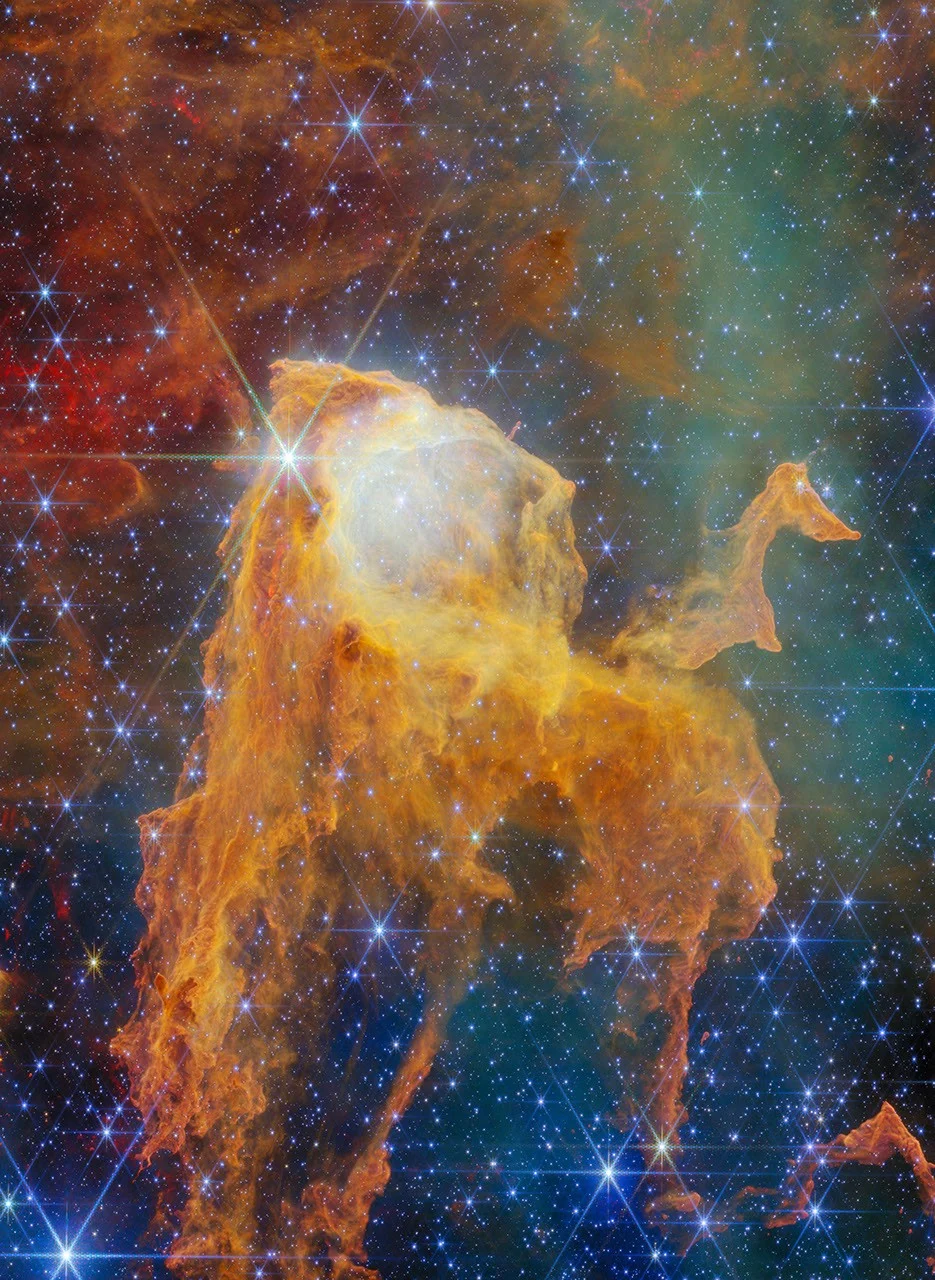
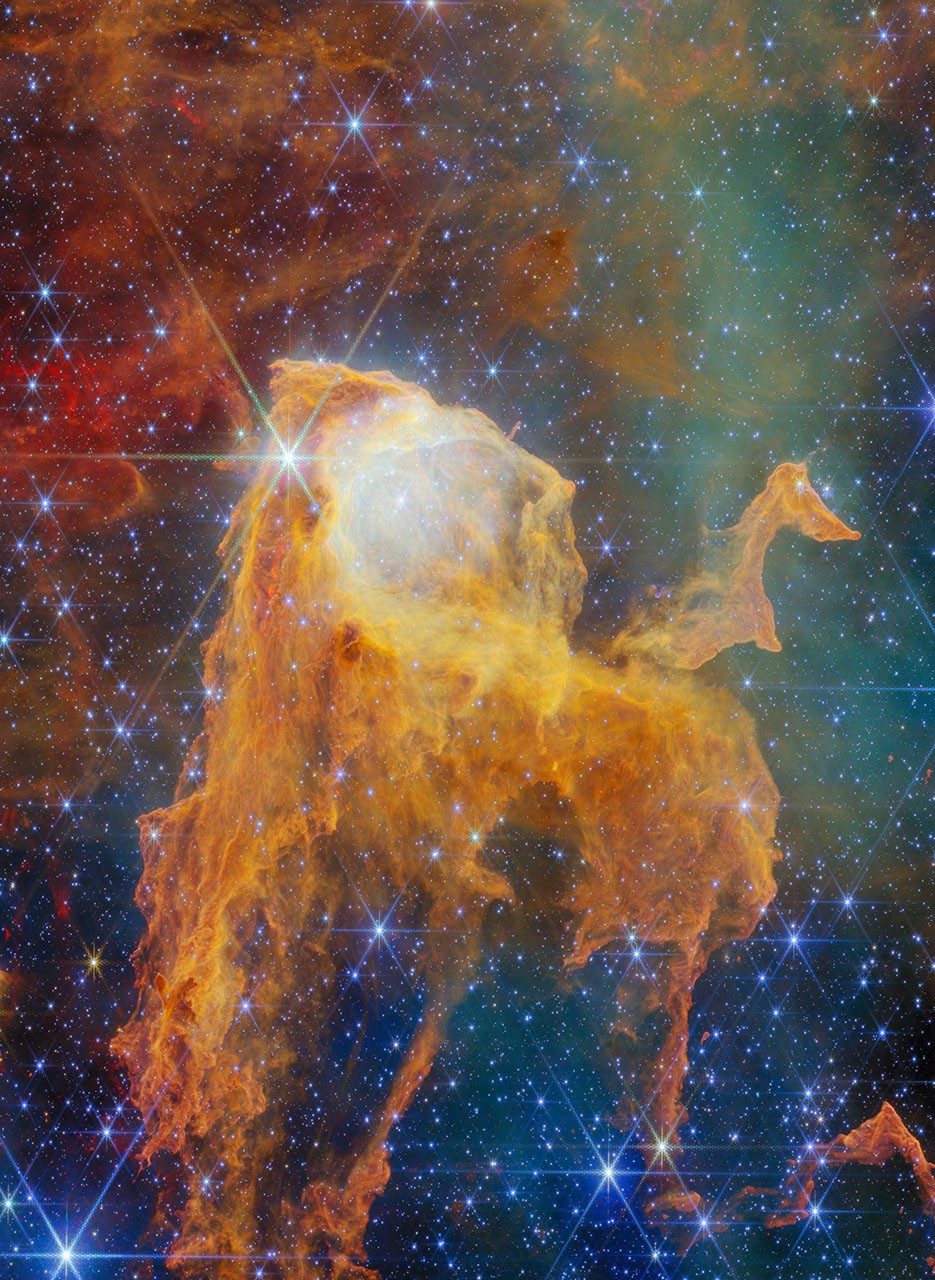
A breathtaking new image captured by NASA’s cutting-edge James Webb Space Telescope (JWST) has revealed a spectacular cosmic structure within the distant Carina Nebula, strikingly resembling an open treasure chest overflowing with nascent stars. This celestial tableau, designated as the Astronomy Picture of the Day (APOD) for September 17, 2026, provides astronomers with an unparalleled view into the dynamic processes of star birth and stellar evolution, approximately 7,500 light-years away within our own Milky Way Galaxy. The image specifically highlights a towering dust pillar, sculpted by the fierce stellar winds and intense radiation emanating from colossal neighboring stars, most notably the hyperluminous Eta Carinae stellar system.
A Glimpse into the Carina Nebula’s Heart
The Carina Nebula (NGC 3372) is one of the largest and brightest nebulae in the night sky, a sprawling complex of gas and dust spanning over 300 light-years. Located in the constellation Carina, it is a quintessential example of a massive star-forming region, teeming with young, hot, and highly luminous stars, including some of the most massive and energetic stars known in our galaxy. Unlike its more famous counterpart, the Orion Nebula, which is about five times closer, the Carina Nebula offers a more extreme environment, characterized by intense ultraviolet radiation and powerful stellar winds that dramatically sculpt its intricate structures. These forces carve out dramatic pillars, like the "treasure chest" featured in the JWST image, and dense globules of gas and dust where new stars are still coalescing.
The "treasure chest" pillar itself is composed of dense interstellar gas and dust, the raw material for star formation. Within its confines, a compact cluster of approximately 70 stars has been identified, a testament to the ongoing stellar genesis within this dynamic environment. Astronomers estimate this particular cluster to be remarkably young, only around 1.3 million years old. For context, our Sun is about 4.6 billion years old, highlighting the infancy of these stellar inhabitants. The excavation of the pillar’s head, giving it the appearance of an open lid, is a direct consequence of the vigorous star formation occurring inside, where the intense energy from newly formed stars is blowing away surrounding material.
The James Webb Space Telescope: A New Era of Astronomical Discovery
The acquisition of such detailed and vibrant images is made possible by the unparalleled capabilities of the James Webb Space Telescope. Launched on December 25, 2021, JWST is the premier space science observatory in the world, succeeding the Hubble Space Telescope. Its primary mission is to observe the universe in infrared light, a crucial advantage for peering through the thick clouds of gas and dust that obscure star-forming regions. Unlike visible light, which is scattered and absorbed by dust, infrared light can penetrate these shrouds, revealing the hidden processes of star and planet formation, as well as the earliest galaxies in the universe.
JWST’s 6.5-meter primary mirror, composed of 18 hexagonal segments, offers significantly greater light-gathering power than any previous space telescope. Its sophisticated instruments, including the Near-Infrared Camera (NIRCam) and the Mid-Infrared Instrument (MIRI), allow astronomers to capture an extraordinary range of infrared wavelengths. For the Carina Nebula observations, JWST’s infrared vision is instrumental in unveiling the young stars embedded within the dust pillar, stars that would remain hidden from optical telescopes. The detailed resolution and sensitivity of JWST allow for the precise identification and characterization of individual stars within the cluster, offering vital data on their masses, ages, and evolutionary stages. This particular image, with its exquisite detail and vibrant colors, underscores JWST’s transformative impact on our understanding of cosmic phenomena, continuing to deliver groundbreaking discoveries since its "First Light" images were released in July 2022.
Stellar Evolution in a Cosmic Cradle
Among the numerous stars within the "treasure chest" pillar, astronomers have identified a particularly massive star, estimated to be approximately 19 times the mass of our Sun. Such massive stars are relatively rare in the universe but play a disproportionately significant role in shaping their galactic environments. They are born from the densest parts of molecular clouds, accumulate mass rapidly, and quickly ignite nuclear fusion in their cores. Due to their immense mass, these stars burn through their nuclear fuel at an astonishing rate, shining with extraordinary luminosity — often hundreds of thousands or even millions of times brighter than the Sun. This intense luminosity, combined with powerful stellar winds, dramatically influences the surrounding interstellar medium, pushing away gas and dust, creating cavities, and triggering subsequent waves of star formation.
The rapid evolution of massive stars means their lifetimes are relatively short, typically just a few million years, compared to the billions of years for Sun-like stars. They end their lives in spectacular supernova explosions, enriching the galaxy with heavy elements essential for the formation of new stars, planets, and even life itself. The presence of such a prominent massive star within the 1.3-million-year-old cluster confirms the vigorous and relatively recent star formation activity within the pillar, cementing its status as a dynamic stellar nursery. These massive, luminous stars are indeed the "shiniest jewels" in this cosmic treasure chest, illuminating the complex interplay between stellar birth and the forces that sculpt our galaxy.
The Dominant Influence of Eta Carinae
A crucial element in understanding the morphology and dynamics of the "treasure chest" pillar is the nearby Eta Carinae stellar system. Located within the same Carina Nebula, Eta Carinae is one of the most luminous and massive stars in the Milky Way, radiating energy equivalent to over 5 million Suns. It is a highly unstable hypergiant star, known for its dramatic and unpredictable outbursts, most famously the "Great Eruption" of the 1840s, which temporarily made it the second-brightest star in the sky.
The powerful stellar winds and intense ultraviolet radiation continuously streaming from Eta Carinae are the primary forces responsible for sculpting the intricate structures observed throughout the Carina Nebula, including the "treasure chest" pillar. These energetic outflows erode the less dense outer layers of molecular clouds, leaving behind the denser, more resistant pillars and globules where star formation continues. The ongoing interplay between the destructive power of massive stars like Eta Carinae and the constructive forces of gravity within the dust pillars creates a cycle of star birth and stellar feedback that is fundamental to galactic evolution. Future observations of this region will continue to shed light on the precise mechanisms by which such extreme stellar environments influence the formation and early evolution of star clusters.
APOD: Bridging Science and Public Engagement
The selection of this stunning image as the Astronomy Picture of the Day (APOD) for September 17, 2026, continues APOD’s long-standing tradition of making cutting-edge astronomical discoveries accessible to a global audience. Established in 1995, APOD, a service of NASA and Michigan Technological University, daily presents a different image or photograph of our fascinating universe, accompanied by a brief, informative explanation written by a professional astronomer. This initiative serves as a vital bridge between the scientific community and the general public, fostering interest and understanding in astronomy and space exploration.
The APOD platform has become a trusted and widely celebrated resource for cosmic imagery and scientific dissemination, reaching millions of viewers worldwide. The concise and expert-written explanations ensure that complex astronomical concepts are presented in an understandable manner, allowing enthusiasts of all ages to engage with the latest celestial wonders. The credit for this particular APOD image is shared among international collaborators, including the European Space Agency (ESA), NASA, and the Canadian Space Agency (CSA), highlighting the global nature of modern space exploration. The image processing and scientific interpretation are attributed to M. Reiter, with acknowledgment to M. H. Özsaraç, while the APOD explanation itself is authored by Cecilia Chirenti, Robert Nemiroff, Jerry Bonnell, and Keighley Rockcliffe, all part of the dedicated team that curates this daily astronomical offering.
In a significant administrative update, APOD’s main NASA site is undergoing a transition from apod.nasa.gov to science.nasa.gov/apod. This move is indicative of NASA’s ongoing efforts to consolidate its online resources and enhance the accessibility and integration of its science communication platforms. By embedding APOD directly within the broader science.nasa.gov domain, the initiative aims to reach an even wider audience and streamline access to NASA’s vast repository of scientific information and educational content. This strategic relocation underscores the enduring value and popularity of APOD as a key component of NASA’s public outreach and science activation efforts, supported by the Astrophysics Science Division (ASD) at NASA’s Goddard Space Flight Center (GSFC) and NASA Science Activation. The transition ensures the continued availability of this invaluable resource for generations of stargazers and aspiring astronomers.
Broader Implications and Future Research
The "treasure chest" image from JWST is more than just a visually stunning photograph; it represents a significant contribution to our understanding of some of the most fundamental processes in the universe. By providing unprecedented detail of a young star cluster within a dynamic dust pillar, it allows astronomers to refine models of star formation, particularly those involving massive stars and their profound influence on their environments. The data gleaned from such images, especially when combined with spectroscopic observations that reveal the chemical composition and velocities of gas and dust, will help scientists to address long-standing questions about how stellar feedback mechanisms regulate the rate of star formation in galaxies.
The intricate details resolved by JWST will enable further studies into the initial mass function of stars in these extreme environments, determining the relative proportions of massive versus less massive stars formed. This, in turn, has implications for galactic chemical evolution and the eventual fate of galaxies. As JWST continues its mission, it is expected to deliver a continuous stream of such groundbreaking images and data, pushing the boundaries of human knowledge and inspiring a new generation of scientists and space enthusiasts. The Carina Nebula, with its treasure trove of stellar activity, remains a prime target for future observations, promising even deeper insights into the cosmic ballet of birth, life, and death among the stars.