The Astronomy Picture of the Day (APOD), a revered daily offering from NASA and Michigan Technological University, is transitioning its primary online presence from its long-standing apod.nasa.gov domain to science.nasa.gov/apod. This strategic move, effective with recent daily updates, integrates APOD more directly into NASA’s broader Science Mission Directorate web infrastructure, aiming to enhance accessibility and unify its diverse scientific outreach efforts. Coinciding with this platform evolution, APOD recently featured a stunning image of Messier 33, popularly known as the Triangulum Galaxy, highlighting its critical role in establishing the cosmic distance scale of the universe.
The Astronomy Picture of the Day: A Daily Window to the Cosmos
Since its inception in June 1995, APOD has served as a cornerstone of astronomical public outreach, delivering a new image or photograph of the universe each day, accompanied by a concise explanation penned by a professional astronomer. Founded by Robert Nemiroff and Jerry Bonnell, both astrophysicists, the program quickly garnered a global following, becoming one of the most popular websites on the internet in its early years. Its mission has remained steadfast: to showcase the beauty and complexity of the cosmos while providing educational context in an accessible format. The archive, a vast repository spanning nearly three decades, offers a chronological journey through astronomical discovery and imaging techniques, allowing enthusiasts and researchers alike to "Discover the cosmos!" as its tagline suggests.
The success of APOD lies in its simplicity and consistency. Each entry presents a different facet of the universe—from distant galaxies and nebulae to planets within our own solar system, and even celestial phenomena visible from Earth. The accompanying explanations, crafted by experts, distill complex astronomical concepts into understandable language, making cutting-edge science approachable for a wide audience, from casual observers to aspiring astronomers. This daily dose of cosmic wonder has played a significant role in fostering public interest in space science and inspiring countless individuals to explore the mysteries beyond Earth.
Messier 33: A Galactic Neighbor and Cosmic Benchmark
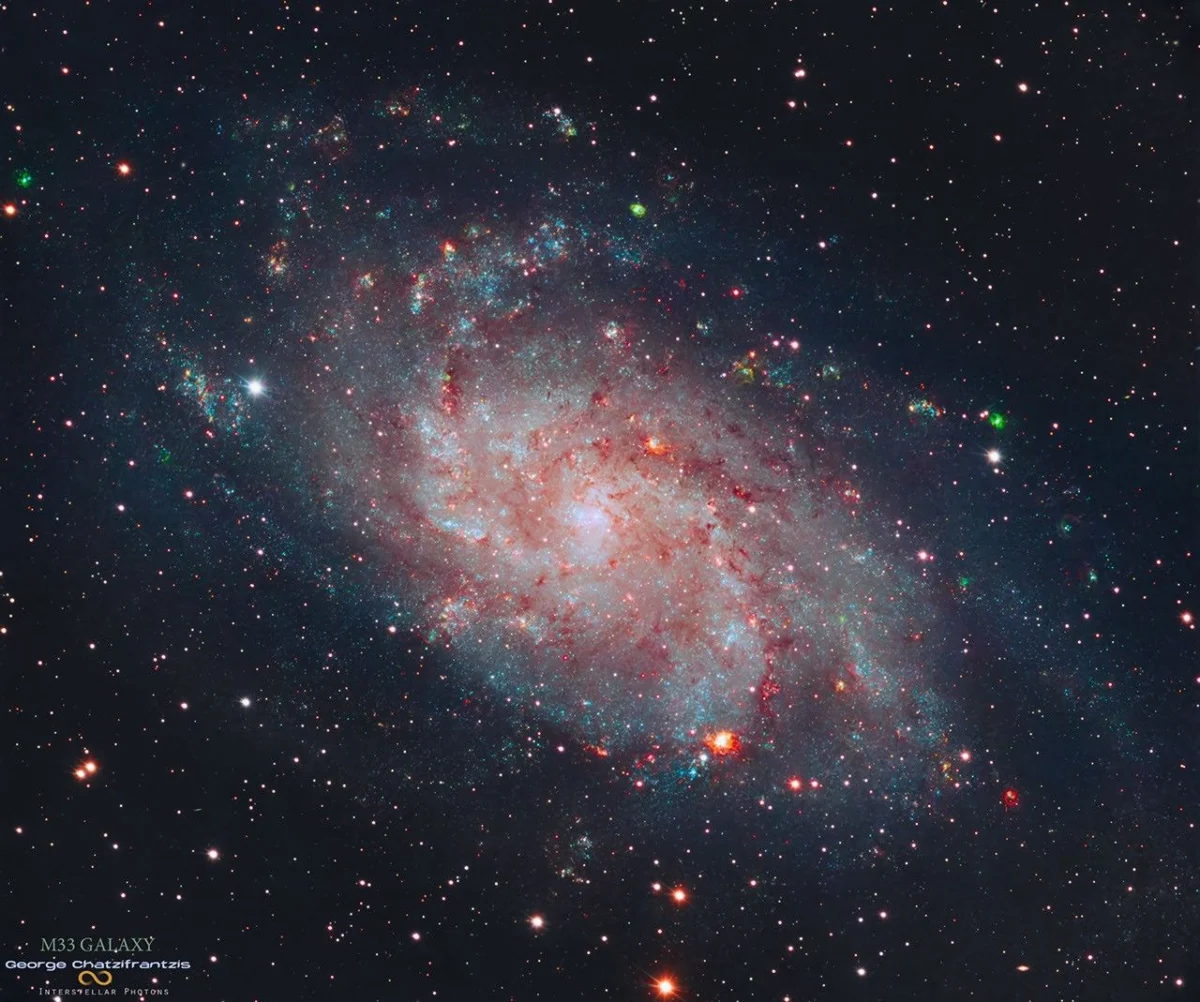
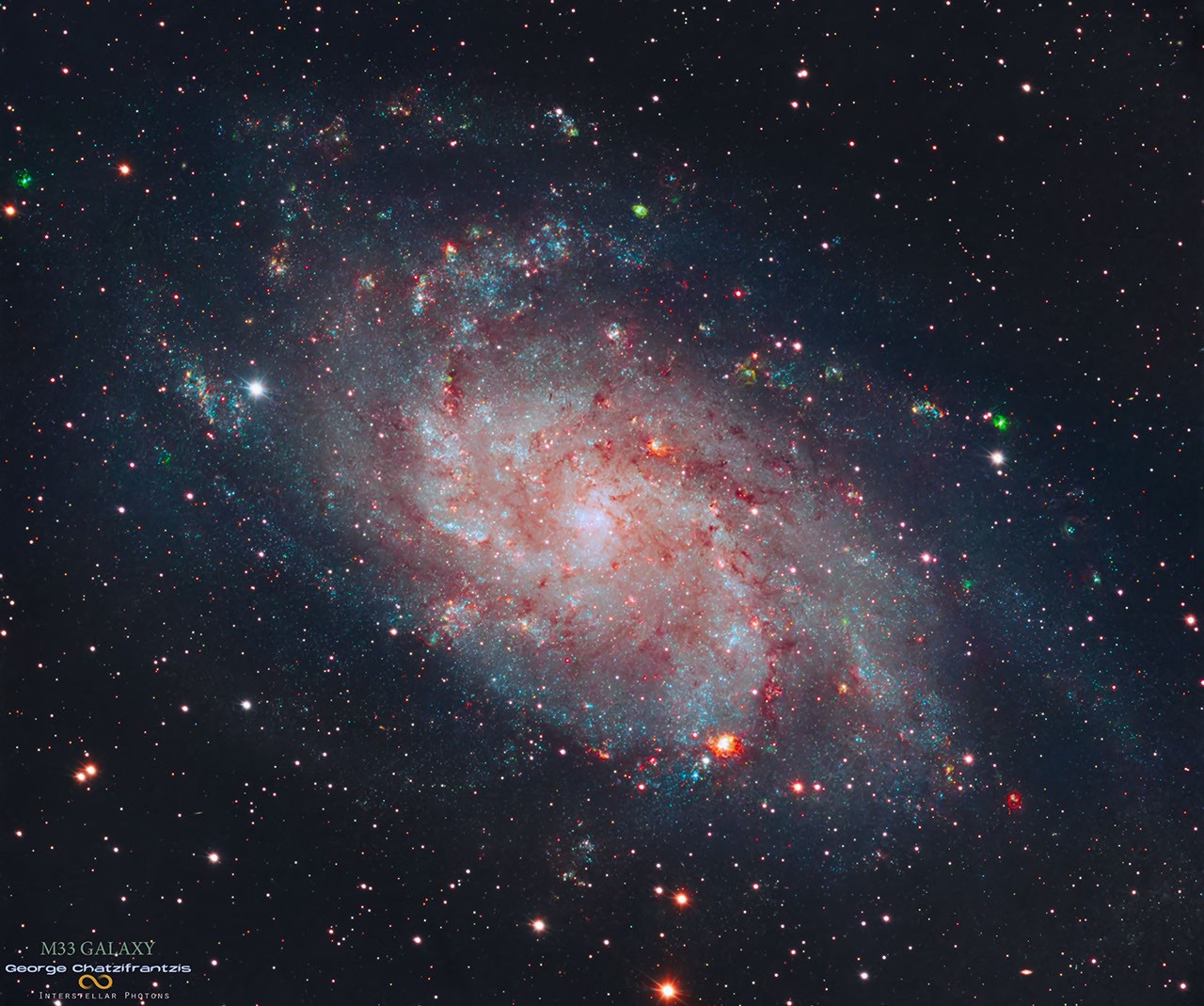
The recently featured image captures the magnificent face-on spiral galaxy Messier 33, residing within the small, northern constellation Triangulum. Known by several popular monikers, including the Pinwheel Galaxy and simply the Triangulum Galaxy, M33 presents a breathtaking spectacle of stellar nurseries and intricate spiral arms. This galaxy is a prominent member of our galactic neighborhood, the Local Group, and holds particular significance for astronomers due to its proximity and structure.
Measuring over 50,000 light-years in diameter, M33 ranks as the third-largest galaxy in the Local Group, surpassed only by the colossal Andromeda Galaxy (M31) and our own Milky Way. Its relatively close distance of approximately 3 million light-years from the Milky Way makes it an invaluable object for detailed study. Astronomers postulate that M33 is gravitationally bound to, and perhaps a satellite of, the Andromeda Galaxy, a relationship that offers fascinating insights into galactic dynamics and evolution within a clustered environment. From the perspective of potential observers within M33 or Andromeda, the views of each other’s grand spiral star systems would undoubtedly be spectacular, offering a unique dual perspective on galactic structures.
The sharp telescopic image displayed by APOD vividly illustrates M33’s defining characteristics. It reveals numerous blue star clusters, indicative of vibrant regions of young, hot stars, alongside prominent pinkish star-forming regions, often referred to as H II regions. These areas glow brightly as hydrogen gas is ionized by intense ultraviolet radiation from newly formed massive stars. One particularly notable and cavernous star-forming region, NGC 604, is prominently visible in the image, typically found at about the 5 o’clock position from the galaxy’s core. NGC 604 is one of the largest and most luminous star-forming regions in the entire Local Group, containing hundreds of massive stars and spanning approximately 1,500 light-years. Its detailed study offers crucial data on stellar formation processes in environments beyond the Milky Way.
The Cosmic Distance Ladder: M33’s Indispensable Role
Beyond its visual appeal, Messier 33 holds profound scientific importance as a "cosmic yardstick" for establishing the distance scale of the universe. This designation stems from the presence of well-measured variable stars within its structure, particularly Cepheid variable stars. These pulsating stars exhibit a direct relationship between their pulsation period and their intrinsic luminosity (absolute brightness). By observing their pulsation periods, astronomers can determine their true brightness, and by comparing this to their apparent brightness as seen from Earth, they can accurately calculate their distance.
This method forms a crucial rung on the cosmic distance ladder, a sequence of techniques used by astronomers to measure increasingly greater distances in the universe. The ladder begins with direct measurements for nearby objects (like parallax), then extends to Cepheid variables for galaxies within the Local Group and nearby clusters, and further still to Type Ia supernovae for the most distant galaxies. Edwin Hubble famously used Cepheid variables in M31 (Andromeda) in the 1920s to prove that it was a separate galaxy far beyond the Milky Way, thereby revolutionizing our understanding of the universe’s scale and structure. M33, being closer and presenting a face-on view, offers an excellent laboratory for calibrating these Cepheid measurements, which then serve as a foundation for estimating distances to more remote galaxies where only Type Ia supernovae can be observed.
The precision offered by M33’s Cepheids is vital for refining the Hubble Constant, a fundamental parameter in cosmology that describes the rate at which the universe is expanding. Discrepancies between different methods of measuring the Hubble Constant—known as the "Hubble Tension"—are a significant area of ongoing research, and accurate measurements from nearby galaxies like M33 are indispensable for resolving these cosmological puzzles.
The Local Group: Our Galactic Neighborhood
Messier 33 is an integral part of the Local Group, a gravitationally bound collection of over 50 galaxies, dominated by the two largest spirals: the Andromeda Galaxy (M31) and the Milky Way. While M31 and the Milky Way each boast hundreds of billions of stars, M33 is significantly smaller, estimated to contain around 40 billion stars. This hierarchical structure, where smaller galaxies orbit larger ones, is a common arrangement throughout the universe.
The dynamics within the Local Group are a subject of intense study. Current models predict that the Andromeda Galaxy and the Milky Way are on a collision course, expected to merge in approximately 4.5 billion years to form a larger elliptical galaxy. The fate of M33 in this cosmic ballet is also of interest. As a potential satellite of Andromeda, it could either merge with M31 prior to or during its collision with the Milky Way, or perhaps be ejected from the Local Group altogether. Understanding the interactions and evolutionary paths of these neighboring galaxies provides crucial insights into how galaxies form, grow, and interact across cosmic timescales.
NASA’s Digital Evolution: Consolidating Scientific Outreach
The migration of the APOD website to science.nasa.gov/apod signifies a broader initiative by NASA to consolidate its vast digital presence and streamline access to its scientific content. This move places APOD directly under the umbrella of NASA’s Science Mission Directorate (SMD), which oversees the agency’s research and exploration programs across astrophysics, heliophysics, planetary science, and Earth science.
The original APOD site, hosted on apod.nasa.gov, was a testament to the early internet’s decentralized nature, often hosted on various university or center servers. As NASA’s digital footprint has grown and matured, there has been a push towards a more unified and consistent user experience. Integrating APOD into the science.nasa.gov domain aligns it with other major science initiatives and data portals, making it easier for users to navigate between different facets of NASA’s scientific endeavors.
This migration is not merely a change in URL but represents a strategic effort to enhance the program’s visibility, improve its technical infrastructure, and potentially facilitate the integration of new features or interactive elements in the future. By bringing APOD into a more modern, centralized platform, NASA aims to ensure its longevity and continued relevance as a premier source of astronomical imagery and education. The agency’s commitment to public engagement remains paramount, and this transition is expected to further democratize access to cutting-edge astronomy for a global audience.
Broader Impact and Future Horizons
The continued success of programs like APOD underscores the profound human fascination with the cosmos. By presenting scientific discoveries in an engaging and visually stunning manner, APOD bridges the gap between complex research and public understanding. It inspires curiosity, fosters scientific literacy, and serves as a powerful tool for STEM education. The high-quality images, often sourced from observatories like the Hubble Space Telescope, James Webb Space Telescope, or ground-based facilities, not only showcase scientific data but also evoke a sense of wonder and perspective about humanity’s place in the vast universe.
As NASA continues to push the boundaries of space exploration—with missions like the upcoming Europa Clipper, the Mars Sample Return program, and ambitious plans for lunar and Martian habitation—the need for effective scientific communication remains critical. Platforms like APOD, now seamlessly integrated into the Science Mission Directorate’s digital hub, are vital in communicating these endeavors and their scientific returns to the public that supports them.
The transition of APOD’s main NASA site marks a significant programmatic update for a beloved institution in astronomical outreach. Simultaneously, the featured image of the Triangulum Galaxy serves as a powerful reminder of the universe’s beauty and the fundamental scientific challenges astronomers continue to tackle, particularly in charting the immense distances that define our cosmos. With the promise of "Tomorrow’s picture: star party weekend," APOD signals its unwavering commitment to daily celestial inspiration, now from an enhanced digital home.