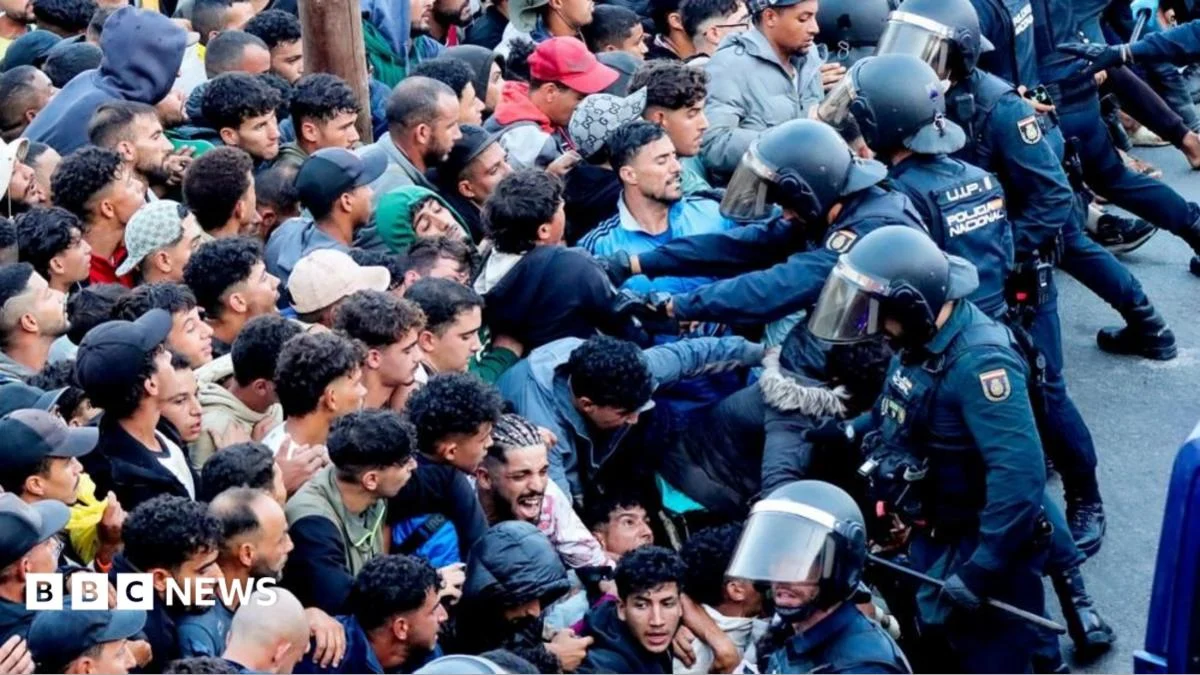
Police forces in Ceuta, the Spanish autonomous city situated on the northern coast of Africa, have commenced a significant operation to relocate hundreds of migrants to a newly established tented site within the city’s port area. This extensive transfer, initiated after weeks of makeshift living conditions on the territory’s beaches, aims to centralize the migrant population for identification, care, and the determination of their administrative status. The operation, which began in the early hours of Friday, unfolded with considerable challenges, including struggles to manage large crowds and reports of warning shots fired by officers to maintain order.
Background to the Crisis: Ceuta as an EU Border Flashpoint
Ceuta, alongside Melilla, represents the European Union’s only land border with Africa, making it a critical point of entry for migrants seeking to reach Europe. Its unique geopolitical position often places it at the center of complex migration dynamics and diplomatic tensions between Spain and Morocco. The current situation in Ceuta is a direct consequence of an unprecedented surge in border crossings that occurred in May 2021, and a subsequent, albeit smaller, influx in July. During the initial May crisis, an estimated 12,000 to 15,000 individuals, predominantly Moroccan citizens, breached the border into Ceuta within a 48-hour period. This mass entry was largely facilitated by a perceived relaxation of border controls on the Moroccan side, widely interpreted as a political maneuver by Rabat amidst diplomatic disagreements with Madrid over the Western Sahara issue and the hospitalization of the Polisario Front leader in Spain.
The sudden influx overwhelmed Ceuta’s limited resources and infrastructure, transforming its beaches and public spaces into temporary encampments for thousands. While the vast majority of these individuals, estimated at over 10,000 to 11,000, were swiftly returned to Morocco in the days and weeks following the initial crossings, a significant number remained. Many were unaccompanied minors, who under Spanish law, cannot be immediately repatriated without a complex legal process ensuring their best interests. Others were adults who managed to evade immediate return or claimed asylum, leading to an ongoing humanitarian and administrative challenge for the Spanish authorities. The Spanish government reported that approximately 72,000 migrants had attempted to breach the border in total during the May and July events, with over 13,000 believed to have remained in the enclave prior to this latest operation. This protracted presence has placed immense strain on the local administration, emergency services, and humanitarian organizations operating in Ceuta.
The Current Operation: A Detailed Chronology and Challenges
The transfer operation commenced at approximately 07:00 local time (05:00 GMT) on Friday, marking a decisive move by the Spanish government to bring order to the lingering humanitarian situation. According to Efe, the Spanish government-owned news agency, the plan envisioned the transfer of more than 3,000 migrants to the new facility. The site, strategically located in the port area, has a stated capacity for 1,700 people, suggesting a phased approach or an acknowledgement that not all remaining migrants would be accommodated immediately in this single facility.
The initial hours of the operation were characterized by intense scenes of disorder and desperation. Officers found themselves struggling to contain large crowds of people, many of whom had been living in precarious conditions on the beaches for weeks, jostling to secure a place at the new site. The desire for shelter, stability, and access to basic services after prolonged exposure to the elements and uncertainty fueled a frantic scramble. Reports from the ground indicated that shots could be heard, with subsequent confirmation that police had fired into the air as a crowd control measure. This highlights the high-pressure environment in which the operation was conducted and the challenges faced by law enforcement in managing such a large and anxious population.
During the process, a 2-kilometer (1.2-mile) designated route had been established for the migrants to walk to the port area. However, video footage captured moments of chaos, showing young men running in the darkness as police officers endeavored to maintain control along the cordon. Several hundred migrants successfully reached the new camp in the initial phase of the operation, underscoring the determination of those seeking improved conditions. Efe further reported that more than 170 police officers were deployed for the operation, including specialized drone technicians, indicating a comprehensive security and logistical effort. Despite the initial difficulties, the situation was reportedly "brought under control quickly," allowing the transfer operation to continue steadily throughout the day.
Humanitarian Imperatives and Facility Design
The primary objective behind establishing the new tented site and executing this transfer operation is to centralize the migrants in facilities where their needs can be systematically addressed. This includes critical steps such as identification and registration, providing basic care (food, water, medical attention), and initiating the process to determine their individual administrative status. Many of the migrants are young men, often Moroccan, but also include individuals from sub-Saharan African nations, each with potentially different legal claims and needs.
Humanitarian organizations, such as the Spanish Red Cross and CEAR (Spanish Commission for Refugee Aid), have been actively involved in providing assistance on the ground. The new camp aims to offer a more structured and humane environment compared to the makeshift beach encampments. It is designed to provide shelter, sanitation facilities, and access to medical services, which are crucial for a population that has endured significant hardship. However, concerns remain about potential overcrowding, even with the stated capacity, given the total number of migrants still believed to be in the enclave. Ensuring adequate access to psychosocial support, especially for vulnerable individuals who may have experienced trauma, will also be a critical component of the care provided. The long-term plan is to process each individual’s case, which could lead to repatriation for those without a legal basis to remain, or to the initiation of asylum procedures for those who qualify.
Official Responses and Stakeholder Perspectives
The Spanish government has consistently framed these operations as a necessary measure to restore order, ensure humanitarian treatment, and uphold the rule of law. Officials emphasize that the goal is not merely containment but also to provide dignified care and a systematic approach to determining each individual’s legal status. The Minister of Interior, Fernando Grande-Marlaska, has reiterated Spain’s commitment to managing its borders responsibly while adhering to international human rights obligations. The government has also sought to highlight its cooperation with European partners in managing migration flows, underscoring the fact that Ceuta is an external border of the EU.
Local authorities in Ceuta have frequently voiced their concerns about the disproportionate burden placed on the autonomous city’s resources. The influx of thousands of migrants, particularly unaccompanied minors, has strained municipal services, healthcare facilities, and social welfare programs. They have consistently called for greater financial and logistical support from the central government and the European Union to manage the ongoing crisis effectively. The local government’s primary focus is on ensuring public order and the well-being of both the migrant population and the permanent residents of Ceuta.
While the Moroccan government has remained largely silent on the specifics of this particular operation, the broader context of Spain-Morocco relations looms large. The diplomatic fallout from the May crisis led to a temporary recall of Morocco’s ambassador to Spain and highlighted the critical role Rabat plays in border control. Any future large-scale repatriations or long-term solutions will inevitably require ongoing cooperation and dialogue between the two nations. Human rights organizations, both national and international, are closely monitoring the situation. They have expressed concerns regarding the use of force during transfers, the conditions within detention or processing centers, and the guarantee of due process for asylum seekers and vulnerable individuals, particularly unaccompanied minors. Their advocacy focuses on ensuring transparency, legal aid, and protection against refoulement for those with legitimate claims for international protection.
Legal and Administrative Framework for Migrant Processing
The legal framework governing migrants in Spain is multifaceted. Individuals who enter without authorization are generally considered undocumented. However, those who express a fear of persecution or seek international protection are entitled to apply for asylum, triggering a specific legal process. Unaccompanied minors are subject to particular protections under Spanish and international law, with the state assuming guardianship and prioritizing their best interests. The new facility in Ceuta is intended to serve as a central point for initial screening, identification through fingerprinting and documentation checks, and the registration of intentions, including asylum claims.
The administrative determination of status is a complex and time-consuming process. For Moroccan nationals, if no asylum claim is made or deemed valid, repatriation agreements between Spain and Morocco typically facilitate their return. For individuals from other countries, particularly sub-Saharan Africa, the process can be more protracted, often involving diplomatic efforts with their countries of origin or further processing within the Spanish mainland. The sheer volume of individuals remaining in Ceuta presents a significant administrative challenge, requiring substantial human resources and a robust legal framework to ensure fair and efficient processing.
Broader Implications and Future Outlook
The situation in Ceuta is not an isolated incident but rather a microcosm of the broader migration challenges facing Europe. It underscores the persistent pressures on the EU’s external borders, particularly along the Mediterranean routes. The crisis highlights the intricate interplay of geopolitical factors, humanitarian imperatives, and national sovereignty in managing migration flows.
The ongoing management of the migrant population in Ceuta will continue to have significant implications for Spain-Morocco relations. Effective border control and cooperation on migration are crucial components of their bilateral ties, which have historically been susceptible to fluctuations based on political disagreements. For the European Union, Ceuta serves as a stark reminder of the need for a cohesive and unified migration policy, one that balances security concerns with humanitarian responsibilities and equitable burden-sharing among member states. The EU often provides financial support and operational assistance to frontline countries like Spain to help manage these challenges.
In the long term, the Spanish government faces the formidable task of integrating or repatriating thousands of individuals. This involves not only immediate care but also addressing the root causes of migration, fostering sustainable development in countries of origin, and developing effective legal pathways for migration where appropriate. The economic impact on Ceuta, a small territory, will also be significant, necessitating continued investment in social services and infrastructure. Moreover, ensuring stability and preventing unrest within the migrant population and the broader community will remain a key security concern.
The operation to transfer migrants to the new tented site in Ceuta’s port marks a critical phase in Spain’s efforts to manage a complex and protracted humanitarian crisis. While the immediate goal is to centralize and provide care for those who remained after the May and July influxes, the underlying challenges of irregular migration, international relations, and human rights will continue to shape the narrative and demand comprehensive, multi-faceted solutions for the foreseeable future.