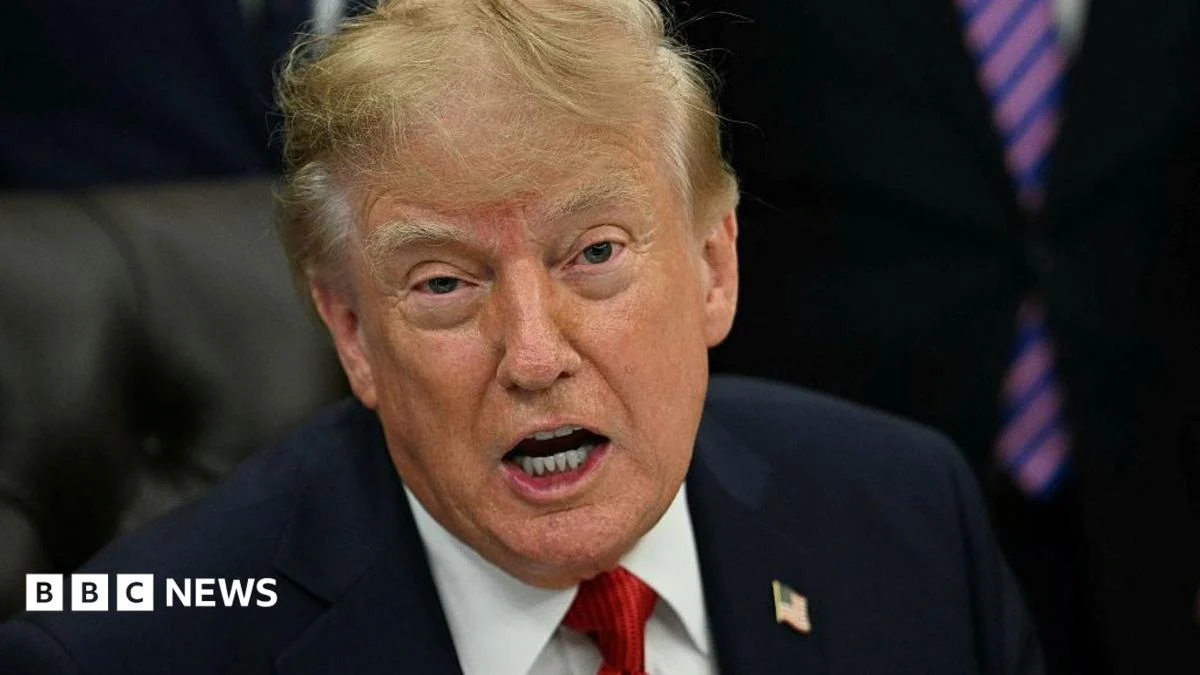
United States President Donald Trump announced on Friday an immediate ban on three prominent media organizations – CNN, MS NOW (formerly MSNBC), and Politico – from the White House, marking a significant escalation in his administration’s long-standing adversarial relationship with the press. The unprecedented directive, conveyed via a post on his social media platform, Truth Social, cited claims that these outlets "constantly write or report fiction or lies" about his administration and the nation, though specific examples to substantiate these accusations were not provided. The move has been met with swift condemnation from the affected networks and leading press freedom advocacy groups, who decry it as an unconstitutional assault on American journalistic principles and the First Amendment.
The Announcement and Its Immediate Fallout
The presidential declaration, made on a Friday afternoon, left many details vague, including the precise mechanism of enforcement. President Trump himself characterized it as a "very simple ban" but offered no further explanation as to how it would be implemented or whether it would physically prevent employees of the targeted outlets from accessing the White House grounds, which traditionally serve as a critical hub for newsgathering. The ambiguity surrounding the ban’s practical application immediately raised questions about its legality and feasibility.
Despite the abrupt announcement, reporters from both Politico and CNN were observed still operating within the White House complex shortly after the news broke. Furthermore, a CNN news crew was actively traveling with Vice-President JD Vance, covering his engagements to and from an event in Iowa, underscoring the immediate disjunction between the presidential decree and the practical realities of White House press coverage. This immediate operational discrepancy highlighted the confusion and potential logistical challenges inherent in such a broad, vaguely defined prohibition.
CNN was quick to issue a forceful rebuke, labeling the proposed ban an "illegal assault" on the fundamental freedoms guaranteed to the American press. In a comprehensive statement, the network unequivocally asserted its constitutional right to conduct reporting "without hindrance or interference from the government." It affirmed its full support for its White House team and their commitment to fair and accurate reporting, vowing to challenge any attempt to enforce the ban through legal channels, emphasizing that such an action would constitute "an illegal assault on that fundamental and constitutionally-protected right." As of the initial reports, Politico and MS NOW had not yet released official statements regarding the President’s directive.
President Trump’s Justification and Long-Standing Grievances
In his Truth Social post, President Trump articulated his rationale, stating, "Media outlets shouldn’t be able to constantly write or report fiction and lies when they’re covering the President of the United States, the Trump Administration or the United States of America. Other news outlets to follow." This concluding phrase hinted at the potential for a broader crackdown on media organizations deemed critical of his administration, intensifying concerns among the journalistic community.
When pressed by reporters in the Oval Office about the timing of the announcement, President Trump dismissed the notion of any specific trigger, stating there was "no reason" for it being made on that particular Friday afternoon. He attributed the decision to a cumulative effect of what he perceived as biased reporting over several years. "It’s really just cumulative stories over the last few years," he explained, adding, "You get sick of it." He reiterated that "there may be others to join them," without naming any additional outlets, further fueling speculation about future targets.
Acknowledging the near certainty of legal challenges, President Trump expressed a defiant stance. "I think it’s good to point it out, whether it survives or doesn’t," he remarked. "To be honest with you, I don’t think that a court should allow fake news to be written day after day after day." This statement underscores his long-held belief that certain media outlets engage in "fake news" and that judicial intervention should not protect such reporting, even when it pertains to the executive branch.
A Pattern of Confrontation: A Chronology of White House Press Relations under Trump
This latest ban is not an isolated incident but rather the culmination of a deeply contentious relationship between President Trump and segments of the news media, a dynamic that has defined much of his political career and presidency. Since his return to office in January 2025, the Trump administration has repeatedly clashed with members of the White House press corps, demonstrating a consistent strategy of challenging traditional norms of media access and engagement.
January 2025: Return to Office and Renewed Tensions
Upon President Trump’s inauguration in January 2025, there was an immediate re-emergence of the strained interactions that characterized his first term. Press briefings became more confrontational, and the President frequently used his social media platform, Truth Social, to criticize specific journalists and news organizations, setting the stage for renewed tensions.
February 2025: White House Assumes Control of Press Pool
In a significant departure from established precedent, the White House announced in February 2025 that it was taking direct control of the press pool. For over a century, this critical mechanism, which provides a rotating group of journalists with close-up access to the President, had been managed independently by the White House Correspondents’ Association (WHCA). The administration’s move to centralize control was widely seen as an attempt to exert greater influence over which journalists had access to the President’s most private moments and movements, sparking immediate concern about press independence.
February 2025: The "Gulf of America" Incident and AP Ban
Later that same month, the administration moved to bar Associated Press (AP) reporters and photographers from limited-access spaces, including the Oval Office and Air Force One. The stated reason for this unprecedented action was the AP’s consistent use of the term "Gulf of Mexico" instead of the administration’s preferred "Gulf of America." The Associated Press swiftly filed a lawsuit challenging this restriction, arguing it was an arbitrary and politically motivated attempt to control journalistic language. The case remains ongoing, highlighting the judiciary’s increasing role in mediating these disputes.
First Term Precedent: The Jim Acosta Ban (2018)
During his first term, President Trump famously banned CNN correspondent Jim Acosta from the White House in November 2018, revoking his press credentials following a contentious exchange during a press conference. The administration initially cited Acosta’s alleged "inappropriate behavior." CNN, supported by numerous media organizations, promptly sued, arguing a violation of Acosta’s First and Fifth Amendment rights. A federal judge ultimately ordered the White House to restore Acosta’s credentials, ruling that the administration had violated his due process rights. This legal victory for CNN established a significant precedent regarding the limits of presidential authority to revoke press access based on perceived unfavorable reporting. The current ban evokes strong parallels with this earlier, legally challenged action.
Throughout both his terms, President Trump has frequently engaged in direct clashes with reporters during Oval Office appearances, aboard Air Force One, and at White House events. His common epithets for journalists include "fake news" and "rude," often using these terms to dismiss critical questions or reports. This consistent rhetoric has contributed to a climate of distrust and antagonism between the executive branch and much of the mainstream media.
Legal and Constitutional Challenges: A Battle for Press Freedom
The announcement was met with immediate and widespread condemnation from leading advocacy organizations dedicated to freedom of the press, who swiftly indicated that the ban would be challenged in court. Their statements collectively underscore the deeply unconstitutional nature of such a directive.
The Knight First Amendment Institute at Columbia University issued a pointed statement on Friday afternoon, noting the President’s history of legal setbacks on similar issues. "With so many courts having ruled against him on exactly this point, you’d think President Trump would have learned this lesson by now," the institute stated. Jameel Jaffer, the institute’s executive director, elaborated on the legal basis for their concern: "If President Trump means to expel these news organizations from the White House press pool, his action is doubly unconstitutional because the press pool is a ‘public forum’ under the First Amendment, which means the president can’t exclude journalists from it on the basis of their viewpoints." This argument centers on the principle that government entities cannot discriminate against speech based on its content or viewpoint in designated public forums.
The Reporters Committee for Freedom of the Press, a major group providing legal services to the media, echoed these sentiments, expressing confidence that Trump’s ban would be "quickly struck down by the courts because it is ‘flatly unconstitutional’." Bruce Brown, the group’s president, succinctly summarized the legal position: "The First Amendment is clear that once the White House invites in some journalists, it can’t ban others because it doesn’t like their reporting," referring to the potential ban as "textbook viewpoint discrimination." This legal concept prohibits the government from regulating speech based on the ideas or opinions it conveys.
The Freedom of the Press Foundation also weighed in, unequivocally calling the ban illegal and adding a blunt assessment: "It’s also hard to imagine a dumber move." The organization argued that President Trump’s repeated "retaliating against the press for years… hasn’t helped him," concluding that "these outrageous attacks only demonstrate how scared he is of an informed public." This perspective suggests that such actions are counterproductive, ultimately highlighting, rather than suppressing, critical scrutiny.
Broader Implications for Press Freedom and Democratic Governance
This latest move by the Trump administration carries significant implications for the landscape of press freedom in the United States and the functioning of democratic governance. White House press credentials are not merely symbolic; they provide journalists with essential access to information, officials, and events crucial for informing the public about the executive branch’s activities. Barring specific outlets, particularly those with large audiences like CNN, directly impedes the public’s right to receive information from a diversity of sources.
The repeated attempts by the administration to control or restrict media access, from managing the press pool to banning individual reporters and now entire organizations, represent an erosion of long-standing norms that have historically governed the relationship between the presidency and the press. These norms are vital for maintaining government transparency and accountability. The judiciary has consistently played a critical role in upholding these norms, particularly when First Amendment rights are challenged. Past court decisions, such as the one involving Jim Acosta, suggest a strong legal precedent against viewpoint discrimination in granting press credentials.
Furthermore, President Trump’s ongoing legal battles against various news organizations, including the Wall Street Journal, the New York Times, and the BBC, underscore a broader strategy of using litigation as a tool to pressure and potentially silence critical media. While some of these lawsuits have resulted in media organizations agreeing to multimillion-dollar settlements, others, like his lawsuit against the BBC, remain ongoing, indicating a sustained and multifaceted effort to challenge the financial and operational viability of news outlets he deems unfair.
As the legal challenges to this latest ban inevitably unfold, the case will undoubtedly become a pivotal test of the First Amendment’s protections for the press against executive overreach. The outcome will not only determine the immediate fate of CNN, MS NOW, and Politico’s White House access but will also set important precedents for the future of press freedom and the critical role of an independent media in American democracy.