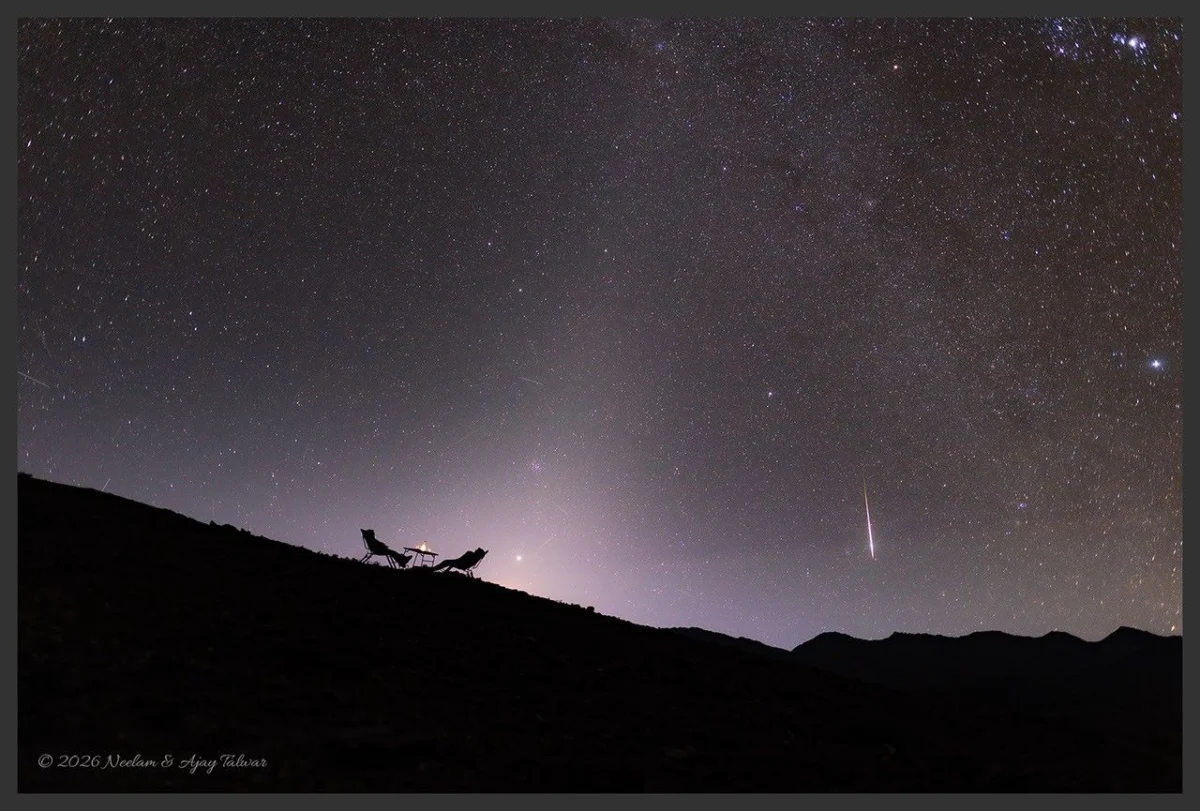
On September 9, 2026, the Astronomy Picture of the Day (APOD) presented a breathtaking nocturnal vista from the remote Hanle Dark Sky Reserve in Ladakh, India, showcasing the ethereal glow of zodiacal light, often dubbed the "false dawn." This mesmerizing astronomical phenomenon, a luminous band stretching across the night sky, was captured just moments before the onset of astronomical twilight during a dedicated star party. The image not only highlights the pristine dark skies of one of Earth’s premier astronomical havens but also draws attention to recent groundbreaking discoveries by NASA’s Juno spacecraft, which suggest a surprising origin for this pervasive interplanetary dust: the planet Mars.
The Celestial Spectacle from Hanle
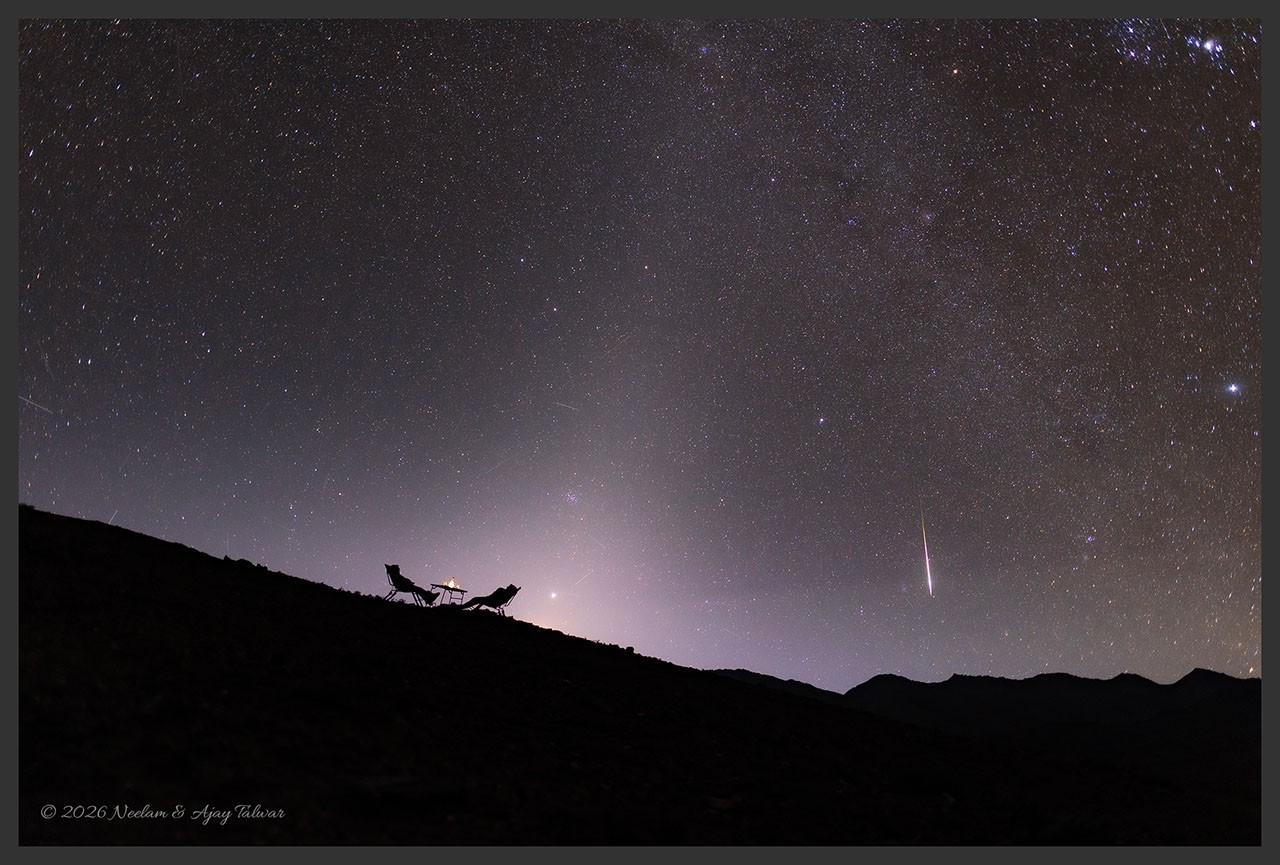
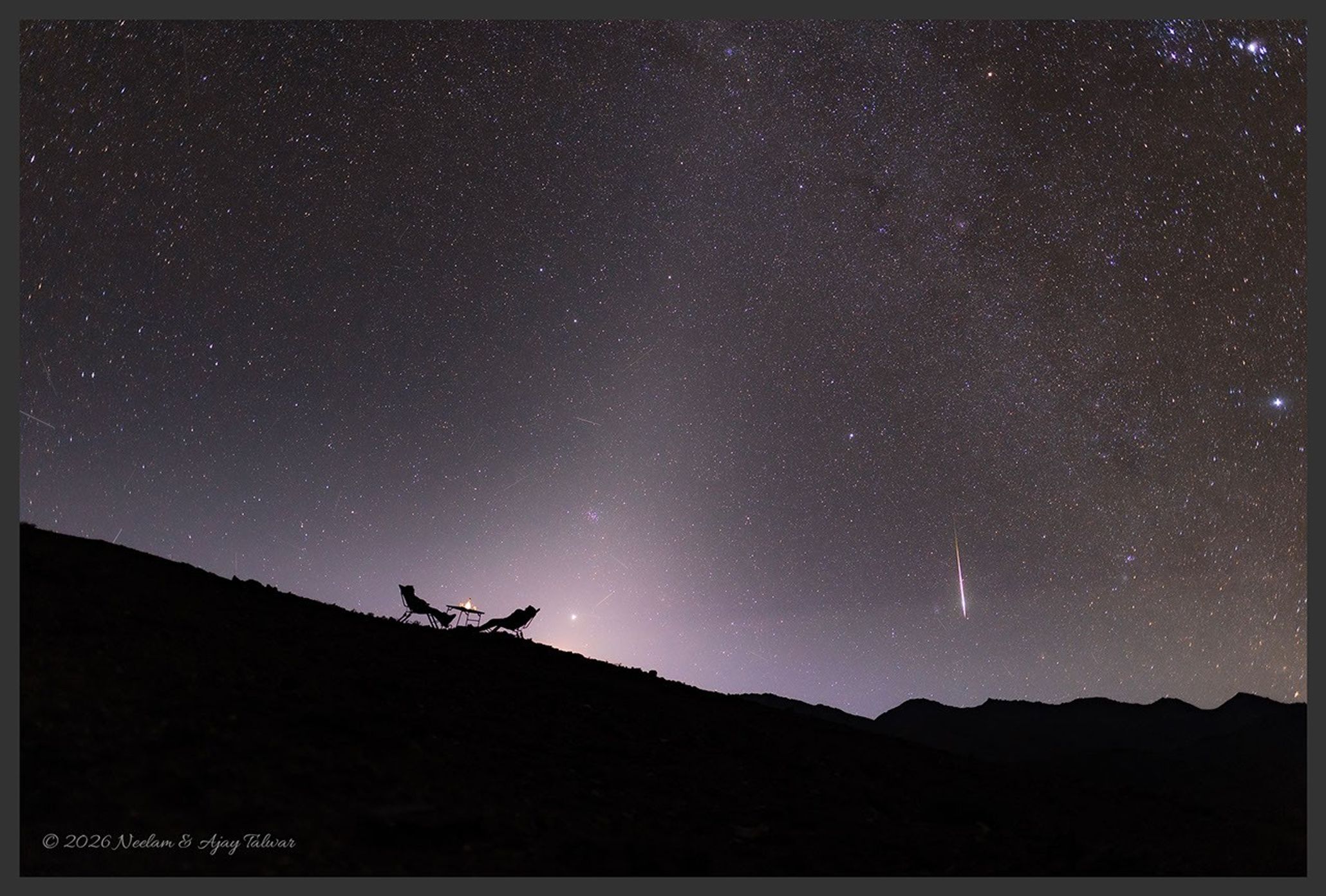
The featured image from September 9, 2026, depicts a serene scene where two individuals are observed gazing upwards, enveloped by the vast expanse of the cosmos. The dominant feature is the delicate, pyramid-shaped glow of the zodiacal light, extending upwards from the eastern horizon. This subtle radiance is caused by sunlight scattering off a vast cloud of dust particles distributed throughout the plane of our solar system, known as the ecliptic. Historically, observers have referred to this phenomenon as "false dawn" or "false dusk" due to its resemblance to the approaching or receding light of the Sun, even when the Sun is well below the horizon.
Nestled in the Changthang region of Ladakh, at an impressive altitude of approximately 4,500 meters (about 14,760 feet) above sea level, the Hanle Dark Sky Reserve offers unparalleled conditions for stargazing and astrophotography. Its extreme elevation, coupled with minimal atmospheric pollution and stringent light pollution controls, renders it a critical location for both professional astronomical research and amateur enthusiasts. The reserve, India’s first of its kind, was officially designated to protect its pristine night skies, ensuring that the faint signals from distant celestial objects, like the zodiacal light, remain visible without interference from artificial illumination. The star party, an event likely organized to promote astronomy and public engagement, provided the ideal setting for capturing such a profound cosmic display.
Within the celestial tableau, several prominent objects enhance the visual narrative. The gas giant Jupiter appears prominently immersed within the zodiacal glow near the eastern horizon, its brilliant light contributing to the overall luminosity of the scene. Higher in the zodiacal band, closer to the zenith, the open star cluster M44, also known as Praesepe or the Beehive Cluster, is discernible. This cluster, a glittering assemblage of hundreds of stars, offers a stark contrast to the diffuse glow of the zodiacal light. Adding a distinct splash of color, a yellowish-tinged Mars is positioned near the center of the frame, its presence particularly significant in light of recent scientific revelations regarding the source of the very dust that produces the zodiacal light.
Unraveling the Mystery of Zodiacal Dust: Juno’s Serendipitous Discovery
For decades, the source of the interplanetary dust responsible for the zodiacal light remained a subject of extensive scientific debate. Conventional theories primarily attributed this dust to comets, as they shed particles during their passages through the inner solar system, and to collisions within the asteroid belt. However, a series of unexpected detections by NASA’s Juno spacecraft has introduced a compelling new hypothesis, fundamentally altering our understanding of the distribution and origin of cosmic dust within our planetary neighborhood.
The Juno mission, launched in 2011, was primarily designed to study Jupiter’s atmosphere, magnetosphere, and gravitational field. Its instruments, particularly its star trackers—cameras used for navigation—were not initially intended for dust detection. Yet, as Juno journeyed through the inner solar system en route to Jupiter, these star trackers inadvertently registered tiny impacts from dust particles. Each impact created a brief streak in the images as small flecks of dust struck the spacecraft at high velocities, effectively acting as unintended dust detectors.
Researchers, analyzing the patterns and frequency of these impacts, noted a peculiar concentration of dust originating from specific regions. A study published in the Journal of Geophysical Research: Planets in 2020, and further highlighted by NASA in 2021, detailed these serendipitous findings. The analysis suggested that a significant portion of the zodiacal dust in the inner solar system, particularly what causes the zodiacal light visible from Earth, could be traced back to Mars.
The mechanism proposed by scientists involves Mars’s gravitational influence. It is theorized that Mars, through its gravitational pull, is capable of dislodging dust from its two small moons, Phobos and Deimos, or even lifting fine particles from its surface, particularly during intense dust storms. Once liberated, this Martian dust would then gradually spiral inward towards the Sun, influenced by solar radiation pressure and the Poynting-Robertson effect, eventually populating the ecliptic plane where it scatters sunlight to create the zodiacal light we observe. This groundbreaking finding challenges the long-held view that comets and asteroids are the sole or primary contributors to this widespread dust cloud.
This discovery underscores the power of unexpected observations in space exploration. What began as a mission focused on a gas giant inadvertently provided critical insights into the dynamics of the inner solar system and the subtle, yet pervasive, influence of a terrestrial planet like Mars. The implications extend beyond merely identifying a dust source; it prompts a re-evaluation of models of dust transport, planetary evolution, and the overall particulate environment within our solar system.
The Significance of Dark Sky Reserves and Astronomical Outreach
The Hanle Dark Sky Reserve, where the APOD image was captured, exemplifies a growing global effort to preserve pristine night environments. Light pollution, a byproduct of industrialization and urban expansion, increasingly obscures the night sky, diminishing visibility for astronomers and severing human connection to the cosmos. Dark sky reserves, designated by organizations such as the International Dark-Sky Association (IDA), serve as vital sanctuaries. They are not merely tourist attractions but crucial sites for scientific research, offering conditions that are becoming increasingly rare worldwide.
The establishment of such reserves, particularly in regions like Ladakh with its unique geographical advantages, provides a stable platform for long-term astronomical observations and research. For instance, the Indian Astronomical Observatory (IAO), operated by the Indian Institute of Astrophysics (IIA), is located near Hanle and benefits immensely from these protected dark skies. The star party mentioned in the APOD explanation is indicative of the reserve’s commitment to public engagement, fostering a deeper appreciation for astronomy and environmental conservation among attendees. Such events transform abstract scientific concepts into tangible, awe-inspiring experiences, inspiring future generations of scientists and advocates for dark sky preservation.
Programs like NASA’s Astronomy Picture of the Day play a pivotal role in this outreach. By daily showcasing compelling images of the universe accompanied by expert explanations, APOD democratizes access to astronomical knowledge. It bridges the gap between complex scientific research and the general public, making discoveries like Juno’s findings on zodiacal dust accessible and understandable. The longevity of APOD, running for over 30 years, is a testament to its effectiveness in sustaining global interest in space science.
Broader Implications and Future Research
The revelation of Mars as a significant contributor to interplanetary dust has several profound implications for planetary science. Firstly, it refines our models of the solar system’s dust environment, which is crucial for understanding collision risks for spacecraft and the processes that shaped the planets. Dust plays a role in atmospheric chemistry, thermal balance, and even the formation of new celestial bodies over astronomical timescales. Knowing its precise origins allows for more accurate simulations and predictions.
Secondly, it highlights the dynamic interaction between planets and their immediate environments. Mars, often perceived as a desolate world, is revealed to be actively contributing to the broader interplanetary medium. This encourages further investigation into how other planets, and even their moons, might influence the distribution of dust and other small particles throughout the solar system. Future missions might incorporate dedicated dust detectors or refine existing instruments to specifically track these Martian contributions.
Thirdly, the discovery underscores the interdisciplinary nature of space science. A mission designed for Jupiter yields insights into Mars and the general interplanetary environment. This serendipitous outcome emphasizes the value of broad scientific inquiry and the potential for unexpected discoveries when instruments are used beyond their primary objectives. It encourages scientists to continually re-examine existing data with new questions in mind.
From an observational standpoint, astronomers will continue to study the zodiacal light with renewed interest, perhaps developing methods to differentiate between dust originating from comets, asteroids, and Mars. Variations in the light’s intensity and distribution could provide clues about the frequency of Martian dust storms or the long-term stability of dust within the Martian system. The image from Hanle, therefore, serves not just as a beautiful photograph but as a tangible link to cutting-edge research.
As NASA’s Astronomy Picture of the Day program itself undergoes a transition, moving its main site from apod.nasa.gov to science.nasa.gov/apod, it symbolizes the continuous evolution and refinement within scientific communication and data dissemination. This administrative change ensures that APOD remains an integral part of NASA’s broader science outreach efforts, continuing its mission to enlighten and inspire millions worldwide with daily glimpses into the wonders of the cosmos. The journey of understanding the universe is an ongoing one, marked by continuous discovery, from the faint glow of zodiacal light in a remote Himalayan sky to the intricate workings of a distant spacecraft like Juno.