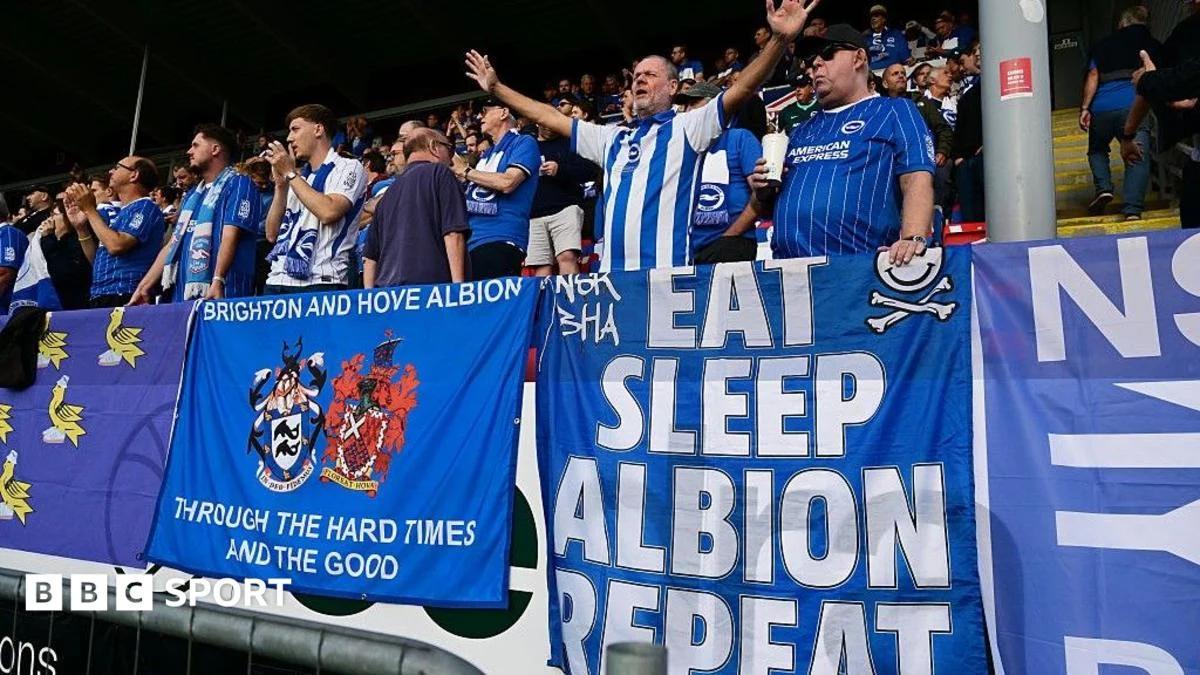
Thursday, 9 November, 2023, marked a significant moment in the history of Brighton & Hove Albion, a club that has undergone a seismic transformation over its 125-year existence. On this particular evening, manager Roberto de Zerbi stood before his players in the iconic Amsterdam Arena, preparing for a Europa League encounter against Dutch giants Ajax. His words resonated with the weight of their journey: "There’s 3,000 Brighton fans in this stadium tonight," he declared, his Italian accent underscoring the global reach of their aspirations. "But there’s more than twice that number in the city who have travelled over. Remember that when you go on to that pitch."
The sentiment was palpable. For a senior club official, a lifelong fan who had dedicated nearly three decades of his professional life to Brighton, the scene evoked a powerful emotional response. "It made the hairs on the back of my neck stand up," he confided, reflecting on the surreal nature of the occasion. For many football clubs, a European tie against a storied institution like Ajax is a familiar fixture. For Brighton, it was an emblem of their extraordinary ascent. "The royalty of European football," the official described Ajax, his voice tinged with awe. "From where we’ve come from, to be in that environment. It was a pinch-me moment." The subsequent 2-0 victory for Brighton in that match, a high point of their inaugural European campaign, only amplified the significance of their presence on such a stage.
However, this triumphant moment in continental competition, while deeply cherished, stands in stark contrast to the most defining memory for many long-term supporters. Paul Samrah, a devoted Brighton fan, points to a different, yet equally profound, milestone: August 2007. His most memorable moment was not on a pitch, but in the quiet resolve of a planning committee. "After the years of campaigning, the days and nights I spent fighting for regime change and then for the stadium, the moment I heard we’d actually got planning permission, that our objectors had decided not to continue their fruitless efforts to stop the stadium," he recounted, the echoes of past struggles evident in his voice. "We’d won our battle." These two narratives, the European triumph and the stadium victory, encapsulate the dramatic "before and after" reality of Brighton & Hove Albion, a club that has navigated an almost unimaginable trajectory.
A Tumultuous Past: From Football League Aspirations to Existential Crisis
Founded in 1901, Brighton & Hove Albion spent nearly two decades in the Southern League before earning a place in the Football League. Their initial foray into the top flight was brief, lasting only seven seasons before promotion in 1979. For many outside Sussex, the club was primarily associated with a single, heart-wrenching moment: the BBC Radio commentary of "And Smith must score…" during the 1983 FA Cup final. The late Peter Jones’s dramatic narration captured the agonizing miss by Gordon Smith, clear on goal in extra time, his shot ultimately saved by Manchester United’s Gary Bailey. The subsequent replay saw United clinch the trophy, leaving Brighton to reflect on what might have been.
The late 1980s and early 1990s brought a period of escalating financial difficulties. In 1995, under chairman Bill Archer, the club made the devastating decision to sell the Goldstone Ground, their home since 1902, due to insurmountable debts. This move, undertaken without fan consultation, plunged the club into a crisis. Brighton did not depart the Goldstone until 1997, their final season there marked by a dramatic pitch invasion from thousands of furious fans protesting the ownership’s decision. The crossbars were snapped in the ensuing chaos, a visceral symbol of the club’s desperate plight.
The consequences were dire. For two seasons, Brighton were forced to play 70 miles away in Gillingham, a geographical displacement that tested the loyalty of their fanbase to its limits. Plans for a new stadium in Brighton’s Toad’s Hole Valley proved unfeasible. The club eventually returned to the city in 1999, but only to the Withdean Stadium, a former athletics venue with a capacity of just 6,000. This move represented a stark regression from the modern footballing environment they had once aspired to. As Paul Samrah elaborated, "After the 1983 FA Cup final, players were sold, there was no investment, the Goldstone was decaying and the crowds were dipping. There was no communication between board and fans, directors came and went. There was no continuity, no leadership, no direction. We were just rudderless." This period of instability and uncertainty threatened the very existence of Brighton & Hove Albion, bringing them within 27 minutes of relegation out of the Football League in 1997.
The Architects of Revival: Resilience and Vision
The narrative of Brighton’s near-demise is inextricably linked to the individuals who fought tirelessly for its survival and eventual resurgence. Former Football Association executive director David Davies played a crucial role in advocating for the club’s interests. Deputy Prime Minister John Prescott’s intervention was instrumental in overturning a rejected planning application for the club’s current stadium site in Falmer. Crucially, former chairman Dick Knight is credited with stabilizing the club during its most precarious years. Without the combined efforts of these figures, and countless other dedicated supporters involved in fan campaigns, protests, and financial appeals, the continued existence of Brighton & Hove Albion would have been far from guaranteed.
The period spent at the Withdean Stadium, a venue that housed only 6,000 spectators, starkly highlighted the chasm between Brighton’s past struggles and their burgeoning aspirations. The fact that over 7,000 fans travelled to Amsterdam to support the team against Ajax underscores the monumental shift in the club’s fortunes and fanbase engagement. This contrast is not merely anecdotal; it represents a fundamental redefinition of the club’s identity and capabilities.
The Bloom Era: A New Dawn of Success and Sustainability
The contemporary iteration of Brighton & Hove Albion is a testament to visionary leadership and strategic investment. The club’s current European campaign, a second foray into continental competition, began in the Norwegian city of Tromsø in the Europa Conference League, offering the tangible prospect of securing that elusive first major trophy. This pursuit of silverware is now underpinned by a state-of-the-art stadium, the American Express Community Stadium, conveniently located near the city center and boasting modern amenities and an inclusive atmosphere.
At the heart of this remarkable turnaround is Tony Bloom, a lifelong Brighton fan and a formidable entrepreneur who made his fortune in finance and gambling, leveraging sophisticated data analysis. Bloom, whose family has deep roots in the club, with his grandfather Harry serving as former vice-chairman and uncle Ray as a director, became chairman in 2009. Under his stewardship, Brighton has ascended from League One to become a consistent Premier League force. The club’s innovative recruitment model, characterized by identifying and developing promising talent before selling them on for substantial profits, is now widely emulated and envied across the footballing landscape. This astute strategy has not only yielded financial success but has also fuelled on-field achievements. Last season, Brighton’s average attendance exceeded 31,000, a remarkable figure that speaks volumes about their renewed connection with the local community and beyond.
The club’s recent performance statistics paint a compelling picture of their ascendancy. Brighton has achieved a remarkable run of form against Manchester United, winning at Old Trafford for the fifth time in their last six visits. This consistent success against established top-six clubs, coupled with their consistent presence in the top half of the Premier League table – sitting fifth after four games of their tenth consecutive top-flight campaign – signifies their arrival as a genuine contender.
A Legacy of Resilience, A Future of Promise
The 125th anniversary of Brighton & Hove Albion, celebrated around the fixture against Arsenal, serves as a poignant reminder of their extraordinary journey. Sporting director Mike Cave articulated the profound transformation: "Anyone walking into Brighton today compared to even 15 years ago would not think it was the same football club. The club has been on an unbelievable journey. We’ve got staff members and many fans who have done that journey. For those of us who weren’t here 15 years ago, our responsibility is to ensure what’s to come – and I think there’s lots – is better than what’s happened in the recent or long-distance past."
Tony Bloom himself, reflecting in the matchday programme for the Arsenal game, encapsulated the club’s enduring spirit. "Since 1901, this football club has been part of the fabric of our city and the broader county of Sussex," he wrote. "It has connected generations of families and communities. Grandparents have brought their children and grandchildren to matches. Lifelong friendships have been forged on terraces, in stands and on away trips. Through good times and bad, Brighton & Hove Albion has provided so many of us with some of the most memorable moments of our lives."
Bloom’s personal connection to the club runs deep, intertwined with cherished memories of the Goldstone Ground. His ascension to ownership was viewed as a custodianship, a responsibility to nurture and develop the club for future generations. He acknowledged the hardships endured by the fanbase, from the loss of the Goldstone and the challenging years at Gillingham and Withdean, to the unwavering determination of the supporters. "What got this football club through was the determination of its fans. The bucket collections. The protests. The refusal to accept the Albion should disappear. This anniversary belongs as much to those supporters as anyone. Quite simply, without them, we would not be here today."
Whether Brighton secured three points against Arsenal or not, the club stands as a powerful symbol of resilience, a testament to the vision of those who fought to preserve its heritage and the foresight of those who invested in its future. The journey from the brink of oblivion to the grand stage of European football, and sustained Premier League success, is a narrative that resonates far beyond the south coast of England, inspiring clubs and fans alike with the enduring power of hope, determination, and strategic foresight. Brighton & Hove Albion, a club that has truly earned its place among football’s modern elite.