Iran-backed Houthi militants in Yemen have claimed responsibility for a significant series of drone and missile attacks targeting Saudi Arabia’s capital, Riyadh, and critical energy infrastructure on the kingdom’s Red Sea coast. The coordinated strikes, which occurred on Saturday, marked a substantial escalation in the protracted conflict between the Houthis and the Saudi-led coalition, prompting widespread concern over regional stability and global energy security.
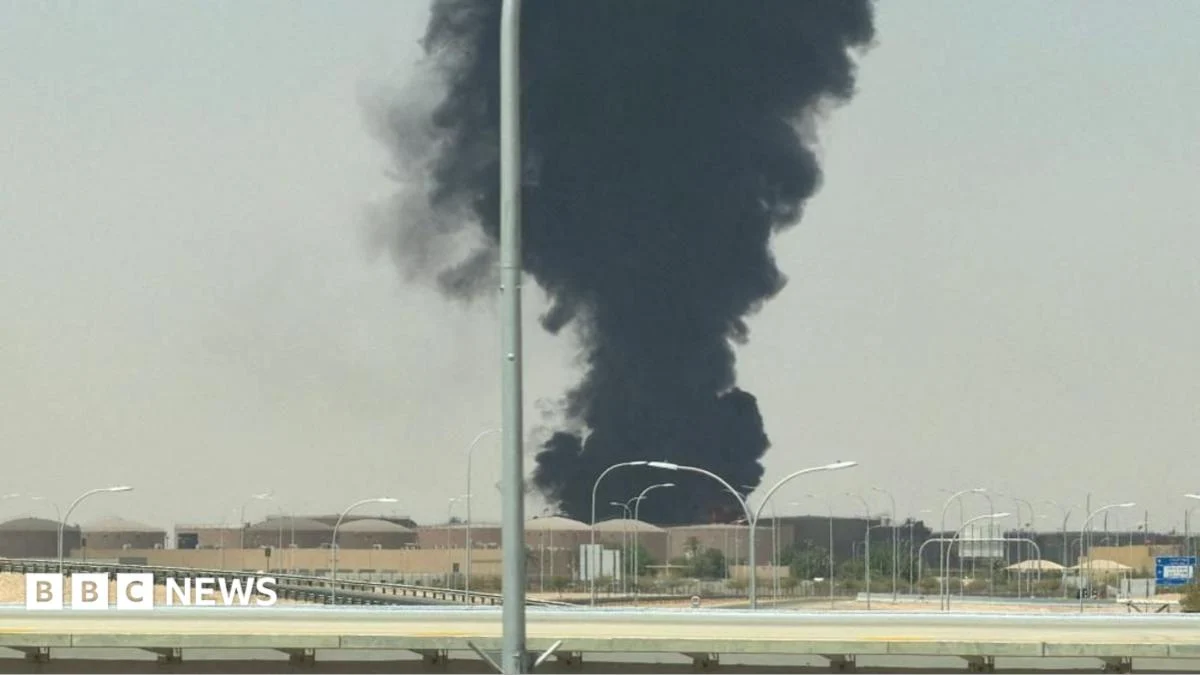
Visual evidence from Riyadh corroborated parts of the Houthi claims, with a prominent column of black smoke observed rising from what appeared to be fuel tanks near King Khalid International Airport. The attacks were preceded by unprecedented air raid alerts issued to residents in the Saudi capital, urging them to seek shelter indoors—a rare occurrence that underscored the severity of the threat and the growing reach of Houthi offensive capabilities. This was the first time residents had been given such a direct alert and urged to stay indoors since a recent intensification of the conflict with the Houthis.
Houthi Claims and Stated Motivations
In a statement widely circulated online, Houthi military spokesman Yahya al-Sarea asserted that a "large number of ballistic and cruise missiles and drones" had been deployed in the assault. He specified that the targets included "sensitive sites" in Riyadh and vital facilities belonging to the state-owned oil and gas giant Aramco in Yanbu, a strategically important port city on the Red Sea coast.
Al-Sarea framed the attacks as a direct "response to the Saudi enemy’s criminal attempts" to target the Yemeni capital, Sanaa. He further accused Saudi Arabia of conducting an extensive aerial campaign over Yemen, claiming that the Saudi-led coalition had carried out approximately 300 strikes across the war-torn nation during the preceding week alone. These reciprocal claims highlight the brutal tit-for-tat nature of the conflict, where civilian populations on both sides often bear the brunt of the violence.
The Broader Context: Yemen’s Devastating Civil War
The latest Houthi offensive is deeply rooted in Yemen’s complex and devastating civil war, a conflict that began in late 2014 when the Houthi movement seized control of Sanaa, forcing the internationally recognised government of President Abdrabbuh Mansour Hadi into exile. In March 2015, Saudi Arabia, perceiving the Houthi advance as an Iranian proxy expansion on its southern border, assembled a coalition of Arab states to intervene in Yemen. The stated objectives were to restore Hadi’s government and counter what Riyadh views as increasing Iranian influence in the region.
Eight years on, the conflict has devolved into one of the world’s worst humanitarian crises. The United Nations and numerous international aid organizations have consistently highlighted the catastrophic impact on the Yemeni population, with millions facing famine, displacement, and a lack of access to basic services. The Saudi-led coalition has imposed a blockade on Houthi-controlled areas, which the Houthis contend is crippling and contributes significantly to the humanitarian catastrophe, while the coalition argues it is necessary to prevent arms smuggling to the Houthis.
Escalating Tensions and Recent Chronology
The recent attacks on Saudi territory are part of a discernible pattern of escalating aggression from the Houthis, who have repeatedly demonstrated their capacity to strike targets deep within Saudi Arabia. Previous assaults have targeted airports, oil installations, and other critical infrastructure, utilizing a growing arsenal of drones and ballistic missiles, many of which are believed to be supplied by or developed with assistance from Iran.
Just days before the Saturday attacks, the Houthis claimed responsibility for downing a Saudi fighter jet over Yemeni airspace, a claim that, if confirmed, would represent a significant operational loss for the coalition. This incident underscored the Houthis’ persistent challenge to the coalition’s air superiority.
Earlier in the week, reports from the International Organization for Migration (IOM), a UN body, underscored the escalating human cost of the conflict, stating that the number of people displaced as a result of recent fighting had surpassed 104,796. This figure serves as a stark reminder of the continuous suffering inflicted upon the Yemeni populace as the conflict grinds on.
The Houthis have also made strategic gains on the ground, notably seizing control of the crucial port city of Mokha and Perim Island. This island, situated at the narrow Bab al-Mandeb Strait, is a gateway to a key international shipping route that is vital for global trade, including oil exports from the Gulf states to Asia and Europe. The Houthis have justified these naval advancements and their declared naval blockade as retaliation for the Saudi-led blockade of ports and airports in Houthi-controlled north-western Yemen. For Saudi Arabia, this stretch of the Red Sea has become increasingly important for its oil exports, especially since geopolitical tensions, including the US and Israel’s war with Iran, have at times threatened the security of the Strait of Hormuz.
On-the-Ground Reports and Witness Accounts
In Riyadh, multiple apparent explosions were heard throughout Saturday, and significant disruptions were reported at King Khalid International Airport. Flight tracking website FlightRadar24 documented widespread delays and cancellations, indicating the immediate operational impact of the attacks. An AFP journalist on the scene reported observing firefighters actively engaged in extinguishing flames from a burnt-out fuel tank belonging to Aramco, providing tangible evidence of the damage.
The Saudi Civil Defence had initiated phone alerts overnight, cautioning residents of potential danger in Riyadh and other regions, before issuing an all-clear on Saturday morning. Despite the all-clear, residents recounted harrowing experiences. Speaking on condition of anonymity to AFP, individuals described hearing what sounded like a series of explosions echoing across the city after the alerts. "I heard the alarm, then my windows shook," stated a 27-year-old resident of northern Riyadh. "It was definitely scary. I was not expecting this." Such testimonies underscore the psychological toll of the conflict extending to civilian populations within Saudi Arabia.
Official Responses and International Reactions
Immediately following the attacks, official comment from Saudi authorities remained conspicuously absent. This initial silence is often part of a deliberate strategy to gather comprehensive information, assess damage, and formulate a coordinated response. However, it is anticipated that Saudi Arabia will issue strong condemnations, reiterate its inherent right to self-defense, and reaffirm its commitment to the objectives of the Saudi-led coalition in Yemen. The Kingdom will likely emphasize the provocative nature of the Houthi actions and underscore the threat they pose to regional and international security.
The internationally recognized Yemeni government, currently operating from Aden, is expected to condemn the Houthi aggression unequivocally, characterizing it as an act of terrorism and a deliberate attempt to destabilize the region. They will likely appeal for increased international support to counter the Houthi insurgency and restore legitimate governance across Yemen.
International bodies, particularly the United Nations, are expected to voice deep concern over the escalation. The UN Secretary-General and his special envoy for Yemen will likely issue statements condemning attacks on civilian infrastructure and reiterating urgent calls for a de-escalation of hostilities, an immediate ceasefire, and a return to UN-led peace negotiations. The dire humanitarian situation in Yemen will undoubtedly be highlighted, with renewed pleas for unimpeded humanitarian access.
Key international partners, including the United States and European nations, are also expected to condemn the Houthi attacks. These condemnations will likely be coupled with expressions of solidarity with Saudi Arabia and reiterations of support for its security. However, these statements may also be balanced with calls for all parties to exercise restraint and prioritize diplomatic solutions to end the protracted conflict in Yemen. The Biden administration, while reaffirming its commitment to Saudi Arabia’s defense, has also shifted its policy towards Yemen, ending support for offensive operations by the Saudi-led coalition and emphasizing a diplomatic path.
Broader Impact and Implications
The latest Houthi attacks carry significant implications across several dimensions:
Economic Impact:
The targeting of Aramco facilities and other energy sites in Yanbu and Riyadh immediately raises concerns about global energy markets. Saudi Arabia is the world’s largest oil exporter and a critical guarantor of global energy stability. Attacks on its oil infrastructure, even if quickly contained, can trigger volatility in oil prices. Investment banking giant JP Morgan, acknowledging the unpredictability of the conflict’s trajectory, recently informed investors in a rare note that "we simply don’t know how to model the endgame," underscoring the profound uncertainty surrounding the impact on oil prices. Sustained or more damaging attacks could disrupt supply chains, increase insurance premiums for shipping through the Red Sea, and deter foreign investment in the Kingdom, impacting global economic recovery.
Humanitarian Crisis:
The continuous escalation of hostilities further exacerbates Yemen’s already catastrophic humanitarian situation. Increased fighting means more displacement, greater strain on limited resources, and further impediments to humanitarian aid delivery. The staggering figure of over 104,000 newly displaced individuals is a grim testament to the ongoing human cost, and continued conflict will only deepen this crisis, pushing millions closer to famine and disease.
Geopolitical Implications:
The Houthi attacks contribute to a broader climate of instability in the Middle East. They underscore the Houthis’ growing military sophistication and their willingness to project power beyond Yemen’s borders, challenging Saudi Arabia’s security and sovereignty. This escalation also highlights the persistent regional proxy conflict between Saudi Arabia and Iran, with the Houthis often perceived as a key Iranian proxy. Any further intensification of hostilities risks drawing in other regional actors, potentially igniting a wider conflict. It also complicates international efforts to achieve a peaceful resolution in Yemen, as both sides become more entrenched in their positions.
Security Implications for Saudi Arabia:
Despite Saudi Arabia’s advanced air defense systems, including Patriot missile batteries, the frequency and increasing sophistication of Houthi attacks demonstrate the persistent vulnerability of its vast territory and critical infrastructure. The use of drones and cruise missiles, which can fly at low altitudes and present complex detection challenges, necessitates continuous adaptation of defensive strategies. The latest attacks will undoubtedly prompt a review of Saudi air defense protocols and potentially lead to requests for enhanced military assistance from allies.
In conclusion, the Houthi drone and missile attacks on Riyadh and Yanbu represent a dangerous new chapter in the Yemen conflict, signaling a significant escalation that carries profound economic, humanitarian, and geopolitical implications. As the conflict enters its eighth year, the path to peace appears increasingly fraught, with both sides demonstrating an unwavering resolve to pursue military objectives, thereby perpetuating a cycle of violence that continues to exact an unbearable toll on the region.