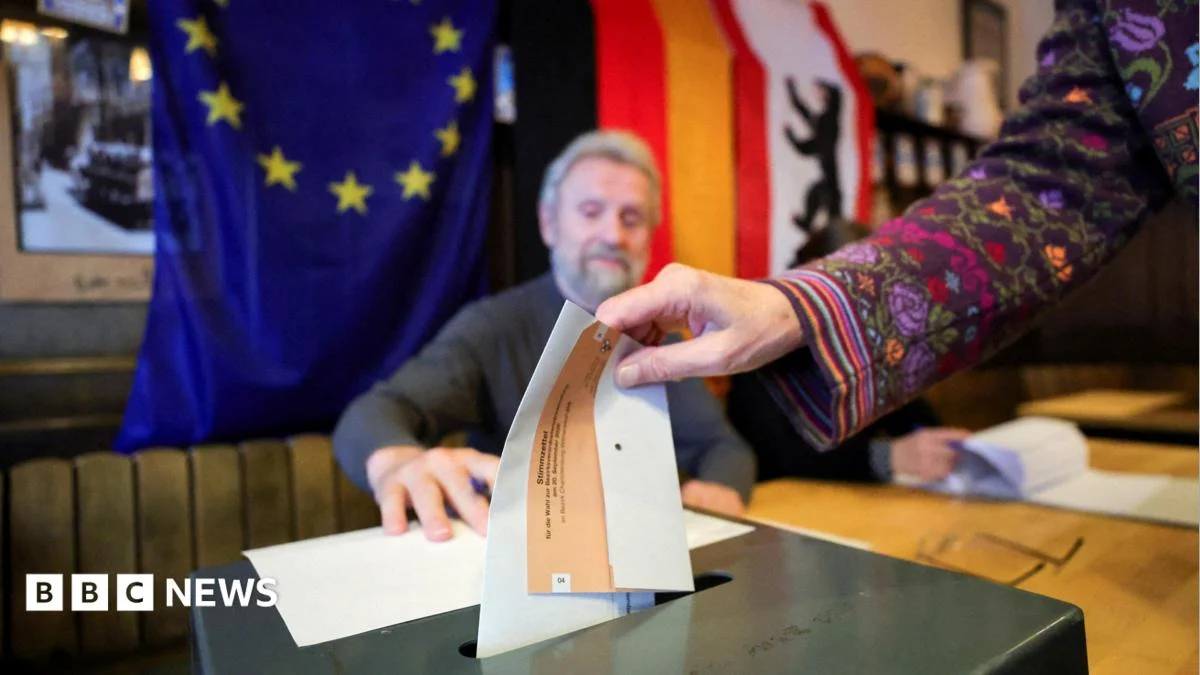
Sunday’s pivotal local elections in the German states of Berlin and Mecklenburg-Vorpommern are poised to significantly amplify the political pressure on Chancellor Friedrich Merz, whose Christian Democratic Union (CDU) faces the prospect of damaging defeats that could cast a long shadow over his leadership. These contests follow a fortnight after the far-right Alternative for Germany (AfD) secured a landmark victory in Saxony-Anhalt, a result that saw the CDU’s vote share dramatically halved and underscored a volatile national political landscape.
The immediate stakes for Chancellor Merz are exceptionally high. Speculation has been rife within German political circles regarding a potential mid-term replacement for Merz should the CDU’s electoral fortunes fail to improve. Despite his public assertions of commitment to his role, the Chancellor is grappling with persistently poor approval ratings. Whispers of a "chancellor swap" are circulating, though potential challengers within his party appear to be exercising caution, as reported by the German news site Tagesschau. The outcome of these Sunday elections will serve as a critical barometer of public sentiment and could either solidify or further destabilize Merz’s position at the helm of Germany’s government.
The Berlin Battlefield: A Fight for the Capital
In the bustling capital city of Berlin, opinion polls suggest a tight race, with Merz’s conservatives at risk of losing their hold on power. The CDU is locked in a fierce contest for first place with Die Linke (The Left), a party traditionally strong in parts of the former East Berlin. Berlin, a city renowned for its diverse political landscape and often leaning left, presents a unique challenge for the CDU. Historically, the city’s political leadership has frequently been in the hands of the Social Democrats (SPD), with the CDU often struggling to form stable majorities. A defeat here would not only be symbolic, given Berlin’s status as the capital, but would also signify a broader rejection of the CDU’s platform in a major urban center.
The political dynamics in Berlin are complex, reflecting a mosaic of urban, progressive, and often economically diverse communities. For the CDU, a strong showing in Berlin would demonstrate an ability to appeal beyond its traditional conservative base. Conversely, a poor result could be interpreted as a failure to connect with younger, more liberal voters and those in Germany’s urban centers, potentially forcing a re-evaluation of the party’s strategic direction. The city’s unique status, with its own distinct political culture and a history of protest movements, often makes it a bellwether for shifts in national sentiment, albeit with its own local peculiarities.
Mecklenburg-Vorpommern: A Battleground in the East
Meanwhile, in the north-eastern state of Mecklenburg-Vorpommern, the CDU finds itself in an even more precarious position. Polling data indicates that the party is barely hovering above the crucial 5% threshold required for parliamentary representation. This grim forecast suggests the CDU could be facing its worst-ever result in a state election in Mecklenburg-Vorpommern, a state that has historically seen a strong presence of the Social Democrats (SPD) but has also become a fertile ground for the AfD.
Mecklenburg-Vorpommern, like much of Germany’s former communist east, has been grappling with demographic shifts, economic challenges, and a sense of being overlooked by the federal government. These factors have contributed to a growing disillusionment with traditional parties and a receptiveness to the anti-establishment rhetoric of the AfD. The potential for the CDU to fall below the 5% threshold is a chilling prospect for the party, as it would mean a complete loss of representation in the state parliament, effectively marginalizing them in a region where they once held significant sway.
The local political narrative in Mecklenburg-Vorpommern has been largely shaped by the contest between the surging AfD and the incumbent centre-left SPD. The SPD’s lead candidate, Manuela Schwesig, currently the state premier, has orchestrated a notable late comeback, positioning herself as the "Die Frau gegen Blau" – "Woman against Blue," in reference to the AfD’s party colours. Her strategy aims to consolidate the anti-AfD vote by presenting a strong, localized alternative. However, Schwesig’s considerable local popularity stands in stark contrast to the less favourable national fortunes of her own SPD party, which is currently locked in what has been widely described as a "loveless coalition" with Merz’s CDU at the federal level. This dynamic highlights the complex interplay between local appeal and national party standing, a tension that could influence voter behaviour.
The Unrelenting Rise of the AfD
The current electoral challenges facing the CDU, and by extension Chancellor Merz, are inextricably linked to the escalating influence of the far-right Alternative for Germany (AfD). The party’s recent landslide victory in Saxony-Anhalt two weeks prior served as a stark demonstration of its growing appeal, particularly in the country’s eastern states. In that election, the CDU saw its vote share plummet, while the AfD cemented its position as a significant political force. This success has fueled the AfD’s ambitions to top the polls in Mecklenburg-Vorpommern, further expanding its territorial influence.
The AfD’s platform, characterized by its staunch anti-immigration stance, a more Russia-friendly foreign policy, and a "Germany-first" economic agenda, has resonated deeply in parts of the former communist east. This region, often referred to as the "New Länder," has experienced unique socio-economic transitions since reunification, leading to a sense of alienation and a search for alternative political voices. While some branches of the AfD have been designated as right-wing extremist by domestic intelligence agencies – a classification the party vehemently rejects – its populist message has found fertile ground amidst national gloom. The party skillfully capitalizes on public anxieties related to the economy, immigration, and perceived failures of mainstream politics, presenting itself as the only true opposition to the established order. The AfD’s strategy is not merely to gain seats but to fundamentally shift the political discourse and challenge the consensus of Germany’s post-war democratic order.
Merz’s Stuttering Chancellorship: 16 Months of Turbulence
Friedrich Merz assumed the chancellorship approximately 16 months ago, inheriting a nation grappling with a multitude of domestic and international challenges. His tenure has been marked by a continuous struggle to galvanize public support and project a clear vision for the country. The original article notes that he is "having to answer for the tumbling popularity of his own party," a burden made heavier by the concurrent rise of the very political force – the AfD – that he had aimed to counteract.
Merz’s supporters often point to the difficult global events that have transpired during his time in office, arguing that many of the nation’s current problems were inherited rather than created by his government. Indeed, the period has seen significant geopolitical instability, including the ongoing war in Ukraine, which has had profound effects on energy prices and supply chains in Europe. Germany, heavily reliant on Russian energy prior to the conflict, faced a particularly acute energy crisis, contributing to inflationary pressures and economic uncertainty. Furthermore, the global economic slowdown has impacted Germany’s export-oriented economy, leading to a "long-stuttering economy" and a general sense of unease.
However, the initial faith in Merz’s ability to navigate these complex issues appears to be "ebbing away." The "brutal truth," as the original article states, is the increasing difficulty in finding voters who express genuine liking for the Chancellor. His approach, characterized by a distinct tack to the right on issues like immigration, has paradoxically failed to significantly erode AfD support. Instead, it has arguably alienated voters further to the left, potentially pushing them towards the SPD, Die Linke, or even the Greens. This strategic miscalculation suggests a struggle to appeal to the broad center of German politics, which has historically been crucial for the CDU’s success.
Adding to his woes is Merz’s distinctive communication style, which has frequently caused irritation. His dismissal of the concept of "work-life balance," coupled with calls for Germans to "work more and take less sick leave," while perhaps intended as a dose of tough love, has been perceived by many as out of touch and insensitive. This bluntness, combined with a perceived arrogance by some, as articulated by AfD supporter Reinhart from Neubrandenburg, has contributed to his poor approval ratings. Reinhart’s comment, "He is arrogant, out of touch, not on the same level as the general public," encapsulates a sentiment shared by a segment of the electorate. While supporters might contend that Merz is a leader willing to administer necessary, albeit unpalatable, "medicine" for the nation’s ailments, the public’s appetite for such remedies appears limited, especially when coupled with persistent economic challenges and fraught societal debates.
Internal Discontent and the "Chancellor Swap" Narrative
The mounting external pressures are mirrored by growing internal discontent within the CDU. While no prominent figure within the party has openly challenged Merz for the top job, "murmurings of discontent have grown louder." The statement from the leaders of eight German states earlier this week, backing Merz and emphasizing "listening and taking political action, not in debates over personnel," while seemingly supportive, also subtly hints at underlying tensions. Such public endorsements often arise when leadership is perceived to be under threat, signaling a need for party unity even if it masks deeper divisions.
Local CDU candidates are also voicing their concerns, albeit cautiously. Martin Rohloff, the CDU candidate for Neubrandenburg, expressed a common sentiment, noting that Merz lacks "Fingerspitzengefühl," a German term referring to an intuitive feel or sensitivity, particularly "for the small persons." This criticism underscores a perceived disconnect between the Chancellor and the everyday concerns of ordinary citizens, a vulnerability that the AfD has expertly exploited.
The historical precedent for a mid-term "chancellor swap" in Germany is rare but not unprecedented. While typically associated with coalition breakdowns or severe loss of confidence, the current speculation highlights the depth of the crisis facing Merz. Potential challengers, often rumored to include figures like Hendrik Wüst (Minister-President of North Rhine-Westphalia) or Daniel Günther (Minister-President of Schleswig-Holstein), are likely weighing the risks of challenging an incumbent leader against the potential gains of revitalizing the party. Their "hesitation" could be attributed to a desire to avoid appearing opportunistic or to allow the current electoral cycle to fully unfold before making a decisive move.
Broader Implications for German Politics
The cumulative effect of a long-stuttering economy, persistently high energy costs, and contentious debates surrounding immigration is fostering a pervasive sense of "national gloom" across Germany. This environment provides fertile ground for populist narratives and contributes to the erosion of trust in established political institutions. The results of these state elections, therefore, extend beyond the immediate fortunes of Friedrich Merz and the CDU. They offer a snapshot of a nation grappling with its identity, its economic future, and its place in a changing world.
Should the CDU suffer significant losses, especially in Mecklenburg-Vorpommern, it would not only weaken Merz’s standing but also raise profound questions about the party’s strategic direction. A continued decline could prompt a fundamental re-evaluation of its conservative platform and its ability to appeal to a broader electorate. For the broader political landscape, the continued rise of the AfD poses a significant challenge to Germany’s democratic consensus. The normalization of far-right politics and the potential for increased fragmentation of the Bundestag could lead to more complex coalition formations and potentially unstable governance at both state and federal levels.
Conversely, a surprisingly resilient performance by the CDU, particularly in Berlin, could provide Merz with a much-needed reprieve, allowing him to argue for continuity and stability. However, even in such a scenario, the underlying issues of economic malaise and the AfD’s persistent threat would remain. The Sunday elections in Berlin and Mecklenburg-Vorpommern are therefore not merely local contests but critical markers in the ongoing evolution of German politics, with far-reaching implications for its leadership, its party system, and its future trajectory. The results will undoubtedly shape the national political discourse for months to come, influencing policy debates, party strategies, and the ongoing saga of Chancellor Friedrich Merz’s leadership.