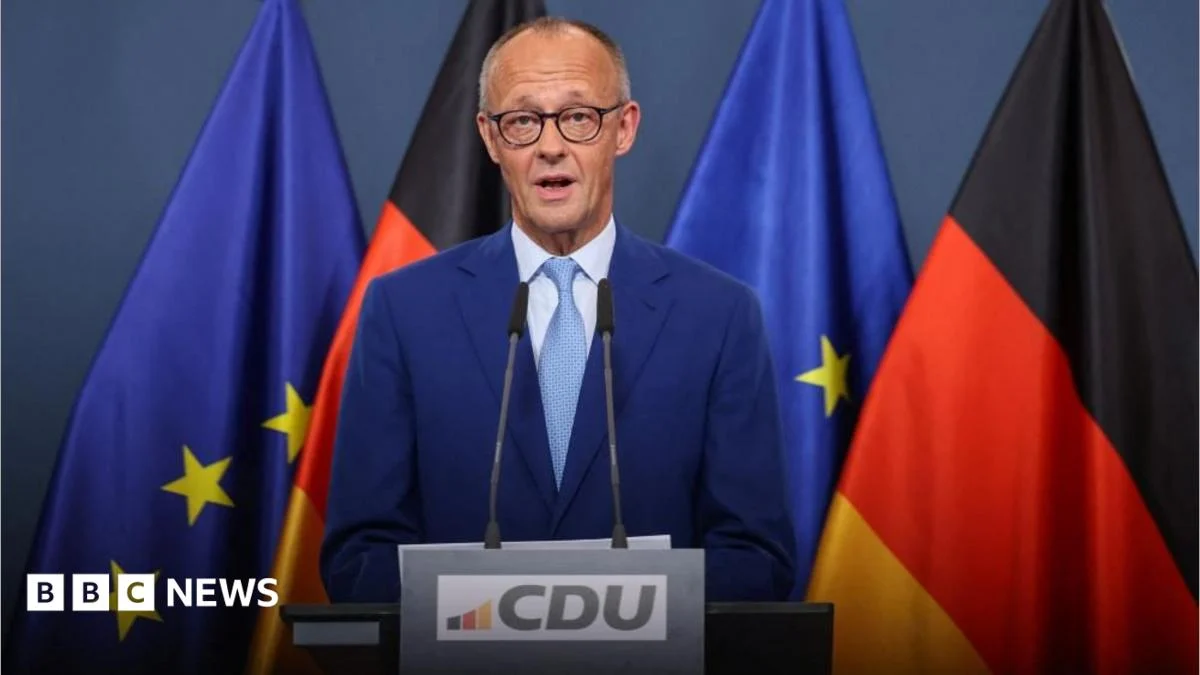
Embattled German Chancellor Friedrich Merz has firmly declared his intention to remain in office, despite preliminary exit poll data from two crucial local elections on Sunday, which indicate further damaging defeats for his centre-right Christian Democratic Union (CDU) party. These results, particularly in the north-eastern state of Mecklenburg-Vorpommern and the capital city of Berlin, underscore a period of profound instability and mounting pressure on Merz’s leadership, barely 16 months into his tenure as Chancellor.
Immediate Aftermath: A "Disaster" and a Vow of Defiance
The initial projections painted a grim picture for the CDU. In Mecklenburg-Vorpommern, a state located in Germany’s less economically prosperous north-east, the party was forecast to barely secure enough votes to enter the state parliament. This outcome is particularly alarming given that the far-right Alternative for Germany (AfD) was projected to emerge as the dominant political force, securing the largest share of votes. Merz, reacting to these projections during the CDU’s subdued election night gathering in Berlin, did not mince words, branding the result "a disaster" for his party. The atmosphere in the CDU’s campaign headquarters was reportedly devoid of any celebratory cheer, reflecting a stark recognition of the party’s deepening troubles.
Concurrently, in the politically significant state of Berlin, the ruling CDU was also anticipated to face a significant setback, with projections suggesting it would be outpolled by Die Linke (The Left), a party traditionally strong in the capital. This dual blow compounds the challenges facing Merz, who has seen his approval ratings plummet and has been the subject of intense speculation regarding a potential mid-term "chancellor swap" – a rare but not unprecedented manoeuvre in German politics.
Despite the electoral setbacks, Merz adopted a defiant posture, reiterating his commitment to his coalition government’s agenda. Echoing remarks made after a similar defeat just a fortnight prior in Saxony-Anhalt, he told reporters on Sunday evening that he would press ahead with a comprehensive package of economic, tax, and welfare reforms. "The reforms have to come," Merz insisted, underscoring the urgency he perceives in his policy objectives. "I am taking on this responsibility, because I want to move our country forward." He further articulated his vision for these reforms, stating, "I would even go so far as to say that these reforms are the antidote to the authoritarian poison that, with the fascination of authoritarianism, is penetrating ever deeper into our society." This statement highlights Merz’s perception of the critical juncture Germany faces, linking his reform agenda directly to combating the rise of extremist ideologies.
A Chronology of Mounting Pressure and Electoral Woes
The Sunday elections were the latest in a series of setbacks for Merz and the CDU. Just two weeks prior, the party experienced a significant reduction in its vote share in the state of Saxony-Anhalt, where the AfD secured a major victory, further solidifying its presence in Germany’s eastern states. In that election, the CDU saw its support halved compared to previous cycles, a stark indicator of shifting voter loyalties.
Friedrich Merz, a former corporate lawyer and long-time political figure, has openly harboured ambitions for the top job in German politics for decades. His ascent to the Chancellorship 16 months ago was seen by many as a reassertion of traditional conservative values within the CDU. However, his tenure has been marked by persistent challenges, both internal and external. His initial strategy, often described as a "tack to the right" on issues such as immigration and social policy, was intended to reclaim voters from the surging AfD. However, this approach has largely failed to erode the AfD’s support base, while simultaneously alienating more moderate voters and those further to the left, contributing to the CDU’s current predicament.
In-Depth Analysis of the State Election Results
Detailed projections released by public broadcaster ZDF following the close of polls at 18:00 local time (17:00 BST) provided further clarity on the electoral landscape:
Mecklenburg-Vorpommern: A Far-Right Stronghold Emerges
In Mecklenburg-Vorpommern, the AfD was projected to secure an unprecedented 38% of the total vote share. This represents a substantial increase from its previous performance and positions the party as the undisputed leader in the state. Historically, Mecklenburg-Vorpommern, like much of Germany’s eastern Länder (states), has struggled with economic transformation post-reunification, experiencing higher unemployment rates and demographic shifts due to outward migration. These socio-economic factors, coupled with a sense of political neglect and disillusionment with traditional parties, have created fertile ground for the AfD’s anti-establishment, anti-immigration, and often nationalistic rhetoric.
The centre-left Social Democratic Party (SPD), Merz’s coalition partner at the federal level, was projected to come in second with 36% of the vote, demonstrating a surprising resilience in the face of the AfD’s surge. The CDU, by contrast, was relegated to a distant third or even fourth place, projected to just "scrape into parliament" – a significant decline from its historical standing in a region where it once commanded considerable support.
The immediate implication of the AfD’s strong showing is a severe challenge to government formation. While the AfD secured the largest share of votes, it remains highly unlikely to govern the state. This is due to the widely adopted "cordon sanitaire" – a political consensus among all other mainstream parties to refuse any form of cooperation or coalition with the AfD. This collective refusal, while upholding democratic values against extremist elements, often leads to complex and prolonged coalition negotiations, potentially resulting in minority governments or unprecedented alliances. The prospect of a stable government in Mecklenburg-Vorpommern now hinges on intricate negotiations between the SPD, CDU, Die Linke, and potentially the Greens or Free Democratic Party (FDP), all of whom face the challenge of bridging ideological divides to form a viable majority without the AfD.
Berlin: A Capital Divided and a Leftward Shift
In Berlin, the political landscape presented a different, yet equally challenging, picture for the CDU. The broadcaster’s projections indicated the CDU secured approximately 20% of the vote share, placing it behind Die Linke, which was projected to garner nearly 26%. This outcome reflects Berlin’s historically left-leaning and diverse electorate, where issues such as affordable housing, social justice, and climate action often dominate the political discourse.
For the CDU, which has struggled to establish a strong urban presence in recent years, this result signifies a continued disconnect with the capital’s voters. Despite Merz’s attempts to broaden the party’s appeal, its more conservative stance on social issues and economic policy often fails to resonate in the cosmopolitan and progressive environment of Berlin. The expected victory for Die Linke underscores the continued strength of left-wing parties in the capital, which historically has seen coalition governments formed around the SPD, Greens, and Die Linke.
While state elections are distinct from federal polls, results from the capital often carry significant symbolic weight. A defeat in Berlin, the seat of the federal government, can be interpreted as a broader rejection of the incumbent Chancellor’s party, even if not directly impacting the federal coalition’s majority.
Official Responses and Broader Implications
Merz’s defiant stance, coupled with his strong emphasis on reform, reveals a leader attempting to seize control of a narrative that is increasingly slipping away. His reference to "authoritarian poison" is a direct acknowledgement of the existential threat posed by the AfD’s rise and an attempt to frame his reform agenda as a bulwark against it. However, the efficacy of this approach remains to be seen, particularly given the public’s apparent dissatisfaction with his current leadership.
Adding to the complexity, speculation about Merz’s potential replacement has been rife in German political circles for weeks, intensifying with each electoral defeat. Earlier in the week, in a clear effort to shore up his position, leaders of eight German states publicly backed Merz, who has only held the chancellorship for 16 months. While intended to project unity and strength, this public show of support inadvertently highlighted the fragility of his position, suggesting that such interventions were deemed necessary to prevent further erosion of his authority. His backers have argued that many of the nation’s current problems—ranging from economic stagnation to energy crises—are inherited from previous administrations, a plausible defence that nonetheless struggles to gain traction amidst Merz’s consistently low personal approval ratings. Recent national polls have frequently placed Merz’s approval below 30%, significantly lower than his predecessors at similar points in their tenures.
The broader implications of these election results extend beyond Merz’s personal fate. The sustained rise of the AfD, particularly its ability to garner over a third of the vote in a major state, signals a fundamental shift in the German political landscape. The party’s appeal is often rooted in disillusionment with mainstream politics, concerns over immigration, and economic anxieties. While the AfD’s isolation by other parties prevents it from directly entering government in most states, its growing electoral strength forces other parties to dedicate significant resources to countering its influence and often pushes mainstream discourse further to the right. This creates a challenging environment for forming stable coalitions and can lead to political paralysis, especially in state parliaments where complex multi-party alliances become the norm.
For the federal coalition, comprising the CDU, SPD, and FDP, these state-level results serve as a potent barometer of public sentiment. While not directly threatening the federal government’s majority, sustained poor performance by the CDU at the state level can weaken Merz’s standing within the coalition, potentially empowering his partners or leading to internal challenges within the CDU itself. The coalition’s ambitious reform agenda, which includes significant shifts in economic policy, climate initiatives, and social welfare, requires strong political capital and public trust, both of which appear to be diminishing for the CDU.
Germany is currently grappling with a complex array of challenges, including inflationary pressures, a slowdown in its crucial manufacturing sector, and the ongoing energy crisis exacerbated by geopolitical tensions. Public discontent over these issues is palpable, and voters are increasingly looking for decisive leadership and tangible solutions. Merz’s insistence on pushing through reforms is a direct response to this perceived need, but whether his proposed solutions will resonate with an increasingly fractured electorate remains the central question facing German politics today. The coming months will be critical in determining not only Chancellor Merz’s political future but also the trajectory of Germany’s internal political stability and its role on the European stage.