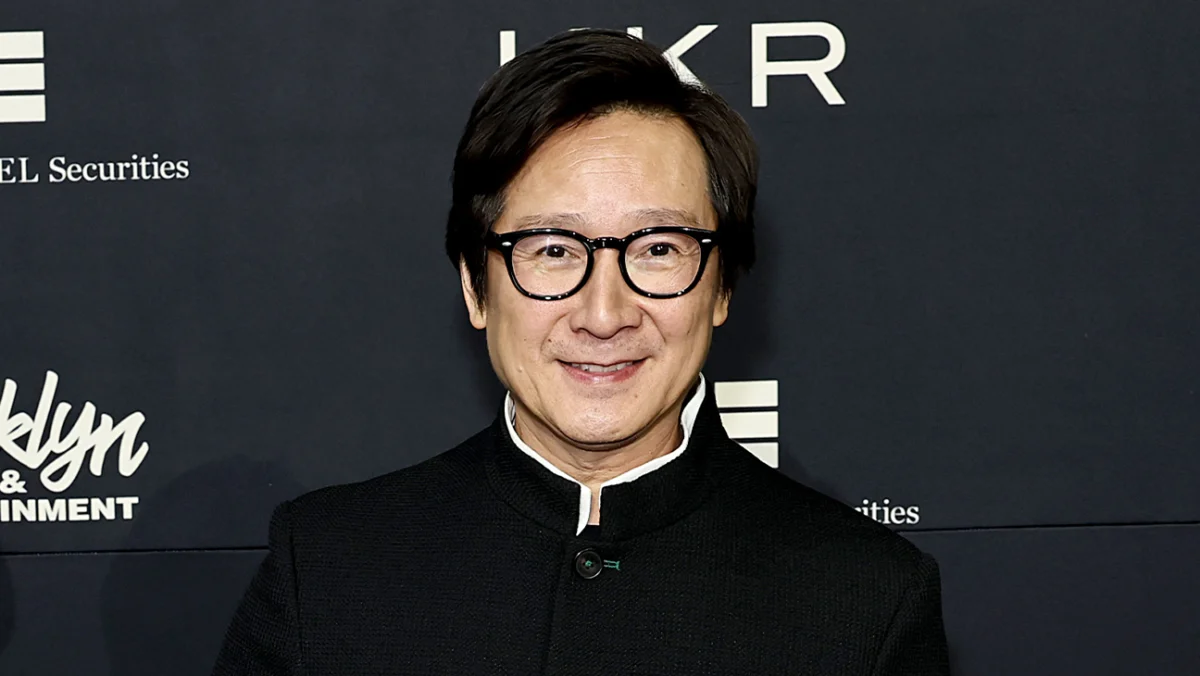
Ke Huy Quan, the acclaimed Oscar-winning actor, has unveiled a deeply personal and financially transformative moment from his childhood in his newly released memoir, Never Say Die. The book, which hit shelves on Tuesday, details Quan’s astonishment at receiving a $100,000 residual check for his pivotal role as Short Round in Steven Spielberg’s 1984 blockbuster, Indiana Jones and the Temple of Doom. At the tender age of 12, Quan, who had already secured his first major acting role, was unaware that beyond his initial compensation, he would also benefit from the film’s ongoing success through residual payments.
The Astonishing Discovery: A Life-Altering Sum
Quan recounts the moment he discovered the substantial sum in his memoir, painting a vivid picture of a quiet afternoon that would prove to be a watershed event for his family. "One afternoon, I walked into the kitchen and found my parents standing together at the table," Quan wrote, as reported by Entertainment Weekly. "Mom was holding an envelope with my name printed across it. Dad had the papers that had been inside." The envelope, originating from Lucasfilm, contained a check for nearly $100,000. This amount, Quan admits, was "an amount that didn’t make any sense to me" at the time, given his limited understanding of the film industry’s financial intricacies.
The young actor, still processing his newfound fame and the experience of working on a major Hollywood production, did not grasp the concept of residuals—payments made to actors for subsequent broadcasts or uses of their performances. Having already received his base pay for his contribution to Temple of Doom, the follow-up to the hugely successful 1981 film Raiders of the Lost Ark, the sudden appearance of such a significant sum was bewildering.
A Generous Gesture: The Unseen Impact of Residuals
Quan’s memoir illuminates the rarity and profound generosity of this gesture from director Steven Spielberg and producer George Lucas. At a time when profit-sharing and residual payments were largely exclusive to established stars, the inclusion of a child actor in such a lucrative arrangement was virtually unheard of. "Back then, almost no actors got a piece of a movie’s profits," Quan explained. "Even today, only the biggest stars do. That a kid like me, making his first film, would be included in something like that was unheard of."
The context of Indiana Jones and the Temple of Doom amplifies the significance of this act. As a sequel to a massive cultural and commercial hit, the film was anticipated to generate substantial revenue. The fact that Quan, a newcomer, was granted a share in these potential profits underscored the extraordinary nature of the filmmakers’ foresight and benevolence. He described the residuals clause as "a quiet gesture from Steven and George." This "small share," as he referred to it, was "life-changing for my family."
The Chronology of a Child Star’s Journey
Ke Huy Quan’s career began to blossom at a remarkably young age. Born in Saigon, Vietnam, in 1969, his family emigrated to the United States. His breakthrough role came in 1984 with Indiana Jones and the Temple of Doom, where he charmed audiences as the resourceful and loyal sidekick to Harrison Ford’s iconic adventurer. This was followed by a memorable role in the beloved 1985 film The Goonies, solidifying his status as a notable child actor of the era.
However, as the 1980s waned and the early 1990s arrived, opportunities for Quan began to diminish. The landscape of Hollywood, particularly for young actors transitioning into adulthood, proved challenging. Quan stepped away from acting for a period, pursuing other interests and educational endeavors, including studying film at the University of Southern California.
It was not until decades later that Quan experienced a remarkable resurgence in his acting career. His performance in the 2022 independent film Everything Everywhere All at Once, directed by Daniel Kwan and Daniel Scheinert, earned him widespread critical acclaim and an Academy Award for Best Supporting Actor. This pivotal role marked a triumphant return to the industry and a testament to his enduring talent.
A Legacy of Gratitude: Spielberg’s Enduring Influence
Quan’s journey back to the pinnacle of Hollywood is deeply intertwined with the foundational support he received early in his career. The impact of Spielberg’s early belief in him extended far beyond that initial $100,000 check. During his acceptance speech at the 2023 Golden Globe Awards for his role in Everything Everywhere All at Once, Quan emotionally acknowledged Spielberg, stating, "As I grew older, I started to wonder if that was it, if that was just luck. For so many years, I was afraid I had nothing more to offer. No matter what I did, I would never surpass what I achieved as a kid."
The sentiment underscores the profound psychological impact that early success and subsequent career challenges can have on an artist. Quan’s ability to overcome these fears and achieve a second act in his career is a powerful narrative of resilience and perseverance. The $100,000 residual, while a significant financial windfall for a child and his family, also represented a powerful early validation of his talent and potential by a filmmaker of Spielberg’s stature.
The Broader Implications: The Evolving Landscape of Actor Compensation
The story of Ke Huy Quan’s $100,000 residual check from Indiana Jones and the Temple of Doom offers a compelling snapshot of actor compensation trends in Hollywood, particularly during the 1980s. At that time, the concept of residuals was still evolving, and while unionized actors were beginning to benefit from residual payments for television reruns, their application to film profits was less common and often reserved for A-list talent.
The Screen Actors Guild (SAG), now SAG-AFTRA, has historically been instrumental in negotiating for better compensation and working conditions for actors. The development of residual payment structures for theatrical films has been a gradual process, influenced by union negotiations, industry shifts, and the rise of new media platforms like home video, cable television, and streaming services.
For a young actor like Quan to receive such a substantial sum from a film’s backend profits was an anomaly that highlights the progressive vision of Spielberg and Lucas. This early exposure to profit-sharing likely provided a degree of financial security and future opportunity for Quan’s family, demonstrating the long-term benefits of equitable compensation practices.
Supporting Data and Industry Context
To contextualize the $100,000 sum, it is important to consider the economic landscape of the 1980s. Inflation-adjusted figures reveal that $100,000 in 1984 would be equivalent to approximately $280,000 to $300,000 today, depending on the specific inflation calculator used. This underscores the significant financial impact the check would have had on a family at that time.
Furthermore, the box office performance of Indiana Jones and the Temple of Doom was substantial. The film grossed over $333 million worldwide against a production budget of around $28 million, making it a major financial success for Lucasfilm and Paramount Pictures. This strong performance directly contributed to the revenue streams from which residual payments are derived.
Looking Ahead: A Testament to Talent and Generosity
Ke Huy Quan’s memoir, Never Say Die, not only recounts a pivotal childhood experience but also serves as a broader narrative of perseverance, the enduring power of mentorship, and the transformative impact of opportunity. The revelation of the $100,000 residual check is more than just a financial anecdote; it is a testament to the generosity of Hollywood pioneers and a poignant reminder of how a single act of foresight can shape a life and a family’s future. As Quan continues to captivate audiences with his renewed career, his story remains an inspiration, celebrating both his personal triumphs and the foundational moments that paved his extraordinary path.