Almost two million people across Japan were placed under evacuation orders as Typhoon Dujuan, the 25th named storm of the year, battered several of the country’s prefectures with destructive winds and torrential rainfall. The powerful typhoon has tragically resulted in at least two confirmed fatalities and left four individuals missing, underscoring the severe immediate threat posed by the extreme weather event.
The full force of Typhoon Dujuan began to be felt as it tracked along Japan’s Pacific coast, bringing sustained winds of 130 km/h (80.8 mph) and ferocious gusts reaching 194 km/h. These velocities are characteristic of a significant tropical cyclone, capable of causing widespread structural damage and posing extreme danger to human life. The Japan Meteorological Agency (JMA) had initially issued "imminent threat to life" warnings for several regions, urging residents to seek shelter and prepare for the worst. While some of these severe weather warnings have since been downgraded as the typhoon continues its northward trajectory, the immediate aftermath has revealed a landscape of disruption and loss.
Human Toll and Urgent Evacuations
The most devastating consequence of Dujuan’s passage has been the loss of life and the ongoing search for missing persons. Public broadcaster NHK reported the initial figures of two deaths and four missing, with a specific focus on four individuals reported missing in Kanagawa prefecture, a densely populated area south of Tokyo.
Details emerging from the affected regions paint a grim picture of the typhoon’s destructive power. In Yokosuka City, within Kanagawa prefecture, fire department officials confirmed a tragic incident where a woman in her 60s lost her life. Rescue crews, responding to reports, discovered her buried alive inside her home, which was likely engulfed by a landslide triggered by the typhoon’s heavy rains. Despite immediate efforts, she was pronounced dead upon recovery. The sheer force of the landslip underscores the perilous conditions faced by residents in areas prone to such geological instability, particularly during extreme weather events.

A separate fatality was reported in Sodegaura City, Chiba prefecture. Here, a man in his 50s became trapped while engaged in clearing debris at a landslide site. The Sodegaura City Fire Department indicated that the worker, along with heavy machinery, fell into a bamboo thicket. Although rescued and transported to a hospital, his death was subsequently confirmed, according to local reports. Police authorities have initiated an investigation into the circumstances surrounding this incident, highlighting the inherent dangers faced by emergency responders and workers during post-storm clean-up operations.
Beyond the tragic fatalities, the widespread evacuation orders have significantly impacted the lives of nearly two million people. These orders, issued by local authorities, ranged from advisory (voluntary) to mandatory (strong recommendation for immediate evacuation), reflecting the varying levels of threat across different municipalities. Public shelters were activated across affected prefectures, providing temporary refuge for families forced to leave their homes due to the risk of flooding, landslides, or structural damage from high winds. The logistical challenge of coordinating such large-scale evacuations, especially during a rapidly evolving weather crisis, placed immense pressure on emergency services and local government bodies.
Widespread Disruption to Infrastructure and Daily Life
The typhoon’s onslaught brought immediate and severe disruptions across Japan. Power outages affected more than 50,000 households, plunging communities into darkness and impacting essential services. Strong winds, characteristic of Dujuan’s intensity, tore down power lines and damaged electrical infrastructure, necessitating extensive repair efforts that often cannot begin until weather conditions significantly improve. These outages not only caused inconvenience but also posed risks to vulnerable populations dependent on electricity for medical devices or heating/cooling.
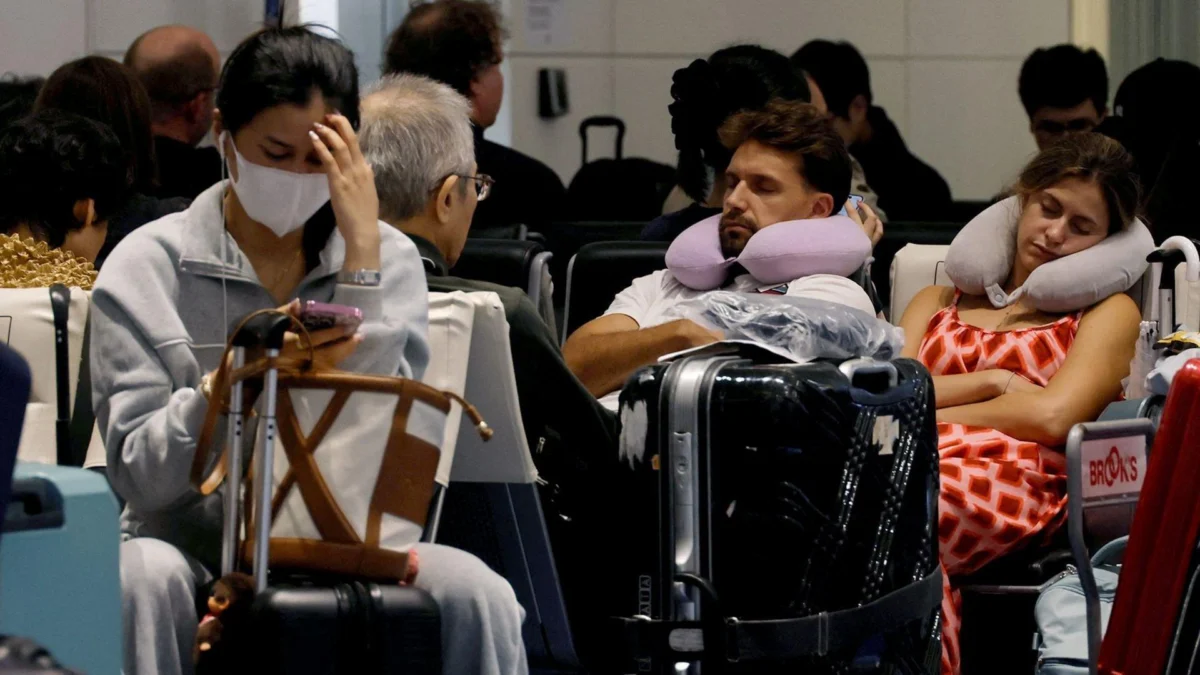
Transportation networks bore the brunt of the typhoon’s fury, leading to widespread cancellations and suspensions. Hundreds of flights, primarily impacting domestic routes but also potentially affecting international travel to and from major hubs like Narita and Haneda airports, were grounded. This resulted in thousands of stranded passengers, visible in images of crowded airport lounges as individuals awaited updates or alternative travel arrangements. Rail services, a cornerstone of Japan’s highly efficient public transport system, were also significantly curtailed. Key lines, including sections of the Shinkansen (bullet train) network and numerous local train services, were suspended as a precautionary measure against high winds, potential debris on tracks, and flooding. Road closures, due to fallen trees, landslides, and inundation, further compounded the travel chaos, effectively isolating some communities.
The timing of Typhoon Dujuan’s arrival coincided with a significant five-day national holiday period, amplifying the disruption to social and economic activities. This extended break, often referred to as ‘Silver Week’ when it falls in September, typically sees a surge in domestic tourism and public events. The typhoon forced the cancellation of several highly anticipated events, delivering a blow to both organizers and attendees. The Rock in Japan music festival, a major cultural event, saw its Monday concerts cancelled, disappointing thousands of music fans. Similarly, the Tokyo Game Show, a globally renowned video game convention, was forced to cancel its Monday program, impacting exhibitors and attendees from around the world. These cancellations not only represented significant financial losses for organizers and local businesses but also deprived the public of cherished leisure activities during a holiday period.

Government Response Amidst International Engagements
In response to the unfolding crisis, Japan’s government activated its emergency protocols. Prime Minister Sanae Takaichi, while preparing for a critical diplomatic trip, addressed the nation’s concerns. In a post on X (formerly Twitter), she extended her deepest condolences to those who had lost their lives in the typhoon. Demonstrating a firm grasp of the gravity of the situation, she stated, "With a sense of urgency, I instructed Chief Cabinet Secretary Takehara and Minister Hosono to respond with utmost preparedness." This directive highlighted the government’s immediate focus on disaster relief and public safety, ensuring that key officials were mobilised to coordinate the national response.
Despite the domestic emergency, Prime Minister Takaichi confirmed her decision to proceed with her scheduled trip to the United States. She boarded a flight to the US, where she was slated to speak at the UN General Assembly in New York on Tuesday and hold a meeting with US President Donald Trump. This decision underscored the delicate balance between addressing pressing national emergencies and fulfilling pre-scheduled international diplomatic commitments, particularly those deemed vital for Japan’s foreign policy and global standing. The Prime Minister’s public communication aimed to reassure the populace that while she would be abroad, the government’s machinery for disaster response was fully engaged and operating under strict instructions.
The Japan Meteorological Agency (JMA) played a crucial role throughout the event, issuing timely warnings and updates. Their initial "imminent threat to life" warnings were critical in prompting early evacuations and precautionary measures. As the typhoon progressed and its immediate threat diminished in certain areas, the JMA responsibly downgraded some warnings, allowing for a gradual return to normalcy while still advising vigilance against residual dangers such as lingering heavy rainfall, potential landslides, and high waves. Public service announcements across all major media channels reinforced the official advisories, guiding citizens on safety protocols and emergency procedures.
The Role of El Niño and Climate Change in Intensifying Storms
Typhoon Dujuan is not an isolated event but rather the latest in a series of intense storms that have impacted the Pacific region. Scientists and meteorologists point to the influence of a "super El Niño" phenomenon as a significant contributing factor to the heightened intensity of these storms. El Niño, a natural climate pattern characterized by the warming of ocean surface temperatures in the central and eastern tropical Pacific, has a profound effect on global weather patterns. A "super El Niño" signifies an exceptionally strong event, leading to even warmer ocean waters. These elevated sea surface temperatures act as a powerful fuel source for tropical cyclones, providing the energy needed for them to develop greater intensity, stronger winds, and increased moisture content. While El Niño doesn’t necessarily increase the total number of typhoons, it can significantly influence their formation locations, trajectories, and overall strength, potentially steering more powerful storms towards regions like Japan.

Beyond the cyclical influence of El Niño, a broader and more long-term concern is the impact of climate change on typhoon activity. While scientific research suggests that climate change may not increase the overall number of tropical storms globally, there is a strong consensus that it is contributing to their intensification. Warmer ocean waters, a direct consequence of global warming, mean that typhoons can absorb more energy, leading to higher wind speeds and more rapid intensification. This phenomenon results in storms that are not only more destructive upon landfall but also more challenging to forecast accurately in terms of their rapid strength changes.
Furthermore, a warmer atmosphere can hold more moisture. This means that when typhoons do form, they are capable of bringing significantly heavier rainfall. Such intense precipitation dramatically increases the risk of flash floods, riverine flooding, and landslides, as tragically evidenced by the incidents linked to Dujuan. Japan, with its mountainous terrain and extensive coastline, is particularly vulnerable to these combined threats. Some research indicates that Japan has become more exposed to such destructive storms, not necessarily in terms of frequency, but certainly in terms of their potential for widespread damage due to increased intensity and associated hazards. The confluence of a strong El Niño event and the ongoing effects of climate change presents a formidable and evolving challenge for disaster preparedness and resilience in the region.
Economic and Social Repercussions
The economic repercussions of Typhoon Dujuan extend beyond immediate infrastructure damage and event cancellations. Businesses, particularly those reliant on tourism and hospitality during the holiday period, faced significant losses. Supply chains for various industries, including manufacturing and agriculture, could also experience disruptions due to transportation impediments and damage to production facilities. The cost of repairs to public infrastructure, including roads, bridges, and power grids, will run into millions, placing a burden on local and national budgets.
Socially, the trauma of experiencing a major typhoon, coupled with the loss of homes, livelihoods, and tragically, lives, can have lasting impacts on affected communities. The psychological toll on individuals and families forced to evacuate or cope with damage is considerable. Recovery efforts will require not only financial investment but also community support and mental health services to help residents rebuild their lives.
Ongoing Vigilance and Recovery Outlook

As Typhoon Dujuan continues its journey along Japan’s Pacific coast, heading northward, authorities maintain a high level of vigilance. While the immediate threat may have subsided in some southern prefectures, northern regions remain at risk of experiencing the typhoon’s residual effects, including heavy rainfall, strong winds, and high waves. The full extent of the damage, particularly in more remote or heavily impacted areas, may not become clear until Tuesday or even later, as assessment teams gain access to affected zones.
The focus will now shift from immediate emergency response to comprehensive damage assessment and the initial phases of recovery. This will involve restoring power, clearing debris, repairing critical infrastructure, and providing support to displaced populations. Public advisories continue to urge residents to remain attentive to weather information and official guidance, even as the storm moves away, due to lingering hazards such as saturated ground, which can lead to delayed landslides, and damaged structures.
The experience of Typhoon Dujuan serves as a stark reminder of Japan’s inherent vulnerability to natural disasters and the increasing complexities introduced by global climate phenomena. The nation’s advanced disaster preparedness systems are continually tested, necessitating ongoing investment in resilient infrastructure, early warning technologies, and community education to mitigate the impact of future, potentially more intense, weather events.
Reporting by Jamie Whitehead and Kurumi Mori (Tokyo correspondent), with additional contributions from Chie Kobayashi and Mark Poynting (climate reporter).