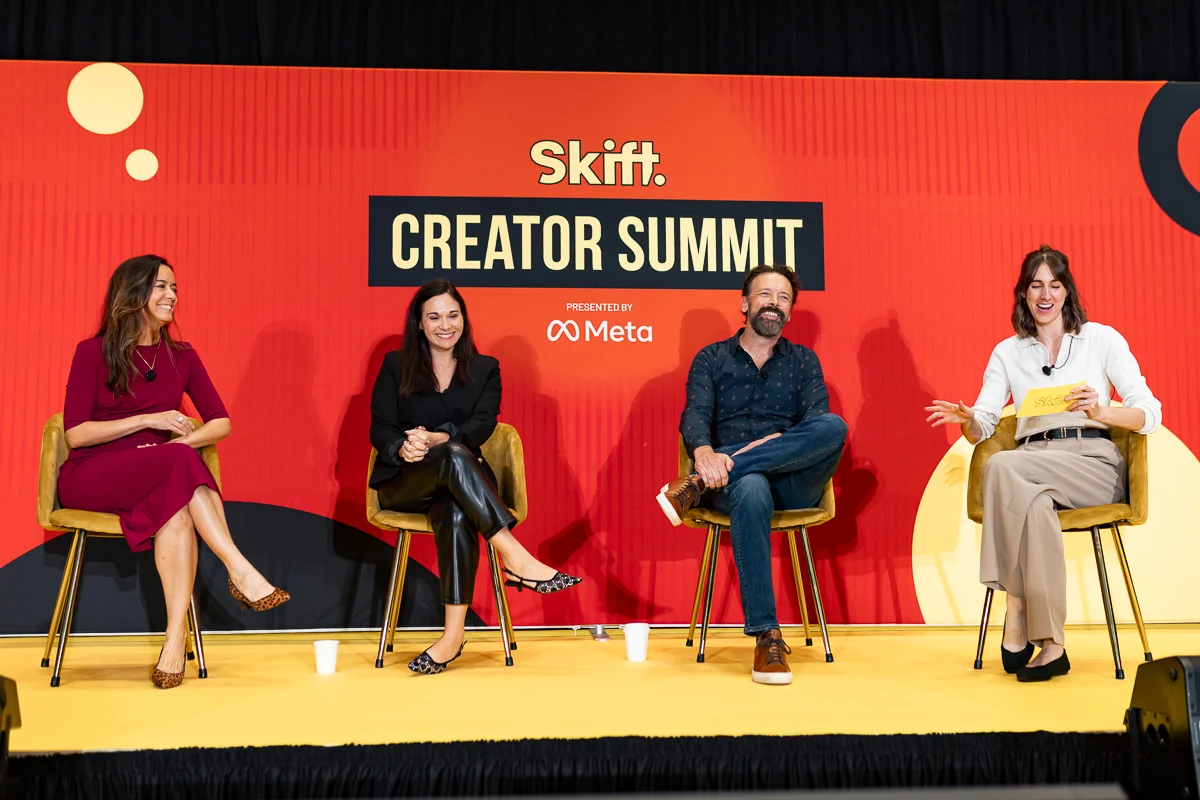
The disconnect between digital inspiration and final conversion has become the primary hurdle for the global travel industry, as marketing leaders struggle to track a consumer journey that often spans several months and multiple platforms. At the Skift Creator Summit held in New York City on September 22, 2026, industry experts highlighted a growing crisis in measurement: the traditional "click-based" attribution model is failing to capture the true value of short-form video and creator-led content. As travelers increasingly turn to platforms like Instagram and TikTok for discovery, the time elapsed between a user viewing a viral travel reel and actually clicking "book" can range from several weeks to half a year, leaving a massive data gap that brands are now racing to fill.
The panel, featuring Diana Lucas, Director of Marketing Science for North America at Meta Platforms; Laurie Blair, Senior Vice President of Global Marketing and Loyalty at Hyatt; and Ross Borden, Founder and CEO of Matador Network, delved into the complexities of the modern traveler’s psyche. The consensus among the speakers was clear: the industry is moving away from a linear funnel toward a more fragmented "ecosystem of influence" where the initial spark of inspiration is often invisible to traditional tracking software.
The Death of the Click: Why Traditional Metrics are Failing
For years, the "last-click" attribution model—which gives 100% of the credit for a sale to the last ad a user clicked—was the gold standard for ROI. However, Diana Lucas of Meta argued that this methodology is increasingly obsolete in an era where 60% of all content consumed on Facebook and Instagram is video. Video content, by its nature, is a passive-to-active medium; users often watch, save, or share a video without immediately clicking a link to purchase.
"If you are only focusing on the click, you are missing the vast majority of the impact," Lucas told the audience in Manhattan. She noted that while a user might see a stunning video of a Hyatt property in the Maldives in June, they may not actually book that trip until September. If that user eventually goes directly to the Hyatt website or searches for it on Google, the original creator content that sparked the interest receives zero credit in a traditional attribution setup. This "attribution lag" creates a significant challenge for marketing departments trying to justify large budgets for creator partnerships and high-production video content.
The challenge is compounded by the sheer volume of video consumption. With Meta’s internal data showing that more than half of user time is spent in video feeds, the "view-through" value has become more critical than the "click-through" value. This shift requires a fundamental change in how marketing science is applied to travel, moving toward "incrementality testing"—a method that measures the lift in sales caused specifically by an ad campaign compared to a control group that did not see the ad.
The Hyatt Strategy: Connecting Loyalty to Inspiration
From the perspective of a major hospitality brand, the stakes are high. Laurie Blair of Hyatt emphasized that the goal is no longer just about getting a "like" on a photo, but about driving long-term brand affinity and loyalty. Hyatt has been aggressive in integrating creator content into its broader marketing strategy, but Blair acknowledged the difficulty in connecting the dots between a TikTok influencer’s video and a World of Hyatt loyalty member’s stay.
Blair explained that Hyatt is increasingly looking at "soft conversions" as leading indicators of success. These include "saves" on Instagram, shares to direct messages, and the use of specific promo codes tied to creators. However, the ultimate goal remains the "hard conversion" of a room booking. To bridge this gap, Hyatt is experimenting with more sophisticated data-sharing partnerships with platforms like Meta to better understand the cross-device journey of their customers.
"The traveler’s journey is not a straight line; it’s a series of loops," Blair said. "A creator might introduce the brand, a travel blog might provide the details, and a loyalty email might close the deal. We have to understand the role each touchpoint plays, rather than just rewarding the final one."
Matador Network and the Role of the Modern Creator
Ross Borden, whose Matador Network has evolved from a travel publication into a major content house and creator platform, argued that the industry needs to stop treating creators as "billboards" and start treating them as "trust-builders." Borden noted that the average consumer in 2026 is highly skeptical of traditional advertising but remains deeply influenced by the authentic experiences of creators they follow.

According to Borden, the "attribution gap" is actually an "authenticity gap." When a brand tries to force a direct-response "Book Now" button onto a creator’s organic-feeling video, it often breaks the immersion and reduces the video’s effectiveness. Instead, Matador advocates for a "full-funnel" approach where creators are used for top-of-funnel awareness, while retargeting ads—often using the same creator’s likeness—are used later in the cycle to drive the booking.
Borden shared data suggesting that campaigns utilizing creator-led video see a 35% higher brand recall than traditional display ads, even if the immediate click-through rate is lower. This suggests that while the "dot-connecting" is difficult, the underlying impact on the consumer’s intent is undeniable.
Supporting Data: The 2026 Travel Discovery Landscape
The discussions at the summit were supported by emerging industry data that paints a picture of a rapidly changing marketplace. According to a 2026 Travel Marketing Report:
- The 90-Day Window: The average time from first seeing a travel destination on social media to making a booking has increased to 87 days for international travel.
- The Rise of Social Search: 54% of Gen Z and Millennial travelers now use TikTok and Instagram as their primary search engines for travel planning, surpassing Google for the first time in late 2025.
- Video Dominance: Short-form video (under 60 seconds) accounts for 72% of all travel-related engagement on social platforms.
- The Halo Effect: Brands that invest in creator partnerships see a 12% average increase in "direct-to-site" traffic, suggesting that social inspiration leads to brand-specific searches later in the journey.
These statistics highlight the "messy middle" of the travel purchase journey—a period of research and deliberation where travelers are influenced by hundreds of digital touchpoints. For brands, the challenge is staying "top of mind" during this three-month window without over-relying on expensive search engine marketing (SEM) at the very end.
Chronology of a Booking: From Scroll to Stay
To illustrate the complexity, the panel outlined a hypothetical chronology of a 2026 traveler:
- Day 1 (Discovery): A user sees a 15-second Reel of a boutique hotel in Mexico City posted by a travel creator. They "save" the post but do not click any links.
- Day 14 (Research): The user sees a second video, this time an "educational" piece from the same creator about "Top 5 Neighborhoods in Mexico City."
- Day 45 (Comparison): The user begins searching for flights and looks at Hyatt’s official Instagram page to see more professional photos of the property.
- Day 60 (Validation): The user reads reviews on a third-party site and watches a YouTube vlog about the destination.
- Day 82 (Conversion): The user receives a targeted email from their loyalty program or sees a retargeting ad with a "limited time offer" and finally completes the booking on a desktop computer.
In this scenario, a "last-click" model would give all the credit to the final email or retargeting ad, completely ignoring the 81 days of influence exerted by the initial creator content.
Broader Implications for the Travel Industry
The shift toward a more holistic view of marketing measurement has profound implications for how travel brands will allocate their budgets in 2027 and beyond. The "Skift Creator Summit" served as a wake-up call for CMOs who have historically prioritized easily measurable, lower-funnel tactics over long-term brand building.
One major implication is the professionalization of the creator economy. As brands demand better data, creators are being asked to provide more than just "reach" and "engagement" metrics. They are increasingly being integrated into the brands’ own data stacks, allowing for "whitelisting" (where a brand runs ads through a creator’s account) to track performance more accurately through Meta’s or TikTok’s backend systems.
Furthermore, the industry is seeing a rise in "Marketing Mix Modeling" (MMM). This statistical analysis uses historical data to estimate the impact of various marketing tactics on sales, accounting for external factors like seasonality and economic shifts. Unlike click-tracking, MMM can estimate the long-term "tail" of a video campaign, providing a more accurate picture of how creator content contributes to the bottom line over a six-month period.
As the summit concluded, the message to the travel industry was clear: the path to purchase has changed, and the tools used to measure it must change as well. In an era dominated by video and creator-driven discovery, the brands that succeed will be those that embrace the complexity of the journey rather than trying to force it into a simplified, click-based box. The "dots" may be harder to connect, but for those who master the science of attribution in 2026, the rewards in brand loyalty and booking volume are higher than ever.