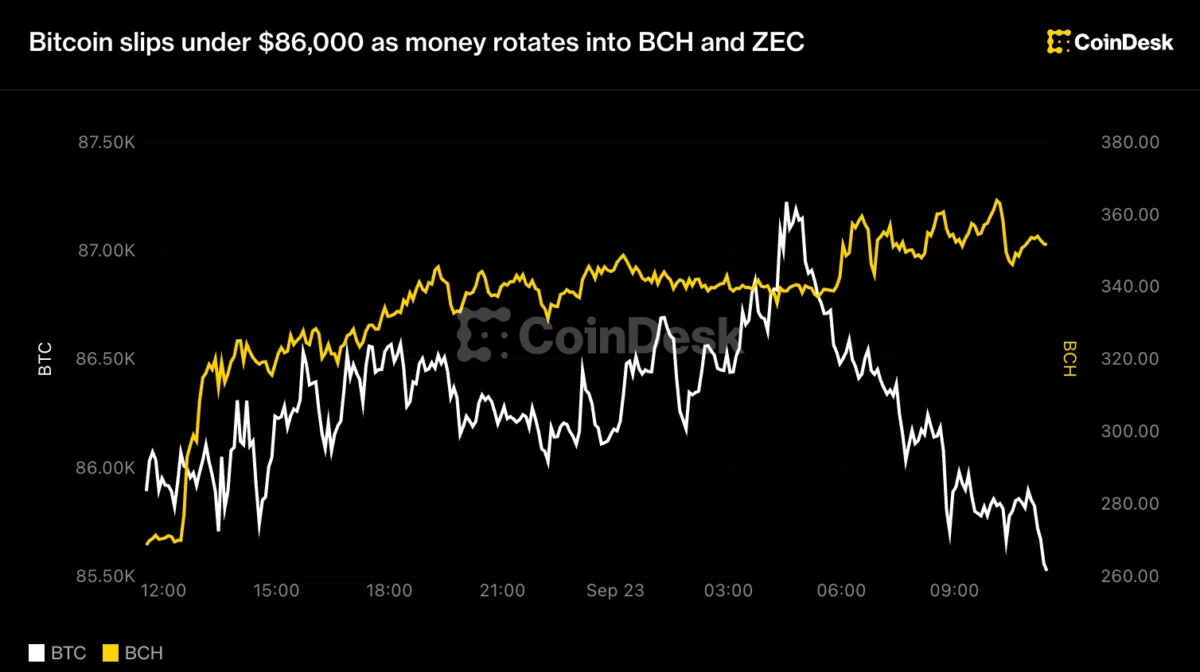
Bitcoin Cash (BCH) recorded a significant valuation increase of 28 percent over a 24-hour period, reaching a peak of approximately $349 following a strategic announcement from CME Group regarding the expansion of its digital asset derivatives suite. The Chicago-based exchange, which stands as the world’s largest regulated derivatives marketplace, confirmed on Monday its intention to introduce futures contracts for both Bitcoin Cash and Uniswap (UNI) effective October 19, pending regulatory review. This development represents the most substantial price movement among high-market-capitalization digital assets in the current trading cycle, signaling a renewed institutional interest in established altcoins.
The inclusion of Bitcoin Cash on a regulated United States exchange serves as a critical bridge for institutional capital. For many hedge funds, pension funds, and asset managers, internal mandates and regulatory frameworks strictly prohibit the direct custody of digital assets due to security concerns, insurance requirements, or lack of clear legal standing. By utilizing futures contracts, these entities can gain exposure to the price movements of BCH without the logistical and compliance-related burdens of holding the physical token. Furthermore, the presence of a regulated futures market provides market makers with a robust venue for hedging, a mechanism that typically leads to increased liquidity and tighter bid-ask spreads in the spot market.
The Strategic Expansion of CME Group Digital Asset Products
CME Group’s decision to list Bitcoin Cash and Uniswap futures is part of a broader effort to cater to the growing demand for diversified crypto-asset exposure. Historically, the exchange has been selective with its cryptocurrency offerings, beginning with Bitcoin futures in late 2017 and subsequently adding Ether (ETH) futures in 2021. The addition of BCH and UNI suggests that the exchange perceives sufficient institutional demand and underlying market maturity for these specific assets.
The timing of the October 19 launch is significant, as it aligns with a period of heightened volatility and increased trading volume across the broader financial markets. By providing a transparent and regulated environment for these trades, CME Group is effectively legitimizing these assets in the eyes of traditional finance. The move also highlights the divergence in the altcoin market, where specific tokens are being singled out for institutional integration while others remain relegated to retail-focused offshore exchanges.
Market Reaction and Comparative Asset Performance
While Bitcoin Cash dominated the headlines with its near 30 percent rally, the rest of the cryptocurrency market exhibited a mix of consolidation and localized gains. Bitcoin (BTC), the market leader by valuation, was trading at approximately $85,800 at the time of reporting, representing a marginal decline of less than 1 percent over the same 24-hour window. This price action followed a Monday intraday high of $87,300, a level that triggered significant selling pressure as traders capitalized on recent gains.
The stagnation in Bitcoin’s price appears to have facilitated a rotation of capital into the altcoin sector. Zcash (ZEC) experienced a notable appreciation of 9 percent, climbing to just above $1,646, while XRP saw a 3 percent increase to nearly $1.59. Conversely, Tron (TRX) faced a minor correction, falling 2 percent as investors reallocated funds toward the high-momentum BCH trade. This internal market rotation is a common phenomenon in the digital asset space, often referred to as "altseason," where capital moves from the highly liquid Bitcoin into smaller, higher-beta assets in search of greater percentage returns.
Analytical Perspective: The Shift of Speculative Capital
Alex Kuptsikevich, a senior analyst at FxPro, provided insight into the current market dynamics, noting that the optimism observed in the altcoin market and traditional equities suggests a temporary migration of speculative capital. "Many investors had parked their cryptocurrency-allocated capital in the most liquid asset class and are now seeking more profitable opportunities," Kuptsikevich stated in a communication to market participants.
This observation underscores a fundamental shift in trader sentiment. After Bitcoin’s sustained run toward the $90,000 threshold, many market participants view the primary cryptocurrency as being in a consolidation phase. According to Kuptsikevich, this does not necessarily portend a bearish reversal for Bitcoin but rather a healthy pause. "In such situations, there has previously been a slowdown but not a reversal in BTC, as price pullbacks have attracted new buyers who had previously kept their money out of the risky crypto market," he added. The influx of "sidelined" capital into price dips suggests that the underlying structural demand for digital assets remains intact, even as speculators rotate into tokens like Bitcoin Cash.
Historical Context and Technical Resistance Levels
Despite the recent 28 percent surge, Bitcoin Cash remains significantly below its historical peaks, providing a broader perspective on its current recovery. The token’s climb to $349 merely returns it to valuation levels last seen in the second half of May. Earlier in the year, BCH experienced a volatile trajectory, reversing near the $660 mark in early January before entering a prolonged downtrend that saw it bottom out at $190.
The current rally has broken through several intermediate resistance levels, but technical analysts point to the $450 mark as the next major hurdle for the asset. This price point served as a significant zone of buyer and seller activity between October 2023 and May 2024. A sustained bid above $349 could open the door for a retest of that $450 range, provided that the momentum generated by the CME announcement does not dissipate. The historical volatility of BCH makes it a favorite for short-term speculators, but the introduction of futures suggests a potential shift toward more stable, long-term institutional positioning.
Institutional Mandates and the Importance of Regulated Hedging
The significance of CME Group as a venue for these futures cannot be overstated. Unlike unregulated or offshore exchanges, CME operates under the oversight of the Commodity Futures Trading Commission (CFTC). This regulatory umbrella is a prerequisite for many institutional investors who are subject to fiduciary duties and strict risk management protocols.
The ability to hedge is particularly vital for market makers—firms that provide liquidity by simultaneously offering to buy and sell assets. Without a regulated futures market, these firms take on significant directional risk when they facilitate large spot trades. By using CME futures, they can offset this risk, allowing them to offer better prices to retail and institutional clients alike. This process, known as "arbitrage-driven liquidity," often results in the spot price of the asset becoming more stable and reflective of global demand.
Implications for the DeFi Sector and Uniswap
The CME announcement also included Uniswap (UNI), the governance token for the largest decentralized exchange (DEX) by volume. While BCH is primarily a medium of exchange and a "digital silver" to Bitcoin’s "digital gold," Uniswap represents the decentralized finance (DeFi) infrastructure. The listing of UNI futures is a landmark event for the DeFi sector, as it marks the first time a major U.S. derivatives exchange has offered a product tied to a decentralized protocol’s governance token.
This move suggests that institutional interest is expanding beyond simple payment currencies and into the underlying protocols that power the crypto ecosystem. The inclusion of UNI alongside BCH indicates that CME Group is diversifying its offerings to cover different niches within the digital asset economy: a "hard money" fork of Bitcoin and a "utility-driven" DeFi protocol. This diversification provides institutional investors with more granular control over their crypto-sector exposure.
Chronology of the Recent Market Move
To understand the magnitude of the BCH surge, it is helpful to look at the timeline of events leading up to the current price level:
- Early January: Bitcoin Cash reaches a yearly high near $660 amidst broader market optimism surrounding the potential for spot Bitcoin ETFs.
- February – April: A period of sustained correction occurs as the market cools, with BCH eventually finding a floor near $190.
- May: A brief recovery pushes the price back toward the $350 range before it settles into a period of sideways trading.
- Monday Morning: CME Group officially announces the upcoming launch of BCH and UNI futures for October 19.
- Monday Afternoon: BCH price begins a rapid ascent, breaking through the $300 resistance level.
- 24-Hour Peak: BCH reaches approximately $349, a 28 percent gain, outperforming all other major tokens in the top 20 by market capitalization.
Broader Economic Impact and Future Outlook
The rally in Bitcoin Cash occurs against a backdrop of general optimism in traditional equity markets. As interest rate expectations stabilize and corporate earnings show resilience, investors’ appetite for risk has increased. This "risk-on" sentiment typically benefits assets at the further end of the risk spectrum, including cryptocurrencies and high-growth tech stocks.
The expansion of CME’s crypto offerings is likely to encourage other traditional financial institutions to reconsider their digital asset strategies. If the BCH and UNI futures see significant trading volume upon their October 19 debut, it may pave the way for other altcoins—such as Solana (SOL) or Cardano (ADA)—to be considered for similar regulated products.
However, market participants remain cautious about the sustainability of the current altcoin rally. While the CME news provides a fundamental catalyst for Bitcoin Cash, the broader market remains tethered to Bitcoin’s performance. Should Bitcoin face a deeper correction from its $85,800 level, the speculative capital currently flowing into altcoins could quickly retreat to the safety of stablecoins or cash. For now, the 28 percent jump in BCH stands as a testament to the power of institutional infrastructure in driving market sentiment and price discovery in the evolving digital asset landscape.