The Arctic Ocean’s sea ice cover reached its annual minimum extent on September 12, 2026, measuring an estimated 1.78 million square miles (4.6 million square kilometers), a figure that ties with the minimums recorded in 2008, 2010, and 2025 as the tenth lowest in the continuous satellite record maintained by NASA and the National Snow and Ice Data Center (NSIDC) at the University of Colorado Boulder. This latest measurement underscores a profound and unwavering long-term trend of diminishing Arctic sea ice, with the past two decades, spanning from 2007 through 2026, collectively accounting for the 20 lowest annual Arctic sea ice minimum extents observed since comprehensive satellite measurements commenced in late 1978.
The Unrelenting Retreat of Arctic Sea Ice
The Arctic sea ice minimum is a critical indicator of the health of the planet’s climate system. Sea ice, a relatively thin layer of frozen seawater floating on the ocean surface, plays a vital role in regulating global temperatures by reflecting solar radiation back into space, a phenomenon known as the albedo effect. When sea ice melts, it exposes the darker ocean surface, which absorbs more sunlight, leading to further warming and accelerating ice melt in a positive feedback loop known as Arctic amplification. The persistent decline in Arctic sea ice extent has profound implications not only for the Arctic region itself but also for global weather patterns, ocean circulation, and marine ecosystems.
Historically, the average minimum sea ice extent during the first two decades of satellite observation (1979-1998) was significantly higher, often exceeding 2.5 million square miles (6.5 million square kilometers). The 2026 minimum, while not a new record low, remains alarmingly far below this historical average, cementing its place among the most severe reductions ever documented. The record low occurred in 2012, when the Arctic sea ice plummeted to 1.31 million square miles (3.41 million square kilometers), a stark illustration of the region’s vulnerability to climate change. Subsequent years have seen fluctuations, but the overall trajectory remains unequivocally downward.
Linette Boisvert, a sea ice scientist at NASA’s Goddard Space Flight Center in Greenbelt, Maryland, noted that while increased cloud cover over the last decade has somewhat mitigated the direct impact of solar radiation, preventing an even faster acceleration of melt, this has only led to a "plateauing" of the September sea ice extent in recent years. Walt Meier, a senior research scientist at NSIDC, echoed this sentiment, stating, "We’ve plateaued, but we’re still low relative to the earlier part of the record." This scientific assessment highlights that the current stability is not a sign of recovery but rather a temporary deceleration in the rate of decline, maintaining the ice cover at a critically low level far below historical norms. The underlying drivers of long-term warming continue to exert pressure on the Arctic system.
A Half-Century of Satellite Surveillance: Tracking the Decline
The continuous monitoring of polar sea ice from space has been instrumental in understanding the dramatic changes occurring in the Arctic and Antarctic. This invaluable record spans nearly five decades, beginning in October 1978 with NASA’s Nimbus-7 satellite. This pioneering mission laid the groundwork for a robust and uninterrupted data series, which was subsequently carried forward by a succession of advanced satellite instruments.
The Defense Meteorological Satellite Program (DMSP) satellites, starting in 1987, provided critical continuity, collecting microwave data that could penetrate cloud cover and darkness, allowing for year-round observation of sea ice. NASA’s Aqua satellite, operational from 2002 to 2011, further enhanced the precision and resolution of these measurements. Today, the Advanced Microwave Scanning Radiometer 2 (AMSR2) instrument, launched in 2012 aboard JAXA’s (Japan Aerospace Exploration Agency) GCOM-W satellite, continues this vital mission, ensuring the unbroken record of sea ice extent and concentration. This multi-agency, international collaboration underscores the global scientific community’s commitment to monitoring Earth’s cryosphere, a cornerstone of climate science.
This extensive dataset reveals a clear and concerning chronology of Arctic sea ice loss. The 1980s and 1990s showed a gradual but consistent downward trend. However, the pace of decline accelerated significantly in the 21st century, particularly after the dramatic melt event of 2007, which saw a then-record low minimum. This event was a wake-up call for many scientists and policymakers, highlighting the potential for rapid, non-linear changes in the Arctic. The 2012 record low further solidified concerns, and the subsequent years have consistently ranked among the lowest on record, indicating that the Arctic is firmly entrenched in a new, reduced ice regime.
Antarctic Sea Ice: A Region of High Variability
In stark contrast to the Arctic’s consistent long-term decline, sea ice dynamics at the opposite pole, around Antarctica, present a more complex and variable picture. As the Southern Hemisphere transitions towards its austral spring, Antarctic sea ice is approaching its annual maximum extent. However, this growth was punctuated by an unusual fluctuation in August 2026, during which sea ice declined by approximately 116,000 square miles (300,000 square kilometers) over a six-day period before resuming its seasonal expansion.
Walt Meier explained that this decline appeared to be primarily associated with specific weather conditions, including strong winds that pushed and compacted the thin, mobile ice near its outer edge. While such localized events of ice movement and compaction are not uncommon, Meier noted that "the magnitude of it certainly is unusual." This highlights the significant influence of short-term meteorological phenomena on Antarctic sea ice extent.
The fundamental difference in geography between the two poles accounts for much of this disparity in ice behavior. The Arctic Ocean is largely surrounded by landmasses, trapping the ice and making it more susceptible to warming air and ocean temperatures. Conversely, Antarctic sea ice forms in the vast, open Southern Ocean, allowing it to respond more freely to changing wind patterns, ocean currents, and atmospheric conditions. This geographical distinction contributes to the higher year-to-year variability observed in Antarctic sea ice extent compared to its Arctic counterpart.
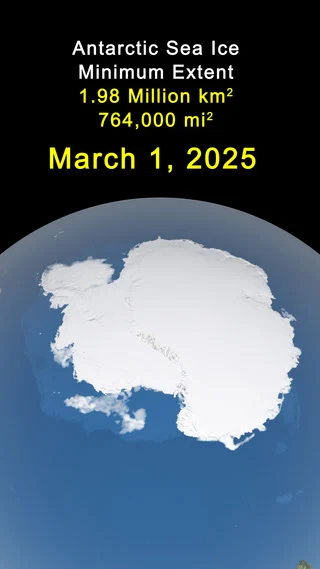
While Antarctic sea ice extent at its annual maximum has generally been lower in recent years, scientists like Boisvert and Meier remain cautious about characterizing these changes as a definitive long-term trend, primarily due to the region’s inherent high variability. This scientific prudence is crucial, as drawing premature conclusions from highly fluctuating data can be misleading. However, it is important to note that the Antarctic has also experienced periods of unprecedented low sea ice. For instance, in early 2023, Antarctic sea ice reached its lowest minimum extent ever recorded during its austral summer, far below previous records, a development that prompted significant scientific concern and further research into the drivers of such extremes. These recent anomalies, both in maximum and minimum extents, underscore the need for continued, rigorous monitoring to discern any emerging long-term trends from the background noise of natural variability.
NASA and NSIDC scientists will continue to track the Antarctic sea ice, and the official 2026 maximum extent will be announced once it is confirmed that seasonal ice growth has concluded, typically occurring in late September or early October.
Broader Implications and Global Impact
The state of polar sea ice is not merely a regional concern; it has far-reaching global implications. The sustained low levels of Arctic sea ice, in particular, contribute to a cascade of environmental changes. The reduced albedo effect means the Arctic Ocean absorbs more solar energy, leading to warmer ocean temperatures. This warming can destabilize Greenland’s ice sheet and accelerate the melt of permafrost, both of which contribute to global sea level rise and release potent greenhouse gases, respectively.
Furthermore, changes in Arctic sea ice can influence mid-latitude weather patterns. Some research suggests a link between reduced Arctic ice and more extreme weather events in North America, Europe, and Asia, including prolonged heatwaves, unusually cold winters, and shifts in the jet stream. The diminishing ice also opens up new shipping routes, such as the Northern Sea Route and the Northwest Passage, which, while offering economic advantages, introduce new environmental risks, including increased pollution, potential oil spills, and disturbance to fragile Arctic ecosystems. Indigenous communities, whose cultures and livelihoods are intimately tied to the ice, face unprecedented challenges to their traditional hunting practices and way of life.
For Antarctica, while the picture is more complex, continued monitoring is vital. The Southern Ocean plays a crucial role in global ocean circulation and carbon sequestration. Any significant long-term shifts in Antarctic sea ice could alter these processes, with potential impacts on marine biodiversity, including krill populations which form the base of the Antarctic food web, and the broader global climate system.
The ongoing satellite record, spanning almost five decades, represents one of humanity’s most critical climate datasets. It provides irrefutable evidence of the rapid changes occurring at Earth’s poles and serves as a vital tool for climate scientists to refine models, understand feedback loops, and project future climate scenarios. The consistent collaboration between international space agencies and scientific institutions highlights the global nature of climate change and the collective effort required to understand and address its challenges. The 2026 Arctic minimum, while not a new record, is a stark reminder of a region undergoing profound transformation, while the dynamic Antarctic system continues to be a focus of intense scientific scrutiny. The future of Earth’s polar ice caps remains a defining challenge of the 21st century.
Media contact: Elizabeth Vlock
NASA Headquarters