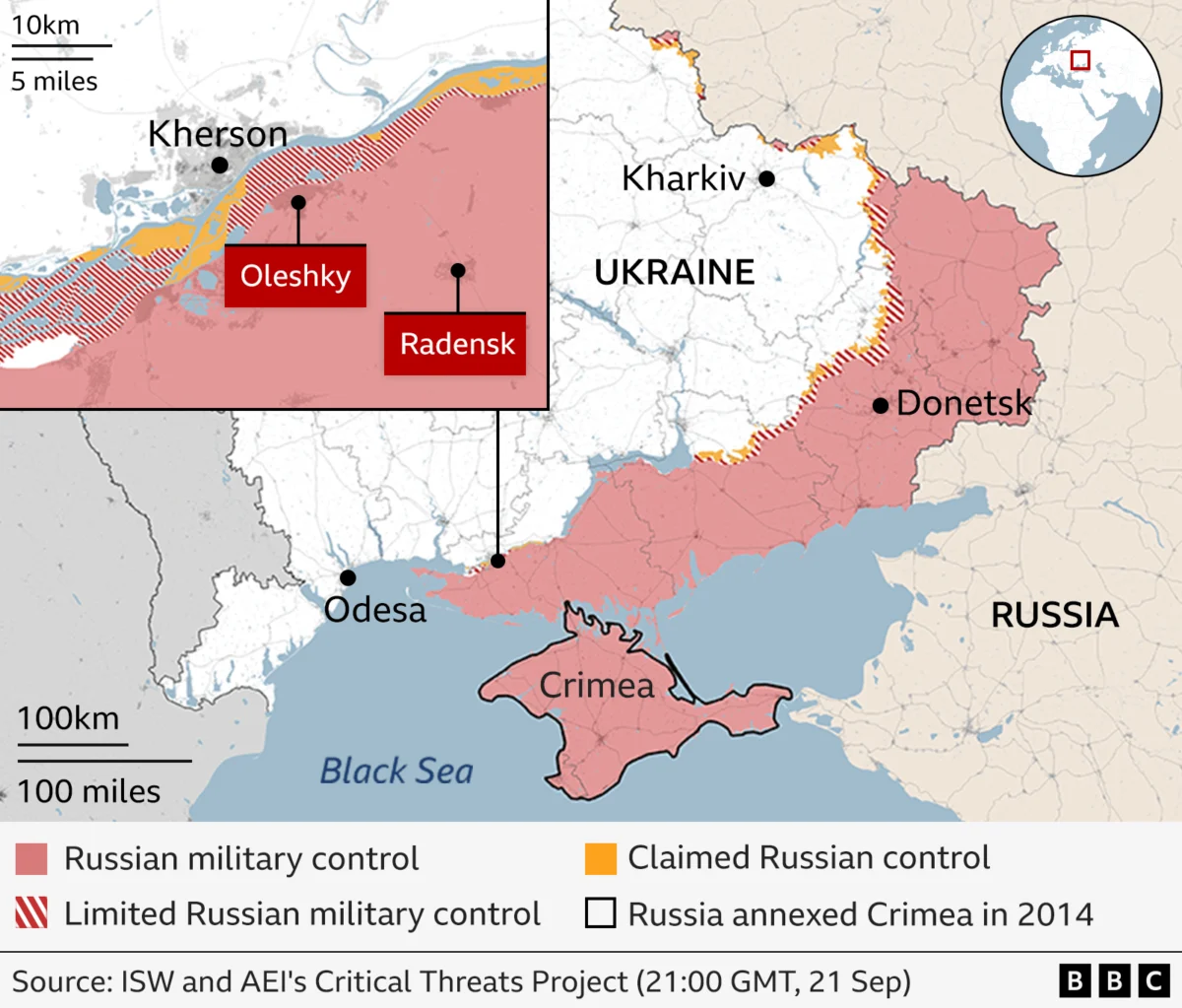
The Ukrainian city of Oleshky, located in the southern Kherson region, is grappling with a humanitarian catastrophe of escalating proportions, as its residents, trapped under Russian occupation since 2022, face dire shortages of food, water, medicine, and basic utilities. Eyewitness accounts and confirmed reports detail a landscape of constant shelling, civilian casualties, and a population pushed to the brink of survival, with recent events underscoring the extreme peril faced by those unable to escape.
A City Under Siege: Immediate Peril and Civilian Fatalities
The grim reality of life in Oleshky was starkly illustrated by a recent incident on September 20, when a husband and wife, returning with a precious bag of food from the neighboring town of Radensk, approximately 23 kilometers away, were killed by a drone. Their deaths occurred after they were unable to reach home before a strict curfew imposed by Russian occupation authorities, highlighting the perilous conditions under which residents attempt to secure basic necessities. Four independent sources have corroborated these tragic civilian deaths, though the identities of the victims remain protected for the safety of those who shared the information.
"Two more civilians died last night," initially reported Halia, a resident whose name has been changed for her protection, before her phone connection was abruptly severed. Days later, she confirmed the victims were a couple she knew well, their lives extinguished in a desperate search for sustenance. Her harrowing testimony is one of many received by journalists from residents in this front-line city, painting a picture of relentless suffering.

Oleshky’s geographical position contributes significantly to its isolation. It is strategically located between the Dnipro River, which serves as a demarcation line from Ukrainian-held territories, and the entrenched Russian forces. This effectively creates a chokehold, severely restricting movement and access for both residents and humanitarian aid.
The Broader Humanitarian Catastrophe: A Struggle for Survival
Beyond the immediate threat of violence, Oleshky’s remaining inhabitants face a comprehensive collapse of essential services. The city has been without electricity, gas, or centralized water supply since the catastrophic collapse of the Nova Kakhovka Dam in June 2023. While the original article incorrectly states "three years ago," the dam’s destruction approximately a year and a half prior caused devastating floods, exacerbating an already fragile situation and leaving much of the city’s infrastructure in ruins. Ukraine and NATO have accused Russia of deliberately destroying the dam, while Russia maintains Ukraine was responsible. Regardless of attribution, Oleshky bore the brunt of the environmental and infrastructural damage, with thousands losing their homes as buildings were submerged up to their rooftops.
The lack of utilities has forced residents into primitive living conditions. Cooking is done over open flames or makeshift stoves, as evidenced by images showing rudimentary cooking setups. The absence of clean water poses a severe public health risk, increasing the likelihood of waterborne diseases.
Food scarcity is equally critical. Halia reported that the last significant food delivery to Oleshky was in May, leaving residents to forage and improvise for survival. "There is no food here in the city," she stated, describing her own diet as a single meal a day, typically plain bread with a tomato or honey and tea. Many have resorted to cooking garden weeds, with local Telegram chats becoming forums for sharing knowledge on edible plants and desperate calls to sell, swap, or share meager food portions. All shops in Oleshky have long ceased operations, and residents are unable to access even basic hygiene products or clothing.

Medical services are virtually non-existent. Multiple independent sources confirm that only one hospital remains partially operational, opening just a few days a week, primarily to perform critical amputations. This skeletal service leaves residents vulnerable to illness and injuries, with little hope for comprehensive care.
Children, estimated to be around 200 within Oleshky and its surrounding areas, are particularly vulnerable. Residents report widespread malnutrition, a complete absence of medical services, and a severe lack of educational opportunities, leading to concerns about their long-term development and well-being. The Ukrainian government estimates that the city, which once had a pre-invasion population of 24,000, now holds only about 6,000 people.
The Uncounted Dead: Civilian Casualties and Undignified Burials
The true scale of civilian casualties in Oleshky remains obscured by the fog of war and deliberate obstruction. The UN Human Rights Monitoring Mission in Ukraine has documented at least 29 civilians killed and 54 injured in Oleshky and the nearby town of Hola Prystan this year. However, local volunteers believe this figure to be significantly understated.
Ksenia Arkhipova, a volunteer who escaped Oleshky in the summer of 2022 and now assists with food deliveries and evacuations, has meticulously documented deaths reported by trusted locals. "I’ve been putting together a spreadsheet of all those who died as soon as I find out about it, with their names and dates of birth – I’ve got around 1,200 people now," she revealed. "Sometimes I don’t have time to update it, as the list grows one or two people longer every day: someone was killed by a drone, someone else stepped on the landmine." While the BBC could not independently verify these specific figures, they underscore the profound human cost of the occupation.

Tetiana, another resident whose name has been changed for safety, shared the devastating personal account of losing both her parents in Oleshky this summer. She confirmed their identities with dates of birth and photos, detailing how "They were shot inside their home. Russian soldiers came there and wanted to take it."
Adding to the horror, residents report severe restrictions on burying the dead imposed by Russian occupation authorities. According to Tetiana, "They do not allow us to bury the dead if they were killed by a drone, stepped on a landmine or were killed in any other way." Russian authorities demand a post-mortem examination by a Russian doctor, a service unavailable in Oleshky. Consequently, only those who die of natural causes are permitted a burial.
This cruel policy has led to unimaginable scenes, with some bodies reportedly remaining on the streets since December. Volunteer Ksenia Arkhipova described bodies "either getting piled" up in the local hospital morgue, which has been without power since winter, or, in a truly grotesque detail verified by numerous graphic images obtained from residents, being consumed by stray dogs. These images are too distressing to publish but serve as stark evidence of the inhumane conditions. Ester Vrataryova, co-founder of the charity Humanity, which aids people in occupied Ukrainian territories, described this practice as a "tool of psychological pressure," warning that "If you try to bury a dead body, you’ll become the next one."
Official Responses and International Appeals
The dire situation in Oleshky has drawn international attention. Earlier this week, the Kremlin acknowledged that Oleshky faced "a critical situation" and "problems with supplies of food and medicine." However, it swiftly added that "Russia’s military was working to resolve them" and placed blame squarely on Kyiv for the humanitarian crisis. This narrative is sharply contradicted by Ukrainian officials and local accounts.

Ukraine’s Foreign Minister Andriy Sybiha, speaking at the UN General Assembly in New York, explicitly described the local population as living under a "full blockade" by Russian forces. He issued an urgent appeal to the international community, calling for concerted pressure on Russia to allow humanitarian aid into the besieged city. Ukraine has attempted to deliver supplies to the area but has faced consistent obstruction and has not succeeded in recent months.
Long-Term Implications and the Call for Action
The ongoing crisis in Oleshky represents a grave violation of international humanitarian law, particularly concerning the protection of civilians and the unimpeded passage of humanitarian relief. The deliberate blocking of aid, the targeting of civilians, and the denial of dignified burial rites constitute severe breaches of fundamental human rights.
The long-term implications for the remaining residents are profound. Beyond the immediate threat to life, the sustained deprivation of food, water, medical care, and education will have lasting physical and psychological scars. The trauma of living under constant threat, witnessing violence, and enduring such extreme hardship will undoubtedly affect generations. The breakdown of social structures, the loss of community members, and the erosion of basic human dignity create a complex humanitarian challenge that will require extensive international support and intervention long after the conflict ends.
As winter approaches, the conditions are expected to worsen significantly, posing an even greater threat to those without adequate shelter, heating, or sustenance. The international community’s response to Ukraine’s pleas for humanitarian access will be crucial in determining the fate of Oleshky’s trapped population. Without immediate and sustained pressure on Russia to open humanitarian corridors and allow aid to reach the city, the humanitarian crisis risks deepening into an even more catastrophic loss of life and human suffering. The plight of Oleshky stands as a stark reminder of the devastating human cost of prolonged conflict and occupation.