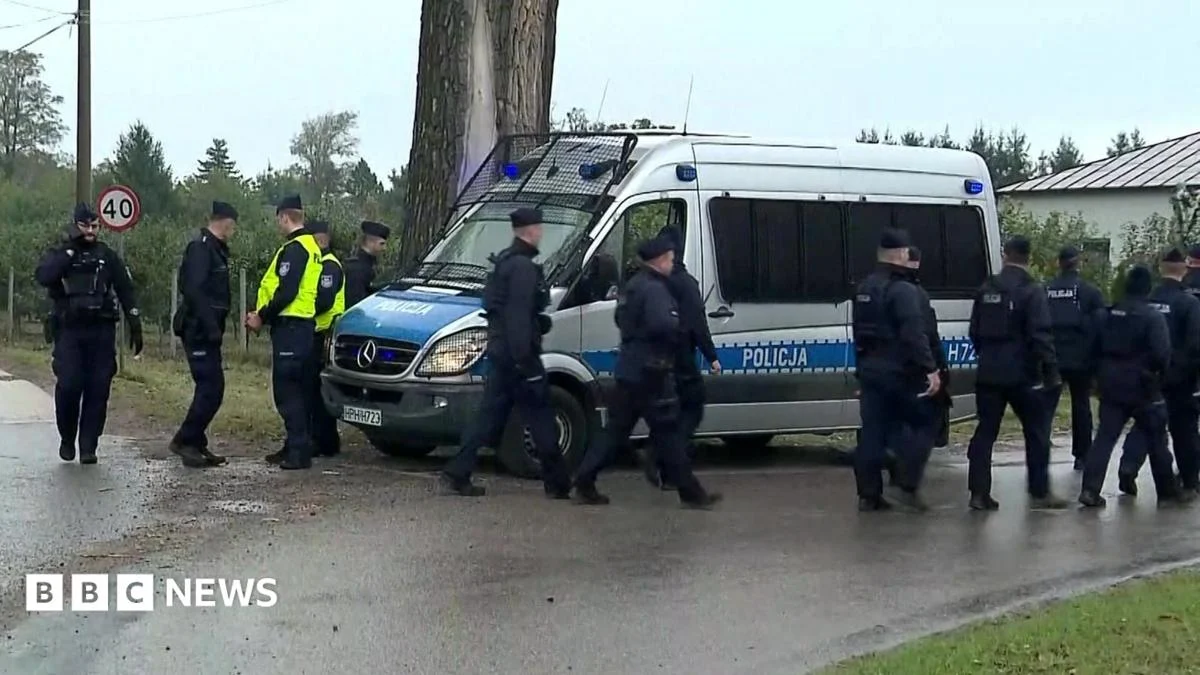
A fire at a Starlink satellite ground station in central Poland has been officially declared a deliberate "act of sabotage" by the Polish government, igniting fresh concerns about Russia’s escalating hybrid warfare tactics against countries supporting Ukraine. The incident, which occurred in the Masovian Voivodeship province, specifically targeted critical infrastructure essential for internet connectivity, including services vital for the Ukrainian military. This accusation comes as European intelligence agencies issue stark warnings about Russia’s intent to intensify non-military aggressions in the coming months.
The Sabotage Incident and its Strategic Implications
The blaze erupted on Wednesday night in Wola Krobowska, at a state-owned Polish satellite station that facilitates internet traffic through Poland to various countries, including Ukraine. This station utilizes SpaceX’s Starlink systems, providing crucial satellite-based connectivity. Polish Deputy Prime Minister Krzysztof Gawkowski unequivocally stated that the fire was "deliberately designed to disable the station… disrupting internet access for various institutions, including the Ukrainian army." Speaking to Polish public broadcaster TVP Info, Gawkowski indicated that while an investigation remains ongoing, "many indications suggest" that the attack aligns with what he described as a "new Russian doctrine of attack." Despite the severity of the incident, the station reportedly remains operational, a testament to its resilience or rapid response efforts.
The strategic importance of Starlink to Ukraine’s defense and civil infrastructure cannot be overstated. Since the full-scale invasion in February 2022, Starlink terminals, provided by Elon Musk’s SpaceX, have played a pivotal role in maintaining communication for the Ukrainian military, government, and civilians, particularly in areas where traditional internet infrastructure has been destroyed or is unreliable due to conflict. Disrupting this network, even temporarily, could severely hamper Ukraine’s command and control capabilities, intelligence gathering, and public information dissemination, making the Polish station a high-value target for any adversary seeking to undermine Ukrainian resistance.
Polish Prime Minister Donald Tusk, while addressing the incident during a news conference with Bulgaria’s leader, acknowledged the gravity of the situation, stating he disliked "labelling something as sabotage versus an accident without 100% certainty, but it looks bad." Tusk’s cautious approach underscores the inherent difficulty in definitively attributing such "grey zone" attacks, even when circumstantial evidence points strongly in a particular direction. The Kremlin, for its part, has yet to issue any comment on the alleged sabotage.
The Expanding Shadow of Hybrid Warfare
The incident in Poland is not an isolated event but rather fits into a broader pattern of escalating hybrid warfare activities attributed to Russia across Europe. Hybrid warfare, or hybrid attacks, are loosely defined terms encompassing non-military methods designed to exert pressure, destabilize adversaries, and achieve strategic objectives without direct armed conflict. These tactics often include cyberattacks, disinformation campaigns, economic coercion, and physical sabotage, frequently carried out by proxies to maintain plausible deniability.
Just as the alleged sabotage in Poland came to light, Denmark’s intelligence service issued a new threat assessment, warning that it expects Russia to escalate hybrid warfare in the coming months. While the assessment maintained that a direct military attack by Russia against NATO countries remained "highly unlikely," it cautioned against "a low but growing risk" that Russia could launch limited military actions to test the alliance’s resolve. This assessment echoes concerns raised by several other European NATO members in recent weeks, who have voiced apprehension that Russia might be preparing various attacks to probe their commitment to supporting Ukraine.
Recent examples underscore these anxieties:
- Germany: Earlier this month, Berlin explicitly blamed Russia for an attempted drone attack on Leipzig/Halle Airport, a significant logistics hub. Such an attack, even if unsuccessful, highlights Russia’s willingness to target critical civilian infrastructure beyond Ukraine’s borders.
- France: In response to perceived threats, France has ordered a comprehensive plan to protect its critical infrastructure and defense industry sites, indicating a proactive stance against potential sabotage or cyber threats.
- Poland’s Airspace Violation: Only days before the Starlink station fire, Poland reported that a Russian military helicopter briefly violated its airspace, forcing the scrambling of fighter jets. This incident, while seemingly minor, represents a provocative act that tests NATO’s air defenses and vigilance.
These incidents collectively paint a picture of an increasingly volatile security landscape in Europe, where the lines between peace and conflict are blurred by continuous, low-intensity aggressions. Russia consistently denies involvement in such incidents, despite a growing body of evidence and expert analysis pointing to its responsibility.
Understanding the "New Russian Doctrine of Attack"
Deputy Prime Minister Gawkowski’s reference to a "new Russian doctrine of attack" suggests a perceived evolution in Moscow’s strategy, moving beyond traditional military confrontation into a more pervasive, covert form of warfare. This doctrine likely involves:
- Targeting Critical Infrastructure: Disrupting energy grids, communication networks, transportation hubs, and financial systems to cause economic damage, societal chaos, and undermine public trust in governments.
- Exploiting Digital Vulnerabilities: Employing sophisticated cyberattacks to steal sensitive information, spread propaganda, and disable essential services.
- Utilizing Proxies and Covert Operations: Employing non-state actors, criminal groups, or special operations forces for deniable sabotage and influence operations.
- Information Warfare: Spreading disinformation and propaganda to sow discord, weaken resolve, and influence public opinion both within adversary nations and internationally.
The objective of such a doctrine would be to degrade an adversary’s capabilities, create internal divisions, and deter support for Ukraine, all while staying below the threshold that would provoke a direct military response under NATO’s Article 5 collective defense clause. This approach presents a significant challenge for NATO, as attributing these attacks definitively and formulating a proportionate response is often complex and time-consuming.
The Unfolding War in Ukraine and Russian Rhetoric
The alleged sabotage in Poland occurs against the backdrop of an ongoing and brutal full-scale invasion of Ukraine, launched by Russian President Vladimir Putin in February 2022. Moscow currently controls approximately 20% of Ukrainian territory, including the Crimea peninsula, which was illegally annexed in 2014.
Recent days have seen a fresh wave of intense Russian attacks across Ukraine. Overnight into Thursday, Kharkiv and Kyiv experienced some of the worst assaults. In the Kharkiv region, six people were killed and twelve others injured in a Russian strike on a farm in the village of Stara Hnylytsia. Ukrainian state emergency services reported that the victims were agricultural workers sorting vegetables, with four identified as women.
Ukrainian forces are facing increasingly sophisticated Russian aerial attacks. Moscow’s deployment of new jet-powered drones has made strikes more devastating and harder to intercept. Kyiv is in a desperate race to develop low-cost weapons systems capable of countering these advanced drones, as its existing arsenal of missiles and fighter jets is often too expensive for such widespread defensive use.
At the UN General Assembly in New York on Wednesday, Ukrainian President Volodymyr Zelensky reiterated his urgent plea for international assistance, specifically calling on the US to provide "ballistic interceptors to protect lives." Zelensky stressed the imperative of stopping Putin from continuing the war and "spreading this evil further," asserting that "Putin is always looking for someone who can help him kill more, kill more people for every kilometre of land." He also outlined Ukraine’s strategy to target the Russian energy sector over the upcoming winter, a tactic aimed at weakening Moscow’s war machine.
Meanwhile, Russian diplomatic maneuvers continue. Reuters reported, citing two sources, that Russian presidential envoy Kirill Dmitriev recently traveled to the US to meet with Trump administration officials, including Steve Witkoff and Jared Kushner. Concurrently, Russian Foreign Minister Sergei Lavrov, speaking at the UN Security Council on Wednesday, declared there would be "no pause" in the war. Lavrov has consistently dismissed Western warnings of potential Russian aggression against NATO, stating earlier this month, "If Europe attacks Russia, it will be a completely different war [from that in Ukraine], and it will be very short." These statements underscore Russia’s confrontational stance and its consistent denial of any offensive intentions towards NATO member states, despite their mounting concerns.
Timeline of Key Events
- 2014: Russia illegally annexes Crimea from Ukraine, initiating a prolonged conflict in eastern Ukraine.
- February 2022: Russia launches a full-scale invasion of Ukraine, marking a significant escalation of the conflict.
- Recent Weeks/Months: Multiple European NATO members express heightened concerns about Russian hybrid attacks and potential provocations. Germany blames Russia for an attempted drone attack on Leipzig/Halle Airport. France orders a plan to protect critical infrastructure.
- Earlier This Month: A Russian military helicopter briefly violates Polish airspace, leading to the scrambling of Polish fighter jets.
- Wednesday Night (Local Time): A fire breaks out at the Starlink satellite ground station in Wola Krobowska, central Poland.
- Thursday Morning (Local Time): Polish Deputy Prime Minister Krzysztof Gawkowski declares the fire an "act of sabotage," attributing it to a "new Russian doctrine of attack."
- Wednesday/Thursday: Intensified Russian aerial attacks hit Kharkiv and Kyiv in Ukraine, causing casualties and destruction. Ukrainian President Volodymyr Zelensky addresses the UN General Assembly, appealing for ballistic interceptors and vowing to target Russia’s energy sector. Russian Foreign Minister Sergei Lavrov states at the UN Security Council that there will be "no pause" in the war.
Broader Implications and the Path Forward
The alleged sabotage of the Polish Starlink station, coupled with a surge in hybrid warfare warnings and incidents across Europe, signals a dangerous escalation of tensions between Russia and NATO. It highlights the evolving nature of modern conflict, where adversaries increasingly operate in a "grey zone" below the threshold of declared war, employing asymmetric tactics to achieve strategic objectives.
For NATO and its member states, the incident underscores the urgent need to enhance critical infrastructure protection, bolster cybersecurity defenses, and improve intelligence sharing and attribution capabilities for hybrid attacks. The challenge lies not only in defending against these diverse threats but also in formulating a robust and credible deterrence strategy that can effectively counter a shadowy adversary that consistently denies its involvement.
The incident is likely to reinforce the resolve of Western nations to continue their support for Ukraine, recognizing that the conflict extends beyond Ukraine’s borders and directly impacts European security. It also serves as a stark reminder that even as attention focuses on the conventional battlefield in Ukraine, the broader geopolitical contest is being waged on multiple fronts, including the digital realm and critical infrastructure networks, with profound implications for international stability. The coming months are expected to test the resilience and unity of the transatlantic alliance as it navigates this complex and increasingly perilous security environment.