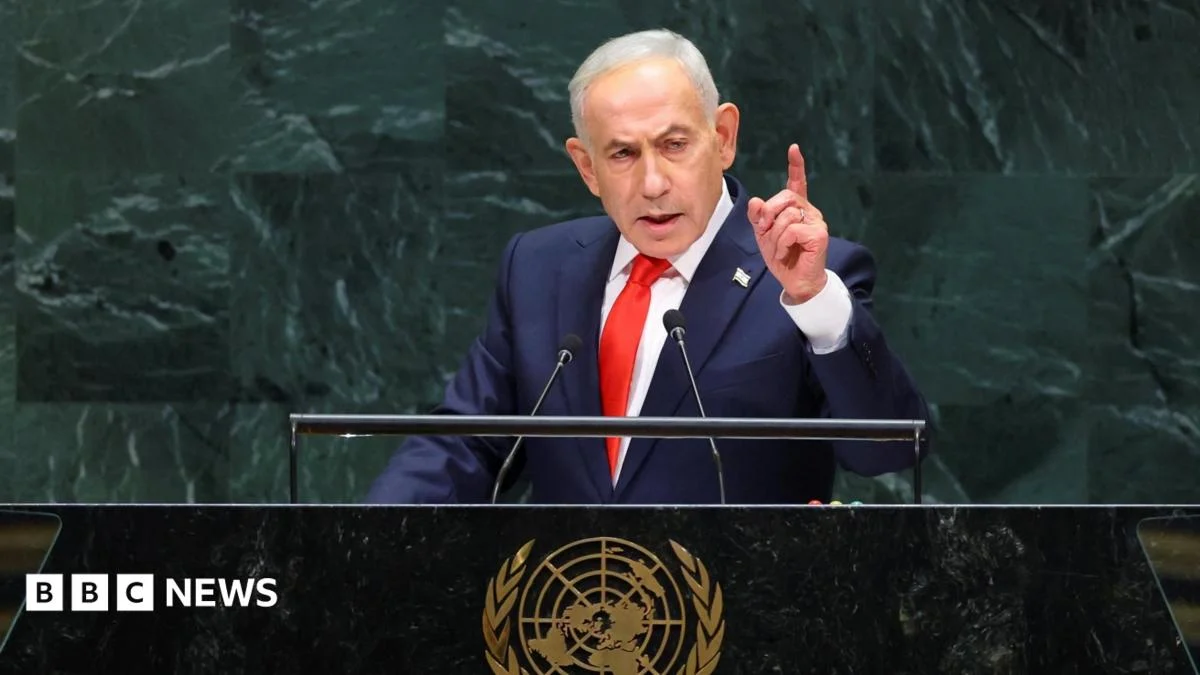
Israeli Prime Minister Benjamin Netanyahu delivered a robust and unyielding defense of his nation’s military campaigns in Iran, Gaza, and across the broader Middle East during a contentious address to the United Nations General Assembly. The speech was marked by an immediate and highly visible walkout of dozens of delegates, a clear sign of the deep international divisions and widespread condemnation surrounding Israel’s recent actions, particularly in the Gaza Strip. Unfazed by the protest, Netanyahu defiantly declared, "We’re going to win. We have no other choice," and provocatively challenged remaining delegates, stating, "If there are any other moral cowards who haven’t left the hall, please do so now." This confrontational posture underscored the high stakes of the ongoing conflict and Israel’s determination to pursue its security objectives despite global criticism.
The Israeli leader also vehemently rejected accusations that his country is committing genocide in Gaza, a charge that has gained significant traction on the international stage, culminating in a case brought against Israel at the International Court of Justice (ICJ). His address came hours after Palestinian President Mahmoud Abbas, speaking via a pre-recorded message to the same assembly due to a denied US entry visa, presented a starkly contrasting narrative. Abbas warned that Israeli policies, particularly the persistent and illegal expansion of Jewish settlements in the occupied West Bank, threatened "the very life and existence of the Palestinian people on their homeland." He further asserted that these actions jeopardized the internationally backed two-state solution, a foundational framework for peace between Israelis and Palestinians. Abbas accused the Israeli military of subjecting Palestinians in Gaza to "killing, destruction, starvation and attempts at displacement, as well as a genocidal war."
A Climate of Confrontation: Netanyahu’s Defiant Stance
Netanyahu’s appearance at the UN General Assembly was set against a backdrop of escalating tensions, both militarily and diplomatically. The Israeli Prime Minister, who himself is subject to an International Criminal Court (ICC) arrest warrant for alleged war crimes, utilized his platform to launch scathing attacks on nations and leaders who have voiced criticism of Israel. His rhetoric aimed to not only defend Israel’s actions but also to delegitimize its critics.
Addressing the long-standing accusations of colonialism leveled against Israel, Netanyahu retorted, "They accuse Israel, tiny Israel, of colonialism – some colonialism. And who’s accusing us? Among them are people in Britain and in France. For God’s sake, they invented the term." This pointed remark sought to highlight what he perceives as hypocrisy from former colonial powers, aiming to shift the historical and moral blame. The accusation of colonialism against Israel is a deeply contested issue, with critics pointing to the displacement of Palestinians and the establishment of settlements on occupied land as classic colonial practices, while Israel maintains its right to exist in its ancestral homeland and defends its actions as necessary for security.
Further exemplifying his combative approach, Netanyahu singled out Turkish President Recep Tayyip Erdogan, labeling him a "tyrant" and accusing him of supporting the Palestinian armed group Hamas. This direct personal attack underscored the deteriorating relations between Israel and Turkey, once key regional allies. Erdogan had, just days prior, used his own address to the UN to assert that the injustices faced by those in Gaza and the West Bank "deeply offends the conscience of humanity," reflecting widespread sentiment in the Muslim world and among many developing nations. The exchange highlighted a broader ideological clash regarding the Israeli-Palestinian conflict and the role of regional powers.
Even New York City’s left-wing mayor, Zohran Mamdani, who had previously vowed to arrest Netanyahu upon his arrival—though later conceding he lacked the authority—did not escape the Prime Minister’s censure. Netanyahu accused Mamdani of fostering an unsafe environment for Jewish residents in New York, stating, "Since you were elected mayor of this city, many Jews no longer feel safe in New York." Mamdani’s office swiftly responded, issuing a statement that accused Netanyahu of using his speech "to repeat baseless lies meant to sanitize his genocide of Palestinians," thereby escalating the local political dimension of the international visit. This interaction underscored the global nature of the debate, spilling over into local politics and highlighting the profound emotional and political divides.
The Palestinian Narrative: A Cry for Existence
In stark contrast to Netanyahu’s defiant stance, Palestinian President Mahmoud Abbas’s pre-recorded message offered a poignant and urgent appeal for international intervention to protect Palestinian lives and their fundamental right to self-determination. His inability to attend the General Assembly in person due to a denied US entry visa added another layer of symbolic protest and frustration, emphasizing the obstacles faced by Palestinian leadership on the global stage.
Abbas’s address focused heavily on the dire situation in the Gaza Strip, where the ongoing military operations have led to unprecedented levels of destruction, casualties, and displacement. He detailed accusations of "killing, destruction, starvation and attempts at displacement," culminating in the charge of a "genocidal war" being waged by the Israeli military. These accusations echo concerns raised by numerous international bodies, human rights organizations, and a significant portion of the international community. Reports from the UN Office for the Coordination of Humanitarian Affairs (OCHA) and the World Health Organization (WHO) have consistently highlighted the catastrophic humanitarian crisis in Gaza, including widespread food insecurity, a collapsing healthcare system, and the displacement of over 85% of the population.
Beyond Gaza, Abbas reiterated the Palestinian leadership’s long-standing concerns regarding the illegal expansion of Jewish settlements in the occupied West Bank. These settlements, considered illegal under international law by the United Nations and most countries, are seen by Palestinians as a deliberate strategy to fragment their territory, undermine the viability of a future Palestinian state, and solidify Israeli control. The continued growth of these settlements, often accompanied by settler violence and restrictions on Palestinian movement and development, poses a direct threat to the two-state solution, which envisions an independent Palestinian state alongside Israel. Abbas’s remarks underscored the Palestinian view that these policies are an existential threat to their presence on their historical homeland.
Chronology and Context: A Deepening Crisis
The speeches delivered at the UN General Assembly represent a critical juncture in a conflict with deep historical roots and a rapidly unfolding contemporary crisis.
- Pre-existing Tensions (Decades): The Israeli-Palestinian conflict has been ongoing for over 75 years, marked by wars, occupation, and failed peace attempts. The issue of West Bank settlements has been a consistent point of contention since 1967.
- Recent Escalation in Gaza (Months): The current large-scale military operation in Gaza began in response to a major attack by Hamas. This operation has led to a humanitarian catastrophe, drawing widespread international condemnation and calls for a ceasefire.
- International Legal Challenges (Recent Months): The accusation of genocide against Israel, brought by South Africa to the International Court of Justice (ICJ), represents a significant legal and diplomatic challenge. The International Criminal Court (ICC) also has an ongoing investigation into alleged war crimes in Palestinian territories, leading to the issuance of arrest warrants, including one against Prime Minister Netanyahu. These legal actions underscore the severity of the accusations and the international community’s struggle to address accountability.
- UN General Assembly (Annual Event): The UNGA serves as a primary forum for world leaders to address global issues. Netanyahu and Abbas’s speeches are part of this annual diplomatic calendar, though their content this year reflects an unprecedented level of urgency and acrimony. Abbas’s denied visa adds to a history of diplomatic friction.
- US-Israel Joint Operations (February): Netanyahu’s mention of joint US-Israel airstrikes against Tehran in February refers to actions taken in response to regional threats, specifically Iran’s nuclear program and its support for various proxy groups. This highlights the broader regional dimension of Israel’s security concerns and its strategic alliance with the United States.
Broader Implications and International Scrutiny
Netanyahu’s speech, characterized by its confrontational tone and unyielding defense, carries significant implications for international diplomacy, the future of the Israeli-Palestinian peace process, and Israel’s global standing. His rejection of genocide accusations comes at a time when the ICJ is actively considering the case, making his statements particularly impactful on the global legal stage. The ICJ’s preliminary rulings have already called on Israel to take measures to prevent genocidal acts, intensifying international scrutiny.
His attacks on Turkey’s President Erdogan further complicate regional dynamics. Turkey, a significant Muslim-majority nation, has historically played a mediating role in the region but has become increasingly critical of Israeli policies under Erdogan’s leadership. This public spat indicates a widening rift that could hinder future diplomatic efforts in the Middle East.
The praise for former US President Donald Trump and the reference to joint US-Israel actions against Iran also signal a particular alignment in international policy. Netanyahu thanked Trump for his "bold leadership," specifically referencing the joint air strikes against Tehran, declaring, "Israel and America acted together not only to protect ourselves, but to save civilisation." This statement underscores the strong strategic partnership between Israel and the US, particularly during the Trump administration, and highlights a shared perception of threats from Iran. It also implicitly contrasts with the current Biden administration’s approach, which, while supportive of Israel, has also expressed concerns over the humanitarian situation in Gaza and the need for a two-state solution.
The protests in New York City, which saw the detention of prominent figures like Oscar-winning actress Susan Sarandon and Emmy-winning actress Hannah Einbinder, underscore the depth of public opposition to Netanyahu’s policies and visit. These celebrity endorsements amplify the protest movement, bringing broader media attention to the demonstrations and reflecting a growing grassroots anti-war and pro-Palestinian sentiment in the West. Such protests, occurring outside the very halls of international diplomacy, serve as a potent reminder that global leaders are accountable not only to their peers but also to an increasingly vocal and engaged global citizenry.
Ultimately, the UN General Assembly speeches by Netanyahu and Abbas served as a powerful illustration of an intractable conflict, marked by profound disagreement over history, rights, and the very definition of justice. While Netanyahu projected an image of defiant resolve, Abbas articulated a desperate plea for recognition and protection. The international community remains deeply divided, caught between the imperative for humanitarian aid, the calls for accountability under international law, and the elusive pursuit of a lasting peace. The events at the UNGA underscore that the path forward remains fraught with diplomatic challenges, legal complexities, and immense human suffering.