The recent high-stakes summit between then-US President Donald Trump and Chinese President Xi Jinping concluded with expressions of profound cordiality and mutual respect, despite the underlying complexities of the world’s most critical bilateral relationship. The gathering, marked by a lavish dinner gala attended by an unprecedented array of American corporate titans, cabinet officials, and diplomatic figures, underscored the dual nature of US-China relations: intense economic interdependence coupled with persistent strategic competition. Both leaders emphasized the importance of fostering a "constructive" and "stable" relationship, even as their individual remarks offered characteristic insights into their diplomatic styles and priorities.
A Grand Diplomatic Overture
The summit, hosted by President Trump, was more than just a formal meeting; it was a meticulously orchestrated display of diplomatic pomp and personal rapport. President Trump extended a warm welcome to President Xi, acknowledging the considerable journey undertaken by the Chinese delegation. His remarks were notably effusive, declaring, "We’ve never gotten along better," a sentiment that aimed to project an image of robust personal chemistry at the apex of US-China leadership. This emphasis on personal connection, a hallmark of Trump’s diplomatic approach, sought to bypass traditional bureaucratic channels and foster direct engagement with foreign counterparts. The perceived strength of the relationship between the two leaders, as articulated by Trump, was presented as a foundation for navigating the multifaceted challenges and opportunities facing the two global powers.
The atmosphere of bonhomie was evident throughout the proceedings, from the initial greetings to the concluding remarks. Such emphasis on personal warmth is often employed in high-level diplomacy to set a positive tone, particularly when substantive discussions on contentious issues are anticipated or are ongoing behind the scenes. For Trump, the personal relationship was often touted as a primary driver of diplomatic progress, distinguishing his approach from more conventional, institution-led foreign policy strategies.
President Trump’s Cordial Welcome and Unscripted Moments
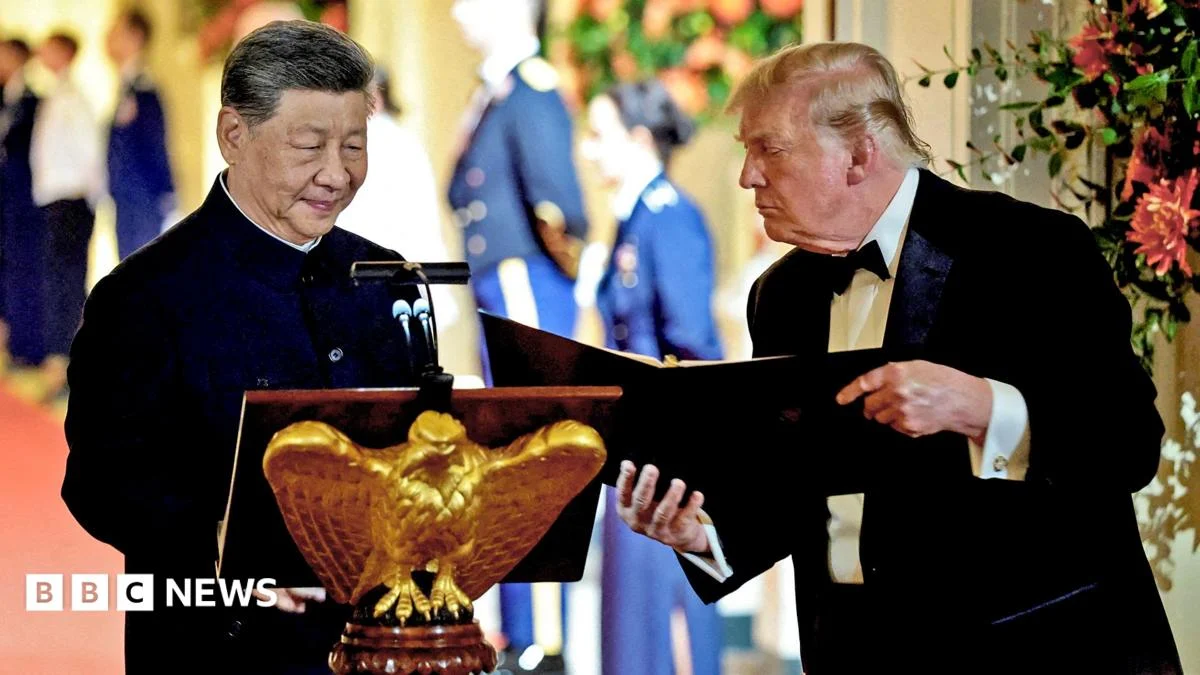
President Trump’s address was a blend of diplomatic protocol and characteristic spontaneity. While he lauded the enduring history of US-China relations, a staple of state visit rhetoric, he notably veered off-script to discuss a personal project: an ongoing ballroom renovation. In an unscripted moment that captured the unique flavor of his presidency, Trump offered President Xi and his wife, Peng Liyuan, the "special treat" of being the first to enter the newly renovated ballroom, even though it was still a year away from completion. He humorously invited them to "walk into a construction site that’s nice and clean and sparkling," adding, "it’s our honour to have you do so." This lighthearted, albeit unconventional, interjection provided a glimpse into Trump’s personality, often blending the personal with the political in his public engagements. While such a deviation might raise eyebrows in traditional diplomatic circles, it also served to humanize the often-rigid proceedings and underscore the host’s personal engagement.
Beyond the architectural aside, Trump presented President Xi with a sculpture of a bald eagle, the revered national symbol of the United States. He explained the gift’s significance, stating it embodied "the free and soaring spirit of America." The gesture was imbued with symbolic weight, representing core American values and aspirations. "We hope it will find a nice, wonderful place in Beijing. It’s your honour," Trump added, emphasizing the respect and significance attached to the gift. He further disclosed that he and then-First Lady Melania Trump had personally participated in the design of the sculpture, adding another layer of personal touch to the diplomatic exchange. Such reciprocal gift-giving is a long-standing tradition in state visits, serving as a tangible representation of goodwill and cultural exchange, often carefully chosen to convey specific messages or honor the recipient’s culture while showcasing the donor’s.
President Xi’s Vision for Bilateral Ties
President Xi Jinping’s response mirrored Trump’s in its emphasis on mutual respect and positive sentiment, albeit delivered with a more measured and formal tone. He expressed profound gratitude to his American hosts for the "meticulous care and consideration" extended to him and his wife, noting that it made them "feel truly at home." This acknowledgment of hospitality is a crucial element in Chinese diplomatic etiquette, signifying appreciation and setting a positive foundation for discussions.
Xi articulated a forward-looking vision for the bilateral relationship, asserting that the two leaders were "making history in our bilateral engagements." This phrase underscored the perceived significance of their meeting, framing it as a pivotal moment in the trajectory of US-China relations. A key outcome highlighted by Xi was the agreement "to build a constructive China-US relationship of strategic stability." This commitment to strategic stability is a significant diplomatic objective, particularly given the inherent complexities and potential for friction between two global powers with diverging interests and political systems. It implies a mutual understanding of the need to manage competition responsibly, avoid escalation, and maintain open channels of communication on critical issues. Xi further elaborated that their discussions involved "sincere and in-depth exchanges" that would undoubtedly strengthen relations between the two countries, suggesting that substantive dialogue, beyond the public pleasantries, had indeed taken place.
A Historical Tapestry of Engagement
Like Trump, Xi’s remarks were rich with flattery and focused on the deep cultural and historical ties between the United States and China. He meticulously invoked shared historical milestones, painting a narrative of enduring connection despite periods of estrangement. Xi reminded attendees that the relationship between the two countries was "forged in blood and fire" during their joint fight against Japan in the Second World War. This historical reference, often cited in Chinese diplomacy, harks back to a period of pragmatic alliance and shared sacrifice, predating the ideological divides of the Cold War. The United States provided crucial aid to China in its resistance against Japanese aggression, fostering a sense of solidarity that, for a time, transcended political differences.
Following this wartime alliance, Xi referenced the "ping-pong" diplomacy of the Nixon administration, a pivotal moment in the thawing of US-China relations in the early 1970s. This series of reciprocal visits by table tennis players in 1971 paved the way for President Richard Nixon’s historic visit to Beijing in 1972, fundamentally altering the geopolitical landscape and initiating the process of normalization between the two nations after more than two decades of estrangement. These historical touchstones, carefully selected by Xi, served to underscore a narrative of resilience and the capacity for the two nations to overcome differences and find common ground.
Towards the conclusion of his speech, Xi articulated a vision where the goals of the US and China could be "mutually reinforcing." This concept suggests a potential for synergy rather than zero-sum competition, implying that the prosperity and security of one nation need not come at the expense of the other. He urged both sides to explore a "new approach for major countries to get along," a recurring theme in Chinese foreign policy that seeks to define a model of great power relations characterized by cooperation and the avoidance of conflict, contrasting with historical patterns of rivalry and confrontation. This call for a "new approach" reflects China’s ambition to establish its place as a peer global power while seeking to manage the inherent tensions with the existing hegemon.
The Power Brokers’ Gala: Tech, Finance, and Diplomacy Converge
The evening’s dinner gala was a spectacle of power and influence, bringing together an extraordinary collection of American leadership across government, technology, and industry. The BBC’s observations from inside the dining hall painted a vivid picture of the atmosphere. SpaceX CEO Elon Musk, a figure known for his entrepreneurial vision and often unconventional public persona, was seen regaling guests at a table, his storytelling apparently so entertaining that two others were "barreled over with laughter." This anecdotal detail highlights the informal networking and social dynamics at play, even amidst the gravity of a state dinner.
In stark contrast, Defense Secretary Pete Hegseth (likely a reference to a former official or a misidentification, as James Mattis was Secretary of Defense at the time) was observed at another table, sporting a "serious look on his face," accompanied by his wife, Jared Kushner, and then-White House chief of staff Monica Crowley (likely a misidentification, as John Kelly or Reince Priebus held the role). This juxtaposition of jovial interaction and earnest contemplation underscored the diverse range of interests and concerns present in the room, from the cutting edge of tech innovation to the weighty matters of national security and foreign policy.
The guest list itself was a powerful statement on the multifarious dimensions of US-China relations. The White House had extended invitations to scores of US officials, reflecting the whole-of-government approach to diplomatic engagement. Alongside them were prominent conservative broadcasters, indicating an effort to shape public perception and rally support for the administration’s foreign policy initiatives. Crucially, the attendance of numerous tech industry bosses, social media CEOs, and other corporate executives signaled the profound economic stakes involved in the US-China relationship.
A Curated Guest List: Corporate Titans and Cabinet Members
Attendees included key members of President Trump’s cabinet, ensuring representation from various government departments that interface with China on trade, security, and economic policy. Family members, such as Ivanka Trump, Eric Trump, and Tiffany Trump, also graced the event, highlighting the blend of official and personal diplomacy that characterized the Trump administration.
However, the most striking feature of the guest list was the overwhelming presence of leaders from the American technology sector, underscoring the critical role of innovation, digital economy, and intellectual property in bilateral discussions. Luminaries included Apple’s Tim Cook, OpenAI’s Sam Altman, Google’s Sundar Pichai, Amazon’s Jeff Bezos, and Nvidia’s Jensen Huang. The seating arrangement itself was telling: both Tim Cook and Jensen Huang were seated at the same table as President Trump and President Xi, indicating their perceived importance in the dialogue. Elon Musk, who had previously served in an advisory capacity within the Trump administration, leading efforts to streamline government, also held a prime seat at the presidential table, reflecting his dual influence in technology and government affairs, particularly given Tesla’s significant investments and market presence in China.
The presence of these tech giants carried significant implications. Apple, under Tim Cook, has a massive manufacturing footprint and consumer market in China, making the stability of US-China relations vital to its global supply chain and revenue. Google, though largely absent from mainland China’s consumer internet, remains a global technology leader whose innovations are watched closely. Amazon’s Jeff Bezos represents the e-commerce and cloud computing sectors, areas with immense potential for growth and competition in China. Nvidia’s Jensen Huang leads a company at the forefront of AI chip development, a sector increasingly central to US-China technological rivalry and export controls. OpenAI’s Sam Altman, representing the cutting edge of generative AI, highlights the strategic importance of artificial intelligence in future economic and military competition.
Beyond tech, leaders from other major corporations were also in attendance, including General Motors, Visa, Paramount Skydance, and ExxonMobil, among others. This diverse corporate representation underscored the breadth of American economic interests in China, spanning manufacturing, financial services, entertainment, and energy. Social media mogul Mark Zuckerberg, CEO of Meta (then Facebook), also attended, despite Facebook’s services being blocked in mainland China, signaling the broader interest in global digital policy. Jeff Yass, the American billionaire with a significant stake in TikTok’s parent company, ByteDance, was another notable presence, given the ongoing geopolitical scrutiny surrounding the popular social media platform.
Ahead of the event, President Trump confidently stated, "Everybody wanted to be there. I would say you have the entire tech world, the entire banking world, and a lot more." This assertion, while perhaps an exaggeration, captured the immense draw of a state dinner with the Chinese President, particularly for American businesses navigating the complexities of the Chinese market and the broader geopolitical landscape.
The Conspicuous Absence of Anthropic
Amidst the glittering array of technology leaders, one notable absence stood out: Anthropic, one of the world’s largest and most valuable artificial intelligence firms. The BBC’s inquiry into whether Anthropic was invited or chose not to attend highlights a potential underlying tension or strategic positioning within the US tech community regarding engagement with China. Anthropic, a competitor to OpenAI, operates at the forefront of AI research and development, an area of intense strategic competition between the US and China. Its absence could signal a deliberate choice to maintain a distance, perhaps due to concerns over intellectual property, national security implications, or alignment with a more cautious approach to US-China tech collaboration. Alternatively, it could simply reflect a selective invitation process or a logistical oversight. Regardless of the reason, its absence provided a subtle counterpoint to the dominant narrative of broad tech engagement.
Implications for a Complex Relationship
The summit, characterized by lavish hospitality and mutual praise, served as a crucial platform for maintaining high-level dialogue between the United States and China. The leaders’ emphasis on a "constructive relationship of strategic stability" suggests a shared recognition of the need to manage their profound differences without resorting to open conflict. This is particularly vital given the multitude of contentious issues, including trade imbalances, intellectual property theft, human rights, geopolitical competition in the South China Sea, and the status of Taiwan.
The overwhelming presence of American business and tech leaders at the gala underscored the deep economic entanglement between the two nations. Despite growing calls for decoupling or de-risking, particularly in critical sectors, the reality is that American corporations have significant investments, supply chains, and market interests in China. Their attendance signals a desire to influence policy, protect their interests, and perhaps explore avenues for continued engagement amidst a challenging geopolitical climate. The discussions at such events, even informal ones, can offer insights into the administration’s thinking and provide opportunities for corporate leaders to convey their perspectives directly to decision-makers.
President Trump’s unique blend of personal diplomacy and unscripted moments, alongside President Xi’s emphasis on historical ties and a "new approach" for major powers, reflected their respective leadership styles. While the public statements focused heavily on flattery and shared aspirations, the underlying agenda would undoubtedly have touched upon more sensitive subjects. The summit, therefore, represented a delicate balancing act: projecting an image of cooperation and stability while navigating a complex web of competition and disagreement.
Looking Ahead: Navigating Strategic Stability
The commitment to "strategic stability" articulated by President Xi is a diplomatic term of art, implying a framework for managing competition without allowing it to spiral into confrontation. It suggests an understanding that while the US and China will inevitably compete, they also share common interests in global stability, climate action, and preventing proliferation. The path forward for US-China relations remains fraught with challenges, yet this summit demonstrated a willingness, at least publicly, to engage in dialogue and seek common ground.
The future trajectory will depend on whether the personal rapport and expressions of goodwill can translate into concrete progress on substantive issues. The tech industry, in particular, will remain a critical battleground and a crucial bridge. As the world’s two largest economies and technological powers, the nature of their relationship will profoundly shape global politics, economics, and security for decades to come. This summit, with its blend of diplomatic ceremony, corporate networking, and personal touches, offered a snapshot of this enduringly complex and critically important dynamic.