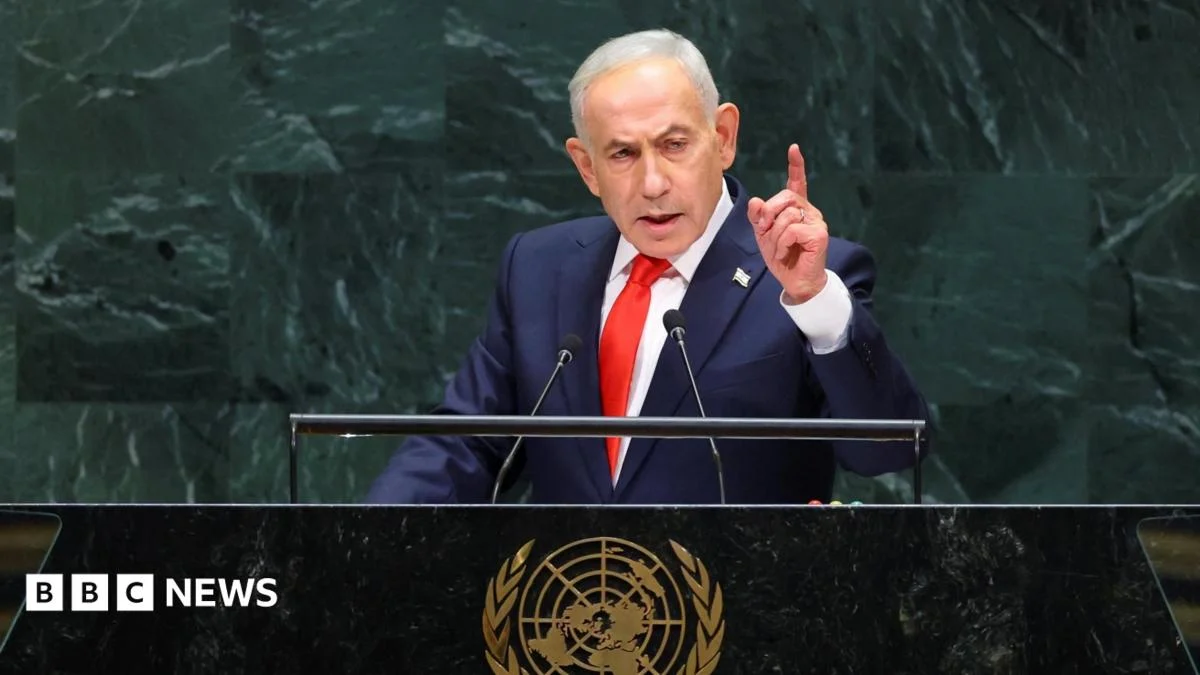
Israeli Prime Minister Benjamin Netanyahu delivered a highly charged and unyielding address to the United Nations General Assembly, vehemently defending his country’s military operations across the Middle East, including in Iran and Gaza. The speech was marked by an immediate and dramatic walkout by dozens of delegates as he ascended the podium, a protest Netanyahu defiantly acknowledged by vowing continued struggle: "We’re going to win. We have no other choice." He further challenged his critics, stating, "If there are any other moral cowards who haven’t left the hall, please do so now," a pre-scripted comment underscoring his combative stance.
Netanyahu’s address, delivered against a backdrop of intensifying international scrutiny and an International Criminal Court (ICC) arrest warrant for alleged war crimes, served as a potent counter-narrative to the widespread accusations of Israeli transgressions. He categorically rejected claims of genocide in Gaza, framing Israel’s actions as a necessary defense against existential threats. This defiant posture was not merely rhetorical; it reflected a strategic effort to solidify domestic support ahead of a critical election and to project an image of unwavering resolve to a global audience where Israel faces growing isolation.
A Tale of Two Speeches: Abbas’s Preceding Indictment
Hours before Netanyahu took the stage, the stark divergence in narratives was already evident. Palestinian President Mahmoud Abbas, addressing the annual gathering via a recorded message due to being denied a US entry visa, painted a harrowing picture of Palestinian suffering and accused Israel of policies threatening the very existence of his people. Abbas specifically highlighted the "illegal expansion of Jewish settlements in the occupied West Bank" as a primary threat, not only to Palestinian life and homeland but also to the internationally backed two-state solution—a foundational framework for peace between Israelis and Palestinians.
Abbas’s speech detailed a litany of grievances, asserting that Palestinians in Gaza were being subjected to "killing, destruction, starvation and attempts at displacement, as well as a genocidal war" by the Israeli military. These accusations align with reports from numerous human rights organizations and UN bodies, which have consistently documented the severe humanitarian crisis in Gaza, exacerbated by the ongoing conflict. The UN Office for the Coordination of Humanitarian Affairs (OCHA) has reported widespread displacement, critical shortages of food, water, and medical supplies, and an alarming number of civilian casualties, particularly among women and children. The denial of Abbas’s visa further amplified the sense of marginalization felt by Palestinians on the international stage, underscoring the diplomatic challenges facing the Palestinian Authority.
Defiance and Accusation: Netanyahu Confronts His Critics
Netanyahu used the prestigious UN platform not only to defend Israel but also to launch scathing attacks on nations and leaders who have criticized his government’s policies. He derided accusations of colonialism, particularly from European nations, stating, "They accuse Israel, tiny Israel, of colonialism – some colonialism. And who’s accusing us? Among them are people in Britain and in France. For God’s sake, they invented the term." This historical reframing sought to deflect criticism by highlighting the colonial histories of some of Israel’s accusers.
A significant portion of his address was dedicated to discrediting reports of violence perpetrated by Jewish settlers in the occupied West Bank. Netanyahu dismissed such incidents, claiming that "maybe two or three" people are killed a year in this context. However, this assertion stands in stark contrast to figures published by the United Nations, which paint a more grim reality. According to UN data, 23 Palestinians have been killed in incidents related to settler attacks this year alone, with the total rising to 72 since the beginning of 2023. These figures, regularly updated by OCHA, illustrate a persistent and escalating pattern of violence that contributes significantly to the instability in the West Bank and undermines prospects for peace. The expansion of settlements, deemed illegal under international law, and the associated violence are core grievances that fuel Palestinian despair and international condemnation.
Regional Confrontations and Diplomatic Repercussions
Netanyahu extended his criticisms to regional leaders, specifically labeling Turkish President Recep Tayyip Erdogan a "tyrant" and accusing him of supporting the Palestinian armed group Hamas. Erdogan, who had addressed the UN earlier, had stated that the injustices faced by those in Gaza and the West Bank "deeply offends the conscience of humanity," aligning with widespread sentiments in the Islamic world.
Netanyahu’s comments provoked a swift and sharp rebuke from the Turkish presidency. Burhanettin Duran, the communications director for the Turkish presidency, stated that the Israeli Prime Minister’s use of the UN General Assembly podium to level "baseless accusations" against Turkey and Erdogan was incompatible with the UN’s "ideals of peace, law and dialogue," according to state-run news agency Anadolu. This exchange highlighted the deteriorating diplomatic relations between Israel and Turkey, two historically significant regional powers whose relationship has often been strained by the Israeli-Palestinian conflict. The accusation of supporting Hamas is a particularly sensitive point, as Turkey maintains open channels with the group, viewing it as a legitimate political actor in the Palestinian landscape, a stance that deeply contrasts with Israel’s and many Western nations’ designation of Hamas as a terrorist organization.
Beyond regional leaders, Netanyahu also took aim at New York City’s left-wing mayor, Zohran Mamdani. Mamdani, who had previously vowed to arrest Netanyahu but later clarified he lacked the authority, was criticized by the Israeli leader who claimed, "Since you were elected mayor of this city, many Jews no longer feel safe in New York." Mamdani’s office responded swiftly, stating that Netanyahu "used his speech to repeat baseless lies meant to sanitize his genocide of Palestinians," reiterating the deep ideological chasm between the two figures and reflecting the intense domestic and international debate surrounding Israel’s actions.
Strategic Alliances and Geopolitical Maneuvering
In a gesture of strategic alliance, Netanyahu publicly thanked former US President Donald Trump for his "bold leadership," specifically referencing the joint air strikes launched by the US and Israel against Tehran in February. He declared, "Israel and America acted together not only to protect ourselves, but to save civilisation." This statement underscored the continued importance of the US-Israel strategic partnership, particularly in confronting perceived threats from Iran. The joint strikes were a significant escalation in the shadow war against Iran, targeting its nuclear facilities and proxy networks, and were framed by both nations as preemptive measures to curb Iran’s regional influence and nuclear ambitions.
The context of these strikes is critical. For years, Israel and the US have expressed deep concerns over Iran’s nuclear program, its development of ballistic missiles, and its support for various proxy groups across the Middle East, including Hezbollah in Lebanon, Houthi rebels in Yemen, and various militias in Iraq and Syria. The February strikes, while not fully detailed publicly, represented a clear demonstration of force and a warning to Tehran, aligning with a broader strategy of deterrence and containment. Netanyahu’s praise for Trump also highlighted the close relationship forged during the Trump presidency, a period characterized by strong US support for Israeli policies, including the recognition of Jerusalem as Israel’s capital and the Abraham Accords.
Domestic Political Stakes and International Isolation
Much of Netanyahu’s fiery speech was meticulously crafted to resonate with two crucial audiences: Israelis, as he faces a critical election next month, and Americans, amidst growing global isolation for Israel and fracturing support abroad. In Israel, Netanyahu’s once unassailable image as "Mr. Security" has come under unprecedented scrutiny following the devastating Hamas attacks of October 7, 2023. Reports in Israeli media, though firmly denied by Netanyahu, suggested he had disregarded warnings of a potential attack, leading some political opponents to question his fitness for office. His characteristic defiance at the UN podium will undoubtedly be a central feature of his election campaign, aiming to galvanize his religious-right wing coalition, which is currently trailing in the polls. The "moral cowards" remark, seemingly pre-scripted for the walkout, is a prime example of his strategy to burnish his image as the only Israeli politician capable of confronting the nation’s increasing number of global critics.
The speech also contained clear messages intended for American audiences, particularly his praise for Trump and the emphasis on joint US-Israeli actions against Iran. Netanyahu, who was born in Israel but spent his formative years in Pennsylvania, has long cultivated an image of having a unique ability to articulate Israel’s case in the US. However, despite continued substantial weapons supply from Washington, Israel faces an increasingly skeptical American public. Recent polls suggest a significant plummet in support for Israel among Democrats, and even a noticeable fracture in historically high levels of backing among Republicans, extending to Trump’s "Make America Great Again" (MAGA) base. This shifting sentiment poses a significant challenge for Israel’s long-term strategic relationship with its most important ally, potentially impacting future aid, diplomatic support, and the perception of Israeli policies within the US political landscape.
The UN General Assembly: A Global Stage for Competing Realities
The United Nations General Assembly, where all 193 member states have equal representation, serves as a unique global forum for heads of state to articulate their national interests, present their perspectives on international issues, and engage in diplomatic discourse. However, it also frequently becomes a battleground for competing narratives, particularly in long-standing conflicts like that between Israelis and Palestinians. The stark contrast between Netanyahu’s defiant defense and Abbas’s impassioned plea underscored the profound chasm in understanding and experience.
The context of international law, including the ICC arrest warrant for Netanyahu and the ongoing International Court of Justice (ICJ) proceedings concerning Israel’s actions in Gaza, loomed large over the proceedings. While the UN General Assembly does not have the enforcement powers of the Security Council, its resolutions and the collective statements of its members carry significant moral and diplomatic weight. The walkout during Netanyahu’s speech was a tangible manifestation of this growing international dissatisfaction, signaling a deepening crisis of legitimacy for Israel’s actions in the eyes of a substantial portion of the international community.
In conclusion, Benjamin Netanyahu’s address to the UN General Assembly was a defiant declaration of Israel’s resolve, a staunch defense of its military campaigns, and a combative rebuttal to its global critics. While strategically aimed at bolstering his political standing at home and reinforcing ties with key allies like the US, it simultaneously highlighted Israel’s increasing diplomatic isolation and the widening gap between Israeli and Palestinian narratives on the international stage. The speeches by Netanyahu and Abbas served as a stark reminder of the enduring complexities of the Israeli-Palestinian conflict, the profound human cost of ongoing hostilities, and the immense challenges that lie ahead in the pursuit of a lasting peace.