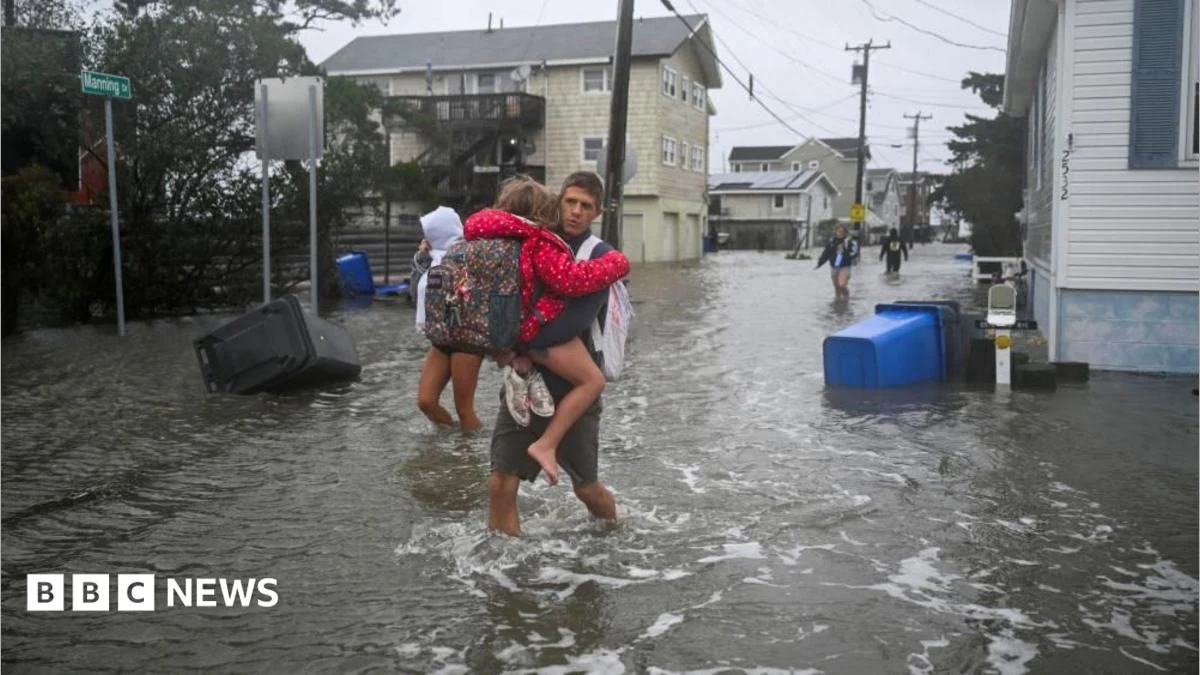
Tens of millions of residents across the northeastern United States found themselves in the grip of a formidable weekend storm, a potent nor’easter that unleashed a torrent of destructive forces, leading to extensive coastal flooding, widespread power cuts, significant travel chaos, and the cancellation of numerous high-profile stadium and cultural events. The severe weather event, which intensified throughout Saturday, prompted emergency declarations in multiple states and left a path of disruption stretching from Virginia to Maine, underscoring the region’s vulnerability to such powerful meteorological phenomena.
The Storm’s Fury: A Region Under Siege
The US National Weather Service (NWS) characterized the nor’easter’s impact on Saturday as bringing "dangerous coastal flooding and beach conditions, strong winds and heavy rainfall" to densely populated areas, including the major metropolitan hubs of New York City and Boston. This powerful extratropical cyclone formed off the East Coast, drawing moisture from the Atlantic and rapidly intensifying as it moved northward. Its counter-clockwise rotation, characteristic of nor’easters, funneled strong winds from the northeast towards the coastline, pushing vast amounts of ocean water inland.
Coastal communities, particularly those in New Jersey and New York, bore the brunt of the storm’s initial onslaught. The confluence of the storm’s intensity with a full moon, which amplified tidal ranges, exacerbated the coastal flooding. Reports from towns like Surf City and Manasquan in New Jersey depicted scenes of streets transformed into rivers, with floodwaters inundating homes and businesses. Residents were forced to navigate submerged roads, some resorting to kayaks and paddleboards to traverse their neighborhoods, as the storm surge overwhelmed seawalls and low-lying areas. The NWS issued stark warnings, urging immediate preparations for "significant inundation in low-lying areas near the shore, including roads underwater and impacts to homes and businesses."

Tragedy Strikes in Brooklyn
Amidst the widespread disruption, the storm claimed a life in Brooklyn, New York City, adding a somber note to the unfolding crisis. Leighton Brown, a 56-year-old employee of the New York City Housing Authority (NYCHA), was tragically killed by a falling tree while working an extra shift in an East Brooklyn neighborhood. Local news outlets reported that Mr. Brown, known for his warm personality and dedicated service, was on foot when the deadly incident occurred, highlighting the immediate and life-threatening dangers posed by the storm’s high winds.
The Office of the NYC Public Advocate expressed profound sorrow over the loss, stating on social media, "We mourn deeply for the loss of Leighton Brown, a NYCHA employee who faithfully served Brooklyn residents and who was known for his warm personality." This tragic event served as a stark reminder of the storm’s unpredictable and severe consequences, prompting renewed calls from officials for extreme caution during the severe weather.
Understanding the Nor’easter Phenomenon
Nor’easters are powerful low-pressure systems that form along the East Coast of North America, typically between September and April. They are characterized by strong winds blowing from the northeast, hence their name, which drive heavy precipitation and often significant coastal flooding. Unlike hurricanes, which are tropical cyclones drawing energy from warm ocean waters, nor’easters are extratropical storms fueled by temperature differences between cold arctic air and warmer ocean air masses. This particular nor’easter exhibited many classic characteristics, including:
- Rapid Intensification: The storm quickly developed and deepened as it moved up the coast.
- Coastal Flooding: Strong onshore winds, combined with the astronomical high tides of a full moon, led to significant storm surges. Tide gauges in some areas reported water levels several feet above normal, leading to inundation that hadn’t been seen in years.
- High Winds: Gusts reached up to 55 mph (86 km/h) in New York, and even higher in exposed coastal areas of Massachusetts, capable of felling trees, damaging property, and downing power lines.
- Heavy Rainfall: While not the primary feature in all areas, significant rainfall contributed to localized freshwater flooding, particularly in urban areas with overwhelmed drainage systems.
The storm’s path and intensity were closely monitored by meteorologists, with NWS models accurately predicting its severe impacts days in advance, allowing for the issuance of critical warnings and emergency preparations.

Widespread Disruptions: Travel and Events Grind to a Halt
The nor’easter’s reach extended far beyond coastal flooding and localized damage, causing cascading disruptions across the region’s infrastructure and public life. Air travel was severely impacted, with FlightAware reporting more than 2,400 flights delayed and an additional 1,199 grounded across the country on Saturday, primarily affecting major hubs in the Northeast like New York’s LaGuardia (LGA) and JFK, and Boston Logan (BOS). Passengers faced long waits, re-bookings, and missed connections, underscoring the economic ripple effect of such widespread travel interruptions.
Ground transportation also suffered. Authorities in states like New York and New Jersey issued advisories against non-essential travel, particularly in flood-prone areas. Roads were closed due to high water, downed trees, and debris, making driving hazardous. Public transportation systems experienced delays and cancellations, further complicating movement for commuters and residents.
Major sporting and cultural events, integral to the weekend’s social fabric, were also called off for safety reasons. In the Boston area, the beloved Red Sox were forced to move the final game of their series against the Chicago Cubs to Florida. A professional football match between Red Bull New York and St Louis City SC was cancelled, disappointing thousands of fans. Perhaps one of the most significant cancellations was the Global Citizen Festival concert in New York City’s iconic Central Park, an event that was set to feature headliners like Lauryn Hill, Wyclef Jean, and John Legend. Ed Sheeran’s highly anticipated concert at Gillette Stadium in the Boston area was also cancelled, with the venue citing safety concerns for attendees and staff due to the severe weather conditions. These cancellations not only affected entertainment but also had economic consequences for vendors, local businesses, and the broader tourism sector.
Official Response and Public Warnings
In response to the escalating crisis, states of emergency were swiftly declared in New York and New Jersey, granting authorities greater flexibility in deploying resources and coordinating relief efforts. These declarations enabled the activation of emergency operations centers, the mobilization of National Guard units if needed, and streamlined access to state and federal aid.

New York City Mayor Zohran Mamdani issued urgent pleas to residents via video messages and public advisories. He emphasized the dangers of the storm, specifically warning of wind gusts up to 55 mph (86 km/h) throughout the weekend, which posed a significant risk of downed trees and power lines. His message was clear and direct: "Don’t travel if you don’t have to. Do not drive or walk through floodwater." This advice aimed to minimize fatalities and injuries, recognizing that a significant number of storm-related deaths occur when individuals attempt to drive or walk through flooded areas.
Utility companies across the Northeast reported a surge in power outages. According to tracker PowerOutage, more than 160,000 households, almost exclusively in the northeastern US, lost electricity during the storm’s peak. Crews were deployed to address downed lines and damaged infrastructure, but persistent high winds and widespread flooding complicated restoration efforts, with many residents facing extended periods without power. States also activated their emergency management agencies, coordinating with local municipalities, first responders, and volunteer organizations to provide assistance, conduct rescues, and manage shelters for displaced residents.
The Aftermath and Road to Recovery
As the nor’easter gradually began to move offshore and weaken, the immediate focus shifted to damage assessment and recovery. While the most intense winds subsided, the lingering effects of the storm—especially coastal flooding and power outages—persisted into the following days. Utility crews worked tirelessly around the clock, often in challenging conditions, to restore electricity to the tens of thousands still without power. This effort involved clearing fallen trees, repairing damaged poles and lines, and navigating flooded roadways.
The long-term implications for affected coastal communities are substantial. Beyond the immediate inconvenience, the repeated battering by powerful storms contributes to significant beach erosion, threatening coastal properties and ecosystems. Infrastructure, including roads, boardwalks, and wastewater treatment facilities, often requires extensive repairs, incurring considerable costs for municipalities. Businesses that rely on tourism and coastal activities face economic setbacks, even after the storm has passed.

Environmental concerns also emerge in the aftermath, including potential pollution from overflowing sewage systems and debris washed ashore. Efforts to clean up beaches and coastal areas become a priority to protect wildlife and prepare for future storm seasons.
Historical Context and Future Outlook
The nor’easter served as a potent reminder of the region’s susceptibility to severe weather events. Historically, the Northeast has experienced numerous powerful nor’easters, some of which have caused even more widespread destruction. Comparing this event to past storms like the infamous "Blizzard of ’78" or more recent events like Superstorm Sandy (which, while a hurricane, transformed into an extratropical storm with nor’easter characteristics upon landfall) provides crucial context for preparedness and mitigation strategies. While this particular nor’easter did not reach the catastrophic scale of Sandy, its impacts were significant and widespread, affecting daily life for millions.
As climate change continues to influence global weather patterns, there is growing concern among scientists that the frequency and intensity of extreme weather events, including powerful coastal storms, could increase. Rising sea levels already make coastal communities more vulnerable to storm surge, meaning that even historically moderate storms can now cause more significant flooding. This necessitates ongoing investment in resilient infrastructure, updated coastal protection measures, and robust emergency preparedness plans to safeguard lives and property in the face of an evolving climate. The weekend’s nor’easter, while destructive, also serves as a critical test of these systems and a learning opportunity for future challenges.