Algol: The Blinking Demon Star of Perseus
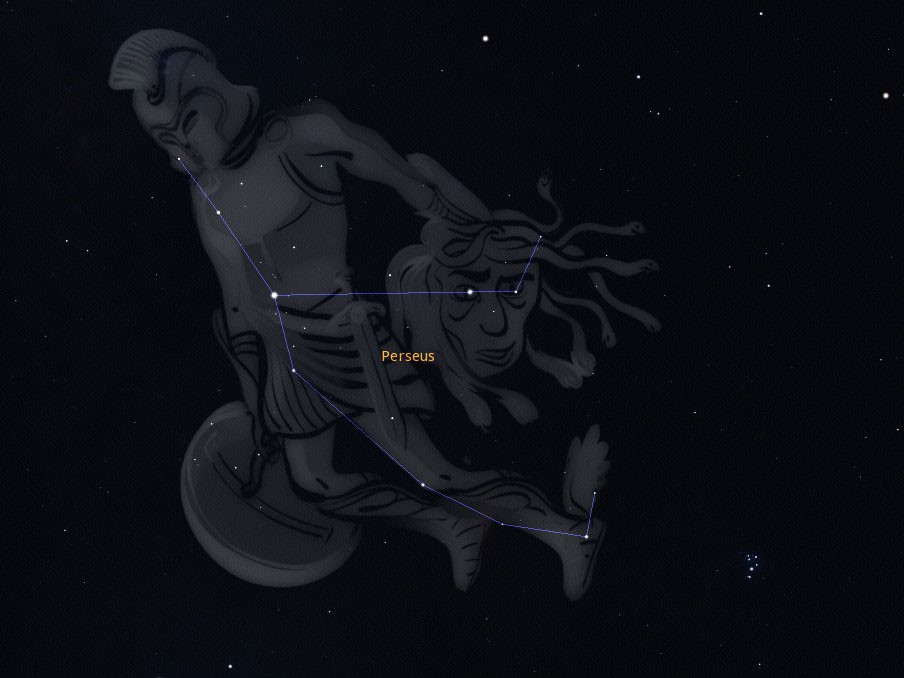
Algol, officially designated Beta Persei, stands as one of the most compelling and historically significant variable stars in the night sky. Located within the constellation Perseus, this star has captivated observers for millennia, earning its ominous nicknames such as "Demon Star" and "The Ghoul" – derived from its Arabic name "Ra’s al-Ghul," meaning "the head of the ghoul." In Greek mythology, Algol traditionally represents the blinking eye of Medusa, the Gorgon whose gaze turned men to stone, held aloft by the hero Perseus. This potent imagery is not merely coincidental but is deeply rooted in the star’s peculiar astronomical behavior: it appears to "blink" or dim periodically, a phenomenon that puzzled early astronomers but is now understood through the lens of modern astrophysics.
A Legacy of Myth and Scientific Discovery:
The variability of Algol was likely recognized by ancient civilizations, as evidenced by its various names across cultures often associated with misfortune or demonic entities. However, its systematic variability was formally documented in the Western world in 1667 by Geminiano Montanari, though it was not fully explained until 1782 by the amateur astronomer John Goodricke. Goodricke, a deaf-mute Englishman, proposed that Algol was an "eclipsing binary" system, where a dimmer companion star periodically passes in front of a brighter primary star, causing the observed dimming. This groundbreaking hypothesis, made when the very concept of binary stars was nascent, laid the foundation for understanding a vast category of variable stars and earned him the Copley Medal of the Royal Society. His work, alongside that of Edward Pigott, established the regularity of Algol’s dimming cycle, marking a pivotal moment in observational astronomy.
The Science Behind the ‘Blink’:
Algol is not just a binary star but a triple-star system. The primary eclipsing pair consists of Algol Aa1 (a hot, blue-white B8V main-sequence star) and Algol Aa2 (a cooler, larger K2IV subgiant star). These two stars orbit each other with a period of approximately 2.867 days (2 days, 20 hours, 49 minutes). It is the periodic eclipse of the brighter Algol Aa1 by the larger, cooler, and less luminous Algol Aa2 that causes the system’s apparent magnitude to drop from a bright +2.1 to a noticeably dimmer +3.4. A third star, Algol Ab, orbits the close binary pair with a much longer period of 681 days.
The dimming event, or primary minimum, lasts for several hours, with the full eclipse taking about 10 hours from the start of dimming to the end of brightening. A shallower secondary minimum also occurs when the brighter star eclipses the dimmer one, though this dip is less pronounced and often imperceptible to the naked eye. This stellar arrangement makes Algol the prototype for a class of eclipsing binary variable stars known as "Algol variables." The system is particularly interesting because the less massive K-type subgiant star is more evolved and larger than its more massive B-type main-sequence companion, a paradox explained by mass transfer between the two stars. The K-type star, having expanded and filled its Roche lobe, has transferred a significant amount of its mass to the B-type star, accelerating its evolution and leading to its current subgiant phase.
Observing Algol’s Eclipses:
For observers, Algol offers a unique opportunity to witness stellar variability with the naked eye. It is readily identifiable in the northeastern sky during autumn evenings, appearing alongside prominent constellations like Cassiopeia and Andromeda after 9 PM. To track its dimming, one can compare Algol’s brightness to nearby reference stars of known magnitudes, such as Almach (Gamma Andromedae) in Andromeda, which has a similar normal brightness. Online resources and astronomical software provide interactive charts and prediction tables for Algol’s minima, allowing observers to anticipate when the star will be at its dimmest. While binoculars or a small telescope can enhance the view and confirm the dimming, the change is distinct enough to be observed without optical aid under dark skies, providing a direct connection to Goodricke’s historic observations.
Algol’s Role in Stellar Evolution Studies:
Data from missions like NASA’s Transiting Exoplanet Survey Satellite (TESS) have been instrumental in refining our understanding of Algol and other eclipsing binaries. TESS, primarily designed to search for exoplanets, continuously monitors large swaths of the sky, collecting precise light curves that reveal even subtle changes in stellar brightness. For Algol, TESS data provides incredibly detailed photometric measurements, allowing astronomers to model the stellar components, their orbital parameters, and the dynamics of mass transfer with unprecedented accuracy. These observations are crucial for understanding stellar evolution, particularly the complex interactions within close binary systems that can significantly alter the life cycles of stars.
The Witch Head Nebula: A Cosmic Reflection
Moving beyond the pulsating glare of Algol, the cosmos presents another seasonally appropriate spectacle: IC 2118, famously known as the Witch Head Nebula. Located approximately 900 light-years from Earth, between the constellations Eridanus and Orion, this reflection nebula paints a ghostly silhouette across the interstellar medium, illuminated by the brilliant supergiant star Rigel (Beta Orionis). Its distinctive shape, resembling a hag’s profile with a pointed nose and chin, has cemented its place among the universe’s more haunting formations.
Illuminating Interstellar Dust:
Reflection nebulae are distinct from emission nebulae and dark nebulae. Unlike emission nebulae, which glow with their own light as gas is ionized by nearby hot, massive stars, reflection nebulae do not emit light. Instead, they derive their luminosity by scattering light from nearby stars. The dust particles within the nebula efficiently scatter blue light more than red light, giving reflection nebulae their characteristic bluish tint – a phenomenon similar to why Earth’s sky appears blue. This scattering process makes them generally fainter and more challenging to observe than their emission counterparts.
The Influence of Rigel:
The Witch Head Nebula’s ethereal glow is primarily due to the intense light from Rigel, one of the brightest stars in the night sky. Rigel, a blue supergiant, is a formidable stellar beacon, radiating immense amounts of energy across the electromagnetic spectrum. Its powerful ultraviolet radiation and stellar winds have shaped and illuminated the vast cloud of interstellar dust and gas that constitutes IC 2118. The nebula’s proximity to Rigel makes it a prime example of how massive stars can dramatically influence their surrounding environment, acting as cosmic lighthouses that reveal otherwise invisible clouds of dust. The dust itself is composed of microscopic particles, including silicates, carbon compounds, and ice, which efficiently scatter the starlight.
Observational Challenges and Astrophotography:
Due to its faintness and the diffuse nature of reflection nebulae, the Witch Head Nebula cannot be seen with the naked eye. Even with binoculars, it presents a significant challenge. Optimal viewing requires dark skies, far from light pollution, and telescopes with very large apertures and low magnification to gather sufficient light and provide a wide field of view. Astrophotographers, however, find IC 2118 to be a rewarding target. With modern digital cameras, particularly those sensitive to low light, and smart telescopes, photographers can capture the nebula’s haunting outline within a few hours of exposure time. Specialized broadband filters can help enhance contrast and reduce light pollution, bringing out the faint blue hues of the scattered starlight. The Witch Head Nebula also has a spectral companion in the cosmic "Halloween" theme: the Witch’s Broom Nebula (NGC 6960), part of the larger Western Veil Nebula in the constellation Cygnus. Unlike the Witch Head, which is a reflection nebula, the Witch’s Broom is a supernova remnant, the expanding shell of gas left over from a massive star’s explosive death, further illustrating the diverse and often dramatic lifecycle of stars.
The Jack-o’-lantern Nebula: A Fiery Cosmic Face
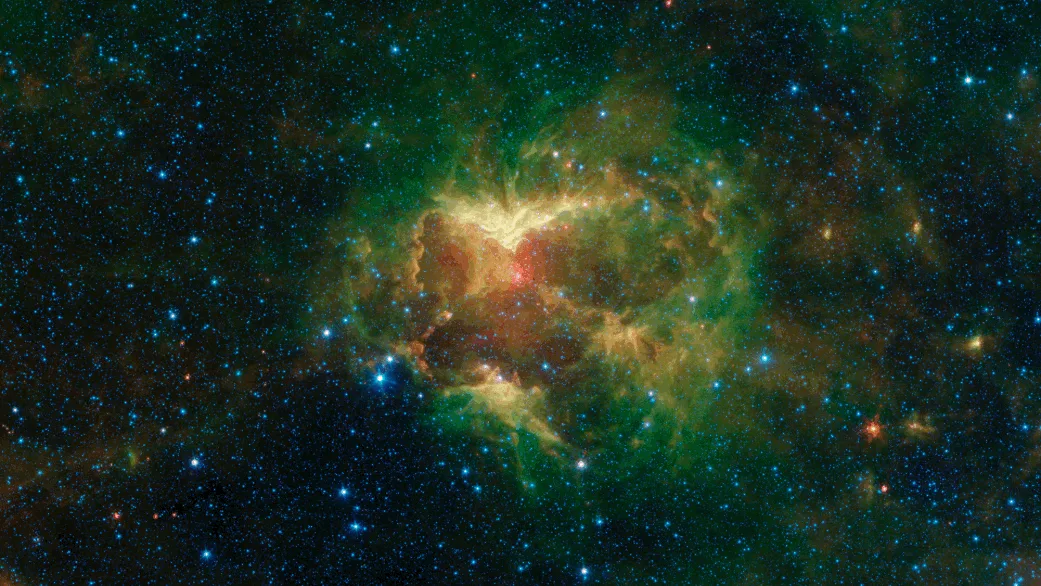
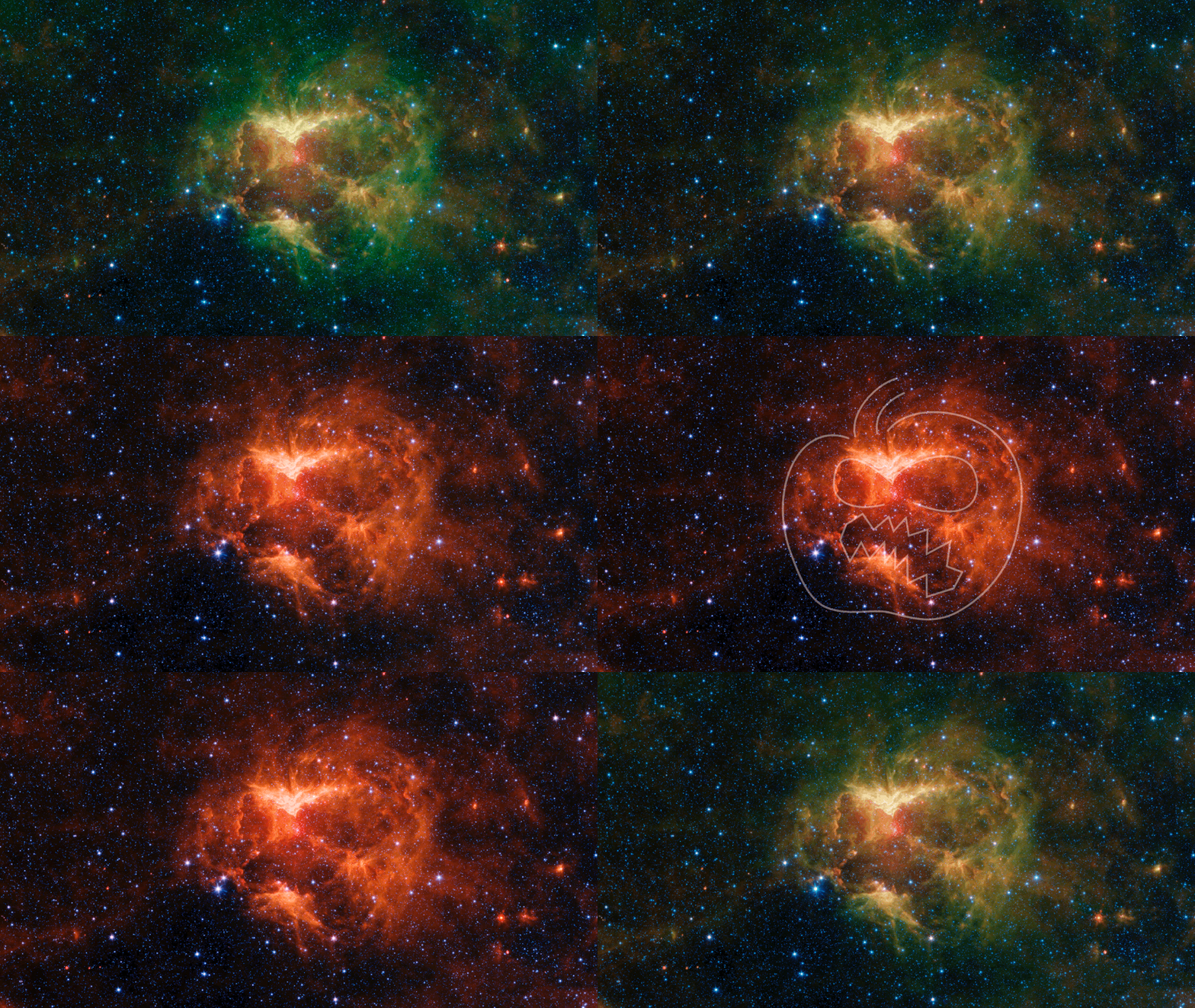
Perhaps the most evocative of the "spooky" celestial objects is the Jack-o’-lantern Nebula, a nickname given to the star-forming region NGC 2467, located in the constellation Puppis. This vibrant nebula, captured in stunning infrared detail by NASA’s Spitzer Space Telescope, presents a cosmic visage uncannily resembling a carved Halloween pumpkin, complete with glowing "eyes" and a fiery "mouth."
Carving Out Stellar Nurseries:
The Jack-o’-lantern Nebula is not a static cloud but a dynamic and active stellar nursery, a region where new stars are being born from collapsing clouds of gas and dust. Its distinctive shape is a direct result of the powerful forces exerted by massive, newly formed stars within its interior. These colossal stars, primarily O-type stars, are incredibly hot and emit intense ultraviolet radiation and powerful stellar winds. This energetic output carves out cavities within the surrounding gas and dust clouds, pushing material away and compressing denser regions at the edges of these cavities. These compressed regions, in turn, become new sites for gravitational collapse and subsequent star formation, a process known as "triggered star formation." The glowing "eyes" of the Jack-o’-lantern are in fact these young, massive stars, their radiation ionizing the surrounding hydrogen gas, causing it to emit light. The orange and red hues visible in infrared images correspond to heated dust and molecular gas, highlighting the intricate structure of the nebula.
Spitzer’s Infrared Gaze:
The true beauty and detail of the Jack-o’-lantern Nebula are best revealed through infrared observations, such as those provided by the Spitzer Space Telescope. While visible light telescopes are hindered by the dense clouds of dust that obscure star-forming regions, infrared radiation can penetrate this dust, allowing astronomers to peer into the heart of these stellar nurseries. Spitzer’s instruments were designed to detect infrared light, which is essentially heat radiation. This capability allowed it to capture the warmth of dust grains heated by young stars, the glow of molecular hydrogen, and the faint light from stars still embedded within their dusty cocoons. The resulting images, like the one showing the Jack-o’-lantern, offer invaluable insights into the earliest stages of star formation, revealing processes that would remain hidden in visible light.
Unveiling Active Star Formation:
Studying nebulae like the Jack-o’-lantern provides critical data for understanding the mechanisms of star birth. Astronomers analyze the distribution of gas and dust, the temperature gradients, and the types of stars forming within these regions to refine models of stellar evolution. The presence of massive O-type stars indicates a recent burst of star formation, as these stars have very short lifespans (only a few million years) compared to smaller stars like our Sun. The intricate structures within the nebula, shaped by stellar winds and radiation, illustrate the violent and energetic environment in which stars are forged. These observations help scientists answer fundamental questions about how galaxies replenish their stellar populations and how the interstellar medium evolves over cosmic timescales.
Beyond the Spooky: Scientific Endeavor and Public Engagement
The exploration of these "spooky" celestial objects transcends mere seasonal amusement, offering profound insights into the fundamental processes governing our universe. From the precise mechanics of binary star systems like Algol to the dynamic environments of star-forming regions such as the Jack-o’-lantern Nebula and the reflective beauty of the Witch Head Nebula, each object serves as a natural laboratory for astrophysical research.
Cultural Resonance and Astronomical Inspiration:
The enduring cultural significance of objects like Algol highlights humanity’s innate desire to understand and interpret the cosmos. Myths and legends, often born from early observations of peculiar celestial phenomena, demonstrate how astronomy has historically intertwined with human culture, shaping our stories, fears, and sense of place in the universe. Modern astronomy, while grounded in scientific rigor, continues to draw inspiration from these ancient connections, fostering a deeper appreciation for the wonders above.
The Broader Impact of Celestial Observations:
The study of variable stars, nebulae, and star-forming regions is not just about individual objects; it contributes to a holistic understanding of galactic evolution. Observations of eclipsing binaries help calibrate the cosmic distance ladder and provide crucial data on stellar masses and radii. Investigations into nebulae like the Witch Head reveal the composition and distribution of interstellar dust, a key ingredient for future star and planet formation. And the detailed imaging of active star nurseries like the Jack-o’-lantern Nebula offers direct evidence of how stars are born, how they influence their surroundings, and how stellar feedback mechanisms regulate the cycle of star formation within galaxies. Agencies like NASA and institutions such as the Jet Propulsion Laboratory (JPL-Caltech), through missions like Spitzer and TESS, consistently emphasize the scientific value of these observations, stating that each dataset adds another piece to the complex puzzle of cosmic origins and evolution.
Engaging Communities Through Sidewalk Astronomy:
The accessibility of some of these phenomena, particularly Algol’s dimming, provides an excellent opportunity for public engagement. Initiatives like "sidewalk astronomy" events, particularly those with a fun, seasonal twist such as "Trick or Treat: Sidewalk Astronomy," can transform public spaces into impromptu observatories. By setting up telescopes and guiding casual observers to these celestial wonders, astronomers and enthusiasts can demystify the night sky, ignite curiosity, and share the joy of discovery. Such events foster scientific literacy and inspire the next generation of scientists and astronomers, making the vastness of space feel a little more personal and a lot less intimidating.
Looking Ahead: Continued Exploration
As technology advances, new instruments and missions will continue to unveil even more intricate details of these cosmic spectacles. The James Webb Space Telescope (JWST), with its unparalleled infrared capabilities, is already providing unprecedented views into star-forming regions and dusty nebulae, promising to reveal even more about the Jack-o’-lantern Nebula and similar objects. Future ground-based observatories and space telescopes will undoubtedly push the boundaries of our understanding, perhaps even discovering new "spooky" features that challenge our current models and inspire new myths for generations to come. The universe remains an inexhaustible source of wonder, continuously inviting us to look up, question, and explore its eerie, beautiful, and scientifically rich depths.