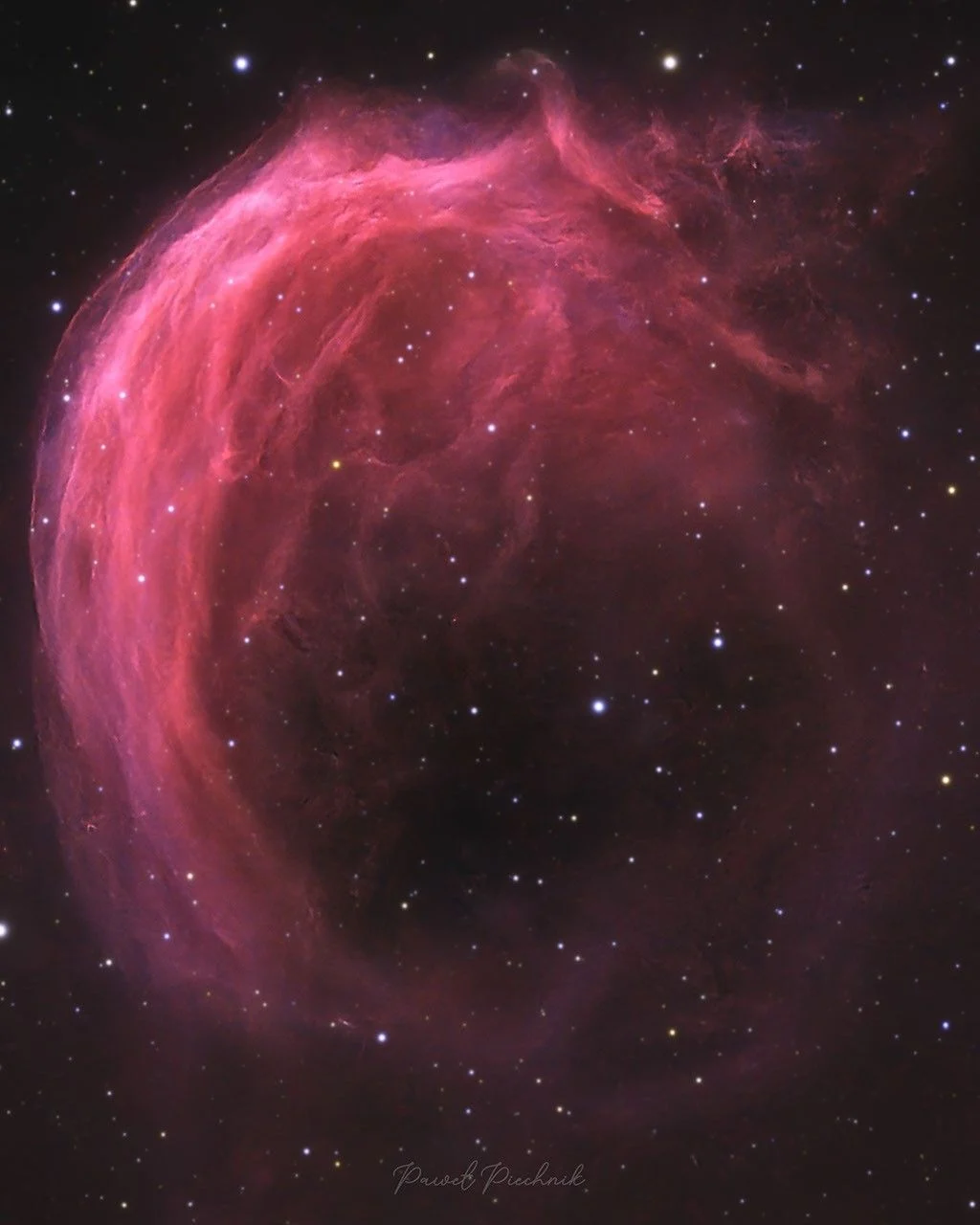
On September 29, 2026, NASA’s renowned Astronomy Picture of the Day (APOD) captivated audiences worldwide with a breathtaking image of the Shrimp Nebula, officially designated Sh2-188, revealing intricate details of its swirling structure. The stunning photograph, credited to astrophotographer Pawel Piechnik from Krakow, Poland, showcases a vibrant pink nebula against a backdrop of distant stars, offering a unique glimpse into the dynamic processes of stellar demise and the subsequent shaping of interstellar gas. The featured image, meticulously captured and digitally processed, highlights the dramatic effects of a rapidly moving white dwarf, the remnant core of a Sun-like star, as it carves a distinct bow shock through the cosmic medium, giving the nebula its characteristic, albeit faint, luminescence and complex morphology.
The Enigmatic Shrimp Nebula: A Celestial Dance of Stellar Demise
The Shrimp Nebula (Sh2-188) stands out among its celestial counterparts due to its unusually large angular size, spanning approximately half the diameter of Earth’s Moon in the night sky. This makes it one of the more expansive planetary nebulae visible from our planet, despite its inherent faintness. Unlike many other nebulae that derive their luminosity primarily from the intense ultraviolet radiation of their central star, Sh2-188 presents a more nuanced mechanism of illumination. Its glow is attributed largely to the compression and subsequent brightening of gas along its leading edge, a phenomenon directly linked to the extraordinary speed of its central white dwarf.
Planetary nebulae are beautiful, transient celestial objects formed during the final stages of a Sun-like star’s life. After exhausting the hydrogen fuel in its core, a star like our Sun expands into a red giant, shedding its outer layers into space. These expelled layers of gas, primarily hydrogen, helium, oxygen, and nitrogen, are then ionized by the intense ultraviolet radiation emitted by the star’s hot, exposed core, which eventually contracts to become a white dwarf. This ionization causes the gas to glow, creating the spectacular, often intricate structures that astronomers observe. While named "planetary" by early observers due to their superficial resemblance to gas giant planets when viewed through early telescopes, they bear no direct relation to planets.
The central white dwarf of Sh2-188 is not merely a static light source; it is a celestial bullet, traversing interstellar space at an exceptionally high velocity. This rapid movement is the primary driver behind the nebula’s distinctive "swirl" and the prominent bow shock observed in the upper left of the APOD image. A bow shock forms when an object moves supersonically through a fluid or gas, much like the wake created by a boat plowing through water or the shockwave generated by a supersonic jet. In the vacuum of space, this interaction compresses the surrounding interstellar medium, heating and exciting the gas to emit light, creating a glowing arc ahead of the moving object. The Shrimp Nebula’s bow shock is a testament to the powerful hydrodynamic forces at play, where the fast-moving white dwarf acts as a piston, dynamically shaping its environment.
Capturing the Cosmos: The Art and Science of Astrophotography
The captivating image of the Shrimp Nebula featured on APOD is a product of advanced amateur astrophotography, showcasing the remarkable capabilities of dedicated individuals like Pawel Piechnik. The photograph was taken using specialized narrowband filters designed to isolate specific wavelengths of light emitted by different elements within the nebula. Specifically, Piechnik employed filters for hydrogen-alpha (Hα), sulfur (SII), and oxygen (OIII).
Narrowband imaging is a crucial technique for astrophotographers, especially when dealing with faint deep-sky objects or observing from light-polluted areas. The Hα filter captures light emitted by ionized hydrogen atoms, which is often the most prevalent element in nebulae. The SII filter isolates light from singly ionized sulfur, while the OIII filter targets doubly ionized oxygen. By combining these distinct spectral lines, astrophotographers can create composite images that reveal the distribution of different elements and the intricate structures within the nebula, often enhancing contrast and detail far beyond what broad-spectrum imaging can achieve.
The raw data from these filters typically results in monochromatic images, which are then assigned specific colors in post-processing to create a visually appealing and scientifically informative representation. While some astrophotographers adhere to "Hubble palette" assignments (e.g., SII to red, Hα to green, OIII to blue), Piechnik digitally adjusted the colors to approximate the nebula’s "true colors." This approach aims to present the nebula as it might appear to the human eye if it were bright enough to be seen directly, balancing scientific accuracy with aesthetic appeal. The precision and dedication required for such an endeavor, particularly from a backyard observatory in Krakow, Poland, underscore the significant contributions of the amateur astronomy community to our collective understanding and appreciation of the cosmos.
The APOD Legacy: Daily Journeys Through the Universe
The Astronomy Picture of the Day (APOD) is more than just a collection of beautiful images; it is a vital educational resource and a cornerstone of public science communication. Since its inception on June 16, 1995, APOD has provided a daily dose of cosmic wonder, featuring a different image or photograph of our fascinating universe accompanied by a concise explanation written by a professional astronomer. Co-founded and continuously curated by Robert Nemiroff (Michigan Technological University) and Jerry Bonnell (NASA Goddard Space Flight Center), APOD has become a global phenomenon, translated into numerous languages and reaching millions of enthusiasts and students daily.
The mission of APOD is to foster an appreciation for the universe and to educate the public about astronomy and astrophysics. Each explanation is crafted to be accessible to a broad audience while maintaining scientific rigor, making complex astronomical phenomena understandable. The selection process for the daily image involves a careful balance of scientific significance, aesthetic quality, and novelty, often highlighting recent discoveries, historical milestones, or particularly striking astrophotography from both professional observatories and amateur enthusiasts. The involvement of editors like Cecilia Chirenti and Keighley Rockcliffe, along with the foundational work of Nemiroff and Bonnell, ensures the ongoing quality and relevance of the daily selections.
APOD is a service provided by the Astrophysics Science Division (ASD) at NASA’s Goddard Space Flight Center (GSFC), in collaboration with NASA Science Activation and Michigan Technological University. This institutional backing ensures its longevity, scientific accuracy, and broad dissemination. Over its nearly three-decade history, APOD has published thousands of unique images, creating an invaluable archive that serves as a visual encyclopedia of astronomical phenomena, from distant galaxies and nebulae to planets within our own solar system and phenomena closer to home, like aurorae and eclipses. The archive allows users to explore the cosmos chronologically, offering a continuous journey through astronomical discovery.
Recent operational updates, such as the change in APOD’s email for image submissions and the relocation of its main NASA site from apod.nasa.gov to science.nasa.gov/apod, reflect the program’s ongoing evolution and adaptation to modern digital platforms, ensuring its continued accessibility and relevance for future generations of sky-watchers and scientists.
Scientific Context: Understanding Stellar Evolution and its Implications
The study of planetary nebulae like the Shrimp Nebula is crucial for understanding the life cycles of stars and the chemical enrichment of the universe. When Sun-like stars shed their outer layers, they disperse heavy elements that were forged in their cores through nuclear fusion. These elements, including carbon, oxygen, nitrogen, and sulfur—the very building blocks of planets, life, and future stars—are then recycled into the interstellar medium. Over billions of years, successive generations of stars have enriched the cosmos, transforming a primordial universe of hydrogen and helium into the chemically diverse environment we observe today.
The peculiar kinematics of Sh2-188’s central white dwarf, moving at an "unusually fast" speed, presents an intriguing area of research. While the exact cause of this high velocity is not detailed in the APOD explanation, such speeds in white dwarfs can arise from various astrophysical mechanisms. These might include gravitational interactions within a former binary star system, where the white dwarf was ejected after a close encounter with another stellar remnant, or through a "kick" from an asymmetric mass ejection event during the planetary nebula phase. Understanding these dynamics provides insights into the physical processes governing stellar deaths and their subsequent interactions with their environment.
The interaction of the high-speed white dwarf with the interstellar medium, forming the bow shock, also offers a natural laboratory for studying plasma physics and hydrodynamic phenomena on cosmic scales. The compression and heating of gas within the bow shock can trigger new chemical reactions and even potentially initiate star formation in very dense regions, though this is less common for isolated planetary nebulae. Such observations help astronomers refine models of stellar winds, gas dynamics, and the properties of the diffuse interstellar medium.
Broader Impact and Future Discoveries
The continuous stream of high-quality astronomical images and explanations provided by APOD plays a significant role in inspiring the next generation of scientists, engineers, and citizens. By making cutting-edge astronomical research and stunning celestial photography accessible, APOD bridges the gap between the scientific community and the public, fostering a sense of wonder and encouraging scientific literacy. The feature of the Shrimp Nebula on September 29, 2026, serves as a prime example of this mission, inviting millions to "Discover the cosmos!" and contemplate the vastness and dynamism of our universe.
As technology advances, so too will our ability to observe and understand these distant cosmic phenomena. Future telescopes, both ground-based and space-based, promise even more detailed views of planetary nebulae and their central stars, potentially unraveling more mysteries about their formation, evolution, and interactions. The ongoing work of professional astronomers like Robert Nemiroff and Jerry Bonnell, in collaboration with amateur astrophotographers worldwide, ensures that the public will continue to be treated to daily glimpses of our fascinating universe, fostering a deeper connection to the cosmos and inspiring continued exploration. The Shrimp Nebula, with its unique swirling structure and energetic white dwarf, stands as a vivid reminder of the universe’s ceaseless activity and its enduring capacity to surprise and enlighten us.