After a period of anticipation, the Mars 2020 Mission’s Perseverance rover has resumed regular updates, delivering a wealth of groundbreaking information from its ongoing exploration of the Martian surface. The scientific community is abuzz with the latest findings, which detail the rover’s intensive operations throughout 2026 within the enigmatic "Lac de Charmes" area. This region, characterized by a complex tapestry of valleys and ridges situated west of the Jezero Crater rim, has been aptly dubbed a "wild west frontier" by mission scientists, owing to its rugged terrain and the unparalleled antiquity of its geological formations. The insights gleaned from Lac de Charmes are poised to significantly deepen humanity’s understanding of Mars’ earliest epochs and, by extension, the tumultuous evolution of rocky planets across our solar system.
The Genesis of a Mission: Setting the Stage in Jezero Crater
The Mars 2020 mission, spearheaded by NASA’s Jet Propulsion Laboratory (JPL), embarked on its ambitious journey on July 30, 2020, culminating in a spectacular landing within Jezero Crater on February 18, 2021. The selection of Jezero Crater was no arbitrary choice; scientists identified it as a prime location due to compelling evidence of an ancient river delta that once fed into a lake billions of years ago. Such environments on Earth are known to preserve biosignatures, the tell-tale signs of past microbial life. The primary scientific objectives of the Perseverance rover are multifaceted: to seek signs of ancient microbial life, characterize the planet’s geology and past climate, collect carefully selected rock and regolith samples for potential return to Earth, and pave the way for human exploration of Mars.
Perseverance is an astrobiology mission at its core, equipped with an array of sophisticated instruments designed to analyze the Martian landscape with unprecedented detail. Its suite includes Mastcam-Z for panoramic and stereoscopic imaging, SHERLOC (Scanning Habitable Environments with Raman & Luminescence for Organics & Chemicals) for fine-scale imaging and chemical analysis, PIXL (Planetary Instrument for X-ray Lithochemistry) for elemental analysis, and WATSON (Wide Angle Topographic Sensor for Operations and eNgineering) for close-up imaging. Crucially, the rover also carries a sophisticated drill and sample caching system, designed to collect pristine Martian material and seal it in titanium tubes, destined for eventual retrieval by future missions as part of the ambitious Mars Sample Return campaign. The mission’s journey began with meticulous exploration of the crater floor, then moved to the ancient delta front, where sedimentary rocks offered clues about the ancient lake’s history. The shift to the "Lac de Charmes" area represents a strategic pivot towards even older, more primordial Martian terrain.
Delving into the Ancient "Lac de Charmes" Frontier
The "Lac de Charmes" region has proven to be a geological treasure trove, presenting rocks that are among the most ancient Perseverance has encountered since its landing. These formations are believed to have originated during Mars’ infancy, a period when the nascent planet was subjected to intense bombardment by asteroids, long before the formation of the sedimentary rocks that characterize the Jezero Crater floor and delta. Studying these primordial rocks offers a unique window into the planet’s earliest geological processes, its atmospheric evolution, and the conditions that prevailed when life might have first emerged on Mars.
The scientific team adopted a methodical approach to exploring this captivating terrain. Rather than rushing to collect samples, Perseverance meticulously traversed a looping path, winding between intriguing outcrops to build a comprehensive understanding of the region’s formation and composition. This strategy allowed scientists to contextualize their findings, ensuring that any collected samples would represent the most scientifically valuable specimens from this ancient landscape. Throughout its exploration of Lac de Charmes, Perseverance has created a total of 13 abrasion patches on rocks that captured the team’s attention. These patches, created by grinding away a small surface area, expose fresh, unweathered rock for detailed analysis by the rover’s onboard instruments.
Initial investigations of these abrasion patches have yielded fascinating results. Many appear to be igneous rocks, formed from the cooling and solidification of molten lava or magma. Others show characteristics of impactite rocks, which are created by the immense pressures and heat generated during violent asteroid impacts. Intriguingly, some samples exhibit evidence of both processes, suggesting a complex geological history shaped by both internal planetary forces and external cosmic collisions. These findings are crucial for reconstructing the early geological timeline of Mars, shedding light on the intensity of volcanic activity and impact events in its formative years.
Technological Prowess: Boosting Martian Mobility
The extensive exploration of Lac de Charmes was significantly bolstered by a recent technological advancement: a new algorithm that has enhanced Perseverance’s driving capabilities. This innovative software cleverly repurposes a processor originally designated for communication with the Ingenuity helicopter. By optimizing the rover’s navigation and decision-making processes, this algorithm has enabled Perseverance to achieve longer and more accurate drives across the challenging Martian terrain. This enhancement has directly contributed to the efficiency of the Lac de Charmes survey, allowing the rover to cover more ground and investigate a greater number of geological features within the same operational window.
The Ingenuity helicopter, itself an extraordinary technological triumph, demonstrated the feasibility of powered flight on another planet, far exceeding its initial mission parameters. Its success has not only provided invaluable aerial reconnaissance for Perseverance but has also opened new avenues for leveraging existing hardware in innovative ways, underscoring the ingenuity of the JPL engineering teams. The ability to drive further and with greater precision is paramount for a mission focused on detailed geological mapping and targeted sample collection, allowing scientists to reach previously inaccessible areas and refine their understanding of the Martian landscape.
Unveiling "Idubi" and "Gardenia": New Frontiers in Discovery
As Perseverance’s exploration of the "Lac de Charmes" region approaches its conclusion, the pace of discovery has shown no signs of abating. Recently, the science team directed the rover towards an area nicknamed "Idubi," a fascinating locale where hundreds of light-toned boulders were observed from a distance. "Idubi" has rapidly emerged as a scientific bonanza, presenting a concentrated collection of rocks with diverse textures and compositions, offering a microcosm of the region’s geological complexity.
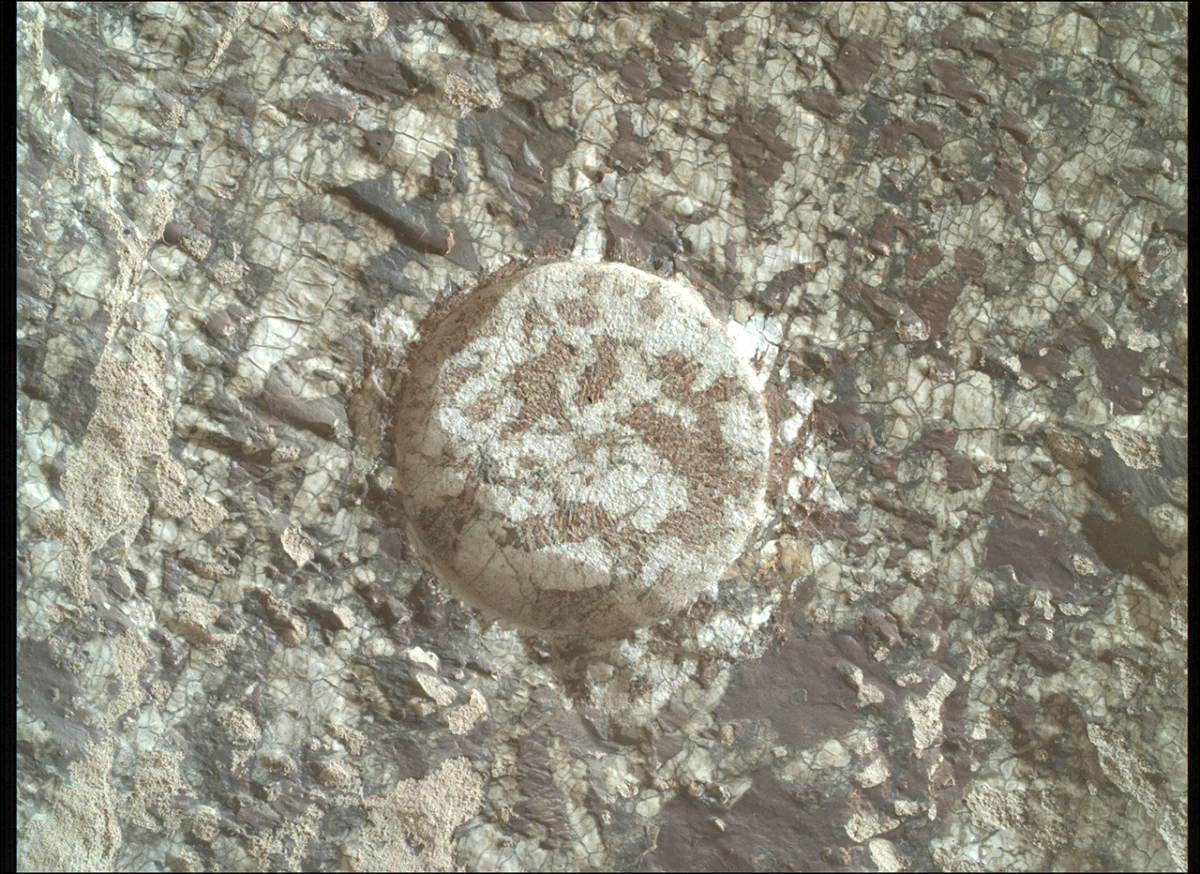
One particular light-toned boulder at Idubi captured the team’s imagination, leading to the creation of an abrasion patch fittingly named "Badger Peak." The exposed surface revealed a spectacular light-and-dark texture, unlike any the rover had encountered before. This striking pattern hints at intricate mineralogical variations or possibly the intergrowth of different rock types, offering a unique puzzle for geochemists and mineralogists. However, an attempt to collect a sample from "Badger Peak" proved unsuccessful due to the boulder’s unexpectedly high hardness. This challenge, while initially disappointing, provides valuable data on the physical properties of these ancient Martian rocks and informs future sampling strategies. The team is now actively searching for a similar rock with more amenable properties for successful collection.
In the immediate aftermath of the "Badger Peak" sampling attempt, Perseverance has shifted its focus to an intriguing outcrop nearby, christened "Gardenia." Preliminary observations suggest "Gardenia" could be a breccia – a type of rock composed of angular fragments of older rocks cemented together. Breccias are particularly valuable to geologists because they offer a snapshot of multiple geological events and rock types within a single formation. If confirmed, "Gardenia" could provide a comprehensive record of the region’s history, containing fragments from various epochs and geological processes. The rover is scheduled to perform an abrasion on "Gardenia" this week, which will allow the science team to conduct a detailed investigation of its composition and structure, potentially revealing further secrets about Mars’ ancient past.
Broader Implications: Unlocking Early Planetary History
The discoveries within Lac de Charmes hold profound implications for several branches of planetary science and astrobiology. By investigating these ancient rocks, scientists are gaining crucial insights into the conditions that prevailed on early Mars, a period when the planet was potentially more hospitable to life. Understanding the formation and alteration of igneous and impactite rocks, as well as complex breccias, provides a critical foundation for evaluating the potential for past habitability and for identifying environments where biosignatures might be preserved.
The mission’s progress also contributes significantly to the broader understanding of rocky planet evolution. Earth’s own geological record from its earliest eons is largely erased by plate tectonics and erosion. Mars, with its relatively static crust and ancient, well-preserved surfaces, offers a natural laboratory for studying processes that shaped all terrestrial planets, including our own, during the Hadean and early Archean eons. The data from Perseverance helps to refine models of planetary accretion, differentiation, and the early bombardment history of the inner solar system.
Athanasios (Thanos) Klidaras, a Ph.D. candidate at Purdue University and a contributing author to the mission updates, emphasizes the collaborative and dynamic nature of the scientific exploration. "Even after months of exploring Lac de Charmes, the team continues to be surprised," Klidaras noted in his recent dispatch. "Every new outcrop, every abrasion patch, presents a unique piece of the Martian puzzle. The challenges we face, like the hardness of ‘Badger Peak,’ are not setbacks but opportunities to learn more about this incredible planet." This sentiment is echoed across the mission team, highlighting the blend of meticulous planning and adaptive problem-solving that characterizes such ambitious space exploration endeavors.
The Road Ahead: Mars Sample Return and Beyond
With Perseverance preparing to transition out of the "Lac de Charmes" region, the mission is poised for its next phase of exploration, promising a continuous stream of new stories and scientific revelations. The primary goal remains the collection of a diverse and scientifically rich suite of samples that can be returned to Earth for exhaustive analysis. The ability to study these Martian rocks in terrestrial laboratories, using instruments far more powerful than those that can be sent to Mars, is considered the holy grail of Mars exploration. The Mars Sample Return campaign, a multi-mission effort involving NASA and the European Space Agency (ESA), envisions retrieving these cached samples in the early 2030s.
The samples collected from Lac de Charmes, especially those representing the planet’s earliest geological history, will be invaluable. They could provide definitive answers to fundamental questions: Did life ever exist on Mars? What was the planet’s climate like billions of years ago? How did its geological processes differ from Earth’s? The perseverance of the rover, coupled with the ingenuity of its operating teams, ensures that the quest for these answers continues with unwavering dedication. Each drive, each abrasion, and each photograph from the red planet pushes the boundaries of human knowledge, bringing us closer to understanding our place in the cosmos and the potential for life beyond Earth. The mission’s ongoing success reaffirms the power of robotic exploration to unravel the deep mysteries of our solar system, inspiring future generations of scientists and explorers.