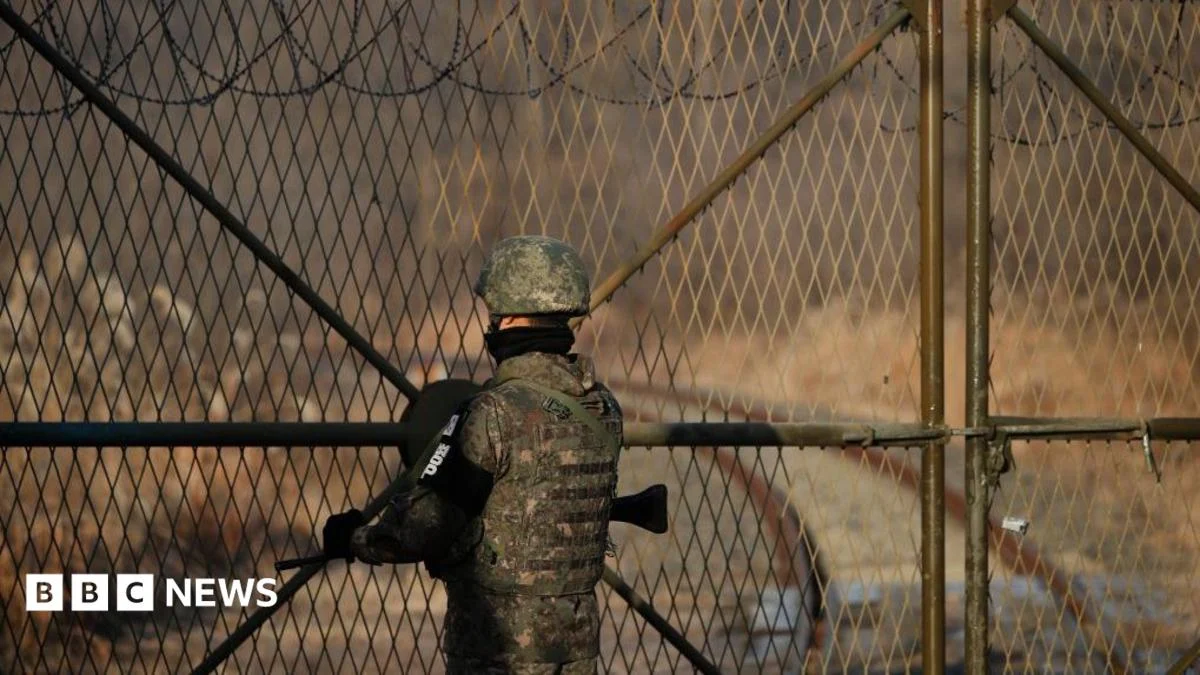
South Korea’s military has formally demanded an apology from North Korea following a series of landmine blasts along their heavily fortified shared border earlier this month that resulted in injuries to South Korean soldiers. The incident, which occurred within the Demilitarised Zone (DMZ), a critical buffer area separating the two Koreas, has ignited a fresh round of accusations and heightened tensions on the peninsula, prompting Seoul to vow "corresponding measures" against what it considers a blatant violation of the longstanding armistice agreement. Pyongyang, however, has vehemently denied any involvement, dismissing South Korea’s claims as a "farce" designed to escalate regional instability.
Escalation of Tensions: The Landmine Incident and Immediate Aftermath
The incident unfolded on September 21, when three South Korean military personnel sustained injuries from successive explosions while on patrol within the southern sector of the Demilitarised Zone. The soldiers were reportedly conducting routine operations when the devices detonated, causing significant injuries and immediately triggering an emergency response. Following an intensive on-site investigation conducted jointly by the South Korean military and the United Nations Command (UNC), Seoul concluded on Tuesday that the blasts were "highly likely" caused by landmines newly laid by North Korean forces.
Defence Minister Kang Shin-chul of South Korea swiftly condemned the act, characterising it as a "clear" and unacceptable violation of the 1953 Armistice Agreement, which brought an end to active hostilities in the Korean War. This armistice, rather than a peace treaty, established the 250-kilometer-long (155-mile) and 4-kilometer-wide (2.5-mile) DMZ, creating a precarious buffer zone that remains one of the world’s most heavily militarised borders. Seoul’s Ministry of National Defense stated its firm intention to take "corresponding measures" in response to this perceived provocation, underscoring the gravity with which the incident is being treated. The specific nature of these measures was not immediately detailed, but such responses in the past have ranged from resuming propaganda broadcasts to enhancing military readiness and conducting joint exercises.
North Korea’s Rebuttal and Warning
In a sharp retort published in state media on Wednesday, Kim Yo Jong, the influential sister of North Korean leader Kim Jong Un, issued a forceful denial of Pyongyang’s culpability. She denounced Seoul’s allegations as "groundless," a "farce," and a deliberate attempt at "political and military provocation." Kim Yo Jong specifically refuted suggestions that North Korean personnel had clandestinely crossed into the South Korean side of the DMZ to plant the mines, labelling such assertions as "a deliberate and planned strained assertion to shift the responsibility for escalating tension" onto North Korea. Her statement went further, issuing a stark warning to South Korea: to "be prepared for paying price for the farce of their own making." This combative rhetoric highlights the deep chasm in inter-Korean relations and North Korea’s unwavering defiance in the face of international condemnation.
On the same day as Kim Yo Jong’s statement, South Korea reiterated its demand for a formal apology from North Korea. In an official statement, Seoul also called for an immediate cessation of any "fortification activities" along the border, particularly those involving the placement of additional landmines. South Korean intelligence sources reportedly believe that the mines were laid by Pyongyang as part of broader efforts to fortify its side of the border, potentially in response to perceived threats or as a means of asserting control over the disputed territory.
The Demilitarised Zone: A Relic of Unfinished War
The Demilitarised Zone itself stands as a stark symbol of the unresolved conflict on the Korean Peninsula. Established at the cessation of the Korean War in July 1953, its primary purpose was to prevent further military engagements between the United Nations Command (led by the United States) and the North Korean and Chinese forces. Despite its name, the DMZ is anything but demilitarised. It is one of the most heavily mined areas on Earth, with estimates suggesting millions of anti-personnel and anti-tank mines scattered across its terrain, many dating back to the war itself, but also continuously added by both sides. The precise number and locations of these mines remain largely unknown, posing a constant threat to military personnel, wildlife, and potential civilian incursions.
The DMZ is bisected by the Military Demarcation Line (MDL), which formally marks the land border. Within this buffer, both Koreas maintain heavily armed guard posts, observation outposts, and military fortifications. Patrols are a constant feature, and strict rules of engagement are in place to prevent accidental clashes from spiralling out of control. However, the history of the DMZ is replete with sporadic clashes, infiltrations, and incidents involving landmines, underscoring the inherent instability of the region.
A Troubling Precedent: The 2015 Landmine Incident
The current incident bears an unsettling resemblance to a significant event in August 2015, when two South Korean soldiers were severely maimed by landmine explosions while on patrol near a guard post within the DMZ. In that instance, South Korea similarly accused North Korea of secretly planting the mines, an allegation Pyongyang vehemently denied. The 2015 incident led to a dramatic escalation, with South Korea resuming propaganda broadcasts via loudspeakers along the border, and North Korea threatening artillery strikes against the loudspeakers. The situation reached a critical point, with both sides exchanging artillery fire across the border, bringing the peninsula to the brink of full-scale conflict before a last-minute agreement was reached through high-level talks.
Kim Yo Jong explicitly referenced the 2015 incident in her recent statement, accusing South Korea of using it as a "pretext" to escalate tensions and asserting that Seoul was employing the same strategy now. This historical context highlights a pattern of reciprocal accusations and military posturing that has characterised inter-Korean relations for decades, making genuine de-escalation challenging.
Deteriorating Inter-Korean Relations and Lack of Communication
Ties between Pyongyang and Seoul have seen a marked deterioration since 2015, exacerbated by North Korea’s accelerating nuclear and ballistic missile programs, as well as South Korea’s increasingly firm stance in response. The brief period of rapprochement in 2018, characterised by summit meetings between the leaders of both Koreas and the United States, has long since dissipated. Instead, the current era is defined by a virtual breakdown of official communication channels, a critical factor that amplifies the risk of miscalculation.
Christopher Green, a senior consultant with the International Crisis Group, observes that "The North Koreans have been wilfully attempting to harden the border [and] eliminate inter-Korean relations." This deliberate strategy, he explains, has led to a situation where the two Koreas no longer possess the "same low-level communication" mechanisms that were available even during the tensions of 2015. This absence of direct lines of communication, from military hotlines to diplomatic channels, is particularly concerning in the context of incidents like the recent landmine blasts. "Accidental escalation on the Korean Peninsula is always just a few steps away, and it’s fewer steps now than it was in 2015," Green warns, underscoring the heightened danger of any minor incident spiralling into a larger confrontation due to a lack of immediate clarity or dialogue.
The Role of the United Nations Command
The United Nations Command (UNC), which oversees the enforcement of the 1953 Armistice Agreement, has confirmed its involvement in the on-site investigations into the recent blasts alongside the South Korean military. The UNC has stated its intention to address the violation "through established Armistice mechanisms." These mechanisms typically involve the Military Armistice Commission (MAC), a joint body intended to supervise the armistice. However, MAC meetings have been rare and often unproductive in recent years, largely due to North Korea’s reluctance to engage with the UNC, which it views as a hostile entity.
Despite these challenges, the UNC remains a crucial impartial actor in managing the fragile peace. In its statement, the Command reaffirmed its commitment to "maintaining and enforcing the Armistice Agreement and fulfilling its responsibilities to preserve stability and prevent escalation on the Korean Peninsula." The UNC’s role involves investigating violations, mediating disputes, and ensuring adherence to the armistice terms, though its effectiveness is often hampered by North Korea’s non-cooperation.
Broader Implications and Future Outlook
The recent landmine incident serves as a stark reminder of the persistent fragility of peace on the Korean Peninsula. It underscores several critical implications for regional security:
- Heightened Risk of Miscalculation: With communication channels largely defunct and mutual distrust at an all-time high, even minor incidents carry a significant risk of misinterpretation and rapid escalation. Both sides’ rapid resort to strong rhetoric rather than immediate investigation and dialogue exemplifies this danger.
- Continued Military Posturing: South Korea’s pledge of "corresponding measures" and North Korea’s warning of "paying a price" suggest a likely continuation, and possibly an intensification, of military exercises, border fortifications, and propaganda warfare. This cycle of action and reaction further entrenches hostile postures.
- Challenges for Diplomacy: The incident further complicates any prospects for renewed diplomatic engagement between the two Koreas or between North Korea and the United States. Pyongyang’s categorical denial and aggressive counter-accusations signal an unwillingness to de-escalate or acknowledge responsibility, making dialogue exceedingly difficult.
- Reinforced Alliance Dynamics: The incident will likely strengthen the security alliance between South Korea and the United States, with both nations emphasising joint readiness and deterrence against North Korean provocations. This could involve increased joint military drills and enhanced intelligence sharing.
- Humanitarian Concerns: Beyond the immediate military implications, the continued laying of landmines poses a long-term humanitarian threat, particularly in a region already heavily contaminated by unexploded ordnance from the Korean War.
As the Korean Peninsula enters another period of heightened tension, the international community will be closely watching for Seoul’s "corresponding measures" and Pyongyang’s potential reactions. The incident serves as a critical test of the resilience of the 1953 Armistice Agreement and the mechanisms designed to prevent a return to open conflict in a region perpetually on edge. The path to de-escalation appears fraught with challenges, with little indication from either side of a willingness to compromise or engage in constructive dialogue in the immediate aftermath of the blasts.