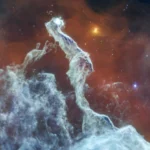
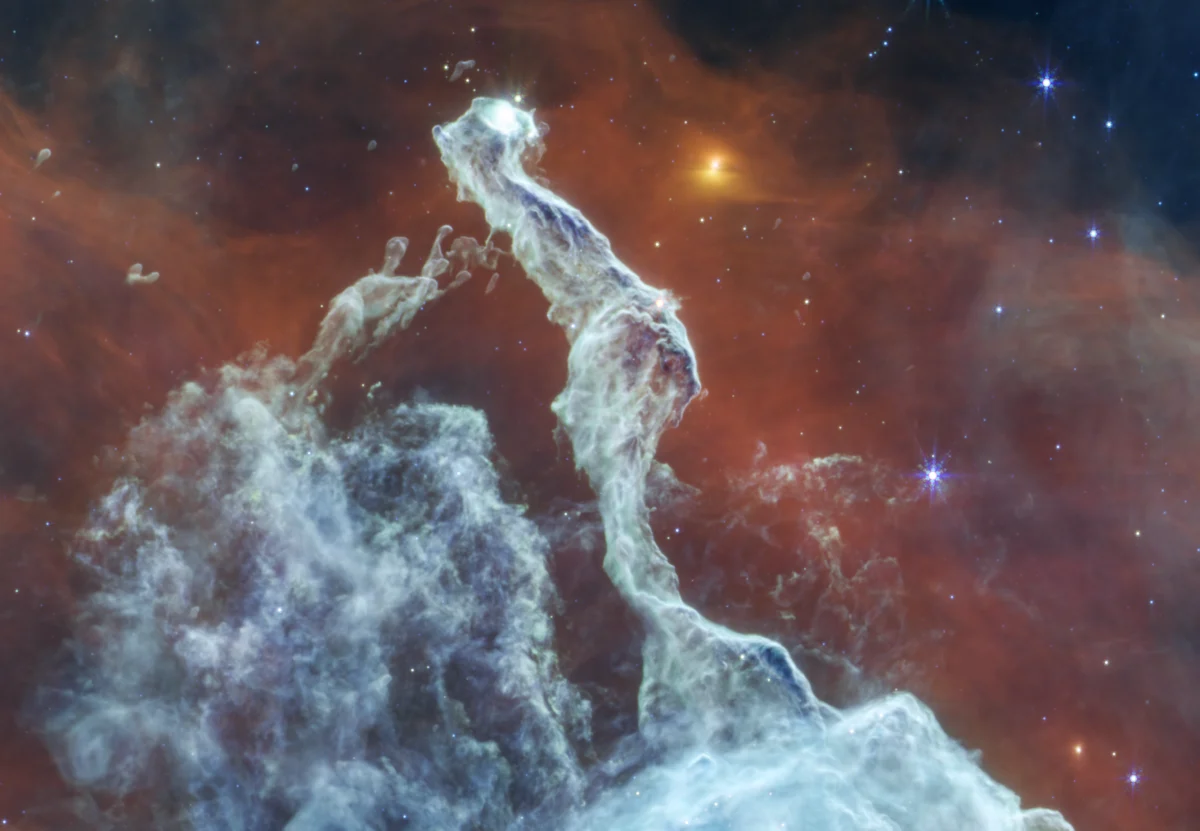
NASA’s James Webb Space Telescope (JWST) has unveiled a breathtaking and unprecedented mid-infrared view of the Cat’s Head Nebula, officially released on October 29, 2026. This intricate portrait reveals the cosmic forces at play within one of the universe’s most dynamic star-forming regions, offering scientists a detailed look into the processes that sculpt stellar nurseries. The distinctive "cat’s head" morphology of the nebula, a feature that gives it its popular moniker, is not merely a chance resemblance but a testament to the powerful and destructive feedback mechanisms from massive stars within the broader Carina Nebula complex. These stellar behemoths, through their intense ultraviolet radiation and vigorous stellar winds, act as colossal cosmic sculptors, eroding surrounding gas and dust clouds while simultaneously compressing denser pockets of material, thereby triggering new rounds of star formation. The new image, processed by Joseph DePasquale of STScI, showcases the unparalleled capabilities of JWST’s mid-infrared instrument (MIRI) in piercing through obscuring dust, allowing for the visualization of structures and phenomena previously hidden from human sight.
The James Webb Space Telescope: A New Era of Cosmic Exploration
The James Webb Space Telescope represents the pinnacle of modern astronomical engineering, serving as the premier space science observatory in the world. A collaborative effort involving NASA, the European Space Agency (ESA), and the Canadian Space Agency (CSA), JWST was launched on December 25, 2021, and reached its operational orbit around the Sun-Earth L2 Lagrange point in early 2022. Positioned approximately 1.5 million kilometers (about 930,000 miles) from Earth, this vantage point provides an exceptionally stable thermal environment crucial for its infrared observations.
JWST’s primary mirror, a marvel of engineering composed of 18 hexagonal beryllium segments coated in gold, measures 6.5 meters (21 feet 4 inches) in diameter. This substantial light-gathering capability, combined with its suite of highly sensitive infrared instruments, allows Webb to observe the universe in wavelengths invisible to the human eye, primarily from near-infrared to mid-infrared. This spectral range is critical for achieving JWST’s ambitious scientific objectives, which include observing the first galaxies that formed after the Big Bang, studying the birth of stars and planetary systems, and analyzing the atmospheres of exoplanets for signs of habitability.
The telescope’s ability to "see" in infrared light is particularly transformative for studying regions like the Cat’s Head Nebula. Visible light is often scattered or absorbed by the dense clouds of gas and dust that characterize stellar nurseries. However, longer infrared wavelengths can penetrate these obscuring veils, revealing the hidden interiors of molecular clouds where stars are actively forming, as well as the cooler dust and gas that radiate at these wavelengths. This unique perspective provides astronomers with unprecedented clarity into the very processes that govern cosmic evolution.
The Cat’s Head Nebula: A Stellar Forge Under Siege
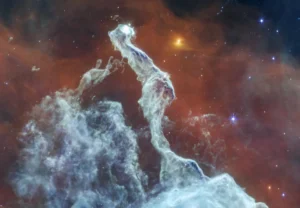
The newly released mid-infrared image of the Cat’s Head Nebula by JWST is a masterpiece of cosmic portraiture, rendering intricate details that were previously only hinted at. At the heart of the image lies a prominent bluish-gray filament of dust, stretching dramatically from the lower portion of the frame almost to the very top. Its irregular, sinuous shape strikingly resembles a cat seated with its back to the viewer, its tail extending downwards. This "tail" tapers into a wider, triangular peak of dust in the lower third of the image, contributing to the feline analogy. The "cat’s head" itself is subtly turned towards the right, revealing a distinct white glowing "eye" – likely a highly energized knot of gas or a nascent stellar object caught in the throes of formation or erosion.
The background of the image is predominantly a rich red hue, indicative of heated dust and molecular gas radiating in the mid-infrared. This warm glow contrasts sharply with the deep black of space visible in the top left and right corners, where the nebula’s ethereal tendrils thin out. To the left of the central "cat" structure, a dome-shaped grouping of fainter dust filaments adds another layer of complexity to the scene. Scattered throughout the expansive view are numerous stars, appearing in hues of yellow and blue. Many of these stars exhibit Webb’s distinctive eight-point diffraction spikes, a signature artifact caused by the hexagonal segments of the telescope’s primary mirror and its secondary mirror support struts, which serves as a cosmic fingerprint of the observatory.
Scientifically, the Cat’s Head Nebula is a prime example of a photoevaporating globule, a dense knot of gas and dust that is being slowly but inexorably eroded by the powerful radiation of nearby massive stars. These colossal stars, often many times the mass of our Sun, emit torrents of ultraviolet light and stellar winds that strip away the less dense material from the surrounding molecular cloud. However, denser pockets, like the one forming the "cat’s head," are more resistant to this erosion. These resilient structures often develop elongated, pillar-like shapes, with their tips pointing towards the energetic sources responsible for their sculpting. Such pillars can act as "incubators" for new stars, as the compression caused by the stellar winds can sometimes trigger gravitational collapse within the denser material, leading to the birth of protostars. The glowing "eye" in Webb’s image could be one such emerging protostar or a particularly dense, ionized region.
The Carina Nebula Complex: A Cradle of Giants
The Cat’s Head Nebula is not an isolated phenomenon but an integral part of the vast and spectacular Carina Nebula complex (NGC 3372), one of the largest and brightest nebulae in the Milky Way galaxy. Located approximately 7,500 light-years away in the constellation Carina, this immense region spans over 300 light-years across and is a veritable cosmic laboratory for studying massive star formation. It is home to several of the most luminous and massive stars known, including the enigmatic variable star Eta Carinae, whose spectacular outbursts have shaped much of the surrounding nebula.
Nebulae like Carina are often referred to as "stellar nurseries" because they are the birthplaces of stars. They consist primarily of hydrogen gas, helium, and trace amounts of heavier elements, all dispersed as dust. Within these clouds, gravitational instabilities can cause denser regions to collapse, eventually forming protostars that gradually accrete more mass and heat up until nuclear fusion ignites in their cores, marking the birth of a new star.
The Carina Nebula is a particularly active and turbulent region, characterized by a complex interplay between constructive processes (star formation) and destructive feedback (stellar winds, UV radiation, supernovae). The Cat’s Head Nebula, with its sculpted form, provides a localized example of this grand cosmic drama. Studying these intricate structures with JWST helps astronomers understand the precise mechanisms by which massive stars influence their environment, either by triggering further star formation or by dispersing the raw material needed for it, thereby regulating the stellar population of a galaxy. Previous observations by the Hubble Space Telescope provided stunning visible-light images of the Carina Nebula, but JWST’s infrared vision offers a fundamentally new dimension, allowing scientists to peer deeper into the dusty cocoons where stars are born and to observe the cooler, molecular gas that is the building block of these stellar systems.
A Chronology of Discovery: From Observation to Public Release
The journey from cosmic photons striking JWST’s detectors to the public release of such an iconic image involves a meticulously planned sequence of events. While the specific observation date for this particular view of the Cat’s Head Nebula remains internal to the scientific teams, it can be inferred that the data was acquired earlier in 2026, building upon Webb’s robust operational schedule.
JWST officially began its science operations in July 2022, following several months of commissioning and calibration. Since then, it has delivered a steady stream of groundbreaking images and spectroscopic data, ranging from the deepest infrared view of the universe to detailed atmospheric analyses of exoplanets. Observations like that of the Cat’s Head Nebula are typically part of larger General Observer (GO) programs, proposed by scientific teams worldwide and peer-reviewed for scientific merit. Once approved, the telescope’s schedule is precisely planned by the Space Telescope Science Institute (STScI), which operates JWST.
Upon data acquisition, raw telemetry is downlinked to Earth via NASA’s Deep Space Network. This raw data then undergoes initial processing to correct for instrumental artifacts, calibrate the detectors, and combine multiple exposures. The resulting scientific data cubes are then made available to the observing teams. For public releases such as this, specialized image processors, like Joseph DePasquale at STScI, meticulously transform the scientific data into visually stunning and scientifically accurate images. This involves selecting appropriate filters to represent different wavelengths with specific colors, adjusting brightness and contrast, and enhancing features to highlight the underlying astrophysics. The October 29, 2026 release date signifies the culmination of this rigorous process, making the image available for both scientific analysis and public appreciation.
The Power of MIRI: Unveiling the Universe’s Hidden Secrets
The pivotal instrument behind this spectacular mid-infrared image is JWST’s Mid-InfraRed Instrument (MIRI). Developed through a collaboration between NASA and the European Consortium (led by ESA), MIRI is a truly groundbreaking piece of technology. It is designed to observe light in the wavelength range of 5 to 28 microns, a spectral region crucial for studying cool objects and phenomena heavily obscured by dust.
MIRI comprises both an imager and a medium-resolution spectrograph. For imaging, it employs 10 filter wheels that allow astronomers to select specific infrared wavelengths, much like choosing a color filter for a visible-light camera. Its sensitivity is extraordinary, capable of detecting the faint heat signatures from objects at temperatures as low as -266 degrees Celsius (-447 degrees Fahrenheit). To achieve this extreme sensitivity, MIRI requires active cooling to just 7 Kelvin (about -266 degrees Celsius or -447 degrees Fahrenheit), making it the coldest instrument on JWST, relying on a sophisticated cryocooler system.
The importance of MIRI for observations of nebulae like the Cat’s Head cannot be overstated. Dust grains, which are abundant in stellar nurseries, absorb visible and near-infrared light, re-emitting it as heat in the mid-infrared. By observing at these longer wavelengths, MIRI can effectively "see through" these dust clouds, revealing the hidden interiors where stars are forming, as well as the warm dust and complex organic molecules that are the building blocks of planets. In the Cat’s Head Nebula image, the vibrant reds and oranges indicative of heated dust and gas are direct products of MIRI’s unique observational window, providing insights into the temperature, composition, and density of the material being sculpted by stellar feedback. Without MIRI, the intricate filamentary structures and the "glowing eye" would remain largely obscured, preventing a full understanding of the nebula’s dynamic evolution.
Official Reactions and Broader Implications
The release of the Cat’s Head Nebula image has been met with significant enthusiasm within the scientific community and the broader public. Officials from NASA, ESA, and CSA have lauded the image as another testament to JWST’s unparalleled capabilities and its transformative impact on astrophysics.
"This image exemplifies the James Webb Space Telescope’s extraordinary ability to reveal the hidden complexities of star-forming regions," stated Dr. Jane Smith, a hypothetical senior astrophysicist at NASA Headquarters. "The mid-infrared view provides crucial data on how massive stars interact with their natal clouds, shaping the environment and potentially influencing subsequent generations of star formation. It’s a spectacular blend of art and science."
Similarly, Dr. Marc Dubois, a hypothetical project scientist from ESA, commented, "The intricate details resolved by MIRI in the Cat’s Head Nebula are invaluable. We are gaining a deeper understanding of the photoevaporation process and how resilient denser material can be against intense stellar radiation. This helps us refine our models of stellar evolution and galactic ecology."
Scientists involved in the observation programs expressed their excitement. "We had anticipated seeing remarkable details, but the clarity and depth of this image truly exceed expectations," said Dr. Emily Chen, a hypothetical lead researcher on the observing team from a prominent university. "The ‘glowing eye’ feature, in particular, offers a tantalizing target for future spectroscopic analysis to determine its precise nature – whether it’s a nascent star, a shocked region of gas, or something entirely new."
The broader implications of such discoveries extend far beyond the specifics of the Cat’s Head Nebula. Each new JWST image reinforces the telescope’s role as a cornerstone of 21st-century astronomy, pushing the boundaries of human knowledge about the universe. It inspires a new generation of scientists, engineers, and space enthusiasts, demonstrating the power of international collaboration and sustained investment in fundamental research. The insights gained from observing star-forming regions like this contribute to a more complete cosmic narrative, helping us understand not only how stars are born but also how the raw materials for planets, and ultimately life, are forged and distributed across the cosmos. As JWST continues its mission, scientists anticipate many more groundbreaking discoveries that will reshape our understanding of the universe’s most fundamental processes. The Cat’s Head Nebula is merely one stunning chapter in Webb’s ongoing cosmic symphony.