

The scientific mission of NASA’s Curiosity Mars rover, a cornerstone of planetary exploration, faced and successfully navigated a complex operational challenge when a rock became lodged in its robotic drill mechanism. Following meticulous remote engineering efforts from Earth, the rover successfully detached itself from the tenacious Martian rock, nicknamed "Atacama," on May 1, 2026, after several days of intensive work. The incident, which began on April 25, 2026, underscored the intricate nature of operating sophisticated machinery millions of miles from Earth and highlighted the extraordinary problem-solving capabilities of the mission’s engineering teams at NASA’s Jet Propulsion Laboratory (JPL) in Southern California.
A Detailed Chronology of the Incident
The sequence of events began on April 25, 2026, when Curiosity, which has been exploring the Martian surface since its landing in Gale Crater in August 2012, performed a routine drilling operation on a selected rock target. The rover’s percussive-rotary drill is a crucial instrument designed to extract powdered samples from the interior of rocks, providing scientists with pristine material untouched by surface weathering and radiation. These samples are then delivered to the rover’s onboard laboratories, the Sample Analysis at Mars (SAM) instrument and the Chemistry and Mineralogy (CheMin) instrument, for detailed analysis to determine the rock’s chemical and mineralogical composition, shedding light on Mars’ past habitability.
During the drilling process on April 25, an unforeseen complication arose. After the drill had successfully created a circular bore hole in the rock and was retracted, it became apparent that the entire rock had been pulled off the surface along with the drill bit, remaining firmly attached to the robotic arm. This was an unusual occurrence, as the drill is designed to extract only a powder sample, not the entire rock specimen. The unexpected attachment posed a significant operational challenge, as the robotic arm’s mobility and the drill’s functionality were compromised.
For several days following the incident, a dedicated team of engineers and scientists at JPL worked tirelessly to diagnose the situation and devise a solution. Operating with the inherent time delay in communication between Earth and Mars, which can range from 4 to 24 minutes one-way depending on the planets’ orbital positions, the team meticulously analyzed telemetry data and images sent back by Curiosity. Their strategy involved a series of precise maneuvers: repositioning the robotic arm in various orientations and carefully vibrating the drill mechanism in an attempt to dislodge the stubborn rock. This process required exceptional precision and foresight, as each command had to be programmed, sent to Mars, executed by the rover, and then verified through subsequent data transmissions.
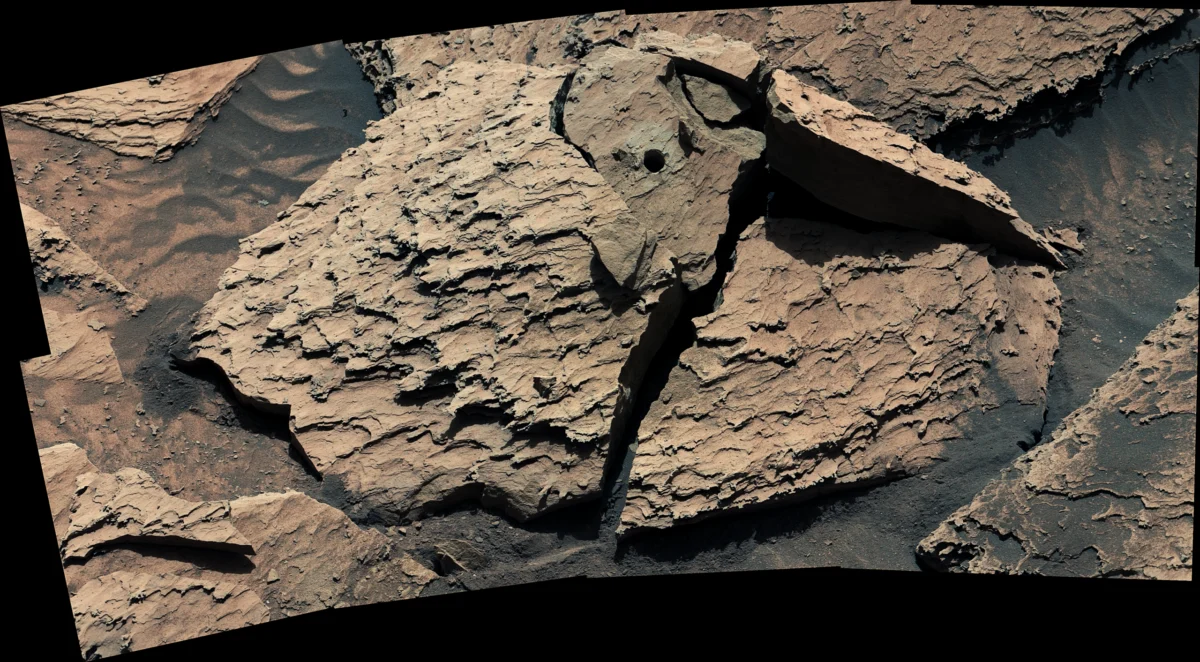
The persistent efforts culminated in success on May 1, 2026. After days of carefully orchestrated movements and vibrations, the rock finally detached from the drill. However, upon detachment, the rock fractured into multiple pieces, an outcome that, while not ideal for preserving the rock’s original morphology, nonetheless presented new scientific opportunities. The breaking apart of "Atacama" exposed fresh interior surfaces, offering scientists a potentially clearer view of its internal structure and composition, free from the effects of surface weathering.
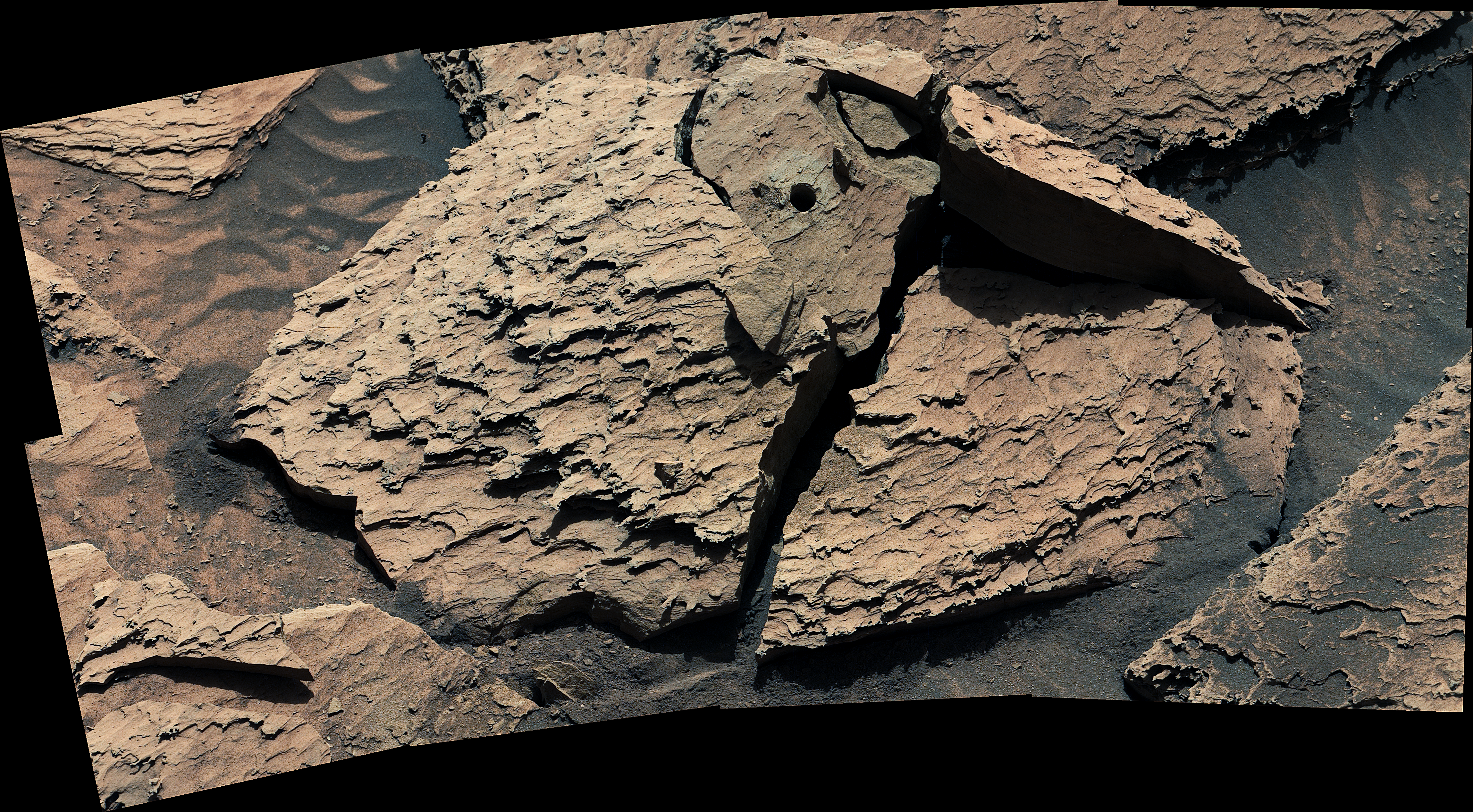
A close-up image of the now-detached and fragmented "Atacama" rock was subsequently captured by Curiosity’s Mast Camera, or Mastcam, on May 6, 2026. This high-resolution image provided critical visual confirmation of the successful detachment and offered the first detailed look at the rock’s post-incident state, including the distinct circular bore hole produced by Curiosity’s drill.
Introducing "Atacama": A Martian Enigma
The rock, affectionately nicknamed "Atacama" by the science team, is estimated to have measured approximately 1.5 feet (45 centimeters) in diameter at its base and was about 6 inches (15 centimeters) thick. Its substantial size contributed to the challenge of its initial adherence to the drill. On Earth, a rock of this volume and density would weigh roughly 28.6 pounds (13 kilograms). However, due to Mars’ lower gravitational pull, which is approximately 37.5% that of Earth’s, "Atacama" would have weighed only about a third of that on the Red Planet, around 9.5 pounds (4.3 kilograms). Despite its reduced Martian weight, the torque and forces involved in its attachment and detachment were significant for the rover’s delicate robotic arm.
The decision to name the rock "Atacama" likely draws inspiration from Earth’s Atacama Desert in Chile, one of the driest places on Earth and a renowned terrestrial analogue for Mars due to its extreme aridity and unique geological features. Scientists often study such Earth environments to better understand potential conditions and life forms on Mars. The rock’s composition, once analyzed, could provide valuable insights into the geological history of Gale Crater, a region known to have hosted ancient lakes and rivers billions of years ago.
Curiosity’s Enduring Mission and Drilling Operations
The Mars Science Laboratory (MSL) mission, spearheaded by the Curiosity rover, was launched with the primary objective of assessing whether Mars ever had an environment capable of supporting microbial life. Since its dramatic landing in August 2012, Curiosity has traversed thousands of meters across Gale Crater, systematically exploring its varied terrain, including the lower slopes of Mount Sharp (officially Aeolis Mons), a 5.5-kilometer-high mountain at the crater’s center.
A key aspect of Curiosity’s scientific toolkit is its ability to drill into rocks. The rover’s drill, part of the Mars Hand Lens Imager (MAHLI) and the Dust Removal Tool (DRT), is a rotary-percussion mechanism capable of creating holes up to 6.5 centimeters (2.5 inches) deep and 1.6 centimeters (0.6 inches) in diameter. The powdered rock samples are then sieved and delivered to the onboard laboratories. This drilling capability has been instrumental in numerous groundbreaking discoveries, including the identification of evidence for ancient freshwater lakes, the detection of organic molecules—the building blocks of life—and the characterization of diverse mineral assemblages indicative of past aqueous environments.
Over its extended mission, Curiosity has successfully performed dozens of drilling operations on various rock types, from mudstones and sandstones to igneous rocks. Each drill site represents a carefully selected geological target, often chosen after extensive imaging and analysis by other instruments on the rover, such as the Alpha Particle X-ray Spectrometer (APXS) and ChemCam (Chemistry and Camera). While drilling operations have generally been successful, the Martian environment presents inherent challenges, including abrasive dust, extreme temperature fluctuations, and the sheer difficulty of executing complex robotic tasks autonomously or semi-autonomously millions of miles away. Previous operational challenges have included minor issues with sample acquisition or delivery, but a rock becoming entirely stuck on the drill was a relatively novel situation, pushing the engineering team to adapt and innovate.
Ingenuity and Remote Engineering Excellence
The successful resolution of the "Atacama" incident is a testament to the ingenuity and dedication of the mission’s engineering team at JPL. Operating a complex robotic system on another planet requires not only advanced technological design but also a profound understanding of remote diagnostics and problem-solving. The team had to precisely model the forces at play, understand the mechanical properties of both the drill and the rock, and then meticulously plan and test a series of commands on Earth-based testbeds before uploading them to the rover.
The decision to reposition the robotic arm and vibrate the drill was a calculated risk. Excessive force could have potentially damaged the arm, the drill, or other sensitive components. The engineers had to carefully balance the need to free the drill with the imperative to preserve the rover’s overall health and functionality for its ongoing mission. The successful execution underscores the robustness of Curiosity’s design and the exceptional skill of the human operators who oversee its daily operations. This type of remote problem-solving is a hallmark of space exploration, where unexpected challenges are the norm rather than the exception.
Broader Implications for Future Mars Missions
The "Atacama" incident, while resolved, offers valuable lessons for current and future Mars missions, particularly those involving sample collection and potential sample return. NASA’s Perseverance rover, currently operating in Jezero Crater, is actively collecting and caching samples for the ambitious Mars Sample Return (MSR) campaign, which aims to bring Martian samples back to Earth for in-depth laboratory analysis. The MSR mission relies heavily on the reliable performance of its drilling and sample caching system.
Experiences like Curiosity’s encounter with "Atacama" provide critical data points for engineers designing future robotic explorers. They highlight the importance of designing drill mechanisms with increased resilience, fault tolerance, and perhaps even automated routines for self-clearing or dislodging unexpected attachments. Furthermore, the incident reinforces the need for extensive testing and simulation on Earth to anticipate potential failure modes and develop contingency plans for a wide range of scenarios that might arise in the unpredictable Martian environment. Lessons learned from Curiosity’s challenges directly contribute to enhancing the reliability and success rate of subsequent complex robotic operations on other celestial bodies.
Scientific Value and Future Outlook
Despite the operational hiccup, the scientific community remains enthusiastic about the potential insights offered by "Atacama." The fact that the rock broke into pieces upon detachment is not necessarily a scientific setback; in fact, it could be a fortuitous development. The exposed interior surfaces of the fragmented rock pieces provide fresh, unweathered material for Curiosity’s instruments to analyze. This could offer new perspectives on the rock’s mineralogy, texture, and potentially reveal layers or inclusions that were not visible on the surface. Scientists will be keen to examine these new exposures for clues about the rock’s formation environment, its interaction with water, and any potential evidence of ancient organic chemistry.
The Curiosity rover continues its journey up Mount Sharp, systematically investigating different geological layers that represent distinct periods in Mars’ environmental history. Each layer tells a part of the story of how Mars transitioned from a potentially habitable world to the cold, arid planet it is today. The successful resolution of the "Atacama" incident ensures that Curiosity can continue its vital scientific work, contributing to humanity’s understanding of Mars and the broader search for life beyond Earth. The mission’s longevity and its ability to overcome such challenges stand as a testament to the enduring spirit of exploration and the remarkable capabilities of robotic spacecraft and the dedicated teams that operate them.