


WASHINGTON – The Federal Reserve on Wednesday concluded its Federal Open Market Committee (FOMC) meeting by voting to maintain its benchmark federal funds rate within the established range of 3.5% to 3.75%. This decision, while largely anticipated by financial markets, was not unanimous, signaling a growing divergence of opinion within the central bank regarding the necessary course of monetary policy to combat inflation that has persistently exceeded the Fed’s 2% target for over five years. Three officials registered dissenting votes, advocating for an immediate rate hike to address these inflationary pressures.
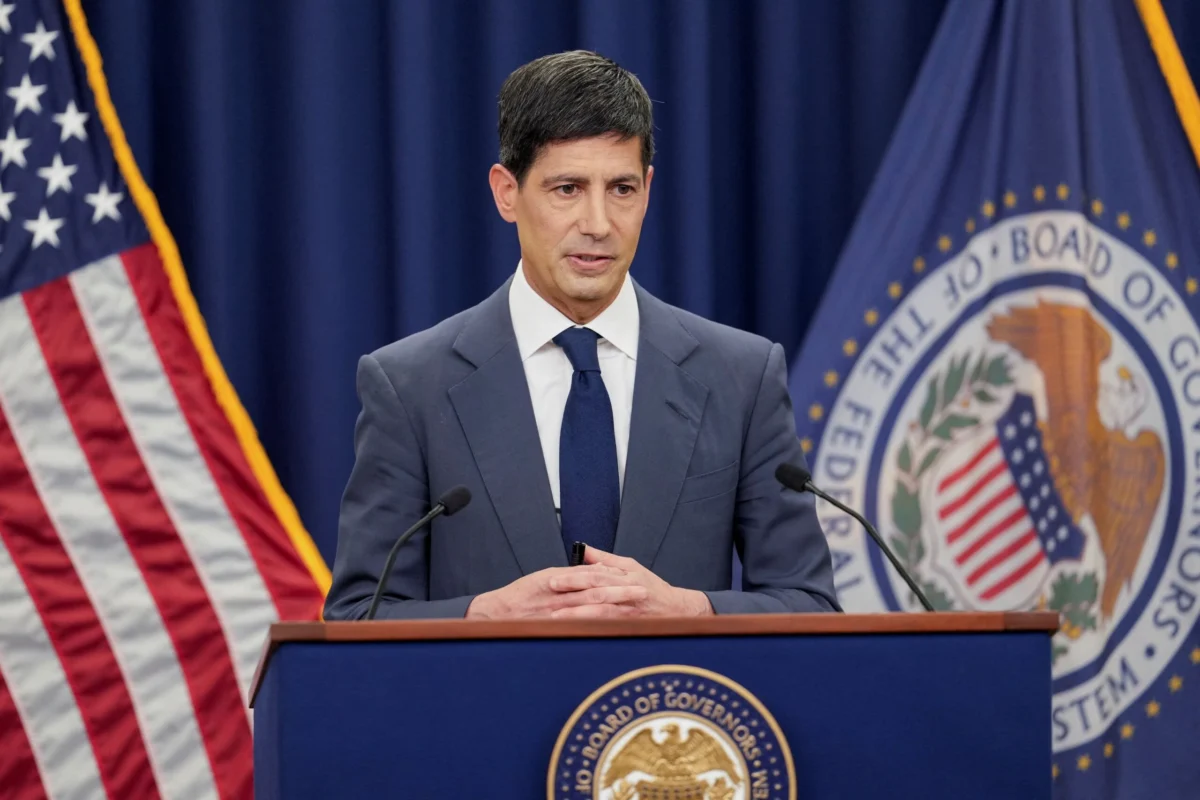
The 9-3 vote saw a notable alignment of opposition from regional Federal Reserve Bank presidents: Beth Hammack of Cleveland, Neel Kashkari of Minneapolis, and Lorie Logan of Dallas. These three policymakers have been among the most vocal in their concerns over the sustained elevated inflation levels and have consistently articulated the necessity of higher interest rates to bring price stability back into equilibrium. Their unified stance marks the first time since September 2016 that three policymakers have dissented with a shared view on the direction of interest rates, underscoring a significant internal challenge for newly appointed Chairman Kevin Warsh.
A Divided Committee Confronts Stubborn Inflation
The Federal Reserve’s dual mandate tasks it with achieving maximum employment and maintaining price stability. While the labor market has shown resilience, with job growth keeping pace with the workforce and the unemployment rate remaining largely unchanged despite a contraction in the U.S. labor force, inflation has proven to be a more formidable challenge. The Consumer Price Index (CPI) has consistently registered above the Fed’s 2% target, with annual figures often hovering between 3% and 4% over the past several years, significantly eroding household purchasing power and creating economic uncertainty for businesses. The core Personal Consumption Expenditures (PCE) price index, the Fed’s preferred inflation gauge, has similarly remained elevated, reinforcing the concerns of the hawkish minority on the FOMC.
The dissenters’ arguments are rooted in the belief that prolonged periods of high inflation risk becoming entrenched in public expectations, making it even harder to bring prices down in the future. Lorie Logan, for instance, had publicly called for "modestly" higher rates, emphasizing the burden that persistent price increases place on American households. Beth Hammack echoed this sentiment, highlighting the broad-based pressure on consumer budgets. Neel Kashkari has also consistently voiced his hawkish leanings, arguing for preemptive action against inflation. Their calls for a quarter-percentage-point increase at this meeting reflect a growing impatience with the current pace of disinflation and a conviction that the economy can withstand higher borrowing costs without derailing growth.
Chairman Warsh’s Early Challenge and Communication Strategy
The unusual level of dissent presents an early test for Chairman Kevin Warsh, who assumed the leadership of the central bank with a stated commitment to recalibrating the Fed’s communication strategy. Warsh has openly criticized the Fed’s past practice of providing extensive forward guidance on its expected path for interest rates, arguing that such specificity can constrain the committee’s flexibility and create undue market dependency. Instead, he has advocated for emphasizing the economic conditions under which policy actions would be taken, rather than pre-committing to specific future moves.
However, the post-meeting statement, which was nearly identical to the one issued after the June 17 decision and largely consistent with the Fed’s approach throughout the year, offered little in the way of such conditional guidance. It reiterated that "Economic activity is expanding at a solid pace despite elevated uncertainty that owes, in part, to the conflict in the Middle East" and concluded with the simple declaration, "The Committee will deliver price stability." This brevity, while consistent with Warsh’s vision for a more streamlined communication, left market participants with limited new information regarding the Fed’s immediate intentions beyond the decided hold.
Ian Lyngen, head of U.S. rates at BMO Capital Markets, characterized the situation succinctly: "We’re reading this as a Committee with vocal hawks." This assessment highlights the internal dynamic that Warsh must now navigate, balancing his desire for policy flexibility and concise communication with the need to build consensus amidst diverse economic viewpoints.
Economic Headwinds and Geopolitical Tensions
The FOMC’s decision was made against a backdrop of complex economic indicators and escalating geopolitical tensions. Officials noted the "solid pace" of economic expansion, a testament to the underlying resilience of the U.S. economy. However, this growth has been tempered by "elevated uncertainty," a phrase explicitly linked in the statement to the ongoing conflict in the Middle East. This geopolitical instability has exerted upward pressure on global energy prices, directly contributing to inflationary pressures through higher fuel and transportation costs.
Furthermore, the statement implicitly acknowledged other factors contributing to the stubborn inflation. Tariffs imposed by the Trump administration on various imported goods have raised the cost of production for many U.S. businesses, which are often passed on to consumers. These supply-side shocks, combined with robust consumer demand and a tight labor market, have created a challenging environment for the Fed to manage. While job growth has been steady, the contraction in the U.S. labor force suggests potential structural issues that could further complicate the inflation outlook, as a smaller workforce could lead to higher wage pressures.
Kay Haigh, global head and chief investment officer of fixed income and liquidity solutions at Goldman Sachs Asset Management, noted, "The Fed appears to be running out of patience with above-target inflation, despite recent data coming in cold. The committee’s growing hawkish sentiment, shown by the three dissents against today’s hold, has also likely been exacerbated by the recent flare up in hostilities in the Middle East." This analysis suggests that even if some recent inflation data points have shown marginal cooling, the cumulative effect of prolonged high inflation and external shocks is pushing more members towards a tightening stance.

Market Expectations and Future Outlook
Leading up to the meeting, financial markets had largely anticipated a hold on rates. According to the CME Group’s FedWatch tool, there was approximately a 1-in-3 chance of a surprise rate hike, while prediction markets indicated a higher certainty for a hold. This expectation largely stemmed from the Fed’s consistent actions throughout the year, following three rate cuts in the latter part of 2025. Those earlier cuts were implemented to provide stimulus amidst signs of slowing global growth and emerging domestic risks.
However, the three dissents inject a new layer of complexity into market expectations for future meetings. The full committee’s projections from June had penciled in one quarter-percentage-point increase by the end of 2026, implying that a hike was still on the horizon, albeit not necessarily immediate. The hawkish shift now suggests that such a hike could come sooner than previously anticipated, with many analysts now pointing to September as a strong possibility for the next move.
The absence of explicit forward guidance from Warsh’s Fed, while aligning with his communication philosophy, leaves market participants to interpret signals from individual FOMC members and the evolving economic data. This "data-dependent" approach means that upcoming inflation reports, employment figures, and geopolitical developments will be scrutinized even more intensely to gauge the Fed’s next steps.
Disparate Policy Views and Internal Dynamics
The internal dynamics of the FOMC reveal a spectrum of policy views that Chairman Warsh must reconcile. Governor Christopher Waller, for instance, had recently voiced concerns over inflation, indicating that higher rates might be necessary if progress isn’t made. Yet, Waller ultimately voted in favor of a hold at this meeting, suggesting he believes current conditions do not yet warrant an immediate hike or perhaps prefers to wait for more conclusive data.
New York Fed President John Williams, a perennial voice of influence on the committee, has expressed confidence that current policy is "well positioned" to guide inflation back to the 2% target without further immediate tightening. This contrasts sharply with the views of Logan and Hammack, who believe the current stance is insufficient.
Chairman Warsh himself has repeatedly stressed the importance of getting prices in check, famously calling inflation "a choice" during recent congressional hearings. He has consistently argued that the Fed must prioritize price stability to ensure long-term economic health. His commitment to reshaping the Fed’s communication, even dedicating one of his five task forces to address the issue, underscores his determination to move away from what he perceives as overly prescriptive forward guidance.
The political dimension also briefly surfaced, with President Donald Trump expressing support for Warsh earlier in the week, calling him "fantastic" while criticizing other Fed officials for having "bad intentions" and potentially political motivations. Such comments, while not directly influencing policy, add another layer of public scrutiny to the Fed’s decisions and internal debates.
Implications for Monetary Policy and Leadership
The recent FOMC meeting signifies a critical juncture for U.S. monetary policy. The growing dissent, particularly from influential regional presidents, indicates that the consensus for holding rates steady is becoming fragile. Should inflation persist or accelerate, the pressure for a rate hike will intensify significantly, potentially leading to a majority vote for tightening at future meetings.
For Chairman Warsh, this early challenge will test his leadership and his ability to forge a cohesive policy path. His communication strategy, which emphasizes flexibility over explicit guidance, will be under close observation. While he aims to empower the committee to react dynamically to economic conditions, the presence of strong dissenting voices suggests that the path to consensus on future actions may be more contentious than initially anticipated. The market’s craving for clarity, juxtaposed with Warsh’s preference for conditionality, sets up a fascinating dynamic for the months ahead.
Ultimately, the Federal Reserve’s commitment to price stability remains paramount. The ongoing debate within the FOMC reflects the difficult balance of risks—between taming persistent inflation and avoiding an undue slowdown in economic growth amidst global uncertainties. The decision to hold rates, despite the vocal opposition, reflects a cautious approach, but the rising number of hawks within the committee signals that this patience may be wearing thin, setting the stage for a potentially more aggressive monetary policy stance in the near future.