


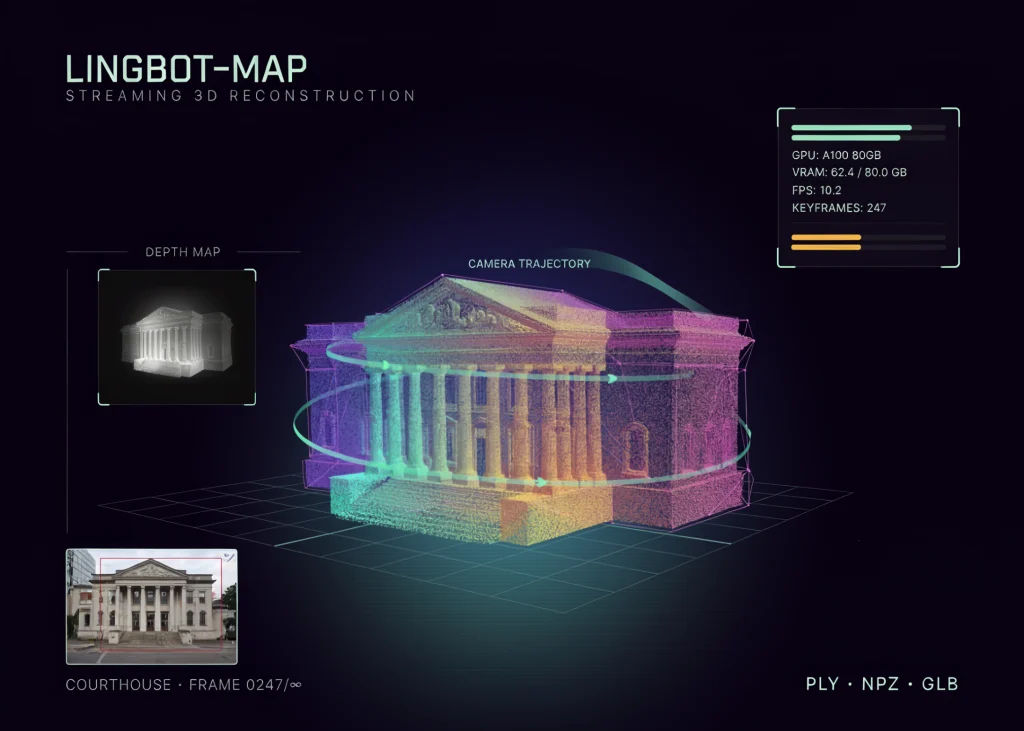
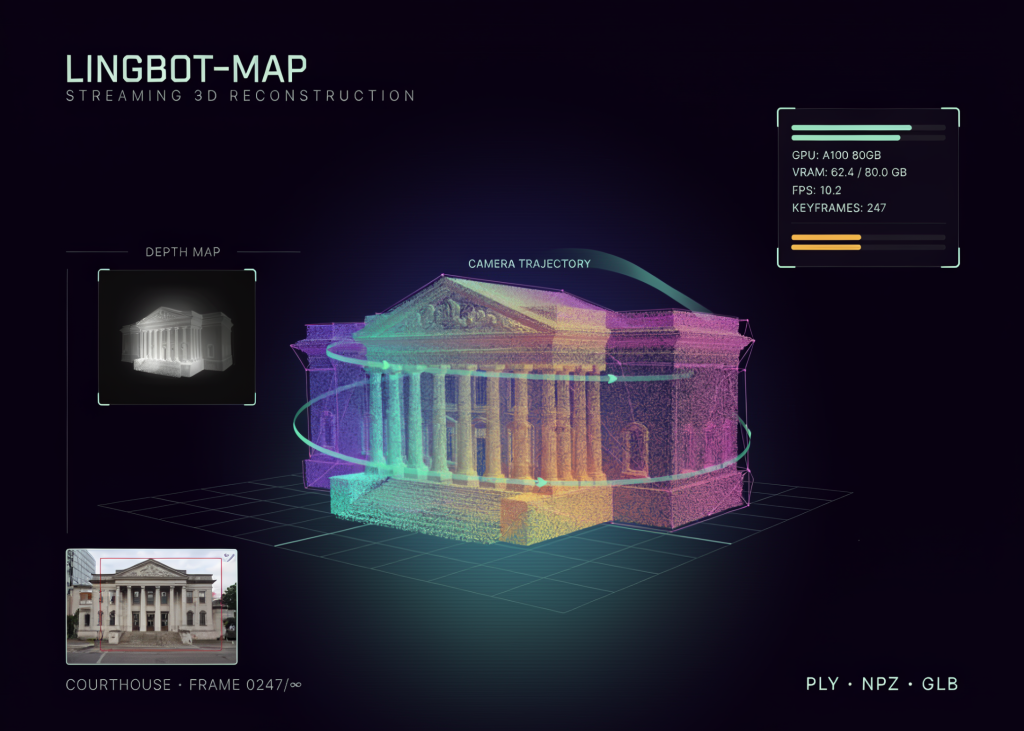
The emergence of high-fidelity 3D reconstruction from monocular video sequences has long been a computational bottleneck in computer vision, requiring significant memory overhead and complex post-processing. To address these challenges, the LingBot-Map framework has introduced an end-to-end streaming 3D reconstruction pipeline designed to process image and video data into spatially consistent 3D environments. By utilizing a specialized GCTStream model architecture, the system enables real-time or near-real-time generation of world-coordinate point clouds, camera trajectories, and depth maps. This development represents a significant shift toward more accessible and hardware-aware spatial computing, allowing researchers and developers to deploy sophisticated reconstruction workflows on a variety of NVIDIA hardware tiers.
Technological Framework of the GCTStream Model
At the core of the LingBot-Map pipeline is the GCTStream model, a neural architecture that integrates streaming attention mechanisms with long-range trajectory memory. Unlike traditional Structure from Motion (SfM) techniques that often require offline, global optimization of all frames simultaneously, GCTStream operates on a sequential basis. This approach is facilitated by a Key-Value (KV) cache system that manages frame history without exhausting system memory.
The model incorporates 3D Rotary Positional Embeddings (RoPE), which provide the transformer-based backbone with a geometric understanding of the spatial relationships between different viewing angles. By employing Scaled Dot-Product Attention (SDPA) or paged-KV attention via FlashInfer, the system achieves a high throughput, often reaching approximately 20 frames per second (FPS) on modern high-end GPUs. The architecture is further enhanced by specialized heads for camera pose estimation, depth prediction, and point cloud generation, allowing it to output comprehensive geometric data in a single inference pass.
Hardware-Aware Optimization and GPU Probing
One of the most distinctive features of the LingBot-Map implementation is its automated hardware tuning module. Recognizing that 3D reconstruction is extremely VRAM-intensive, the pipeline begins with a thorough probe of the available GPU resources. The system queries the NVIDIA System Management Interface (nvidia-smi) to determine the total VRAM and the Compute Capability (SM version) of the device.
Based on these findings, the pipeline automatically categorizes the hardware into tiers to adjust critical hyperparameters:
- Small Tier (<18 GB VRAM): The system limits the reconstruction to 48 frames, utilizes a KV-cache sliding window of 48, and reduces camera refinement iterations to two. This allows devices like the NVIDIA T4 to participate in 3D modeling tasks that would otherwise result in "Out of Memory" (OOM) errors.
- Medium Tier (18-30 GB VRAM): The frame limit is expanded to 96, with scale frames increased to eight and camera iterations set to four.
- Large Tier (>30 GB VRAM): Designed for high-end enterprise hardware like the NVIDIA A100 or H100, the system allows for 240+ frames and larger sliding windows, significantly improving the global consistency of the reconstructed scene.
This tiered approach ensures that the reconstruction quality is maximized relative to the hardware’s ceiling, making the tool versatile for both mobile workstation users and cloud-based enterprise environments.
The Reconstruction Workflow: From Video to Point Cloud
The operational chronology of the LingBot-Map pipeline follows a rigorous sequence of data transformation. It begins with input source configuration, where the user can specify local image directories or raw video files. If a video is provided, the system performs automated frame extraction at a user-defined frequency (FPS), ensuring that the temporal stride is optimized for the reconstruction model.
Following data ingestion, the preprocessing stage involves resizing and cropping images to match the model’s patch-based transformer architecture. Once the images are converted into high-precision tensors, they are fed into the GCTStream model. During the inference phase, the model performs mixed-precision calculations—typically utilizing bfloat16 for newer architectures (SM 8.0+) or float16 for older GPUs—to balance numerical stability with processing speed.
The raw outputs of the model are not immediately usable as a 3D map; they must undergo a decoding process. The system decodes predicted pose encodings into extrinsic and intrinsic camera matrices. Simultaneously, depth maps are converted into world-coordinate points. A critical step in this process is the application of confidence-based filtering. By analyzing the "depth confidence" maps generated by the model, the pipeline discards pixels with high uncertainty, such as those found on reflective surfaces or extreme edges, resulting in a cleaner, more accurate point cloud.
Data Validation and Geometric Sanity Checks
To ensure the reliability of the reconstructed spatial data, the pipeline incorporates a series of geometric validation protocols. A primary metric used is the ratio between the distance from the camera to a point and the predicted depth value. In a perfectly calibrated system, this ratio should hover between 1.00 and 1.15. If the median ratio deviates significantly from this range, the system flags the reconstruction as "suspect," indicating potential pose collapse or scale drift.
Furthermore, the system calculates the scene’s diagonal scale and the total trajectory length of the camera path. These metrics allow developers to compare different runs quantitatively. For instance, in outdoor scenes, the pipeline can be integrated with sky-masking tools to prevent "smearing" artifacts, where sky pixels are incorrectly projected into the far-field 3D space.
Comparative Performance and Ablation Studies
The LingBot-Map framework provides built-in support for ablation experiments, allowing users to measure the trade-offs between speed, memory, and accuracy. In technical trials, researchers observed that increasing the "keyframe interval" drastically reduces KV-cache memory consumption and increases FPS but introduces a "quality cost" in the form of trajectory drift.
Data from recent benchmarks indicate that:
- A keyframe interval of 1 provides the highest trajectory accuracy but consumes the most VRAM.
- Increasing the interval to 4 can double the processing speed (FPS) while maintaining acceptable geometry for short-range sequences.
- Using windowed inference mode instead of pure streaming allows the system to process sequences exceeding 3,000 frames by rotating the memory cache, though this requires careful management of overlapping keyframes to maintain global alignment.
Industry Implications and Broader Impact
The democratization of streaming 3D reconstruction has profound implications across several high-growth industries. In the field of robotics and autonomous systems, the ability to generate a spatially consistent map from a single camera feed in real-time is essential for Simultaneous Localization and Mapping (SLAM). The LingBot-Map pipeline offers a lightweight alternative to traditional LiDAR-based systems, potentially reducing the hardware costs for small-scale delivery robots and drones.
In the realm of Augmented Reality (AR) and Virtual Reality (VR), this technology facilitates the rapid creation of "Digital Twins." Real-world environments can be scanned using a smartphone video and converted into GLB or PLY artifacts, which are compatible with standard 3D modeling software like Blender, MeshLab, and CloudCompare. The inclusion of the interactive Viser viewer within the pipeline allows for immediate inspection of the 3D data, streamlining the asset creation workflow for developers.
Furthermore, the research community benefits from the open-source nature of the LingBot-Map repository. By providing a clear tutorial for end-to-end implementation, it lowers the barrier to entry for studying neural reconstruction. The integration with Hugging Face for pretrained weight distribution ensures that the latest advancements in the model’s weights are easily accessible to global researchers.
Future Directions and Technical Evolution
As the field of computer vision moves toward more robust "in-the-wild" reconstruction, the LingBot-Map project is expected to evolve in several directions. One primary area of focus is the mitigation of "state drift" during long-duration runs. Currently, as sequences grow, the accumulation of small errors in pose estimation can lead to a collapse of the 3D structure. Future iterations may incorporate global loop closure mechanisms to correct these drifts.
Additionally, the transition from simple point clouds to more sophisticated representations like Gaussian Splatting or Neural Radiance Fields (NeRFs) is a logical next step. While point clouds provide excellent geometric foundations, these newer representations offer superior visual fidelity for rendering. By providing the camera trajectories and filtered points, LingBot-Map serves as an ideal initialization tool for these advanced rendering techniques.
In conclusion, the LingBot-Map streaming 3D reconstruction pipeline represents a comprehensive solution for modern spatial computing needs. By balancing hardware constraints with sophisticated neural architectures, it provides a scalable, efficient, and highly configurable pathway from 2D pixels to 3D worlds. As hardware capabilities continue to expand, the principles of hardware-aware auto-tuning and streaming memory management established by this framework will likely become standard practices in the next generation of computer vision applications.