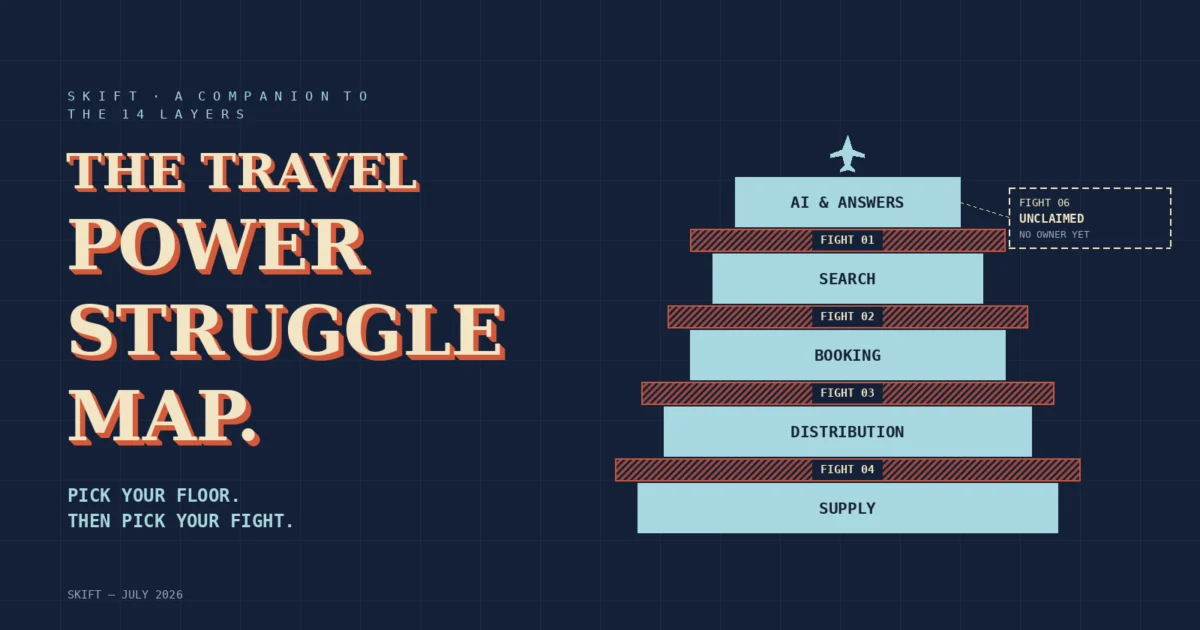
The global travel industry, often perceived as a monolithic entity of leisure and movement, is increasingly being redefined as a fragmented and highly competitive series of strategic skirmishes. For over a decade, the sector has been characterized by a relentless struggle for dominance across every touchpoint of the consumer journey. This competition is not merely about providing a service; it is a multi-front war over who answers the traveler’s initial query, who appears first in search results, who facilitates the booking, who manages the physical inventory, who processes the transaction, and ultimately, who retains the emotional connection to the trip through memory and loyalty. As the industry matures, the barrier to entry for new startups has shifted from technological innovation to the brutal economics of distribution and customer acquisition.
The Structural Fragmentation of the Global Travel Market
To understand the current state of the travel industry, one must look past the surface-level convenience of mobile apps and instant confirmations. The market is structured as a vertical stack where different players fight for "ownership" of the traveler. At the top of the funnel sits the discovery phase, currently dominated by search engines and social media platforms. Below that lies the distribution layer, where Online Travel Agencies (OTAs) and metasearch engines battle for the transaction. At the base is the supply layer—the hotels, airlines, and tour operators who actually provide the service.
The difficulty for modern startups lies in the fact that these layers are no longer distinct. Google has moved from being a simple referrer to a dominant player in flight and hotel search, effectively becoming the "gatekeeper" of the traveler’s intent. Meanwhile, major OTAs like Booking Holdings and Expedia Group have consolidated their power, spending billions of dollars annually on performance marketing to ensure they remain the primary interface for the consumer. For a new entrant, competing in this environment requires more than a superior product; it requires a strategy to bypass or disrupt these entrenched interests.
A Historical Context: From the Gold Rush to Consolidation
The evolution of the travel tech sector can be categorized into distinct eras. The early 2000s saw the rise of the first generation of OTAs, which digitized the manual processes of travel agents. The 2010s were marked by the "sharing economy" boom, led by Airbnb, which unlocked new types of inventory. During this period, venture capital flowed into travel startups with the hope of finding the next "Uber of travel."
However, the late 2010s and the early 2020s brought a period of harsh realization. Many startups that focused on generic travel planning or "social" travel failed to gain traction because they could not solve the fundamental problem of customer acquisition cost (CAC). Unlike recurring software-as-a-service (SaaS) models, travel is often an infrequent purchase. If a company spends $50 to acquire a customer who only generates $20 in commission once a year, the business model is inherently unsustainable. This economic reality has led to a significant shift in how industry veterans and analysts view new ventures. The recent retrospective published on Skift’s 14th anniversary, titled "Don’t Start a Travel Startup," serves as a cautionary analysis of these 14 years of market observation, highlighting that generic "travel" companies are often doomed by their lack of specialization.
Supporting Data: The Economics of Distribution and Marketing
The scale of the competition is best illustrated by the financial reports of the industry’s giants. In 2023, Booking Holdings and Expedia Group collectively spent over $10 billion on marketing, much of it directed toward Google. This "Google tax" creates a high floor for any startup attempting to reach customers through traditional search channels.
According to industry data from Phocuswright and Skift Research, the conversion rate for travel websites remains notoriously low, often hovering between 2% and 4%. This means that 96% of marketing spend is essentially wasted on "lookers" rather than "bookers." Furthermore, the rise of "zero-click searches" on Google—where the user finds the answer directly on the search results page without clicking through to a website—has further squeezed the traffic available to independent startups.
Funding trends also reflect this tightening environment. While travel and hospitality tech startups saw a surge in funding in 2021 as the world anticipated a post-pandemic recovery, 2023 and 2024 have seen a return to disciplined investing. Investors are now prioritizing companies that solve specific B2B pain points—such as revenue management software for hotels or sustainable fuel logistics for airlines—rather than B2C platforms that require massive consumer marketing budgets.
The Fight for the "Wallet" and the "Memory"
The most significant battleground in the current landscape is the control of the "wallet" and the "memory." Controlling the wallet refers to the payment infrastructure and the ownership of the financial transaction. Companies that manage the payment process gain access to valuable data and the ability to offer ancillary services, such as insurance or "buy now, pay later" (BNPL) options. This is why platforms like Hopper have focused heavily on "fintech for travel," creating products that protect travelers against price volatility.
Controlling the "memory" is a more abstract but equally vital objective. It involves brand loyalty and the post-trip relationship. In an era of infinite choice, travelers often default to the brand they trust or the one that offers the best loyalty rewards. The struggle for startups is that building a brand that "owns the memory" takes decades and massive capital. Without a unique value proposition that goes beyond a cheaper price, new companies find it nearly impossible to break the cycle of one-off transactions.
Official Responses and Industry Perspectives
Industry leaders have frequently commented on the difficulty of the "generic" travel model. During various investor calls and industry conferences, executives from major hotel chains like Marriott and Hilton have emphasized their "direct booking" strategies, aimed at reclaiming the relationship with the guest from the OTAs. Their argument is that by owning the data and the loyalty program, they can provide a more personalized experience that no third-party startup can replicate.
Conversely, venture capitalists specializing in travel, such as those from Thayer Ventures or JetBlue Ventures, have noted that the most successful new entrants are those that do not try to be "everything to everyone." Instead, they focus on deep niches—such as the digitization of the "tours and activities" sector, which remains largely fragmented and offline, or the integration of artificial intelligence to solve complex logistical disruptions in aviation.
Broader Impact and Implications for the Future
The implications of this hyper-competitive environment are twofold. First, it suggests that the era of the "generalist" travel startup is likely over. New founders are being advised to build in the "cracks" of the industry—solving specific technical problems that the giants are too slow to address. This includes areas like carbon accounting for corporate travel, decentralized identity for seamless airport security, and hyper-localized content for the "experience economy."
Second, the dominance of a few major players raises questions about innovation and consumer choice. If the "Google-Expedia-Booking" triumvirate continues to control the majority of the distribution, smaller, potentially more innovative players may never reach the scale necessary to survive. This has led to increased regulatory scrutiny, particularly in the European Union, where the Digital Markets Act (DMA) aims to level the playing field by preventing "gatekeepers" from favoring their own services over those of competitors.
As the industry looks toward the next decade, the focus is shifting toward Artificial Intelligence as the potential "great equalizer." Generative AI has the potential to change how travelers "answer" their own questions, potentially bypassing traditional search engines. However, even with AI, the fundamental challenges of the travel market remain: inventory must still be sourced, payments must still be processed, and the physical reality of moving a person from point A to point B must still be managed.
In conclusion, the travel industry is no longer a welcoming frontier for the uninitiated. It is a mature, sophisticated, and capital-intensive arena where the "fights" over the traveler are constant and evolving. Success for new entrants will not be found in broad, consumer-facing platforms, but in the strategic mastery of specific segments of the traveler’s journey, backed by a deep understanding of the economic and structural barriers that define the modern travel landscape.