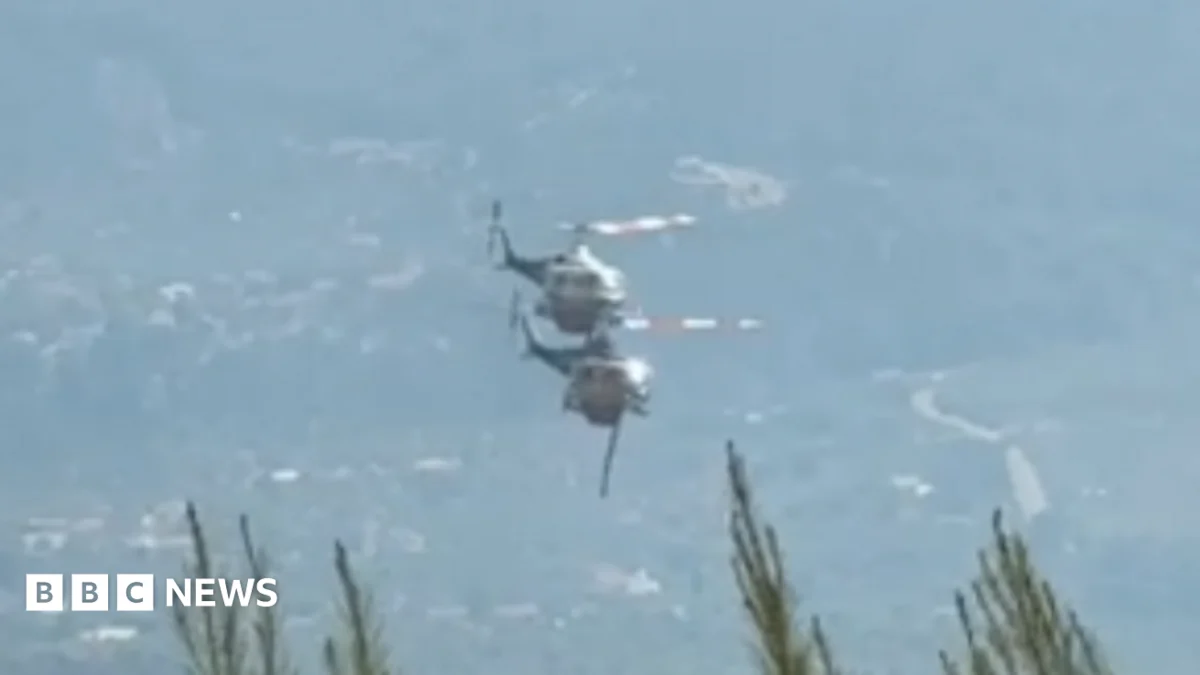
Two crew members have tragically lost their lives following a catastrophic mid-air collision involving two helicopters engaged in aerial firefighting operations in Greece, local authorities confirmed. The devastating incident, which occurred approximately 65 kilometers (42 miles) west of the capital Athens, claimed the lives of a Danish pilot and a Greek fire service liaison officer. A British pilot and another Greek coordinator aboard the second aircraft miraculously survived the crash, sustaining minor injuries. The collision casts a somber shadow over Greece’s relentless battle against a wave of destructive wildfires, exacerbated by a succession of prolonged heatwaves gripping southern Europe.
The Catastrophic Incident and Immediate Aftermath
The collision transpired as the two leased Bell helicopters were actively participating in the arduous efforts to suppress a large and volatile wildfire raging on the Attica-Boeotia border. Eyewitness accounts and video footage circulating online depict a harrowing scene: one Bell helicopter appears to strike the propellers of the other, which then violently erupts into flames before both aircraft plummet into a rugged ravine. The immediate response saw rescue teams scrambling to the remote crash site, a challenging endeavor given the difficult terrain and ongoing fire conditions.
According to statements from the Greek Fire Service, the crew members of one aircraft were swiftly rescued alive, albeit injured. These survivors, identified as a British pilot and a Greek fire service liaison officer, remained conscious throughout the ordeal and were subsequently admitted to a local hospital for observation, a precautionary measure for 24 hours. Tragically, the crew of the second helicopter were recovered unconscious and later pronounced dead, marking a profound loss for both their families and the dedicated firefighting community. The Ministry of Civil Protection later identified the deceased as a Danish national serving as the pilot and a Greek national acting as a crucial fire service liaison. Their sacrifice underscores the inherent dangers faced by those on the front lines of climate change-driven emergencies.
Official Response and Grounding of Aircraft
In the wake of the tragedy, Greek Prime Minister Kyriakos Mitsotakis publicly expressed his "deepest sorrow" over the accident. In a post on X (formerly Twitter), he conveyed that the loss of the Greek coordinator and Danish pilot "fills us all with grief" and extended his heartfelt condolences to their grieving families. The Prime Minister’s statement reflected a nation in mourning, grappling with both the immediate human cost of the collision and the broader environmental catastrophe unfolding across its landscapes.
As a direct and immediate consequence of the incident, and in adherence to established safety protocols, all Bell helicopters operating across Greece have been temporarily grounded. This critical decision, confirmed by a source from the Ministry of Civil Protection to the BBC, allows for a thorough assessment of the aircraft type and operational procedures, ensuring the safety of remaining aerial assets and personnel. While crucial for investigation, this grounding inevitably impacts the available resources at a time when every aerial platform is vital for containing the widespread infernos. However, other specialized firefighting aircraft, including Erickson Air-Crane and Chinook helicopters, as well as Canadair water-bombing aircraft, are continuing their operations, demonstrating the resilience and adaptability of the national and international firefighting effort.
A Nation Engulfed: Greece’s Wildfire Battle
The mid-air collision occurred against a backdrop of an escalating wildfire crisis across Greece, a country perennially vulnerable to such disasters. This week alone has seen numerous significant fires erupt, prompting mass evacuations of communities and threatening critical infrastructure. The specific fire on the Attica-Boeotia border, where the collision took place, has been particularly challenging, demanding intensive aerial and ground resources. Media reports vividly describe "a titanic battle" unfolding across a swathe of territory encompassing Porto Germeno, Psatha, Fokida, Megara, and Kefalonia. Over 500 firefighters, supported by volunteers and military personnel, have been relentlessly struggling for more than 72 hours to bring these situations under control.
The current fire season in Greece has been exceptionally severe, aligning with a broader trend observed across the Mediterranean basin. Data from the European Forest Fire Information System (EFFIS) indicates that Greece has already experienced a significantly higher number of fires and a larger burned area compared to the average of the last decade. This year’s challenges follow a mild and wet winter, which encouraged robust vegetation growth. This lush biomass, subsequently dried out by successive and intense heatwaves, has created an abundance of highly flammable fuel, setting the stage for explosive fire behavior. The country’s topography, characterized by dense forests, dry shrubland, and strong winds, further exacerbates the risk and spread of wildfires.
Wider European Context of the Wildfire Crisis
Greece is not alone in its struggle. Several other European nations have also been grappling with devastating wildfires following an unprecedented succession of prolonged heatwaves. Early this week, both France and Spain battled massive infernos, with two of the most significant fires raging near Madrid and Bordeaux, respectively. While these specific blazes have now been largely contained, they continue to smolder, and the environmental damage is extensive. The scale of the evacuations in these regions was immense, with approximately 300,000 people displaced from their homes, many of whom are only now beginning the slow and difficult process of returning.
The summer of 2023 has been marked by record-breaking temperatures across southern Europe, with numerous countries experiencing heatwave conditions that have pushed thermometers well above 40 degrees Celsius (104 degrees Fahrenheit). These extreme conditions, combined with drought and strong winds, create the perfect storm for large, rapidly spreading wildfires. Scientists increasingly attribute the increased frequency and intensity of such events to anthropogenic climate change, warning that these "new normal" summers will continue to challenge existing emergency response capacities and demand more robust preventative strategies.
The Perilous Nature of Aerial Firefighting
The tragic collision serves as a stark reminder of the immense risks inherent in aerial firefighting operations. Pilots and crew members engaged in these missions operate under extreme pressure, often in hazardous environments characterized by poor visibility due to smoke, unpredictable wind patterns, and complex terrain. Flying at low altitudes, sometimes just meters above treetops, while maneuvering heavy loads of water or retardant, requires exceptional skill, precision, and coordination.
The two Bell helicopters involved in the collision were likely engaged in water-bombing runs, a critical tactic for dousing flames and creating firebreaks. Such operations frequently involve multiple aircraft working in close proximity, sometimes in tight airspaces, making precise communication and strict adherence to flight protocols paramount. The investigation into this specific incident will undoubtedly focus on factors such as air traffic control, communication between the aircraft, flight paths, and any potential mechanical failures, aiming to understand the precise sequence of events that led to this devastating outcome. This meticulous forensic analysis is crucial not only for accountability but also for informing future safety enhancements in aerial firefighting globally.
Implications for Safety Protocols and Future Preparedness
The grounding of Bell helicopters in Greece underscores the seriousness of the incident and the immediate need to review safety procedures. While such actions are standard protocol, the long-term implications could extend to a broader reassessment of aerial firefighting tactics, pilot training, and inter-aircraft communication systems. Authorities will be keen to understand if existing protocols were sufficient or if new measures are needed to prevent similar tragedies. The lessons learned from this investigation will be vital for improving the safety of fire crews, not just in Greece but for all nations facing increasing wildfire threats.
Beyond immediate safety protocols, the incident highlights the broader challenge of disaster preparedness in the face of escalating climate change impacts. The cost of battling these fires, both human and financial, is immense. Investment in advanced forecasting, early detection systems, preventative land management (such as controlled burns and fuel reduction), and robust international cooperation in resource sharing will be critical for mitigating future risks. As climate models predict even hotter and drier summers for the Mediterranean, the imperative to adapt and enhance resilience against wildfires becomes ever more urgent.
A Tribute to the Fallen and an Ongoing Battle
The loss of the Danish pilot and the Greek liaison officer is a profound tragedy that reverberates through the international firefighting community. They represent the countless brave individuals who put their lives on the line daily to protect communities and ecosystems from the ravages of wildfires. Their sacrifice will not be forgotten, serving as a poignant reminder of the human cost of climate-induced disasters and the heroism of those who stand against them.
As investigations proceed and a nation mourns, the immediate battle against the wildfires in Greece continues unabated. The remaining firefighting crews, both on the ground and in the air, press on with their monumental task, demonstrating unwavering courage and commitment. The incident has undoubtedly cast a pall over their efforts, yet the resolve to protect lives and land remains as strong as ever. The long-term challenge, however, extends beyond the immediate crisis: it is a call to action for greater international cooperation, enhanced technological solutions, and a renewed global commitment to addressing the root causes of climate change that fuel these devastating infernos.