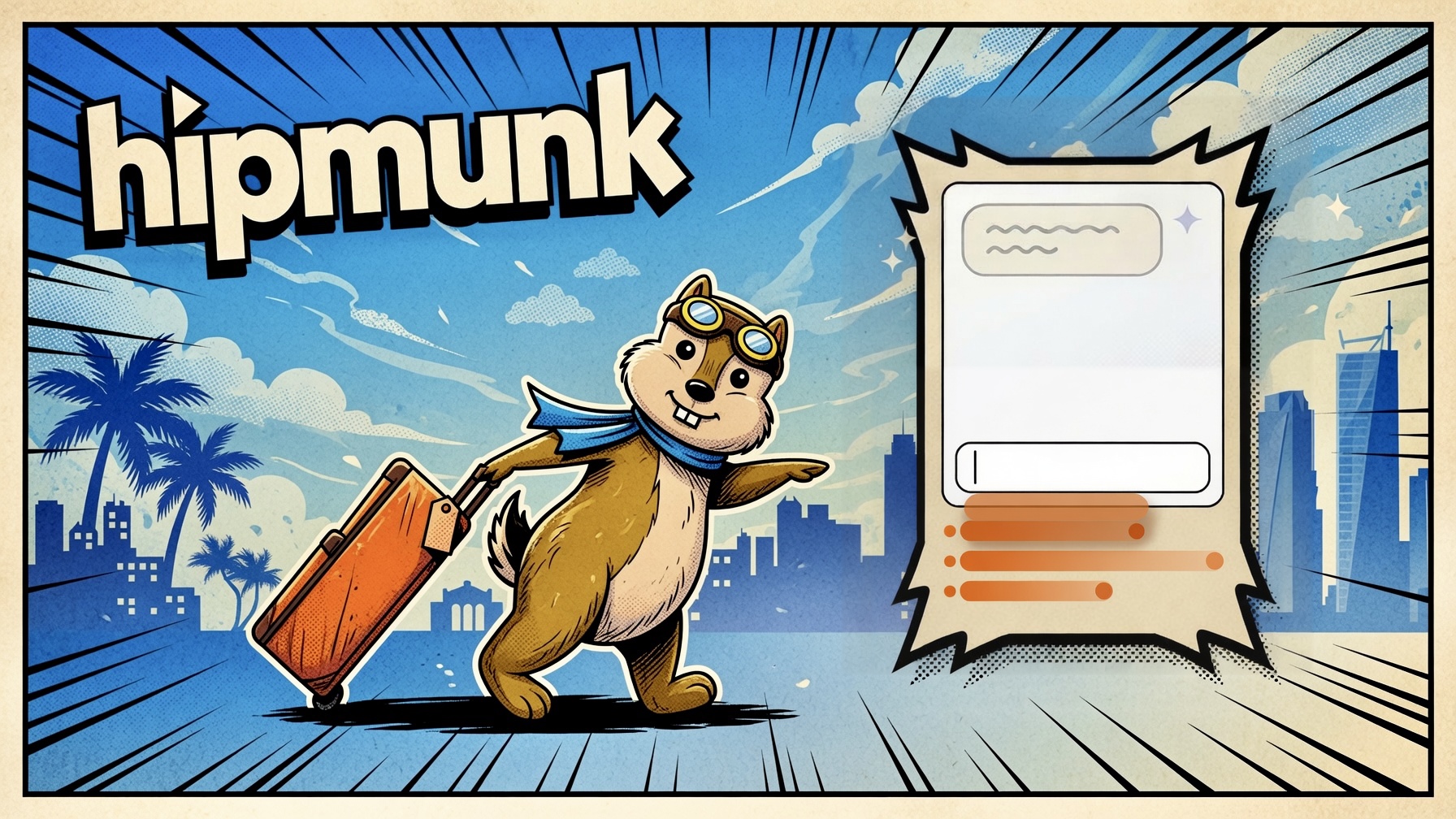
The travel industry stands at a crossroads where the sophisticated linguistic capabilities of generative artificial intelligence have yet to solve a fundamental problem addressed sixteen years ago by a startup called Hipmunk. When Hipmunk launched in 2010, it revolutionized travel search not through proprietary inventory, but through a radical reimagining of the user interface. Today, as the industry pivots toward Large Language Models (LLMs) and conversational agents, the "Agony" of travel planning persists, highlighting a significant gap between the ability to understand a query and the ability to present a solution effectively.
The Genesis of the Agony Index
In August 2010, Reddit co-founder Steve Huffman and Adam Goldstein launched Hipmunk with a simple premise: flight search was fundamentally broken. At the time, the industry standard—represented by incumbents like Expedia, Orbitz, and Kayak—presented flight options as an endless, vertical list of text-heavy boxes. For a traveler to compare a 6:00 AM flight with one stop against a 10:00 AM direct flight, they had to scroll back and forth, mentally cataloging times and prices.
Hipmunk introduced the "Agony Index," a proprietary algorithm that sorted flights based on a combination of price, flight duration, and the number of stops. More importantly, it displayed these results on a visual timeline, similar to a Gantt chart. This allowed users to see the entire day’s flight schedule at a glance, identifying "dead time" during layovers and comparing the visual "blocks" of different airlines.
This visual innovation was not merely an aesthetic choice; it was a cognitive tool. By mapping data points onto a spatial layout, Hipmunk reduced the cognitive load on the traveler. Despite its popularity among power users and tech enthusiasts, the history of the company serves as a cautionary tale for the modern AI era, demonstrating that a superior interface is often insufficient to overcome the gravity of market economics and distribution monopolies.
A Chronology of Innovation and Consolidation
The trajectory of Hipmunk reflects the broader shifts in the travel technology landscape over the last decade and a half.
- 2010: Launch and Rapid Adoption. Hipmunk launches at the TechCrunch Disrupt conference. It quickly gains a cult following for its "no-nonsense" approach and the inclusion of Amtrak results alongside flights.
- 2011-2014: Expansion and Hotel Search. The company expands into hotel search, introducing "Ecstasy" sorting (a counterpart to Agony) and heatmaps that showed hotel proximity to nightlife, shopping, and transit.
- 2015: The Conversational Pivot. Seven years before the public release of ChatGPT, Hipmunk launched "Hello Hipmunk." This was a pioneer in conversational commerce, allowing users to BCC an email address ([email protected]) or message a bot on Slack and Facebook Messenger to get travel recommendations via natural language.
- 2016: The Concur Acquisition. SAP Concur, the corporate travel and expense giant, acquired Hipmunk for an undisclosed sum (estimated at the time to be around $58 million). The move was intended to integrate Hipmunk’s user-friendly interface into the often-clunky world of corporate travel.
- 2020: The Shutdown. In early 2020, SAP announced it would retire the Hipmunk brand and its consumer-facing website. While some of the technology was integrated into Concur’s corporate tools, the standalone innovator ceased to exist.
The Economic Reality of Travel Search
The disappearance of Hipmunk was not a failure of design, but a symptom of the brutal economics of the travel meta-search industry. To understand why Hipmunk’s interface remains a benchmark today, one must analyze the forces that ultimately led to its sunset.
The Google Dominance
The primary headwind for any independent travel search engine is the dominance of Google. As Google integrated its own flight and hotel search products directly into the Search Engine Results Pages (SERPs), organic traffic for third-party innovators plummeted. Google’s ability to place its own "Google Flights" widget above all organic results meant that companies like Hipmunk had to rely heavily on paid acquisition.
High Customer Acquisition Costs (CAC)
Travel is a low-frequency, high-intent purchase. Most consumers book flights only once or twice a year. This makes the cost of acquiring a customer—often through expensive Google Ads or television marketing—extremely high compared to the thin commissions earned from airlines and hotels. While Hipmunk had high "word-of-mouth" organic growth, it lacked the multi-billion-dollar marketing budgets of Booking Holdings or Expedia Group.
The "Good Enough" Competitor
While Hipmunk’s interface was objectively more efficient for complex comparisons, competitors like Kayak and Google Flights eventually "borrowed" elements of its logic. While they never fully adopted the Gantt chart layout, they improved their filtering and sorting mechanisms enough that the average traveler felt the existing tools were "good enough," diminishing the unique value proposition of the Hipmunk brand.
The AI Paradox: Understanding Without Visualizing
As the travel industry enters the "AI-first" era, it faces a paradox. Modern AI, powered by LLMs, is exceptionally good at understanding intent. A traveler can now type, "Find me a flight to London next Tuesday that isn’t too early in the morning and has good Wi-Fi," and the AI will understand the request perfectly.
However, the output of these AI tools is often a regression in user experience. Most current AI travel implementations, including those from Expedia and Kayak using ChatGPT plugins, provide results in a "stream of text" or a series of individual cards.
This format forces the user to read through paragraphs of text to compare options—the exact problem Hipmunk solved in 2010. If an AI suggests three different flight itineraries, the user still has to mentally map out the layovers, arrival times, and price differences. The "conversation" has replaced the "search box," but it has not yet replaced the "comparison engine."
Data and Market Analysis: The Shift to Dynamic UI
Market data suggests that while travelers are open to AI, they remain frustrated by the "black box" nature of current recommendations. According to a 2023 travel sentiment survey, over 60% of travelers still prefer a grid or list view for final decision-making, even if they used a chatbot for the initial discovery phase.
The missing link in current AI travel tools is the lack of a "Dynamic UI." A truly evolved AI travel assistant should not just talk; it should build a custom interface on the fly. If a user asks for a comparison of five flights, the AI should generate a Hipmunk-style visual timeline. If the user asks about hotels near a specific conference center, the AI should generate a heatmap.
Industry analysts suggest that the next phase of travel tech will involve "Generative UI," where the software decides the best way to display data based on the specific query. This would move the industry away from the "fixed format" problem where every answer is a text bubble, and toward a more functional synthesis of natural language and data visualization.
Reactions from the Tech and Travel Community
The legacy of Hipmunk continues to resonate among product designers and travel executives. Former Hipmunk CEO Adam Goldstein has noted in various industry forums that while the technology for understanding travel queries has improved exponentially, the fundamental "unit of decision-making" in travel has not changed. Travelers still need to see the trade-offs between time and money.
Design experts frequently cite Hipmunk in case studies as an example of "information density done right." The criticism of current AI implementations is that they are "information sparse"—they provide an answer, but they don’t provide the context or the "why" behind the recommendation, which is crucial for high-stakes purchases like international travel.
Broader Implications for the Future of Search
The Hipmunk story provides two vital lessons for the current generation of AI developers. First, it proves that "understanding" a user’s need is only half the battle; the other half is presenting the solution in a way that facilitates a confident decision. Second, it serves as a reminder that in a platform-dominated economy, the best product does not always win if it cannot solve the distribution and monetization puzzle.
As AI companies move beyond the "chatbot" phase, they will likely find themselves looking backward at the innovations of 2010. The goal of future travel search will be to combine the conversational ease of an LLM with the visual clarity of the Agony Index.
The industry is currently seeing a surge in "AI-native" travel startups attempting to do exactly this. These companies are investing not just in the "brain" of the AI, but in a flexible front-end that can render complex data visualizations instantly. For these new players, the challenge will be to avoid the fate of Hipmunk by finding sustainable ways to bypass the Google-Expedia duopoly, perhaps through integration into broader digital assistants or by focusing on the high-margin corporate sector that SAP Concur originally targeted.
Ultimately, the "Agony" of travel search will only be solved when the interface is as smart as the underlying logic. Until AI can build a screen that allows for the same instant, visual comparison that Hipmunk pioneered nearly two decades ago, the traveler’s experience will remain a fragmented and unnecessarily complex process. The return of the "interface problem" suggests that while the tools of the trade have changed, the fundamental human need for clear, actionable information remains the same.