The Alibaba Qwen team has officially transitioned its latest flagship model, Qwen3.8-Max, into broad availability, marking a significant milestone in the evolution of large-scale Mixture-of-Experts (MoE) architectures. Alongside the commercial rollout of the Max variant, the organization confirmed that the open weights for the model are scheduled for release next week. In a simultaneous move to support the broader developer community, a secondary, more accessible checkpoint, Qwen3.8-27B, is also slated for an open-weights release. This dual-track strategy aims to cater to both enterprise-grade datacenter operations and on-premise hardware deployments, positioning Alibaba as a dominant force in the increasingly competitive landscape of multimodal generative artificial intelligence.
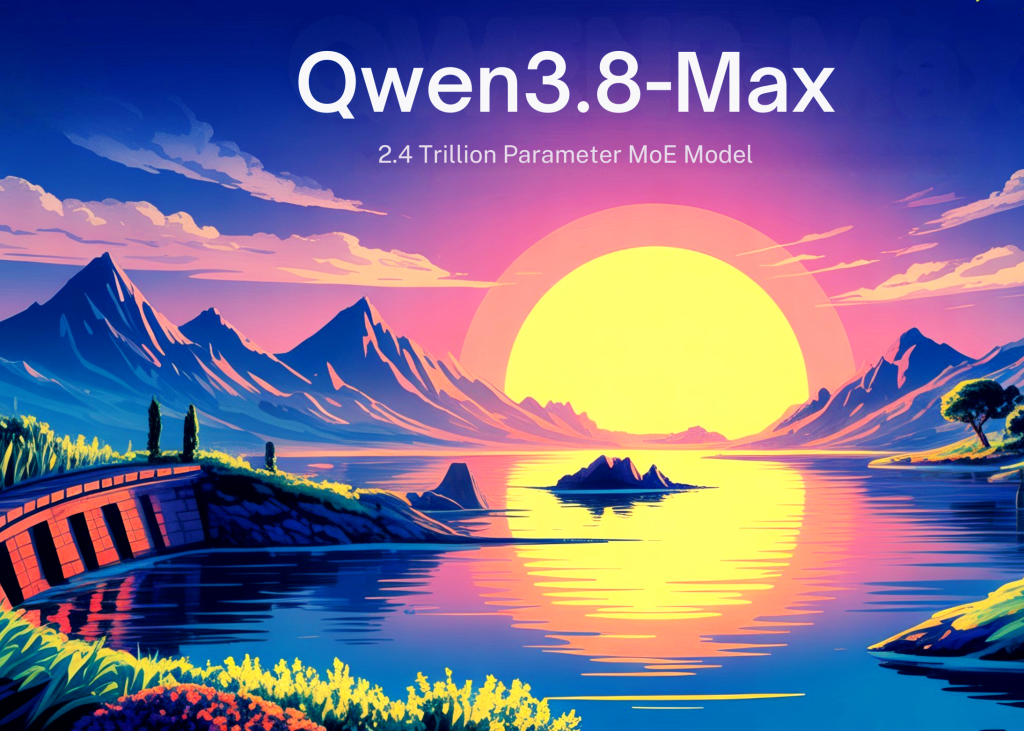
Qwen3.8-Max represents a monumental scaling effort, boasting a total of 2.4 trillion parameters. As a multimodal system, it is designed to accept inputs in the form of text, images, and video, while generating high-fidelity text outputs. This release follows a rapid succession of updates from the Qwen team, which has consistently pushed the boundaries of context window capacity, reasoning depth, and multimodal integration.
Technical Architecture and Deployment Logistics
The 2.4-trillion-parameter count of Qwen3.8-Max places it among the largest models ever made available via both API and open-weight formats. However, the sheer scale of the model introduces specific deployment considerations. While the hosted API is immediately accessible to organizations of all sizes—featuring full compatibility with OpenAI and DashScope protocols—the hardware requirements for local hosting are substantial.
Alibaba has categorized the Qwen3.8-Max checkpoint as a "multi-node datacenter artifact." Due to the massive memory footprint required to house 2.4 trillion parameters, serving the model locally necessitates a sophisticated multi-node GPU cluster. Notably, Alibaba has not yet disclosed the exact number of "activated parameters" per inference pass. In MoE architectures, only a fraction of the total parameters are engaged for any given token, which typically allows for faster inference than a dense model of the same total size. Without this specific data, industry analysts note that precise modeling of serving costs and energy consumption remains speculative for third-party providers.
To address the needs of developers without access to datacenter-scale infrastructure, the Qwen3.8-27B model serves as a strategic alternative. With 27 billion parameters, this model is designed to fit within the VRAM limits of standard professional-grade GPU hardware, such as the NVIDIA A100 or H100, and even high-end consumer setups depending on the quantization level.
Context Window and Pricing Structure
One of the defining features of the Qwen3.8-Max release is its expansive context window. The model supports a 1-million-token context, though the practical limits vary slightly based on the operational mode. For standard inputs, the maximum capacity is 991,000 tokens. When the "thinking" or reasoning mode is enabled—a feature designed to enhance the model’s logical consistency and problem-solving depth—the input limit shifts to 983,000 tokens to accommodate internal processing overhead.
The output capabilities are equally robust, providing up to 131,000 tokens in both standard and reasoning modes. Furthermore, the model allocates a dedicated reasoning budget of up to 262,000 tokens, allowing for extended chain-of-thought processing for complex mathematical or scientific inquiries.
Alibaba has introduced a competitive pricing tier for the Qwen3.8-Max API:
- Standard Input: $2.00 per 1 million tokens.
- Standard Output: $6.00 per 1 million tokens.
A significant focus of this release is cost-efficiency through advanced caching mechanisms. The API supports both implicit and explicit caching. Implicit cache reads are priced at $0.25 per 1 million tokens. For developers requiring more control, explicit cache creation costs $2.50 per 1 million tokens, while subsequent reads from the explicit cache are reduced to $0.17 per 1 million tokens. This pricing model suggests that "prefix stability"—reusing large portions of a prompt across multiple requests—is the primary driver of cost reduction, making the model highly economical for iterative tasks like document review or multi-turn coding assistants.
Performance Benchmarks and Competitive Landscape
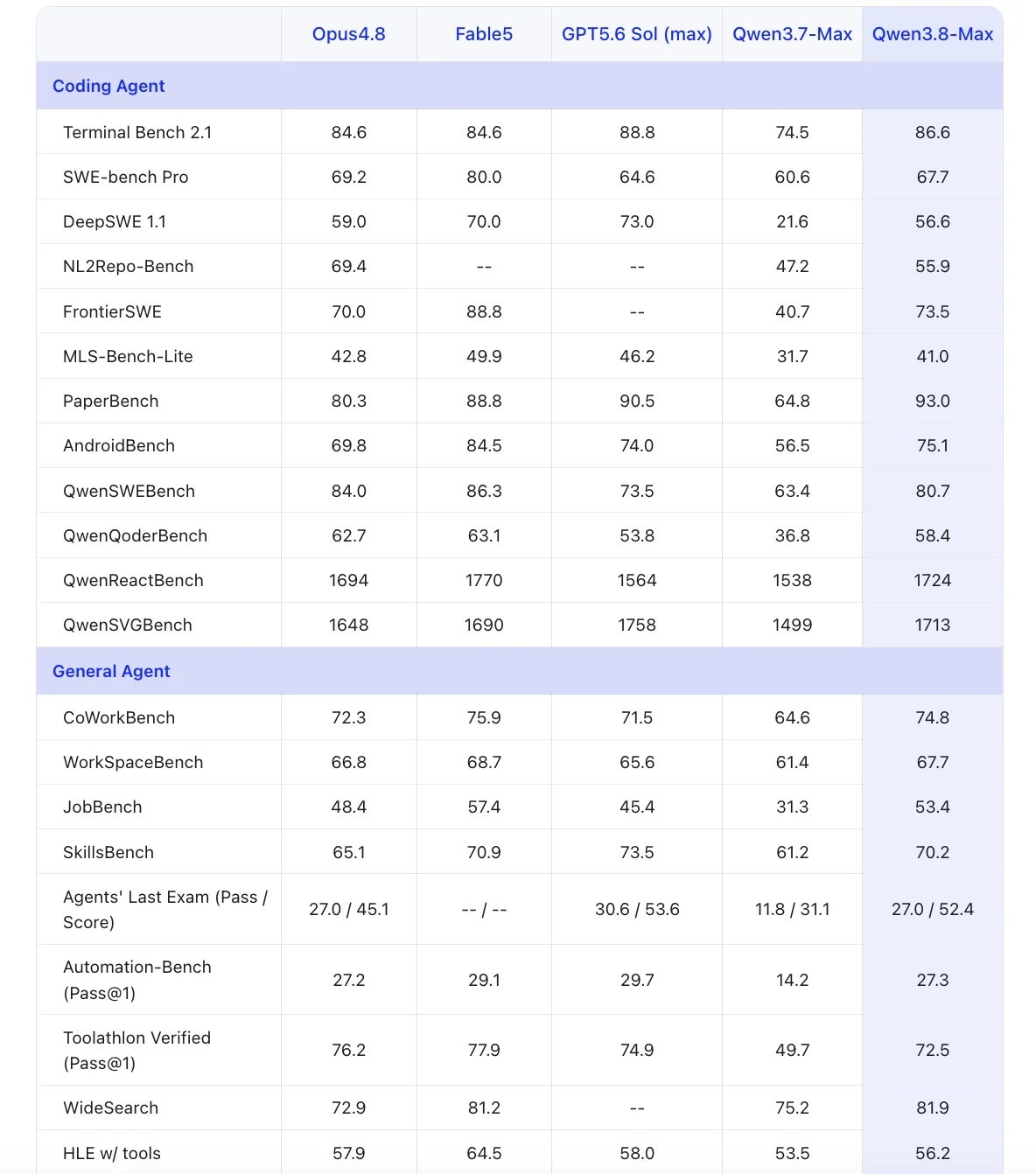
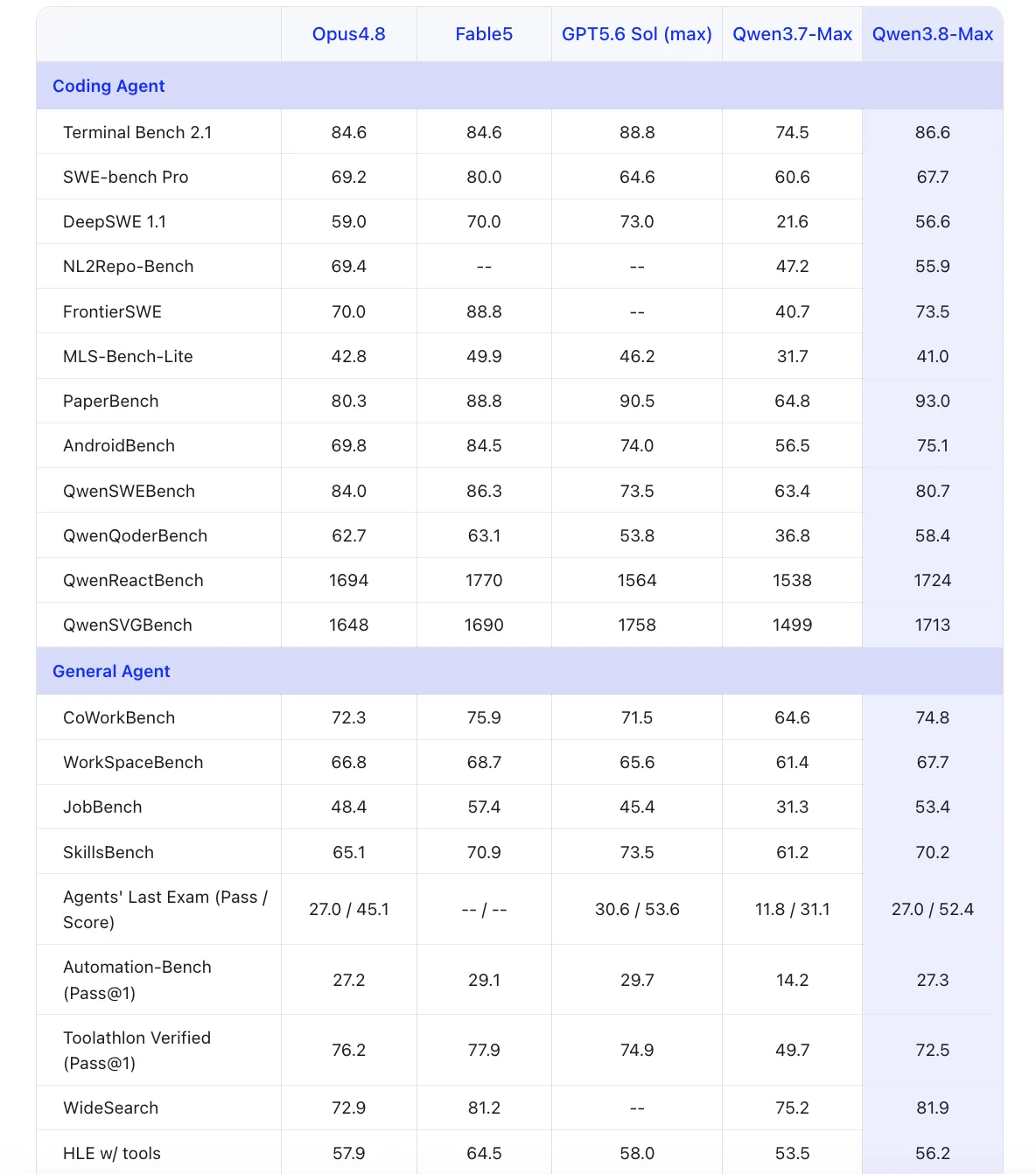
The performance data released by Alibaba suggests that Qwen3.8-Max is a top-tier contender, particularly in multimodal and agentic tasks. In the Terminal-Bench 2.1 evaluation, which measures a model’s ability to interact with shell environments and execute technical commands, Qwen3.8-Max scored 86.6. This performance places it ahead of Claude Opus 4.8 and Claude Fable 5 (both scoring 84.6) and just behind the current industry leader, GPT-5.6 Sol (max), which holds a score of 88.8.
In specialized software engineering benchmarks, the results show a more nuanced competitive field. On SWE-bench Pro, Qwen3.8-Max recorded a score of 67.7, trailing Claude Fable 5’s 80.0. Similarly, on FrontierSWE, the model achieved 73.5 compared to Fable 5’s 88.8. However, the Qwen model reclaimed the lead in academic and instruction-following benchmarks, topping the charts in PaperBench (93.0) and IFBench (82.8).
The leap from the previous generation, Qwen3.7-Max, is most evident in vision and agentic capabilities:
- GPQA Diamond: Increased slightly from 92.4 to 92.6.
- DeepSWE 1.1: Jumped from 21.6 to 56.6.
- FrontierSWE: Improved from 40.7 to 73.5.
- JobBench: Rose from 31.3 to 53.4.
Vision-based benchmarks also highlight the model’s strengths, with Qwen3.8-Max leading in OSWorld-Verified (86.1), Parametric CAD Bench (91.5), and OmniDocBench 1.5 (92.1). Analysts have noted two caveats regarding these figures: the multimodal benchmarks were compared against Qwen3.7-Plus rather than the Max version, which may exaggerate the generational improvement. Additionally, Alibaba’s internal Reinforcement Learning (RL) scaling data indicates a performance peak at approximately 4,000 training environments, with slight regressions observed beyond that point, suggesting a potential "diminishing returns" threshold in current RL scaling techniques.
Targeted Industry Applications
The feature set of Qwen3.8-Max appears specifically engineered to disrupt four primary industries:
1. Software Engineering
With high scores in terminal-based benchmarks and support for repository-scale context, the model is positioned as a backbone for autonomous coding agents. Its ability to index entire codebases within its 1M context window allows it to perform complex refactoring, bug detection, and architectural suggestions that were previously impossible for models with shorter windows.
2. Legal and Financial Document Review
The combination of a massive context window and low-cost caching makes the model ideal for analyzing thousands of pages of legal discovery or financial reports. The "structured output" capability ensures that data extracted from these documents can be piped directly into enterprise databases without manual formatting.
3. Media and E-commerce Operations
The model’s vision and video indexing capabilities allow for the automated tagging, searching, and summarization of long-form video content. In e-commerce, this translates to automated product description generation from video demonstrations and intelligent visual search capabilities.
4. Research and Design
The high reasoning budget and multimodal input support enable the model to act as a sophisticated research assistant. It can process scientific papers (PaperBench 93.0), interpret complex CAD designs (91.5 on CAD Bench), and assist in multi-step hypothesis testing.
Chronology of the Qwen Evolution
The release of Qwen3.8-Max is the culmination of an aggressive development timeline that has seen Alibaba evolve from a regional player to a global AI leader:
- Early 2023: Introduction of the initial Qwen-7B and Qwen-14B models, establishing the foundation for Alibaba’s open-source presence.
- Late 2023 – Early 2024: Release of Qwen1.5 and Qwen2, which introduced improved MoE architectures and expanded language support.
- Mid 2024: The launch of Qwen2.5, which solidified the model’s reputation for coding and mathematical excellence.
- Late 2025 – 2026: The transition to the Qwen3 series, focusing on "Reasoning-first" architectures and massive multimodal integration, culminating in the Qwen3.8-Max release.
Strategic Implications and Market Reaction
The decision to release the weights for a 2.4-trillion-parameter model is a significant challenge to the "closed-source" dominance of companies like OpenAI and Anthropic. By providing the weights, Alibaba allows researchers to scrutinize the model’s architecture and enables enterprises to fine-tune the system on sensitive, proprietary data within their own secure environments.
Industry reactions have been largely positive, though some caution remains regarding the practicalities of the 2.4T checkpoint. "While the API is a direct competitor to GPT-5.6, the open weights are a different beast," noted one lead researcher at a major AI lab. "Most companies simply don’t have the hardware to run a 2.4T MoE model. The real story might be the 27B model, which brings Qwen3-level reasoning to the average enterprise server."
Furthermore, the inclusion of built-in tools such as code_interpreter, web_search, and web_extractor directly within the Responses API indicates a shift toward "agent-ready" models. These tools allow the model to interact with the real world in real-time, reducing the need for developers to build complex wrapper scripts for basic agentic functions.
As the AI industry moves toward larger context windows and higher reasoning budgets, Qwen3.8-Max stands as a testament to the viability of the MoE approach at an extreme scale. The upcoming open-weights release next week will likely spark a new wave of innovation in the open-source community, as developers begin to experiment with the largest "open" model ever created. For now, the Qwen3.8-Max API remains a formidable tool for enterprises looking to leverage state-of-the-art multimodal reasoning with a clear path toward cost-efficient scaling.