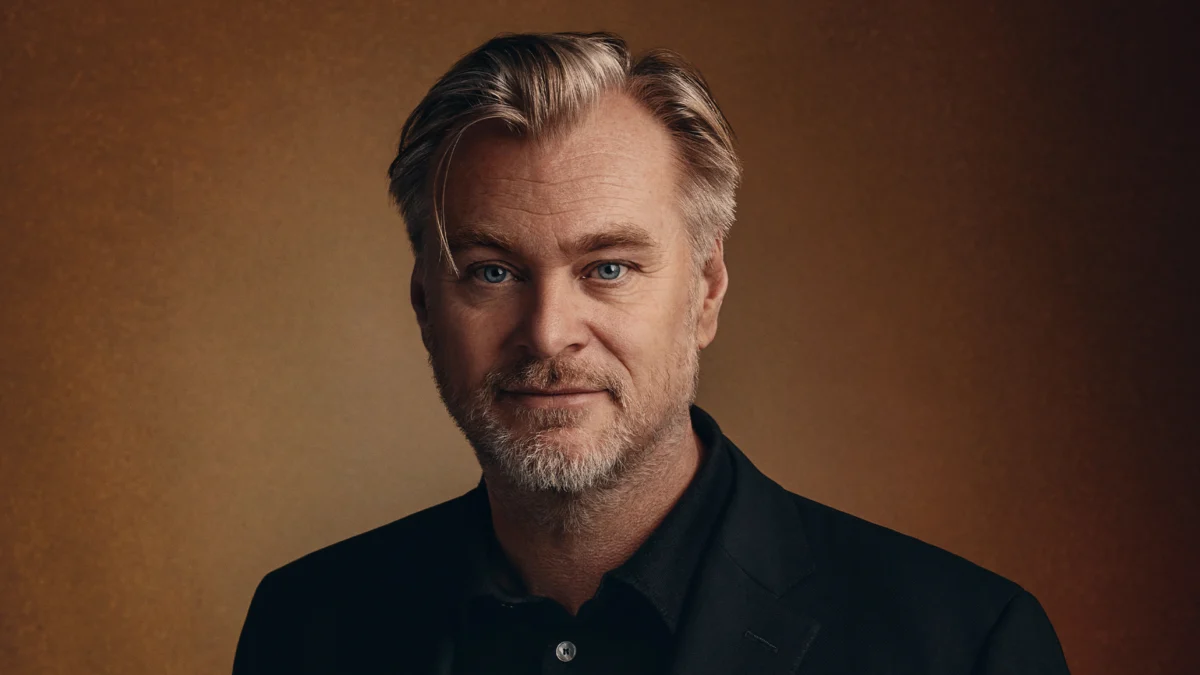
Despite its recent dethroning at the box office by "Spider-Man: Brand New Day," Christopher Nolan’s epic adaptation of "The Odyssey" continues to be a focal point of discussion, largely due to a remarkably philosophical press tour interview the acclaimed director conducted in China. In a rare departure from typical promotional circuits, Nolan engaged in a deep dive with Chinese podcaster and political philosophy lecturer Zhong Shu in Beijing. The conversation, initially broadcast on China’s Bilibili video platform, eschewed lighthearted anecdotes and production details for a profound exploration of art, history, storytelling, modern film criticism, and even the subtle appearance of Christian concepts of atonement within his soon-to-be billion-dollar blockbuster. This candid exchange has since gained significant traction, offering an unprecedented glimpse into the mind of one of the world’s most influential filmmakers at the zenith of his creative powers.
A Bard for a Civilization at Dusk: Nolan’s Historical and Thematic Reflections
The interview commenced with Zhong Shu’s evocative description of Nolan as a modern-day bard, drawing a parallel to Homer’s role in ancient Greece. Shu contrasted Homer’s epic poem, often interpreted as a celebration of war and victory, with Nolan’s adaptation, which she posited reflects a more contemporary, perhaps even somber, worldview. She posed the profound question of whether Nolan, given the tone of his film, saw himself as a "bard of a civilization at dusk."
Nolan responded with characteristic thoughtfulness, acknowledging the aptness of the question. He elaborated on the significant temporal gap—approximately 400 years—between the events depicted in Homer’s original epic and its eventual transcription. This historical chasm, he explained, became a central fascination during his adaptation process. Nolan highlighted that Homer himself was writing about an era perceived by his contemporaries as more advanced, a civilization striving to recapture a past glory. This cyclical view, he suggested, inherently contains the seeds of "a civilization at dusk." He pointed to archaeological discoveries of monumental "Cyclopean walls," which ancient Greeks attributed to giants, as evidence of their reverence for a lost, greater past. This historical context, particularly the Bronze Age collapse that occurred between the Trojan War and Homer’s time, deeply informed his interpretation.
"I think [those themes are] something that from a modern perspective is frightening and interesting," Nolan stated. He further linked this sensibility to his preceding project, "Oppenheimer," a film inherently concerned with the end of the world and civilizational collapse. "So I think yeah I definitely carried that sensibility into this adaptation of The Odyssey," he confessed, underscoring a thematic continuity in his recent work. This reflection suggests a director grappling with contemporary anxieties through the lens of ancient narratives, finding echoes of our present in the ruins of the past.
The Enigma of Atonement: Reinterpreting Ancient Greek Concepts
The conversation then shifted to a more provocative theme: the concept of atonement. Zhong Shu pointed out that the notion of atonement, as understood in a Judeo-Christian context, is largely absent from ancient Greek culture, language, and Homer’s poem. She directly inquired whether Nolan had "Christianized The Odyssey" and the rationale behind the prominence of atonement in his film.
Nolan, while not explicitly conscious of a deliberate philosophical endeavor to "Christianize" the work, focused on the ancient Greek concept of "xenia," often translated as "guest-friendship" or "hospitality." In the film, this is simplified to "Zeus’s Law," emphasizing mutual respect and the principle of treating others as one wishes to be treated, partly due to the belief that divine beings might be disguised among mortals. Nolan explained his deep engagement with this concept, noting its connection to historical mysteries like the "sea peoples," who are theorized to have contributed to the Bronze Age collapse. He posited that a violation of "xenia," or Zeus’s Law—as exemplified by the suitors’ actions in Odysseus’s palace—is the fundamental transgression that precipitates the film’s central conflicts and damages.
Regarding the presence of atonement, Nolan suggested it might be an element that viewers bring to the narrative through their modern sensibilities. "I don’t know whether there really is atonement in the film, or whether we just feel that catharsis or that’s the process we’re seeing in the final meeting that we’ve waited for between Odysseus and Penelope," he mused. He clarified that if atonement is perceived, it is not a conscious attempt to impose Christian theology but rather a natural consequence of delving into the philosophical implications of violating fundamental laws. This perspective invites a re-examination of how ancient ethical frameworks resonate and are reinterpreted through contemporary cultural lenses.
Navigating Modern Film Criticism and the Art of Storytelling
The discussion returned to the relationship between Nolan’s adaptation and Homer’s original poem, with Zhong Shu probing whether Nolan’s version "apologizes" for the inherent "greatness" often celebrated in classical narratives, adapting it to suit modern sensibilities. She questioned if "The Odyssey" had become a story of "apology that demands repentance, and reflection and self-criticism."
Nolan offered a nuanced perspective on storytelling and audience engagement. He asserted that storytelling is an ongoing dialogue between the creator and the audience’s expectations. He critiqued a prevalent flaw in modern film criticism: the notion that a character must be made universally sympathetic, often leading to manipulation or alteration of the character’s essence. "To be able to identify the mechanism does not invalidate the mechanism," he argued, addressing the tendency for critics to dismiss a story’s emotional impact simply because they understand its underlying techniques. He described this as a significant problem in contemporary criticism, where the recognition of narrative devices is mistakenly seen as proof of their ineffectiveness.
Nolan emphasized that when storytellers craft heroic figures, they must be acutely aware of the audience’s inherent predispositions and the dynamic interplay between their intentions and the audience’s reception. The identifiability of a narrative mechanism, he maintained, does not diminish its power. He then addressed the contemporary demand for equality, questioning whether "greatness" must be presented as something to be "apologized for." His answer was pragmatic: "yes, we do, or the audience rejects the greatness, and that is part of the mechanism." Again, he reiterated that the transparency of this mechanism does not render it invalid or unusable.
Later in the interview, Nolan further distinguished between professional and "amateur" film criticism. He suggested that professional critics generally grasp the necessity of narrative mechanisms, which constitute the "lingua franca of storytelling" developed by Hollywood over the past century. This universal language, he noted, is remarkably accessible and understood globally. He described it as a dynamic system with conventions that can be bent or broken, but always with an awareness of their existence. His critique of "amateur" criticism focused on those who, upon identifying a mechanism, feel it negates the story’s impact. He acknowledged that certain tropes, when overused, necessitate evolution, but filmmakers consistently leverage this shared cinematic language, building upon the audience’s accumulated experience with numerous films.
Nolan drew a parallel to his own work, specifically referencing his 2000 film "Memento." He explained that while the film’s chronological structure was unconventional, presented in reverse, it retained a familiar and clear three-act structure. This deliberate juxtaposition of an unconventional surface with a conventional foundation, he argued, is a strategic choice filmmakers make to innovate. "You have to make your choices in terms of ‘how am I orienting the story?’" he stated, illustrating that the manipulation of narrative form is a conscious and effective tool in filmmaking, allowing for surface-level alterations while grounding the experience in established narrative principles.
Broader Implications and Context
This extensive interview in Beijing, far from being a standard promotional stop, represents a significant moment in how international filmmakers engage with diverse cultural audiences and intellectual discourse. Nolan’s willingness to delve into complex philosophical and thematic territory, rather than adhering to pre-packaged soundbites, underscores a growing trend of seeking deeper engagement with global audiences. The interview’s virality on platforms like Bilibili suggests a strong appetite for intellectual engagement with popular culture in China.
The timing of this interview, following "Oppenheimer’s" critical and commercial success and leading into the global rollout of "The Odyssey," places Nolan at a unique juncture. His insights into the enduring power of classical narratives, their adaptability to contemporary concerns, and his nuanced defense of storytelling mechanisms offer valuable perspectives on the art form’s evolution. Furthermore, his reflections on the role of criticism highlight a perennial tension between analytical dissection and the visceral experience of cinema. As "The Odyssey" continues its box office journey, this philosophical interlude in Beijing is likely to inform how audiences and critics alike perceive Nolan’s ambitious reimagining of an ancient epic for a modern world. The conversation serves as a testament to the enduring power of storytelling to bridge cultural divides and provoke profound introspection.