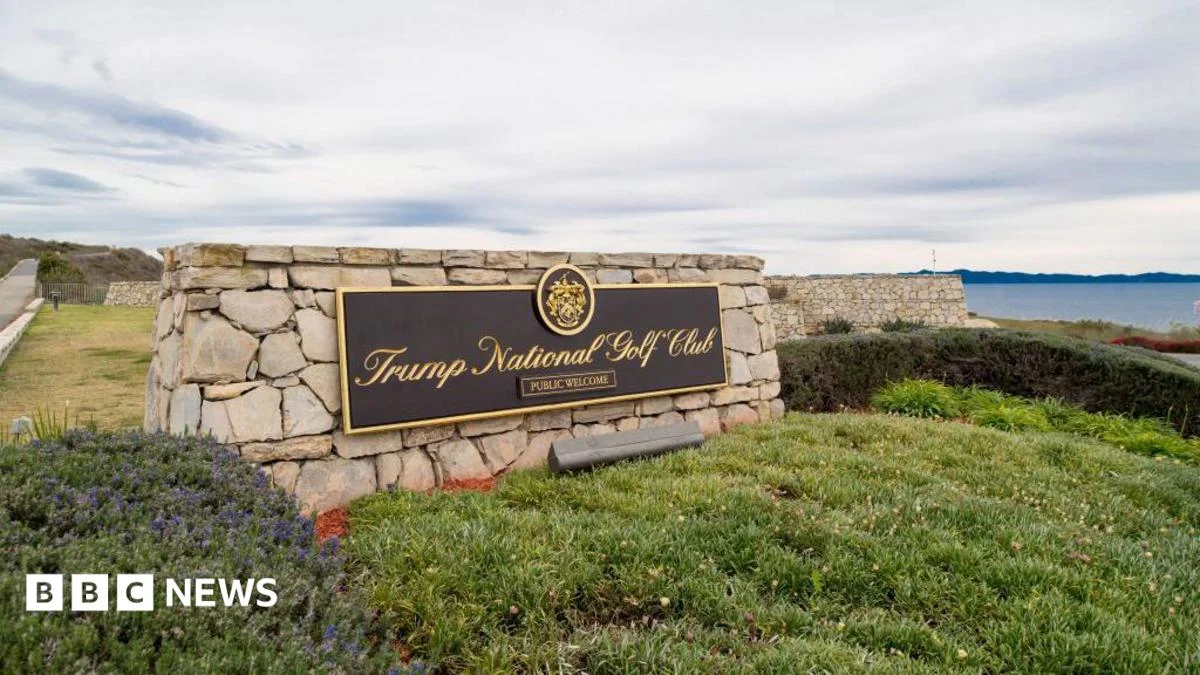
A significant security incident unfolded in Southern California as authorities apprehended a man found in proximity to the Trump National Golf Club in Rancho Palos Verdes, just days before former President Donald Trump was scheduled to host a high-profile fundraising event at the exclusive venue. The arrest of Jeanine John Taele, 38, on Sunday afternoon led to the discovery of an illicit arsenal and deeply concerning materials, prompting a multi-agency investigation involving federal, state, and local law enforcement. While officials have not yet linked Taele to any credible threat against the former president, the incident has underscored the intricate challenges of dignitary protection and the vigilance required in an era of heightened political tension.
The Initial Discovery and Arrest in Rancho Palos Verdes
The series of events that led to Taele’s arrest began on Sunday, around 15:30 ET (23:30 BST), when plainclothes federal agents, conducting advance security assessments for the impending presidential visit, observed a suspicious individual on the sprawling grounds of the Trump National Golf Club. Located in the affluent coastal enclave of Rancho Palos Verdes, known for its dramatic bluffs, panoramic ocean views, and exclusive residential communities, the golf course was a critical focal point for security preparations. The individual, later identified as Jeanine John Taele, was reportedly seen "walking throughout the golf course grounds taking photographs and videos and appearing to monitor security-planning activities," according to a statement released by the Los Angeles County Sheriff’s Department.
The federal agents, trained to identify anomalies in pre-event security landscapes, promptly relayed their observations to local authorities. Deputies from the Los Angeles County Sheriff’s Department responded swiftly, confronting Taele on the golf course premises. During the interaction, law enforcement officers discovered that Taele was in possession of a pistol and, critically, illegal ammunition. Further investigation revealed that he was also being sought on an outstanding warrant issued by the El Segundo Police Department, approximately 15 miles north of Rancho Palos Verdes, in connection with a robbery investigation. The discovery of the outstanding warrant immediately elevated the gravity of the encounter, shifting it from a potential trespassing or minor firearms violation to a more serious criminal apprehension.
Unraveling the Arsenal: Weapons and Prohibited Ammunition
Upon searching Taele, deputies found a 16-round magazine loaded with hollow-point ammunition on his person. This discovery alone constituted a significant violation of California’s stringent gun laws, which prohibit magazines capable of holding more than 10 rounds. The vehicle associated with Taele, found parked at the golf course, was subsequently searched. Inside, investigators uncovered a loaded pistol, alongside another loaded magazine also containing hollow-point ammunition.
The types of ammunition seized are particularly noteworthy. Hollow-point bullets are designed to expand upon impact, maximizing tissue damage and causing severe internal injuries. While not universally illegal for possession in all contexts, their presence in high-capacity magazines is strictly regulated in California. The state boasts some of the toughest gun control measures in the United States, enacted in response to a history of gun violence. These laws include bans on certain types of firearms classified as "assault weapons," universal background checks, waiting periods for firearm purchases, and prohibitions on high-capacity magazines. The possession of a 16-round magazine directly contravenes these regulations, indicating a deliberate disregard for state law. Taele was initially booked on charges of carrying a concealed firearm and possession of armor-piercing/prohibited ammunition, with the El Segundo robbery warrant adding to his legal entanglements.
Escalation of the Investigation: Home Raid and Disturbing Discoveries
The discovery of illegal weapons and ammunition, coupled with the suspicious behavior near a presidential security detail and an outstanding robbery warrant, prompted an immediate escalation of the investigation. On Monday, less than 24 hours after Taele’s arrest, a multi-agency task force executed a search warrant at his residence in Downey, a city also located within the sprawling Los Angeles metropolitan area, roughly 25 miles inland from Rancho Palos Verdes. The raid was spearheaded by agents from the FBI’s Joint Terrorism Task Force (JTTF) and the Los Angeles County Sheriff’s Department Major Crimes Bureau. The involvement of the JTTF, a collaborative unit comprising federal, state, and local law enforcement personnel dedicated to investigating and preventing terrorism, signaled that authorities were treating the incident with the utmost seriousness, assessing potential broader security implications.
The search of Taele’s Downey home yielded an alarming cache of items, significantly expanding the scope of the investigation. Among the discoveries were an "illegally modified AR platform rifle," a .45 pistol, and multiple high-capacity magazines – again, explicitly prohibited under California law. Furthermore, investigators found a "plethora of bullets for pistols and rifles," indicating a substantial personal ammunition supply. Perhaps most concerning were the findings of body armor and "multiple notebooks containing concerning statements." The presence of body armor suggests an intent for self-protection in potentially violent confrontations or a preparedness for offensive actions. The content of the notebooks, while not yet publicly disclosed, is a critical piece of evidence being meticulously analyzed by investigators for any indications of motive, intent, or connections to other individuals or groups. The Sheriff’s Department explicitly stated that the home search was conducted due to the "potential security implications surrounding the incident."
Chronology of a Developing Security Incident
- Sunday Afternoon (Approx. 15:30 ET / 23:30 BST): Plainclothes federal agents observe Jeanine John Taele acting suspiciously, taking photos and videos, and seemingly monitoring security activities at the Trump National Golf Club in Rancho Palos Verdes.
- Sunday Afternoon/Evening: Federal agents report observations to local authorities. Los Angeles County Sheriff’s deputies confront Taele, leading to his arrest. Deputies discover a pistol and a 16-round magazine with hollow-point ammunition on his person. Taele is identified as having an outstanding robbery warrant from El Segundo Police Department. His vehicle is searched, revealing another loaded pistol and high-capacity magazine.
- Sunday Evening: Taele is booked on charges including carrying a concealed firearm and possession of armor-piercing/prohibited ammunition, in addition to the outstanding robbery warrant.
- Monday: A multi-agency task force, including the FBI’s Joint Terrorism Task Force and the LA County Sheriff’s Major Crimes Bureau, executes a search warrant at Taele’s residence in Downey.
- Monday: The search uncovers an "illegally modified AR platform rifle," a .45 pistol, body armor, numerous high-capacity magazines, a large quantity of ammunition, and "multiple notebooks containing concerning statements."
- Ongoing: The investigation continues with assistance from the U.S. Secret Service, analyzing seized evidence and assessing potential further charges.
- Tuesday: Former President Donald Trump is scheduled to attend a Republican party fundraising dinner at the Trump National Golf Club in Rancho Palos Verdes.
- Wednesday: Former President Trump is slated to travel to Las Vegas for a speech.
The Broader Context: Presidential Security and Political Landscape
This incident unfolded against the backdrop of a rare visit by former President Trump to California, a state predominantly aligned with the Democratic Party but nonetheless a crucial hub for political fundraising and donor engagement. Trump’s itinerary included a Republican fundraising dinner at his golf course on Tuesday, where he was expected to deliver a speech critical of California Governor Gavin Newsom. Newsom, a prominent Democrat, is widely considered a potential candidate for the presidency in 2028, particularly after the conclusion of Trump’s current term or potential future term. Trump’s visit, which also includes a speech in Las Vegas on Wednesday, is part of a broader ramping up of campaign activity ahead of the crucial mid-term elections in November, where the balance of power in Congress remains hotly contested.
The protection of current and former presidents, as well as their immediate families, falls under the purview of the U.S. Secret Service. This elite agency employs extensive advance teams, intelligence gathering operations, and highly coordinated security protocols to ensure the safety of its protectees. Any suspicious activity detected near a presidential visit site is treated with the utmost seriousness, triggering immediate responses and collaborative efforts with local and state law enforcement. The involvement of plainclothes federal agents in the initial observation underscores the meticulous, multi-layered security apparatus deployed for such events.
The sensitivity surrounding presidential security is further amplified by former President Trump’s own history. The article notes that Trump has reportedly "survived three assassination attempts in recent years." While specific details of these alleged attempts are often guarded for security reasons, such incidents, real or perceived, invariably lead to reviews and enhancements of security protocols. The most recent alleged incident, where a gunman reportedly stormed a hotel in Washington during a White House dinner, prompted a public statement from Trump’s security team about reviewing their protective measures. This history adds a palpable layer of urgency and gravity to any security breach or suspicious activity occurring in close proximity to the former president.
Official Reactions and Analysis of Implications
Despite the alarming discoveries, the Los Angeles County Sheriff’s Department, in its news release, sought to reassure the public. The statement emphasized that authorities "have not identified any credible threat to our communities." This carefully worded phrase is common in investigations of this nature, aiming to balance transparency with preventing undue public alarm while the full extent of a threat, if any, is still being assessed.
However, the sheriff’s statement also underscored the critical lessons drawn from the incident: "However, this case underscores the importance of vigilance, strong partnerships with local, state, and federal law enforcement agencies, and the proactive steps taken to identify and investigate suspicious activity before it can escalate." This highlights the success of the pre-emptive security measures and inter-agency cooperation that led to Taele’s apprehension. The rapid deployment of the FBI JTTF and the involvement of the Secret Service further illustrate the seamless coordination required for high-stakes security operations.
Legal and Security Implications:
The legal ramifications for Jeanine John Taele are substantial. Beyond the initial charges of carrying a concealed firearm and possession of prohibited ammunition, the discovery of the "illegally modified AR platform rifle," body armor, and additional high-capacity magazines from his home will almost certainly lead to a cascade of new state felony charges. Depending on the content of the "concerning statements" in the notebooks and any other evidence uncovered, federal charges, potentially related to making threats against a federal official or violations of federal firearms laws, could also be considered. The outstanding robbery warrant from El Segundo further complicates his legal standing, ensuring he faces a complex and lengthy judicial process.
From a security perspective, the incident serves as a stark reminder of the constant threat landscape faced by high-profile political figures. While no direct link to a plot against former President Trump has been established, the proximity, the suspicious monitoring, and the nature of the arsenal discovered — particularly the "concerning statements" and body armor — naturally raise questions about potential intent and motivation. The Secret Service will undoubtedly incorporate findings from this ongoing investigation into their operational intelligence and protective strategies. The incident also reinforces the critical role of vigilant citizens and professional security personnel in reporting suspicious behavior, proving that proactive intervention can avert potential crises.
The case also sheds light on the challenges of enforcing strict gun laws. Despite California’s comprehensive regulations, individuals determined to acquire and possess illegal firearms and accessories can still do so. The "illegally modified AR platform rifle" is a case in point, demonstrating attempts to circumvent existing bans. The sheer volume of ammunition and prohibited items found in Taele’s residence highlights the ongoing struggle to control the proliferation of dangerous weapons, even in states with robust legislative frameworks.
As the investigation progresses, with agents from multiple agencies meticulously sifting through digital evidence, forensic analysis of the weapons, and the contents of the seized notebooks, more details are expected to emerge. The community and security agencies alike will be watching closely for further insights into Jeanine John Taele’s motives and whether his actions were an isolated incident or part of a larger, undisclosed agenda. The incident stands as a potent reminder of the persistent vigilance required to safeguard public figures and maintain public safety in a complex and often volatile political climate.