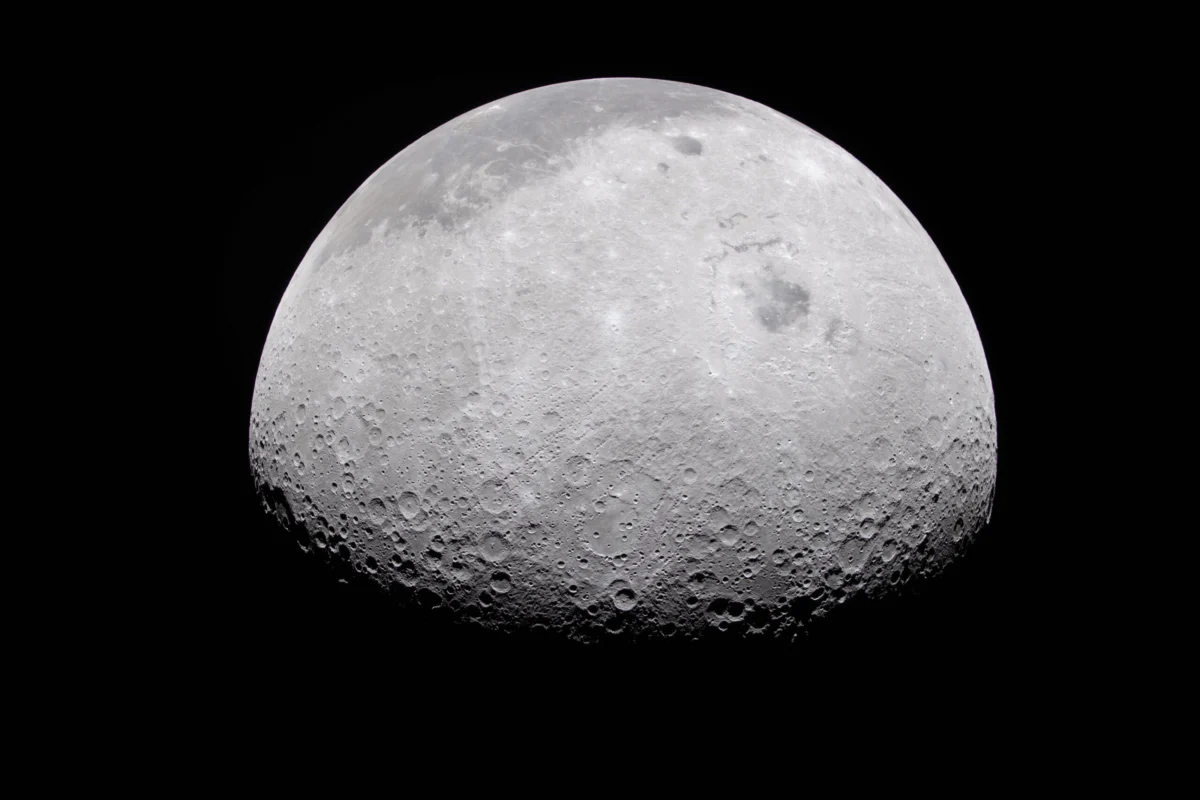
A used Falcon 9 upper stage from a commercial mission, launched by SpaceX, is slated to impact the Moon on Wednesday, August 5, near the Einstein and Bell craters. This event, tracked extensively by NASA and SpaceX using a combination of ground-based telescopes and sophisticated space-based assets, presents a rare scientific opportunity despite its unplanned nature. While the impact poses absolutely no danger to Earth, NASA scientists are poised to collect crucial lunar data from the event, aiming to refine techniques for tracking objects in deep space and enhance understanding of the lunar environment.
Genesis of the Lunar Trajectory: A CLPS Mission’s Legacy
The journey of the Falcon 9 upper stage began on January 15, 2025, when it successfully launched from Earth, carrying Firefly Aerospace’s Blue Ghost 1 lunar lander. This mission was a pivotal part of NASA’s Commercial Lunar Payload Services (CLPS) initiative, a program designed to engage commercial partners in delivering NASA science and technology payloads to the lunar surface. The CLPS initiative represents a significant paradigm shift in space exploration, leveraging the agility and innovation of private industry to accelerate scientific discovery and pave the way for human return to the Moon under the Artemis program.
Firefly Aerospace’s Blue Ghost 1 lander, specifically, was tasked with delivering ten NASA-sponsored payloads to the Moon’s Mare Crisium. These payloads included a diverse array of scientific instruments designed to study lunar regolith properties, thermal behavior, magnetic fields, and other aspects crucial for future human exploration. The successful deployment of Blue Ghost 1 marked a significant milestone for Firefly Aerospace and for the CLPS program, demonstrating the viability of commercial lunar delivery services.
Following its primary mission to deploy the Blue Ghost 1 lander into a trans-lunar injection trajectory, the Falcon 9 second stage, having expended its propellant, became a piece of inert space hardware. Normally, upper stages are often maneuvered into disposal orbits, sometimes burning up in Earth’s atmosphere or being sent into heliocentric (solar) orbits. However, in this particular instance, a confluence of celestial mechanics—primarily the subtle but persistent influence of solar activity and Earth-Moon gravitational forces—perturbed the stage’s trajectory, causing its unplanned return path toward the lunar surface. This phenomenon underscores the complex orbital dynamics at play in the Earth-Moon system and the challenges of predicting the long-term behavior of objects in deep space. NASA and SpaceX have remained in close communication throughout this process, meticulously tracking the upper stage’s flight path as it approached its lunar rendezvous.
Discovery, Confirmation, and Tracking Refinements
The impending lunar impact was first identified not by a major space agency, but by independent astronomers utilizing publicly available tracking data. This highlights the growing role of citizen science and global astronomical networks in space situational awareness. These independent observations served as an early warning, prompting official verification. Subsequently, NASA’s Center for Near Earth Object Studies (CNEOS), located at the agency’s Jet Propulsion Laboratory (JPL) in Southern California, confirmed the trajectory. CNEOS, primarily known for its vigilant monitoring of natural objects that could pose hazards to Earth, applied its sophisticated tracking algorithms to the Falcon 9 stage, ultimately confirming a 100% chance of lunar impact. This confirmation underscored the precision of modern astrodynamics and the collaborative nature of space object tracking.
For NASA, the tracking of this particular object extends beyond mere observation; it forms a critical part of ongoing training operations. The ability to accurately predict the trajectory of objects in the cislunar space (the region between Earth and the Moon) is becoming increasingly vital as humanity plans more ambitious lunar missions, including the establishment of permanent bases. Every tracking event, whether of a natural meteoroid or a human-made artifact, provides invaluable data points that help refine predictive models, improve sensor capabilities, and enhance overall space situational awareness for future deep-space endeavors.
The Dynamics of Lunar Impacts: A Scientific Windfall
The Moon, unlike Earth, lacks a substantial atmosphere. This absence means that incoming objects, whether natural meteoroids or artificial debris, are not slowed or fragmented by atmospheric drag. Consequently, the lunar surface is constantly bombarded. While meteoroids strike the Moon daily, human-made object impacts are far less common, making this Falcon 9 event particularly noteworthy.
Scientists predict that the approximately 4-ton (8,800 lb) Falcon 9 upper stage, traveling at an estimated velocity of about 2.58 kilometers per second (5,770 miles per hour) at the time of impact, will excavate a crater roughly 18 meters (60 feet) wide and 3.6 meters (12 feet) deep. The impact will also generate a significant plume of dust and rock, known as ejecta, radiating outward from the impact site. To put this energy into perspective, a natural meteoroid possessing the same kinetic energy as this upper stage strikes the Moon approximately once every six days. Therefore, the lunar surface is routinely absorbing impacts of comparable force, constantly reshaping its ancient landscape.
Despite the localized disturbance, observing such impacts offers an unparalleled scientific opportunity. A known impactor, with a well-characterized mass, composition, and velocity, provides a controlled experiment in lunar geology and impact physics. By studying the morphology of the resulting crater, the composition of the ejecta plume, and the seismic signatures (if detectable by existing lunar instruments), scientists can gain valuable insights. This data will help reveal how ejecta plumes behave in the vacuum of space, shed light on the subsurface composition and stratigraphy of the Moon, and refine impact models that are crucial for understanding the history of the solar system and guiding future exploration and science missions. For instance, understanding how lunar regolith responds to impacts is vital for designing landing gear for future spacecraft and for developing construction techniques for lunar habitats.
Observational Efforts: Earth-Based and Orbital Assets
Observing this specific impact will present unique challenges. The event itself will not be visible to the naked eye from Earth due to the relatively small size of the impactor and the vast distance. However, NASA is committed to attempting real-time observation using advanced instrumentation.
The Meteoroid Environments Office at NASA’s Marshall Space Flight Center in Huntsville, Alabama, will deploy ground-based telescopes to image the impact. These specialized telescopes are designed to detect faint flashes of light that occur when objects strike the lunar surface. However, the success of these observations is heavily dependent on terrestrial weather conditions, which can obscure views, and lighting conditions on the Moon itself. The impact site’s illumination during the event is a critical factor; optimal viewing requires the impact to occur on the sunlit side of the Moon or in a region where the flash is detectable against the dark limb.
Beyond Earth-based efforts, NASA’s Lunar Reconnaissance Orbiter (LRO) and the ShadowCam instrument aboard South Korea’s Korea Pathfinder Lunar Orbiter (KPLO) are poised to play a crucial role. LRO, which has been orbiting the Moon since 2009, is equipped with a suite of instruments, including the high-resolution LROC (Lunar Reconnaissance Orbiter Camera) system, capable of imaging the lunar surface at unprecedented detail. LRO will attempt to image the impact site both before and after the event, providing comparative data to identify the newly formed crater and characterize its features.
Similarly, ShadowCam, a hypersensitive optical camera developed by NASA and Arizona State University, flying on KPLO, offers unique capabilities. While primarily designed to image permanently shadowed regions of the Moon, its extreme sensitivity will be invaluable for capturing subtle changes on the lunar surface, potentially even detecting the faint flash of the impact itself if conditions align. The availability of imagery from both LRO and KPLO will depend on several factors, including ideal lighting at the impact site, the precise orbital timing of the spacecraft relative to the impact, and their respective positions for optimal viewing. Due to data transmission and processing times, it may take several days, or even weeks, to receive and analyze the high-resolution imagery. Any data successfully collected will significantly advance scientists’ understanding of artificial impacts, their geological consequences, and their broader implications for future lunar exploration.
Historical Context and Space Debris Management
While unplanned in this instance, the disposal of upper stages on the lunar surface is not without precedent and is considered a technically accepted and safe method in certain mission profiles. In fact, for missions operating in low lunar orbit or trans-lunar trajectories, a controlled impact can sometimes be the only practical and safest option for end-of-life disposal. Many operators intentionally choose controlled impacts because they offer predictable and trackable outcomes, ensuring that the spent stages do not become long-term hazards in lunar orbit or interfere with future missions.
Historically, several human-made objects have intentionally impacted the Moon. Perhaps the most notable examples come from the Apollo program, where the S-IVB third stages of Apollo missions were deliberately crashed into the lunar surface to generate seismic waves. These impacts allowed the Apollo-era seismometers, deployed by astronauts, to study the Moon’s interior structure, yielding fundamental insights into lunar geology. More recently, in 2009, NASA’s Lunar Crater Observation and Sensing Satellite (LCROSS) mission intentionally crashed its Centaur upper stage into the permanently shadowed Cabeus crater near the Moon’s South Pole. The goal was to loft a plume of lunar material high enough to be analyzed for water ice, a mission that successfully confirmed the presence of significant quantities of water. Other international missions, such as Europe’s SMART-1 in 2006, also ended with controlled lunar impacts.
This Falcon 9 event, though unintentional, fits into this historical context of human interaction with the lunar surface. It also brings into focus the broader issue of space debris, not just in Earth orbit, but increasingly in cislunar space. As more nations and commercial entities venture to the Moon, the management of spent rocket stages and defunct spacecraft beyond Earth’s immediate vicinity will become an increasingly important aspect of responsible space stewardship. While a single upper stage impacting the Moon poses no environmental threat to the Moon itself, the principle of tracking and managing all human-made objects in space remains paramount.
Implications for Future Lunar Exploration and Policy
NASA is unequivocally committed to debris mitigation and demonstrating responsible disposal practices. This commitment extends beyond safeguarding Earth and its immediate orbital environment to include other planetary bodies. The agency’s policy aims to ensure that human exploration and scientific discovery in the solar system are enabled while simultaneously protecting these celestial environments for future generations and research. The Falcon 9 lunar impact, while unplanned, serves as a real-world case study for these policies.
The lessons learned from tracking this specific upper stage, observing its impact, and analyzing the resulting data will be invaluable. They will contribute to refining global space situational awareness capabilities, particularly for objects in complex gravitational regimes like the Earth-Moon system. As the Artemis program progresses towards establishing a sustained human presence on the Moon, and as commercial lunar missions under CLPS increase in frequency, the cislunar environment will become more congested. Accurate tracking, robust disposal protocols, and international cooperation in managing space traffic will be critical to ensuring the long-term safety and sustainability of lunar operations.
This event also subtly underscores the importance of continued investment in independent astronomical research and the value of public access to space data. The initial detection by independent astronomers serves as a reminder that a decentralized network of observers can significantly augment the capabilities of national space agencies in monitoring the vast expanse of space.
In conclusion, the impending impact of the Falcon 9 upper stage on the Moon, initially an unforeseen consequence of a successful commercial mission, has transformed into a compelling scientific opportunity. It underscores the dynamic nature of space, the intricate ballet of celestial mechanics, and humanity’s ever-evolving relationship with its cosmic neighborhood. By meticulously tracking, observing, and analyzing this event, NASA and its partners will not only deepen our understanding of the Moon’s geological processes but also enhance the critical infrastructure and operational protocols necessary for a safe and sustainable future in space.