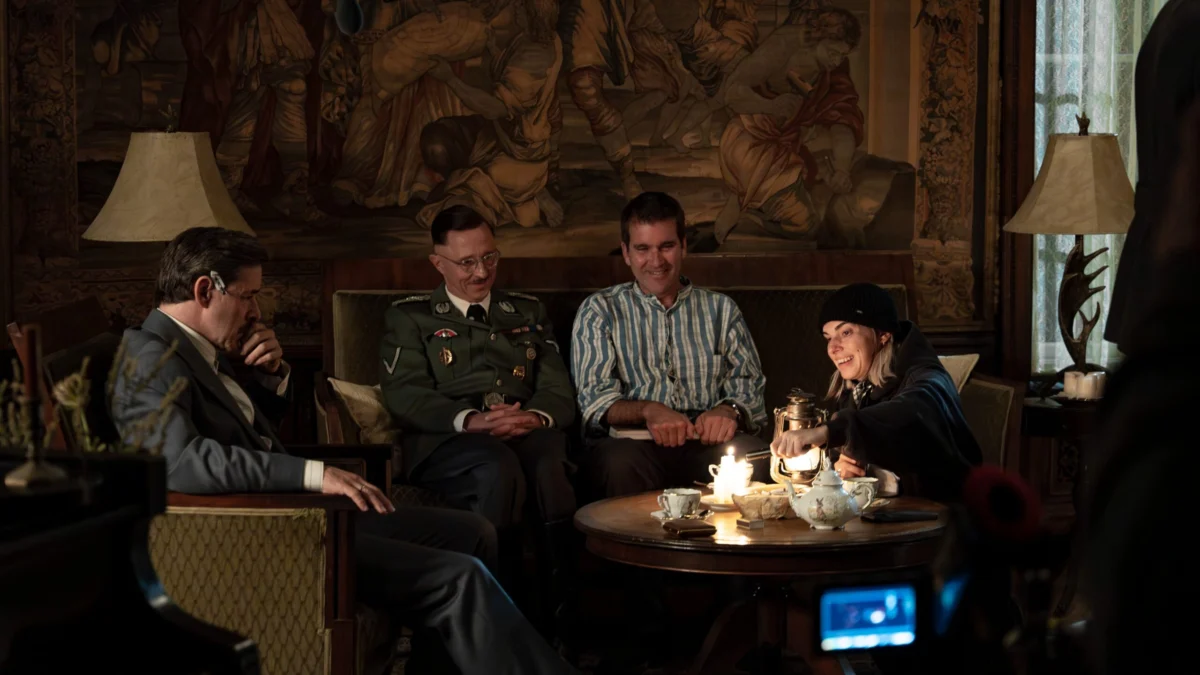
The act of embodying historical figures, particularly those indelibly linked to immense human suffering, presents actors with profound ethical and psychological challenges. For Martin Müller, the German actor tasked with portraying SS leader Heinrich Himmler in Felix Randau’s forthcoming film I Is Another (Ich Ist ein Anderer), this endeavor has been a deeply complex journey, fraught with responsibilities and existential questions. The film, set to premiere on Friday, August 7th, in the prestigious Piazza Grande program of the 79th Locarno Film Festival in Switzerland, delves into the shadowed aftermath of the Nazi era, exploring themes of memory, complicity, and the elusive nature of truth.
I Is Another is set in 1952, a decade after the fall of the Third Reich, and centers on Felix Kersten, portrayed by Claes Bang. Kersten, Himmler’s former personal masseur, finds himself confronted by journalist Hedda, played by Valerie Pachner. Kersten claims to have leveraged his unique access to Himmler to facilitate the liberation of thousands of concentration camp prisoners. However, Hedda harbors deep skepticism, intent on uncovering whether Kersten’s narrative is one of genuine heroism or a self-serving embellishment of past actions. This narrative framework immediately situates the film in a space of moral ambiguity, where personal accounts are scrutinized against the backdrop of unimaginable atrocities.
The casting of Heinrich Himmler proved to be the most significant hurdle for director Felix Randau. "The only part that was really hard to cast was Himmler," Randau confided to The Hollywood Reporter. "I was looking for someone who could play a weasel kind of guy, but it was really, really tough." Randau encountered considerable resistance from actors approached for the role, many of whom expressed reluctance to provide a platform for such a notorious figure. "They accused me of providing a stage for an evil guy like Himmler," Randau recounted. "I think that is really ridiculous and a big mistake because evil is a part of creation. If you ignore or neglect it, it will grow in the dark, and that’s what’s happening here in Germany, as we can all see."
Randau’s prescient warning about the resurgence of extremist ideologies in Germany cannot be overstated. The political landscape has been significantly altered by the rise of the Alternative for Germany (AfD) party, a far-right force that has gained considerable traction amidst growing anti-immigration sentiment, economic anxieties, and a general disillusionment with traditional political parties. In Germany’s 2025 federal elections, the AfD secured second place, demonstrating substantial support, particularly in the eastern states of the former German Democratic Republic. This contemporary context imbues Randau’s thematic concerns with a chilling urgency, suggesting that confronting the historical manifestations of evil is not merely an academic exercise but a crucial act of societal vigilance.
Against this charged backdrop, Randau and his casting director, Suse Marquardt, cast a wide net. Their search ultimately led them to Martin Müller, an actor with a substantial background in stage and television work. "I’m really happy that we found Martin Müller," Randau stated, praising Müller’s ability to embody the specific qualities he sought for the role, and indeed, exceeding those expectations. Müller’s casting signifies a deliberate choice to move beyond the most prominent figures of the Nazi regime, focusing instead on a key architect of its genocidal machinery, whose chillingly bureaucratic approach to mass murder defined a significant aspect of the Holocaust.
A Legacy of Portrayals: Himmler on Screen
Müller joins a distinguished roster of actors who have previously brought Heinrich Himmler to life on screen. These portrayals have spanned various cinematic genres and historical interpretations, each grappling with the challenge of depicting a man responsible for unfathomable cruelty.
- Stephen Graham portrayed Himmler in the 2017 war drama The Man With the Iron Heart.
- Eddie Marsan featured as Himmler in the 2016 historical drama The Exception.
- Matthias Freihof played Himmler in the 2008 Tom Cruise-led film Valkyrie.
- Kenneth Tigar took on the role in the alternate-history series The Man in the High Castle (2016-2019).
- Ulrich Noethen portrayed Himmler in both the Academy Award-nominated Downfall (2004) and My Führer – The Really Truest Truth About Adolf Hitler (2007).
- Ian Holm famously stepped into Himmler’s shoes for the groundbreaking 1978 miniseries Holocaust.
Each of these performances contributed to the cinematic understanding of Himmler, often focusing on different facets of his personality—from his supposed intellectualism and devotion to occultism to his chillingly methodical approach to extermination.

The Actor’s Process: Embracing the Darkness
Müller’s path to the role was facilitated by a long-standing professional relationship with casting director Suse Marquardt. "I got an e-mail for an e-casting, and I did it with my coach and sent it to Suse, and she said, ‘the director wants to meet you’," Müller recalled. The initial meeting with Randau was remarkably swift and decisive. "Felix came to Munich, where I live, instead of me going to Berlin. We just met in a restaurant, and after two hours of talking, I asked him how many people he was meeting. And he said, ‘I’m fine with you. I just wanted to meet you.’ So I was very happy."
The gravity of the role, however, was not lost on Müller. "It’s horrible to take on that role on the one hand, but on the other hand, it’s an interesting person," he stated. "He is a horrible person, but people who are a horror are always interesting for an actor." Müller emphasized that I Is Another does not depict Himmler in the act of perpetrating his worst crimes. Instead, the film’s perspective is filtered through Kersten’s account, which, by its nature, is selective and potentially self-serving. "Himmler isn’t in action in concentration camps or anything like that," Müller explained. "So, the film doesn’t show the real horror of Heinrich Himmler because it’s told via Felix Kersten. And he doesn’t tell us about all the horrors because he doesn’t want to be seen in a bad light." This narrative choice allows the film to explore the psychological impact of proximity to evil and the complex moral compromises individuals made during the Nazi era.
Confronting the "Mathematician of the Holocaust"
Certain scenes proved particularly taxing for Müller, both emotionally and psychologically. He described a scene with Claes Bang where they discussed the logistics of saving Jewish individuals. "We filmed this scene the whole night, and at the end, we said to each other that it was so disgusting to talk about numbers, like people were nothing," Müller shared. "Himmler had no empathy and was really cold. In his mind, he was just organizing things. People talk about Heinrich Himmler as someone who saw himself as a mathematician of the Holocaust. For him, there were no human beings behind the numbers." This observation underscores Himmler’s chilling detachment and his role in transforming abstract policies of extermination into a meticulously managed industrial process. The sheer scale of the Holocaust, estimated to have claimed six million Jewish lives, along with millions of others, was a testament to this dehumanizing bureaucratic efficiency.
The psychological toll of inhabiting such a character extended well beyond the conclusion of filming. "It was really difficult to leave the character," Müller admitted. "It was one thing to leave the four or five kilos that I had gained for the role behind. That was also very hard, and I just finished doing that. But the other thing was leaving this ugly character. These things just really stick with me." The experience prompted Müller to reflect on contemporary political discourse. "I just kept thinking, ‘what are politicians doing nowadays? Oh my God!’ For me, it’s a horror what the politicians are doing at the moment." This connection between historical atrocities and present-day political concerns highlights the enduring relevance of studying and portraying figures like Himmler, serving as a cautionary tale about the fragility of democratic institutions and the potential for the normalization of hateful ideologies.
Physical Transformation and Research Philosophy
Müller’s physical transformation for the role was a deliberate choice, initiated by Randau’s request. "Felix asked me, ‘Could you be a bit more round in the face?’ So, I did less sport and ate more to gain four or five kilos," he explained. This subtle alteration aimed to convey a sense of the man behind the monstrous public persona, perhaps hinting at a life beyond the SS hierarchy, however perverted.
Regarding his research methodology, Müller intentionally avoided immersing himself in other actors’ portrayals of Himmler or extensive biographical details of his private life. "I think he was a totally uninteresting person," Müller stated. "There aren’t any films or other [material] with private stuff about him. He was just hiding. With Hitler, Goebbels or Göring, we know a lot of private stuff. We have some speeches by Himmler, but we have no private recordings to know how he was talking when not giving a speech." This approach allowed Müller to focus on crafting his own interpretation, unburdened by pre-existing cinematic or biographical templates. He stressed the film’s inherent subjectivity: "And keep in mind: It’s not the ‘true’ Heinrich Himmler in the film. It’s Heinrich Himmler as [told] by Kersten. And you don’t know what is true or wrong. That’s what the whole film is actually about." This meta-narrative aspect of I Is Another invites the audience to question the nature of historical truth, the reliability of memory, and the ways in which individuals construct their own legacies, especially in the face of overwhelming evidence of their culpability.
The film’s premiere at the Locarno Film Festival, a renowned platform for independent and auteur cinema, suggests a deliberate artistic intention to engage with complex historical narratives in a nuanced and thought-provoking manner. By focusing on the interactions between Kersten and Hedda, and by presenting Himmler through the filtered lens of Kersten’s potentially unreliable testimony, Randau’s I Is Another promises to be more than just a historical drama; it aims to be an exploration of the enduring psychological and moral consequences of the Holocaust, urging viewers to confront the uncomfortable truths about human capacity for both evil and self-deception.