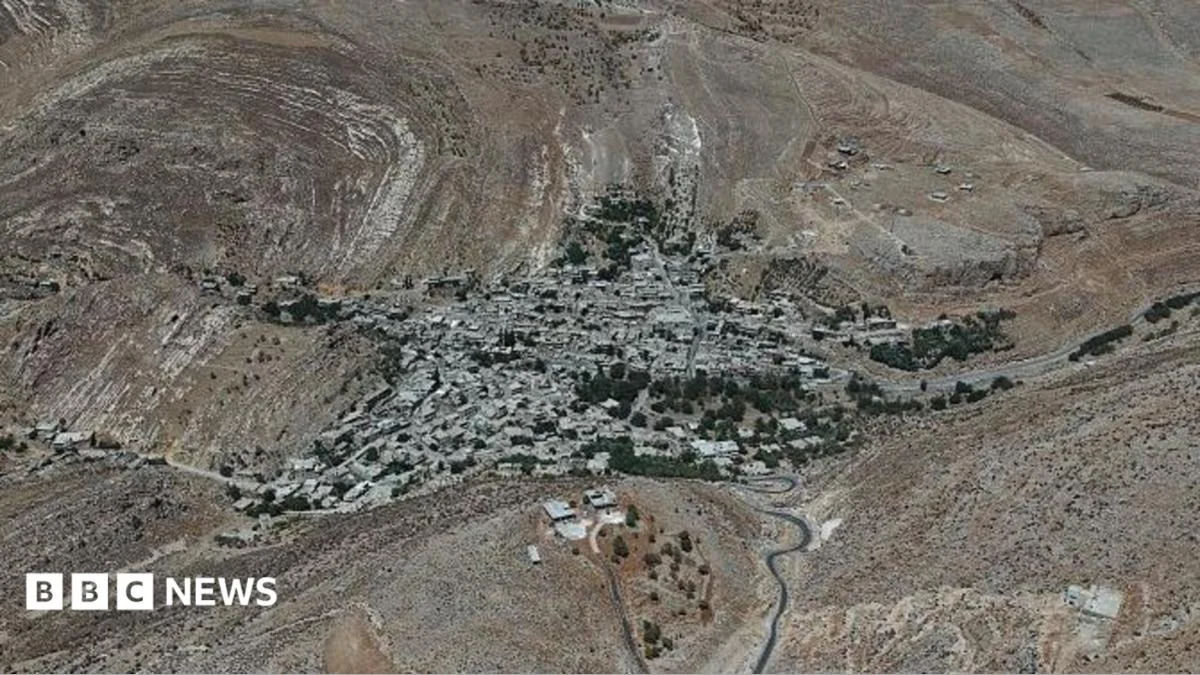
Syria has officially condemned an Israeli military strike on the village of Beit Jinn, located southwest of the capital Damascus, with Syrian officials reporting that the attack targeted a civilian vehicle and resulted in several injuries. This incident marks the second documented Israeli assault on Syrian territory within the span of a week, prompting Damascus to label it a flagrant "violation" of its national sovereignty and international law. The Israeli military, via a post on the social media platform X, provided a counter-narrative, asserting that its forces had specifically targeted a "terrorist" who was in the "final stages" of orchestrating attacks that posed an immediate and credible threat to Israeli soldiers. This latest exchange of hostilities underscores the deeply entrenched and volatile dynamics shaping the Syrian conflict and its broader regional implications, drawing in a complex web of international actors including Turkey and the United States.
The Beit Jinn Incident and Immediate Aftermath
The strike on Beit Jinn, a village situated in the strategic Quneitra governorate near the Israeli-occupied Golan Heights, occurred under circumstances that remain contested by both sides. Syrian state media and local officials were quick to report on the damage to civilian infrastructure and the casualties, emphasizing the humanitarian impact of such cross-border operations. The location of Beit Jinn is particularly sensitive, lying within a zone that has historically been a flashpoint for military engagements and proxy conflicts. For Syria, the attack represents an unacceptable breach of its internationally recognized borders and an act of aggression that further destabilizes a country already ravaged by over a decade of civil war. The condemnation from Damascus was swift and unequivocal, reiterating its long-standing position that Israeli military actions within its territory are illegal and contribute to regional instability.
Conversely, Israel’s justification, framing the target as a "terrorist" actively planning imminent attacks, aligns with its publicly declared doctrine of preventing security threats from materializing on its borders. Israel has consistently maintained that it will act preemptively to neutralize threats posed by state and non-state actors operating within Syria, particularly those linked to Iran or its proxies like Hezbollah, which it views as direct challenges to its national security. The specific details regarding the alleged "terrorist" and the nature of the planned attacks were not immediately released by the Israeli military, a common practice in such operations to protect intelligence sources and methods.
A Week of Escalation: The Abu al-Duhur Airbase Strike
The Beit Jinn attack did not occur in isolation but followed closely on the heels of another significant Israeli strike days prior, targeting a military airbase near Abu al-Duhur, close to the Turkish border in Aleppo province. This earlier incident drew widespread attention due to its geographical location and the subsequent diplomatic fallout. Syrian authorities decried the strike on Abu al-Duhur airbase, warning that such actions risked a severe escalation of tensions across the region, a warning that appeared to be validated by the subsequent Beit Jinn incident.
The Abu al-Duhur airbase strike was particularly notable because of its proximity to areas where Turkish forces maintain a significant presence, as well as its strategic importance within Syria’s broader conflict landscape. This attack elicited a rare and unusually strong rebuke from Washington, with the United States Department of State characterizing it as an "unnecessary escalation that does not advance regional stability." This public criticism from a key ally underscored a potential divergence in strategic priorities or a perceived overreach by Israel in its regional operations.
Diplomatic Fallout and Geopolitical Maneuvering
The US reaction to the Abu al-Duhur strike sparked further controversy, particularly after comments made by the US ambassador to Turkey, Tom Barrack. In an interview on Friday, Ambassador Barrack suggested a provocative interpretation of the Israeli strike, positing that it could be "the Israelis baiting the Turks" in a deliberate attempt to draw Turkey into a conflict. This theory, according to Barrack, might be motivated by upcoming Israeli elections, implying a domestic political dimension to foreign policy decisions.
Ambassador Barrack’s remarks quickly drew a sharp retort from Israel’s far-right Defence Minister, Israel Katz. Writing on X, Katz dismissed Barrack’s account as "full of inaccuracies" and firmly asserted that Israeli forces were acting "in light of clear intelligence information about Turkey’s intentions." This exchange highlighted deep mistrust and differing perspectives among key regional and international players. The Israeli Prime Minister Benjamin Netanyahu’s office subsequently issued a statement following the Tuesday strikes on the Abu al-Duhur airbase, providing a clearer rationale for Israel’s actions: "Israel and Syria agreed to a status quo in security matters, which Syria was on the verge of breaching by permitting Turkish troops to deploy at an airbase near Aleppo." This statement revealed an underlying concern within Israel about shifts in the military balance and power dynamics in northern Syria, specifically regarding the potential for Turkish expansion into areas traditionally not under its direct influence.
Background Context: Syria’s Fragmented Sovereignty and External Actors
To fully comprehend the gravity of these recent incidents, it is crucial to understand the complex and fractured geopolitical landscape of Syria. Over a decade of civil war has left the country’s sovereignty severely compromised, with multiple foreign powers operating within its borders, often with conflicting agendas.
Iran’s Presence and Israel’s "War Between Wars": Iran has significantly expanded its military footprint and influence in Syria, primarily through its Revolutionary Guard Corps (IRGC) and various Shiite militia proxies, including Hezbollah. Israel views this Iranian entrenchment as an existential threat, particularly the alleged transfer of advanced weaponry to Hezbollah in Lebanon and the establishment of missile production facilities in Syria. To counter this, Israel has adopted a proactive military strategy known as the "War Between Wars" (MABAM in Hebrew), which involves hundreds of airstrikes against Iranian targets, weapon convoys, and military infrastructure in Syria. The goal is to degrade Iran’s capabilities and prevent it from establishing a permanent military presence that could threaten Israel’s northern border.
Turkey’s Strategic Objectives: Turkey’s involvement in Syria is multifaceted, driven by a combination of national security concerns and regional ambitions. Its primary objective has been to counter Kurdish forces in northern Syria, particularly the YPG (People’s Protection Units), which it considers an extension of the Kurdistan Workers’ Party (PKK), a designated terrorist organization by Turkey, the US, and EU. Turkey has established several zones of influence in northern Syria through military incursions (Operation Euphrates Shield, Operation Olive Branch, Operation Peace Spring) and maintains military bases and checkpoints. Its presence is also aimed at supporting Syrian opposition groups and preventing a humanitarian crisis on its border. The alleged deployment of Turkish troops at the Abu al-Duhur airbase, as cited by Netanyahu, could be interpreted by Israel as an expansion of Turkish influence into new strategic areas, potentially altering the delicate regional balance of power.
The US Role and Balancing Act: The United States maintains a limited military presence in northeastern Syria, primarily focused on its counter-ISIS mission and supporting the Syrian Democratic Forces (SDF), largely composed of Kurdish YPG fighters. US policy in Syria has been to prevent a resurgence of ISIS, maintain stability in areas under SDF control, and work towards a political solution to the conflict. However, the US finds itself in a precarious balancing act, attempting to manage its relationships with both Israel, a key strategic ally, and Turkey, a NATO member, whose interests often diverge in Syria. The rare US rebuke of Israel underscores this complexity, reflecting concerns about actions that could inadvertently destabilize the region or undermine broader diplomatic efforts.
Implications for Regional Stability
The recent Israeli strikes and the subsequent diplomatic exchanges carry significant implications for the already fragile stability of the Middle East:
Escalation Risk: Each strike, particularly those targeting sensitive areas or involving multiple foreign actors, carries an inherent risk of miscalculation and escalation. The accusation of "baiting" by Ambassador Barrack, while denied by Israel, highlights the potential for deliberate provocations or perceived provocations that could ignite a wider conflict. The involvement of Israel, Syria, Turkey, Iran, and the US creates a highly combustible environment where a localized incident could quickly spiral.
Erosion of Syrian Sovereignty: The continuous foreign military interventions, whether by Israel, Turkey, or other actors, further erodes the concept of Syrian sovereignty. The Syrian government, already struggling to assert control over its territory, finds itself largely unable to prevent these cross-border operations, highlighting its diminished power and reliance on allies like Russia and Iran.
Strained US-Israel Relations: While the US and Israel maintain a strong strategic alliance, the public rebuke over the Abu al-Duhur strike signals potential strains. Such disagreements, particularly when made public, can create diplomatic friction and raise questions about the extent of US support for Israeli military actions in Syria. It also suggests that the US might be increasingly concerned about the broader regional impact of Israel’s "War Between Wars" strategy.
Deepening Israel-Turkey Mistrust: The Israeli accusations about "Turkey’s intentions" and the perceived breach of a "status quo" concerning Turkish troop deployment near Aleppo underscore a deepening mistrust between Israel and Turkey. Both nations are significant regional powers with complex and often competing interests. Any direct or indirect confrontation between them, even through proxies, would have profound implications for regional geopolitics.
Internal Israeli Politics: The suggestion that the strikes could be linked to upcoming Israeli elections, though speculative, points to the potential influence of domestic politics on foreign policy decisions. Leaders often face pressure to demonstrate strength and address security concerns, especially during election cycles, which can sometimes lead to more assertive or risky military actions.
Conclusion
The recent Israeli strikes on Beit Jinn and Abu al-Duhur airbase serve as a stark reminder of the ongoing volatility and intricate web of conflicts plaguing Syria and the wider Middle East. With Syria’s sovereignty continually challenged, and powerful regional and international actors pursuing their often-conflicting agendas, the prospect of lasting peace and stability remains elusive. The exchanges between Israeli, Syrian, and US officials, coupled with the backdrop of Turkish strategic ambitions, illustrate a region perpetually on the brink, where every military action and diplomatic utterance carries the potential to ignite further conflict. As long as the fundamental issues of foreign interference, security concerns, and political vacuums persist in Syria, such incidents are likely to remain a recurring feature of the region’s turbulent landscape.