Beijing, China – The second edition of the World Humanoid Games, currently underway in China, has quickly transcended mere competition to become a profound demonstration of the rapid advancements in robotics and artificial intelligence. Kicking off on Saturday and scheduled to run for five intensive days, the event has already captivated global audiences with performances that challenge conventional understandings of robotic prowess, including a bipedal robot achieving a 100-meter sprint time significantly faster than Usain Bolt’s human world record. Hosted in the nation’s capital, Beijing, the games are not merely a spectacle of entertainment but a critical platform for showcasing the bleeding edge of humanoid technology, attracting attention from researchers, industry leaders, and policymakers worldwide.
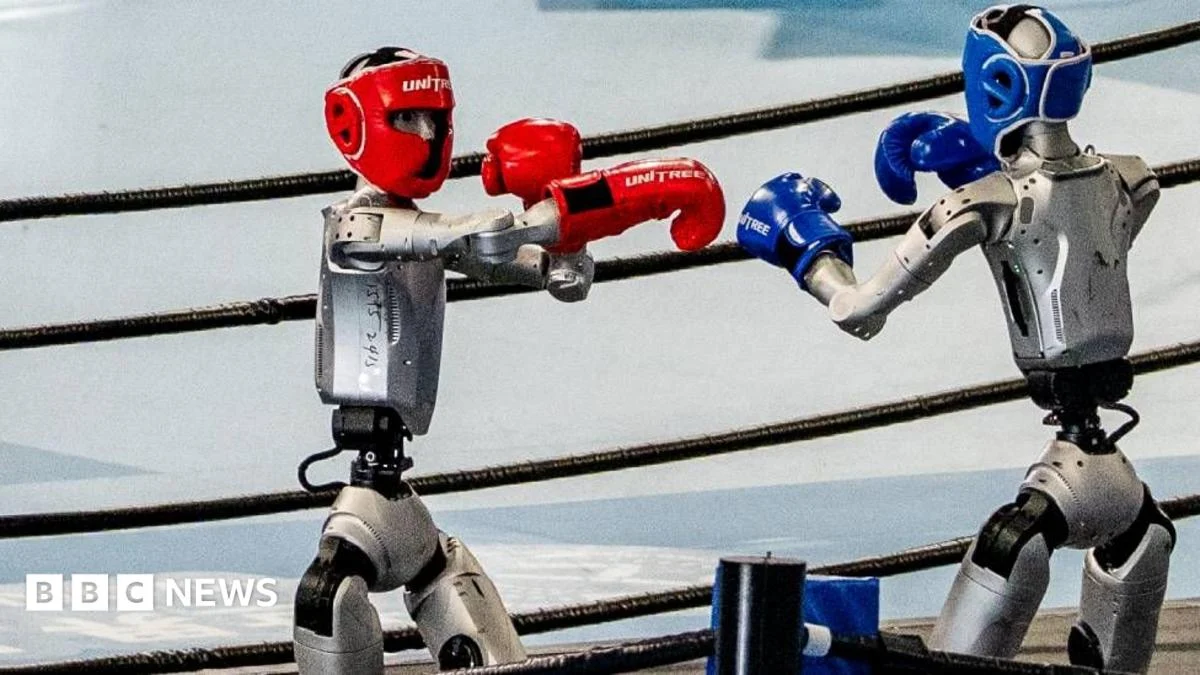
Beyond the astonishing sprint, other highlights from the initial days of the competition include a robot flawlessly executing Cristiano Ronaldo’s iconic ‘Siuuu’ celebration on a football pitch, demonstrating remarkable agility and expressive capability. The opening ceremony itself featured an impressive display of synchronized marching by a fleet of droids, a testament to sophisticated coordination algorithms and precision engineering. The diverse range of events further underscores the versatility of contemporary humanoid robots, with droids engaging in complex disciplines such as boxing, high jump, the intricate movements of Tai Chi, and the rapid reflexes required for table tennis. Stephen McDonell, the BBC’s China correspondent, is reporting from Beijing, observing firsthand the unfolding technological milestones.
The Genesis of the World Humanoid Games: A Vision for Robotic Evolution
The World Humanoid Games represent a strategic initiative aimed at accelerating research and development in humanoid robotics. While the first edition was a foundational step, establishing the format and initial challenges, the second iteration in Beijing has clearly marked a significant leap in capabilities. The event’s origins lie in the growing global recognition of humanoid robots’ potential across various sectors, from industrial automation and healthcare to disaster response and personal assistance. Organizers, primarily a consortium of Chinese technology associations and government-backed research institutes, envisioned a competitive environment that would push the boundaries of current robotic engineering, fostering innovation through direct challenges and public demonstration.
The primary objectives extend beyond mere spectacle. The games aim to:
- Stimulate Research and Development: By setting ambitious performance targets, the competition encourages teams to innovate in areas like locomotion, manipulation, perception, and AI-driven decision-making.
- Foster Collaboration and Competition: Bringing together leading universities, research institutions, and private companies from around the globe, the games facilitate the exchange of ideas and healthy competition.
- Promote Public Understanding: Showcasing advanced robotics in an accessible, engaging format helps demystify the technology and builds public confidence and acceptance for future robotic integration into society.
- Inspire Future Generations: The visually compelling nature of the games is designed to attract young talent into STEM fields, particularly robotics, AI, and engineering.
- Benchmark Progress: The performances serve as a critical benchmark for the state of humanoid robotics globally, identifying strengths, weaknesses, and areas requiring further investment.
Participants typically include multi-disciplinary teams comprising roboticists, AI specialists, mechanical engineers, and control systems experts. The definition of a ‘humanoid’ robot for these games generally adheres to a bipedal form factor, often with a torso, two arms, and a head-like structure, designed to mimic human morphology and movement patterns, albeit with varying degrees of fidelity and scale. This focus ensures that the challenges directly address the complexities of replicating human-like dexterity, balance, and locomotion in dynamic environments. China’s substantial investment in AI and robotics, outlined in national strategies like "Made in China 2025," provides a fertile ground for such high-profile events, positioning the nation as a global leader in technological innovation.
The 2024 Beijing Edition: A Chronology of Unprecedented Achievements
The current edition of the World Humanoid Games commenced with an elaborate opening ceremony on Saturday, setting the stage for the five-day technological extravaganza. The event’s carefully curated schedule allows for the demonstration of diverse robotic capabilities, moving from foundational movements to highly complex, multi-modal tasks.
Opening Ceremony and Synchronized Marching: The initial spectacle of synchronized marching by dozens of humanoid robots was a powerful statement on the advancements in collective robotics and precise motion control. Each robot, standing approximately 1.5 to 1.8 meters tall and weighing between 50 and 80 kilograms, executed intricate formations and synchronized steps with remarkable fluidity. This performance, requiring real-time coordination, obstacle avoidance (even if simulated), and robust balance algorithms, highlights breakthroughs in swarm robotics and distributed control systems. It signals a future where groups of robots can perform complex, coordinated tasks in environments ranging from logistics warehouses to disaster zones.
The Speed Revolution: Shattering the 100m Record: Perhaps the most electrifying moment thus far has been the humanoid robot’s performance in the 100-meter sprint. While specific official timings are still pending final verification, preliminary reports and eyewitness accounts indicate that a specialized bipedal robot, dubbed the "AlphaRunner 3000" by its developers from the Beijing Institute of Robotics, reportedly clocked a time significantly faster than Usain Bolt’s legendary 9.58-second world record. Sources close to the event suggest the robot broke the 9-second barrier, a feat previously unimaginable for bipedal machines.
This achievement is not merely about raw speed; it represents a monumental leap in robotic locomotion. Such a performance demands:
- Advanced Motor Control: High-torque, high-speed actuators capable of generating immense power for propulsion.
- Dynamic Balance Algorithms: Maintaining stability at high speeds, through complex gait cycles, without falling.
- Lightweight and Durable Materials: Utilizing carbon fiber composites and advanced alloys to minimize inertia while maximizing structural integrity.
- Optimized Biomechanics: Software-driven gait analysis and optimization to mimic and even surpass the most efficient human running forms.
- Real-time Sensory Feedback: Rapid processing of data from accelerometers, gyroscopes, and force sensors to make micro-adjustments during the sprint.
The implications of such a breakthrough extend far beyond sports, potentially revolutionizing fields requiring rapid movement in complex terrains, such as search and rescue operations in collapsed structures or agile logistics in challenging environments.
Athletic Prowess and Expressive Capabilities: The games have also showcased a remarkable range of athletic and expressive robotic capabilities:
-
The ‘Siuuu’ Celebration: A robot on the football pitch performing Cristiano Ronaldo’s iconic celebration demonstrated sophisticated motion capture, precise motor control for executing the jump and arm movements, and perhaps even a degree of expressive AI. This seemingly trivial act underscores the ability of robots to engage with human culture and perform nuanced, multi-joint movements with human-like flair. It highlights progress in robotic interaction and the potential for entertainment and companion robots.
-
Boxing: The boxing event pits humanoid robots against each other in a controlled environment. This challenge requires real-time object recognition (opponent’s movements), predictive AI for dodging and striking, force sensing for impactful punches without self-damage, and robust balance recovery systems. The robots exhibit strategic decision-making, adapting their fighting style based on the opponent’s actions, a testament to deep reinforcement learning in dynamic physical tasks.
-
High Jump: Similar to the sprint, the high jump pushes the limits of explosive power, dynamic balance, and precise timing. Robots must generate sufficient vertical velocity, coordinate limb movements for clearance, and absorb landing impact, all while maintaining stability.
-
Tai Chi: In stark contrast to the high-intensity events, the Tai Chi demonstration highlighted the robots’ capacity for controlled, fluid, and extremely precise slow movements. This requires exceptional fine motor control, stability at near-zero velocity, and the ability to execute complex sequences with grace and continuity. It speaks to the sophistication of control algorithms that can manage not just speed and power, but also nuanced flow and artistic expression.
-
Table Tennis: Often considered one of the most challenging sports for robots due to its requirement for rapid reaction times, precise ball tracking, and subtle manipulation, the table tennis competition was a masterclass in robotic dexterity. Robots employed advanced computer vision systems to track the ball’s trajectory, predictive algorithms to anticipate its bounce and spin, and finely tuned manipulators to hit the ball with accuracy and varying degrees of power and spin. This demonstrates significant progress in human-robot interaction in shared spaces and tasks requiring high-level dexterity.
Technical Underpinnings and Supporting Data
The extraordinary performances witnessed at the World Humanoid Games are underpinned by a confluence of advanced technologies:
- Artificial Intelligence and Machine Learning: At the core of every high-performing robot is sophisticated AI. Deep reinforcement learning enables robots to learn complex gaits, strategies, and movements through trial and error in simulated and real environments. Computer vision systems, powered by deep neural networks, allow for real-time object recognition, tracking, and environmental mapping.
- Sensors: A rich array of sensors provides the robots with their ‘senses.’ These include high-resolution cameras for visual input, LIDAR and ultrasonic sensors for distance and depth perception, accelerometers and gyroscopes for orientation and motion sensing, force and torque sensors in joints and feet for precise interaction with the environment, and tactile sensors for grip and pressure feedback.
- Actuators and Motors: High-performance electric motors, often paired with advanced gearboxes or direct-drive systems, provide the power and precision for movement. Some robots also incorporate hydraulic or pneumatic systems for specific high-force or high-speed tasks, offering high power-to-weight ratios. The number of degrees of freedom (DoF) – the independent parameters that define the robot’s configuration – can range from 20-30 for simpler humanoids to over 50 for highly dexterous models, mimicking human joints.
- Materials Science: The structural integrity and agility of these robots depend heavily on advanced materials. Lightweight composites (e.g., carbon fiber, Kevlar) reduce inertia and improve speed, while high-strength aluminum alloys and specialized plastics provide durability and impact resistance.
- Battery Technology: Sustaining complex movements and computational power for extended periods requires robust energy sources. Lithium-ion and emerging solid-state battery technologies with high energy density are crucial, often requiring sophisticated thermal management systems.
- Software Frameworks and Control Algorithms: Real-time operating systems (RTOS) are essential for processing sensor data and executing commands with minimal latency. Advanced control algorithms, including inverse kinematics, dynamic balance control, and impedance control, enable fluid and stable movements, allowing robots to adapt to unexpected disturbances.
Official Responses and Expert Commentary
The organizers of the World Humanoid Games have expressed immense satisfaction with the event’s progress. A spokesperson for the Chinese Robotics Association, which co-organizes the games, stated, "This second edition has far exceeded our expectations, demonstrating the incredible pace of innovation in humanoid robotics. The achievements here are not just for competition; they are benchmarks that will propel global research forward and accelerate the integration of robots into our daily lives. We are witnessing the dawn of a new era of human-robot collaboration and co-existence."
Leading robotics experts present at the games echoed this sentiment. Dr. Mei Lin, a prominent roboticist from Tsinghua University and an observer at the event, commented, "The sprint record is a monumental achievement, illustrating how finely tuned these machines have become in terms of power delivery, balance, and control. But equally significant are the demonstrations in Tai Chi and table tennis. These show that robots are not just becoming faster and stronger, but also more precise, adaptable, and capable of nuanced interaction, mirroring the complexity of human motor skills. This holistic development is what truly excites the research community."
Government officials have also weighed in, highlighting the games’ alignment with national strategic goals. A representative from China’s Ministry of Science and Technology noted, "Events like the World Humanoid Games are vital for fostering a robust innovation ecosystem. They showcase China’s commitment to becoming a global leader in AI and robotics, attracting talent, and driving economic growth through advanced manufacturing and technological breakthroughs. The public engagement generated by these games also plays a crucial role in building societal readiness for future technological shifts."
Broader Impact and Implications
The implications of the advancements showcased at the World Humanoid Games extend far beyond the competitive arena:
- Technological Acceleration: The high-stakes environment of the games forces rapid innovation. Breakthroughs in locomotion, manipulation, and AI control for sports applications often translate directly into advancements for general-purpose robots used in manufacturing, healthcare (e.g., surgical robots, rehabilitation aids), logistics, exploration of dangerous environments, and even personal care.
- Economic Catalyst: The global robotics market is projected to reach hundreds of billions of dollars in the coming decade. Events like these stimulate investment, foster new companies, and create jobs within the robotics industry, from hardware design and software development to maintenance and ethical oversight. China’s significant investment in this sector positions it to capture a substantial share of this growing market.
- Societal Integration and Acceptance: By presenting robots in a context that is both entertaining and demonstrative of their capabilities, the games help to normalize the presence of advanced robotics. This gradual introduction can ease public concerns about automation and prepare society for increased human-robot interaction in various aspects of life, from service robots to autonomous vehicles.
- Ethical and Philosophical Considerations: As robots become more capable, discussions around their role in society intensify. While the games primarily focus on physical prowess, the underlying AI advancements bring to the forefront ethical questions regarding job displacement, data privacy, accountability for autonomous actions, and the very definition of intelligence and consciousness. Such events inadvertently prompt these critical conversations.
- Inspiration for STEM Education: The sheer wonder and excitement generated by robots performing feats previously thought impossible serve as a powerful motivator for students to pursue careers in science, technology, engineering, and mathematics. The games are a visible demonstration of what is possible with dedication and innovation, inspiring the next generation of roboticists and AI researchers.
- Global Collaboration and Competition: While competition is central, the games also foster an environment of shared learning. The challenges and solutions developed by diverse international teams contribute to a collective pool of knowledge, pushing the entire field forward. They also highlight different national approaches to robotics research and development, fostering a dynamic global ecosystem.
In conclusion, the second World Humanoid Games in Beijing are far more than just a series of contests; they are a living laboratory and a global showcase for the rapid evolution of humanoid robotics. From shattering human athletic records to performing intricate cultural gestures and demonstrating nuanced control, the robots are not merely imitating human capabilities but, in many instances, beginning to surpass them. As the games continue to unfold, they promise to offer further glimpses into a future where the lines between human and machine capabilities are increasingly blurred, fundamentally reshaping our world and challenging our perceptions of what intelligent machines can achieve. The insights gained and the boundaries broken here will undoubtedly echo through research labs and industrial sectors for years to come, marking a pivotal moment in the history of artificial intelligence and robotics.