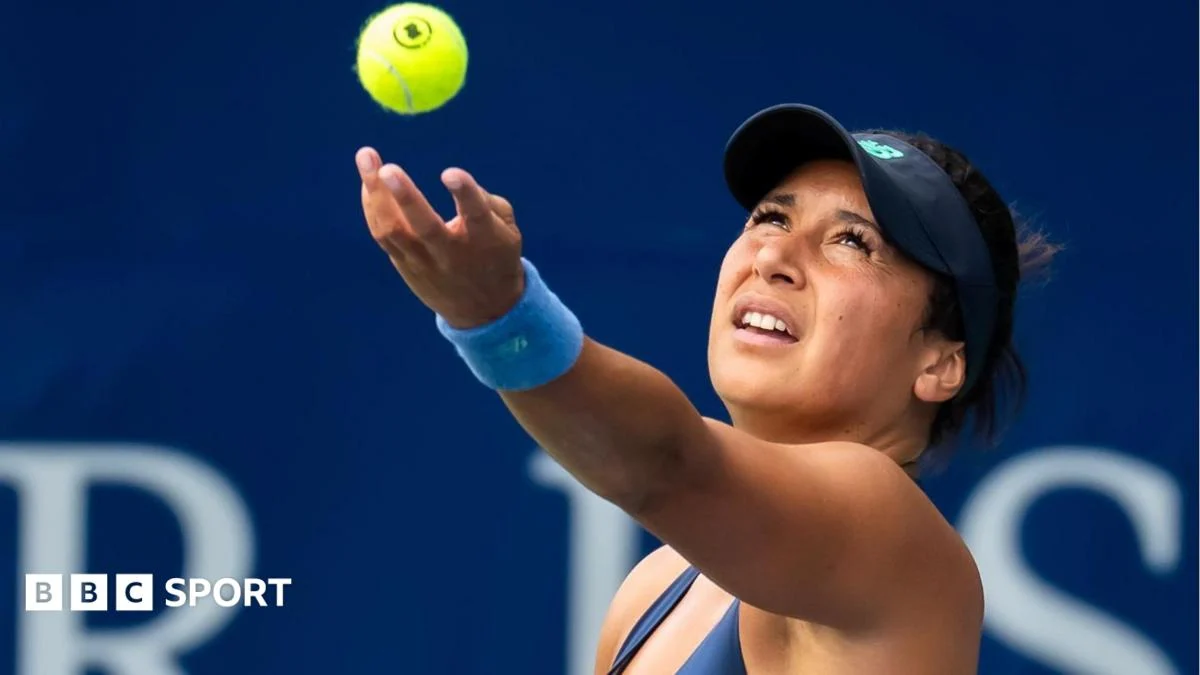
Britain’s Heather Watson battled back from a set down against Claire Liu to keep alive her hopes of securing a first US Open main-draw appearance in five years. The 34-year-old Watson, a seasoned campaigner on the WTA tour, overcame the challenge of sixth seed Liu 4-6 6-2 6-4 in the demanding first round of qualifying in New York, a crucial step towards her return to Flushing Meadows’ prestigious singles draw. Watson demonstrated remarkable resilience, particularly in the deciding set, where she managed to consolidate a double-break lead despite a late surge from her opponent. This hard-fought victory sets up a compelling second-round encounter against Spain’s Angela Fita Boluda, as Watson continues her quest for a significant main-draw berth.
The day also proved successful for a quartet of British men progressing through their respective qualifying brackets. Toby Samuel, Jacob Fearnley, Billy Harris, and Harry Wendelken all secured victories, showcasing the depth of British talent aiming for Grand Slam main draws. Samuel, in particular, displayed grit and determination as he fought back from a set down against Italy’s Francesco Maestrelli. After dropping the opening set in a tie-break (6-7 (2-7)), Samuel regrouped effectively to claim the next two sets 6-3 6-1. This comeback triumph not only advances his own aspirations of reaching a maiden US Open main draw but also sets up an intriguing all-British clash against fellow countryman Billy Harris in the next round.
Harris himself had a commanding performance, dispatching Peru’s Gonzalo Bueno with a decisive 6-1 6-3 win. Jacob Fearnley also advanced, navigating a tough first-round match against Spain’s Roberto Carballes Baena. Fearnley emerged victorious in a closely contested encounter, winning 7-6 (7-3) 6-3. His next opponent will be Frenchman Luka Pavlovic. Harry Wendelken completed the British success in men’s qualifying, overcoming Italy’s Stefano Travaglia 6-4 3-6 6-3. Wendelken is scheduled to face Swiss player Remy Bertola in his subsequent match.
However, the path through qualifying was not without its setbacks for other British players. Liam Broady saw his US Open singles hopes ended by Italy’s Marco Cecchinato, who won 7-6 (7-4) 6-3. Similarly, Felix Gill was defeated by Italian Francesco Passaro in a tight match, losing 7-6 (7-3) 6-2. For all players, the challenge remains immense, as they must successfully navigate three rounds of intense qualifying matches to earn a coveted spot in the main singles draw, which is slated to commence on Sunday. The demanding nature of Grand Slam qualifying underscores the dedication and mental fortitude required at this elite level of professional tennis.
Mixed Doubles Format Revolution Sparks High-Profile Encounters
Beyond the singles qualifying battles, the US Open mixed doubles competition has been dramatically reshaped, introducing a format that has generated significant buzz and some controversy. Britons Henry Patten and Lloyd Glasspool, along with their respective partners, have successfully navigated the qualifying rounds to earn berths in the main draw, setting the stage for potentially historic matchups against some of the sport’s most recognizable figures.
The US Open’s decision last year to revamp the mixed doubles format, including provisions for singles stars to participate, was a strategic move aimed at enhancing the competition’s appeal and viewership. This overhaul has resulted in a condensed schedule and altered scoring systems designed to create more dynamic and engaging matches. Under the new structure, the top six doubles pairs, based on combined singles rankings, received direct entry, with an additional eight pairs earning wildcards. The tournament itself now takes place over three days in the week preceding the main singles draw. The scoring has been significantly shortened: sets are won with just four games, there is no ‘advantage’ scoring, and all matches, except the final, conclude with a 10-point match tie-break instead of a traditional third set.
Both Henry Patten and Lloyd Glasspool had to prove their mettle in the qualifying stages to reach the main draw. Patten, a decorated two-time winner of the men’s doubles title at Wimbledon, partnered with Czech Republic’s Katerina Siniakova, who is the current women’s doubles world number one. Together, they defeated Americans Peyton Stearns and Christian Harrison in straight sets in their second qualifying match. Their reward for this success is a formidable first-round encounter against arguably the most celebrated duo in tennis: 24-time Grand Slam singles champion Novak Djokovic and the current world number one in women’s singles, Aryna Sabalenka. This match promises to be a captivating spectacle, pitting two of the sport’s dominant doubles players against two of its greatest singles legends.
Similarly, Lloyd Glasspool, alongside his New Zealand partner Erin Routliffe, also emerged from qualifying. Their path to the main draw included a victory over El Salvador’s Marcelo Arevalo and France’s Kristina Mladenovic. Glasspool and Routliffe are now set to face another star-studded pairing: 23-time Grand Slam singles champion Serena Williams and seven-time major winner Carlos Alcaraz. This encounter is particularly noteworthy as it marks Carlos Alcaraz’s return to competitive play after a four-month layoff due to a wrist injury. For Serena Williams, this represents a highly anticipated return to the sport after a four-year absence, adding another layer of intrigue to an already compelling draw.
Implications of the Mixed Doubles Overhaul
The radical restructuring of the US Open mixed doubles competition has been met with a mix of anticipation and apprehension within the tennis community. The explicit aim of the organizers was to inject new life into the format by attracting top singles players, thereby boosting spectator interest and television ratings. This strategy, while potentially beneficial for the tournament’s commercial success, has raised questions about the traditional pathways and the competitive balance for dedicated doubles specialists.
The inclusion of singles stars like Djokovic, Sabalenka, Williams, and Alcaraz, even if they are not primarily doubles players, undeniably elevates the profile of the mixed doubles event. These athletes bring immense star power and a global fanbase, ensuring significant media attention and a heightened level of public engagement. For players like Patten and Glasspool, who have dedicated their careers to doubles, the opportunity to compete on the same stage as such iconic figures is a unique experience, offering valuable exposure and the chance to test their skills against the very best.
However, the shortened format and the influx of singles players could be seen as diluting the traditional doubles expertise. The emphasis on quick matches and the absence of conventional scoring nuances might favor players accustomed to the high-octane, shorter formats often seen in singles or other sports. The debate continues regarding whether this approach truly enhances the mixed doubles discipline or merely leverages the popularity of singles stars for a temporary spectacle.
Broader Context of Grand Slam Qualifying and Development
The US Open qualifying tournament represents a vital stage in the annual Grand Slam calendar. It provides a platform for players ranked outside the direct entry cutoffs to compete for a place in the main draw, offering a crucial opportunity for career advancement and significant ranking points. For many, a successful qualifying campaign can be a turning point, offering financial rewards, increased sponsorship opportunities, and the invaluable experience of competing at the highest level.
The presence of seasoned professionals like Heather Watson alongside emerging talents such as Toby Samuel and Jacob Fearnley highlights the diverse landscape of professional tennis. Watson’s experience and resilience demonstrate the enduring appeal of competing at Grand Slams, even after years on tour. Her battle-tested nature is a significant asset in the high-pressure environment of qualifying.
Conversely, the progress of younger players like Samuel and Fearnley signifies the ongoing development of British tennis talent. Their victories, particularly against established international opponents, suggest a promising future for the sport in the United Kingdom. The journey through qualifying is often a crucible, testing not only a player’s technical ability but also their mental fortitude, physical endurance, and strategic adaptability. The ability to perform under pressure, overcome adversity, and maintain focus across multiple demanding matches is paramount.
The US Open, as one of the four Grand Slam tournaments, holds a special place in the tennis world. Held annually in Flushing Meadows, New York, it is renowned for its electrifying atmosphere, passionate crowds, and its role in shaping tennis history. The qualifying event, while less glamorous than the main draw, is an integral part of the tournament’s fabric, representing the dreams and aspirations of hundreds of players vying for a chance to etch their names in the annals of the sport. The success of British players in both singles qualifying and the revamped mixed doubles draw underscores the nation’s continued presence and ambition on the global tennis stage. As the main draw looms, the performances in qualifying provide a compelling narrative of dedication, perseverance, and the unyielding pursuit of excellence in the demanding world of professional tennis.