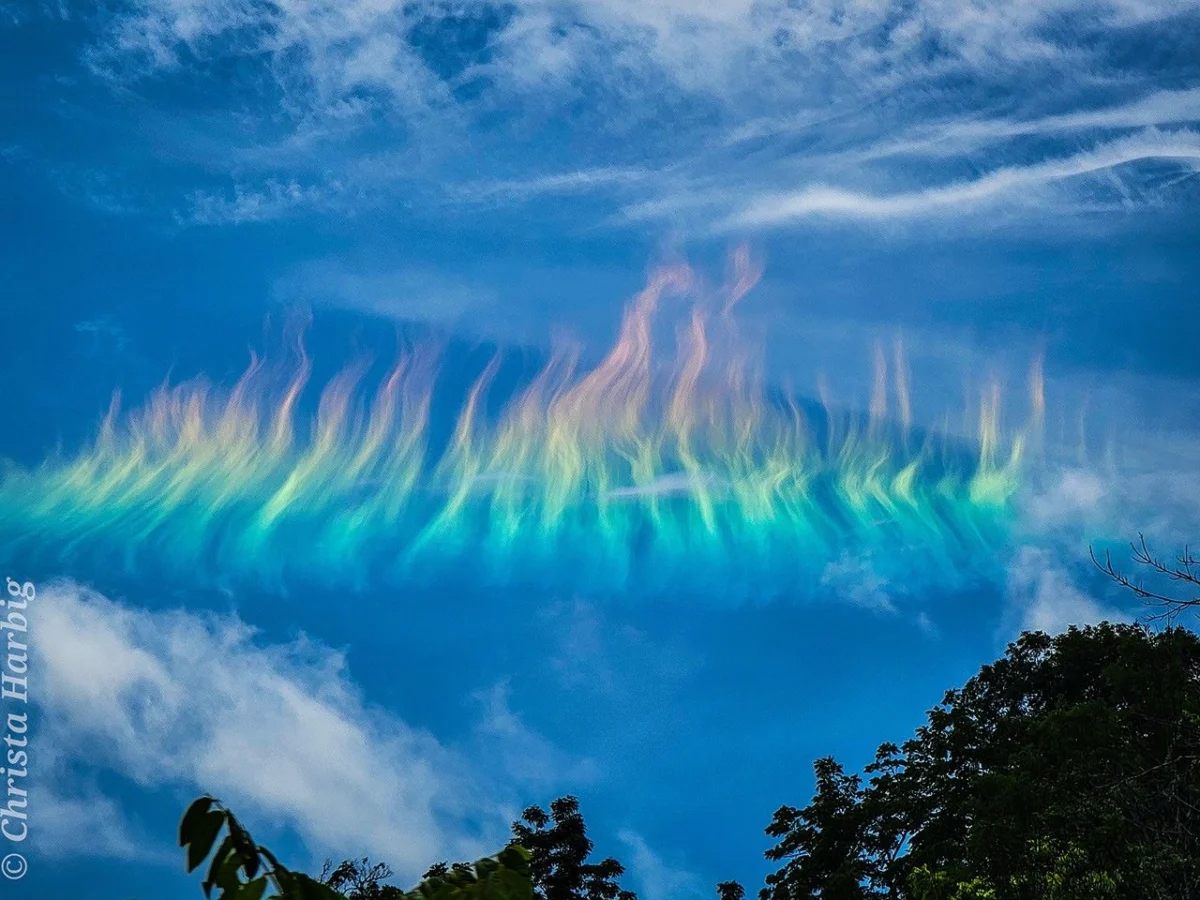
WASHINGTON D.C. – August 2, 2026 – A breathtaking atmospheric phenomenon, informally dubbed a "fire rainbow," has captivated audiences worldwide after being featured by NASA’s esteemed Astronomy Picture of the Day (APOD) on August 2, 2026. The striking image, captured by photographer Christa Harbig in 2021 near North Fork Mountain in West Virginia, USA, showcases a vivid circumhorizon arc, a rare and visually spectacular display of light refraction through ice crystals in the Earth’s upper atmosphere. This celestial event serves as a potent reminder of the intricate beauty woven into our planet’s meteorological tapestry, often mirroring the cosmic wonders APOD typically highlights from beyond our world.
The photograph, lauded for its clarity and vibrant depiction, offers a unique glimpse into the physics of light and atmospheric composition. Unlike typical rainbows formed by water droplets, a circumhorizon arc is a halo phenomenon, a subset of optical events that occur when sunlight interacts with ice crystals suspended in cirrus clouds. Its appearance is so distinctive, with colors arrayed horizontally, that it often evokes comparisons to a flame licking the horizon, hence its evocative moniker, "fire rainbow." The decision by APOD, a daily platform that brings astronomical and, occasionally, atmospheric marvels to a global audience, underscores the scientific and aesthetic significance of Harbig’s capture.
Unpacking the Science of a "Fire Rainbow"
The formation of a circumhorizon arc is a precise dance between solar geometry, cloud type, and atmospheric microphysics. For this particular optical spectacle to manifest, several conditions must align with remarkable exactitude. Foremost, the Sun must be positioned at a high angle in the sky, specifically at least 58 degrees above the horizon. This critical solar elevation ensures that sunlight can enter the ice crystals at the optimal angle for internal reflection and refraction.
Secondly, the presence of cirrus clouds is indispensable. These high-altitude clouds, typically found at elevations between 20,000 to 40,000 feet (6,000 to 12,000 meters), are composed entirely of ice crystals due to the extremely low temperatures at such altitudes. The APOD explanation specifically notes the presence of cirrus fibratus, a species of cirrus characterized by its thin, filamentous structure, often appearing as delicate white strands across the sky. While all cirrus clouds contain ice crystals, the fibratus variety, with its often uniform texture, can provide the consistent medium needed for these arcs.
The most crucial and perhaps rarest condition, however, lies in the morphology and orientation of these ice crystals. The crystals within the cirrus cloud must be flat, hexagonal plates, and, more critically, they must be aligned horizontally with respect to the Earth’s surface. This horizontal alignment acts as a collective array of miniature prisms. As sunlight enters the crystal through one vertical side, it is refracted, travels through the crystal, and exits through the bottom horizontal face, undergoing further refraction. The specific path of light through these aligned, hexagonal plates disperses the sunlight into its constituent colors, much like a conventional prism. The net effect is a brilliant, multi-colored arc that appears parallel to the horizon, hence the more scientific term, "circumhorizon arc." The precision required for such widespread crystal alignment is what renders these events "somewhat unusual to see," as noted by APOD’s professional astronomers.
The Journey of an Image: From West Virginia to Global Stardom
Christa Harbig’s captivating photograph was taken in 2021, a testament to the patient observation and photographic skill required to document such transient natural phenomena. The setting, near North Fork Mountain in West Virginia, provides a dramatic backdrop for the atmospheric display. North Fork Mountain, a prominent ridge in the Allegheny Mountains of the Appalachian range, is renowned for its rugged beauty, extensive forests, and panoramic views. Its elevated terrain and geographical position within a region prone to varied weather patterns likely contribute to the atmospheric conditions necessary for cirrus cloud formation and the potential for such optical events.
The specific moment of capture in 2021 underscores the ephemeral nature of circumhorizon arcs. These phenomena can last anywhere from a few minutes to several hours, depending on the stability of the atmospheric conditions, the Sun’s position, and the persistence of the aligned ice crystals. Harbig’s ability to not only witness but also expertly photograph this particular event speaks to a keen eye for atmospheric optics and a readiness to seize photographic opportunities.
For a photograph to be selected for APOD is a significant achievement within the scientific and photographic communities. The Astronomy Picture of the Day has been a daily fixture since 1995, curated by a dedicated team of professional astronomers including Robert Nemiroff, Jerry Bonnell, Cecilia Chirenti, and Keighley Rockcliffe. The selection process is rigorous, prioritizing images that are not only visually stunning but also scientifically illustrative, often accompanied by an accessible explanation penned by experts. Harbig’s image, after its 2021 capture, likely went through a submission and review process, ultimately earning its place on the prestigious NASA-affiliated platform in 2026, bringing this localized natural wonder to a global audience of millions.
NASA’s APOD: A Portal to Wonders Terrestrial and Cosmic

The Astronomy Picture of the Day (APOD) is a unique and highly successful outreach initiative, a collaborative effort between NASA’s Astrophysics Science Division (ASD) at Goddard Space Flight Center (GSFC), NASA Science Activation, and Michigan Technological University. Since its inception in 1995, APOD has consistently delivered a daily dose of cosmic inspiration, featuring a different image or photograph of our fascinating universe each day, accompanied by a brief, informative explanation written by a professional astronomer. While its primary focus is typically deep-space phenomena—galaxies, nebulae, planets, and stars—APOD occasionally broadens its scope to include striking terrestrial atmospheric events that involve astronomical principles, such as sunlight and atmospheric optics. This inclusion serves to demonstrate the interconnectedness of Earth-bound phenomena with broader astrophysical concepts, making science accessible and engaging for a diverse public.
The inclusion of Christa Harbig’s circumhorizon arc photograph on APOD on August 2, 2026, exemplifies this broader educational mandate. It highlights that the wonders of the universe are not exclusively found light-years away but can also manifest in our immediate skies, driven by the same fundamental laws of physics. The platform’s commitment to presenting "a different image or photograph of our fascinating universe" extends to phenomena that occur within our own planetary system, especially when they are as visually arresting and scientifically intriguing as a "fire rainbow." This approach helps to foster a holistic appreciation for science, linking meteorology and atmospheric physics directly to the realm of astronomy.
Atmospheric Optics: A Window into Earth’s Dynamic Systems
The study of atmospheric optics, which encompasses phenomena like circumhorizon arcs, halos, sun dogs, and glories, provides invaluable insights into the composition and dynamics of Earth’s atmosphere. These optical events are not merely beautiful curiosities; they are indicators of specific atmospheric conditions, including temperature, humidity, and the presence and form of ice crystals or water droplets. Understanding these phenomena contributes to broader meteorological research, helping scientists to better characterize cloud formations, study atmospheric layering, and refine models for weather and climate prediction.
For instance, the consistent horizontal alignment of hexagonal ice crystals required for a circumhorizon arc is not a random occurrence. It is influenced by factors such as the shape of the crystals, their size, and the atmospheric stability at high altitudes. Gravitational forces, combined with air resistance, cause these flat crystals to orient themselves with their largest faces parallel to the ground as they fall or drift. This microphysical detail, crucial for the formation of the arc, is a subject of ongoing research in cloud physics. Observations of rare and well-documented events like Harbig’s photograph provide empirical data points that can be used to validate and improve theoretical models of ice crystal behavior in the atmosphere.
The rarity of circumhorizon arcs, as highlighted by APOD, further underscores their scientific value. While the necessary conditions—high sun angle, cirrus clouds, and specifically oriented ice crystals—can occur, their precise combination across a sufficiently wide area to create a visible arc is infrequent. This makes each documented instance a valuable piece of data for atmospheric scientists.
Implications and Inspiration: Fostering Curiosity in the Natural World
The featuring of the West Virginia "fire rainbow" on APOD has several broader implications. Firstly, it elevates public awareness of the intricate beauty and scientific principles governing our natural world. In an age dominated by digital screens, such images serve as powerful reminders to look up and observe the dynamic environment around us. It encourages a deeper engagement with both meteorology and astronomy, fields that, while distinct, are fundamentally linked by the physics of light and matter.
For Christa Harbig, the photographer, the recognition by APOD is a significant career milestone, validating her skill and dedication to capturing the wonders of nature. It also provides a platform to inspire other amateur and professional photographers to pursue atmospheric optics and astrophotography. Her experience illustrates how a single, well-timed photograph can transcend its initial context and become a tool for global scientific education and appreciation.
Furthermore, the event subtly promotes geographical awareness, placing North Fork Mountain and West Virginia on a global stage as a location capable of hosting such extraordinary natural spectacles. This kind of scientific spotlight can contribute to an appreciation for local natural heritage and potentially encourage eco-tourism focused on natural phenomena.
From a scientific communication standpoint, APOD’s consistent success in translating complex scientific concepts into digestible, visually appealing daily features is exemplary. By showcasing a circumhorizon arc, they bridge the gap between terrestrial atmospheric science and the grander narrative of cosmic exploration, reminding us that the universe begins right above our heads. The anticipation for "Tomorrow’s picture: meteoric photobomb" further exemplifies APOD’s ongoing mission to continually surprise and educate its audience with the boundless wonders of the cosmos, whether they are light-years away or just within Earth’s atmosphere. The "fire rainbow" serves as a brilliant testament to the fact that extraordinary beauty and profound scientific lessons are often found in the most unexpected corners of our shared universe.