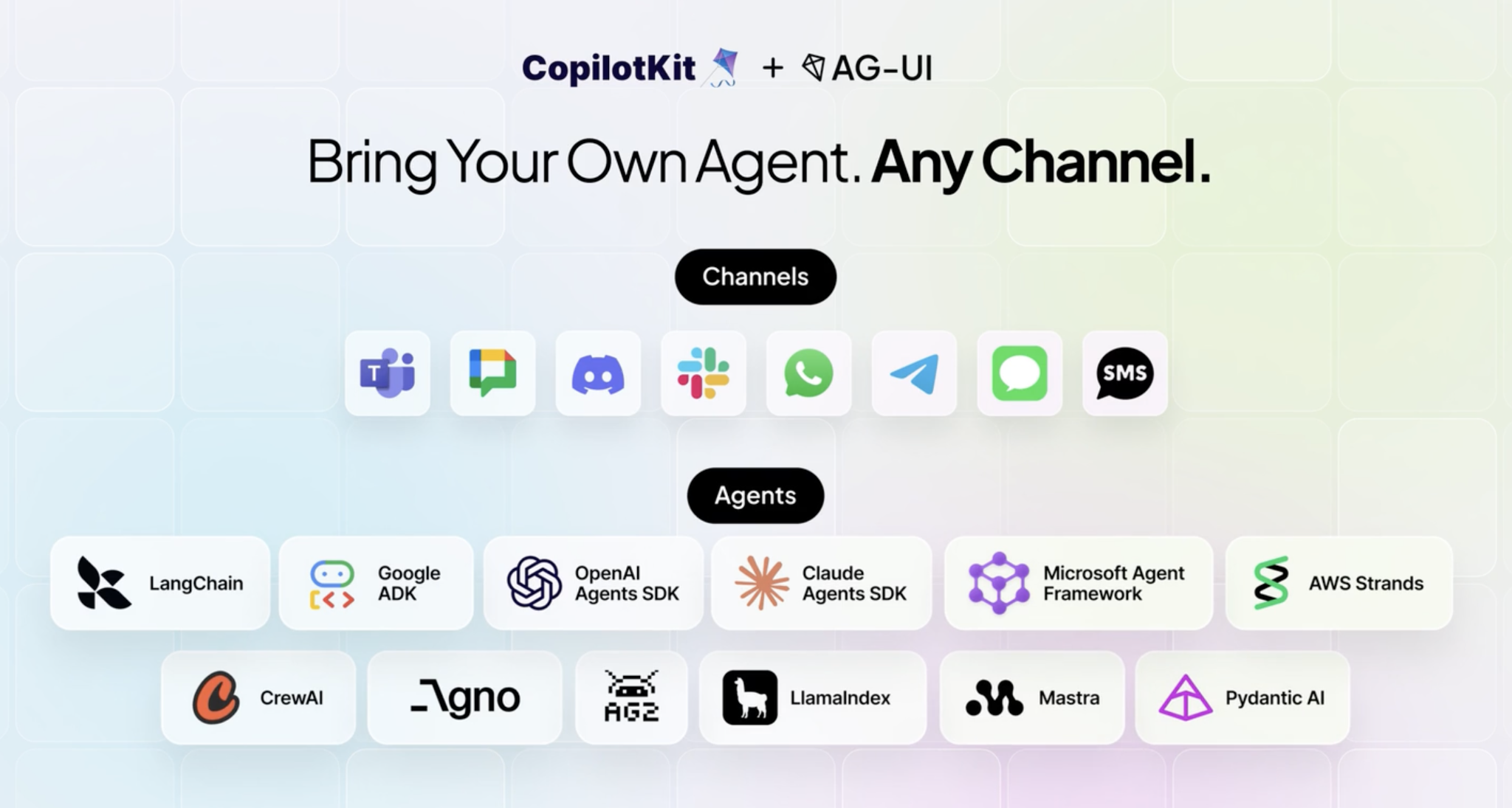
CopilotKit, a leading developer of framework-agnostic AI integration tools, has officially announced the release of its Channels SDK, an open-source library designed to simplify the deployment of autonomous AI agents within enterprise messaging environments. The primary objective of the SDK is to provide a standardized bridge between an agent’s internal logic—including its models, tools, and orchestration layers—and the diverse user interfaces provided by platforms such as Slack and Microsoft Teams. By utilizing the Agent-User Interaction (AG-UI) protocol, the Channels SDK allows developers to maintain a single codebase for their agents while ensuring native-quality interaction across multiple communication services. This release addresses a significant bottleneck in the "agentic" AI lifecycle: the "last-mile" delivery of intelligent workflows to the end-user’s primary workspace.
The Evolution of Agentic Deployment and the Last-Mile Problem
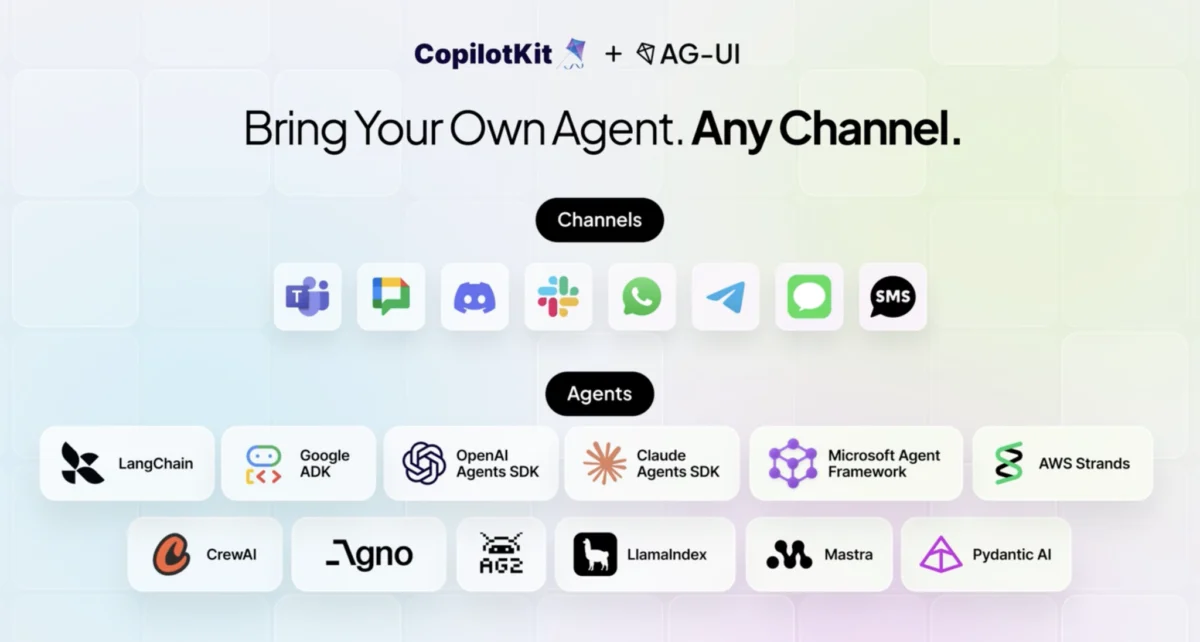
The rapid proliferation of Large Language Models (LLMs) has shifted the focus of AI development from simple text generation to the creation of autonomous agents capable of executing complex tasks. Frameworks like LangChain, CrewAI, and Pydantic AI have enabled developers to build sophisticated reasoning engines that can interact with databases, APIs, and internal business logic. However, a persistent challenge has remained: the fragmentation of the platforms where humans actually work.
Historically, deploying an AI agent to a messaging platform required developers to write custom adapters for each service. For example, integrating an agent into Slack required knowledge of Slack’s Block Kit and its specific event-subscription model, while Microsoft Teams required a separate implementation using Adaptive Cards and the Bot Framework. This fragmentation often led to "text-blob" integrations—where agents simply dumped unformatted text into a chat—which lacked the interactivity and professional appearance required for enterprise-grade tools.
The CopilotKit Channels SDK seeks to eliminate this friction. By acting as a transport and rendering target rather than a secondary agent, the SDK allows the underlying intelligence to remain where it is—whether hosted as a LangGraph workflow or a plain HTTP agent—while the SDK handles the complexities of platform-specific credentialing, message formatting, and interactive event handling.
Technical Architecture: The AG-UI Protocol and Native Rendering
At the heart of the Channels SDK is the Agent-User Interaction (AG-UI) protocol, an open-standard maintained by CopilotKit. AG-UI serves as the common language between the agent’s orchestration layer and the user interface. This protocol ensures that any agent capable of "speaking" AG-UI can be instantly connected to any supported messaging channel. Supported frameworks currently include high-profile libraries such as LangGraph, CrewAI, Mastra, Pydantic AI, and Google ADK.
A critical distinction of the Channels SDK is its approach to rendering. Unlike traditional webhook-based solutions that push raw text, the SDK authors messages as JSX (JavaScript XML), which is then lowered into a serializable intermediate representation. The SDK’s adapter then translates this representation into the native format of the target platform. In Slack, this results in the use of Block Kit components; in Microsoft Teams, it manifests as Adaptive Cards. This ensures that the agent’s output is not only readable but also contains interactive elements—such as buttons, menus, and input fields—that behave natively within the host application.
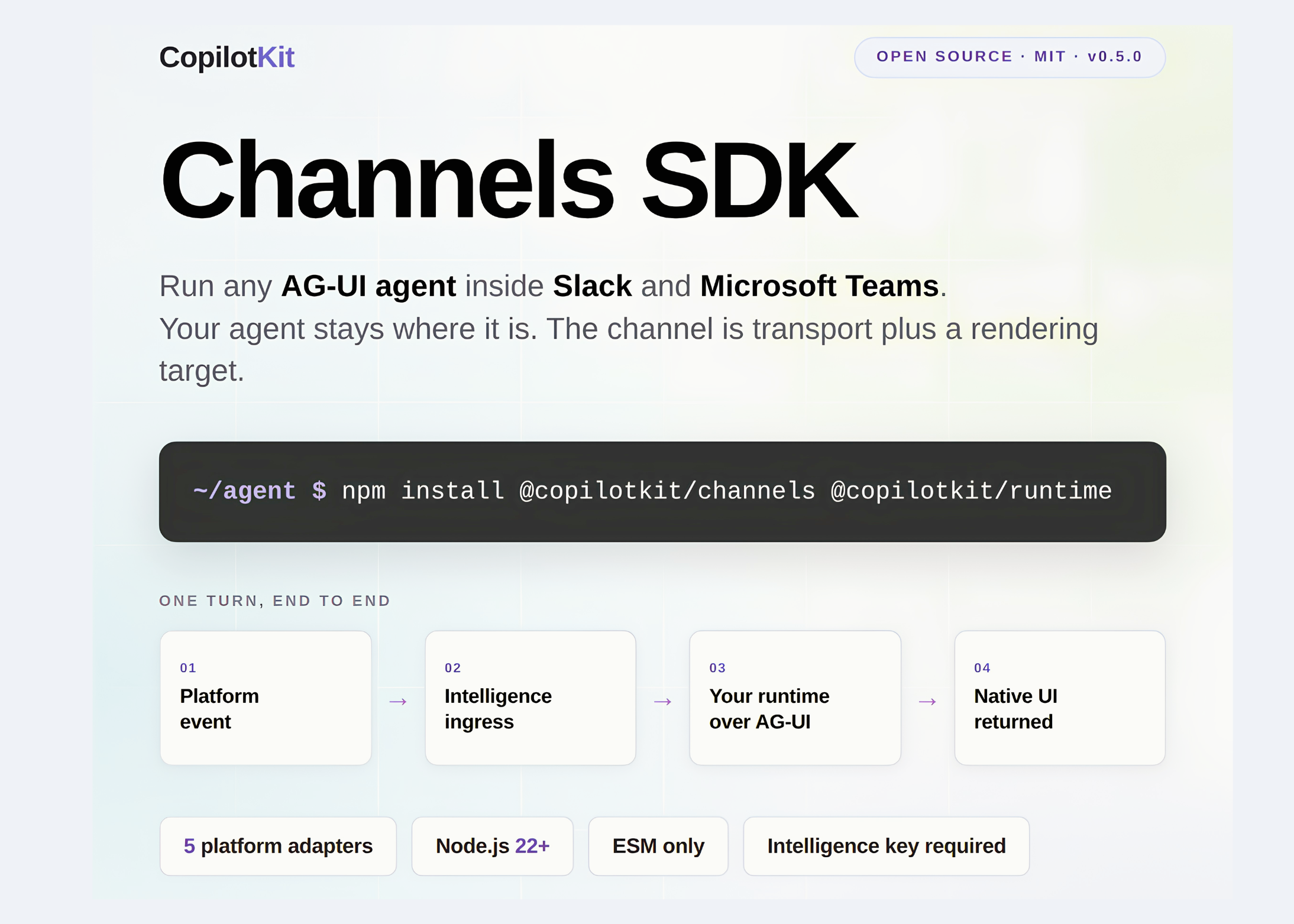
The installation process is designed for minimal friction, requiring only two core packages: @copilotkit/channels and @copilotkit/runtime. This lightweight footprint allows developers to integrate channel support into existing Node.js, Hono, or Express applications with minimal architectural changes.
Understanding the Operational Lifecycle and Runtime Contract
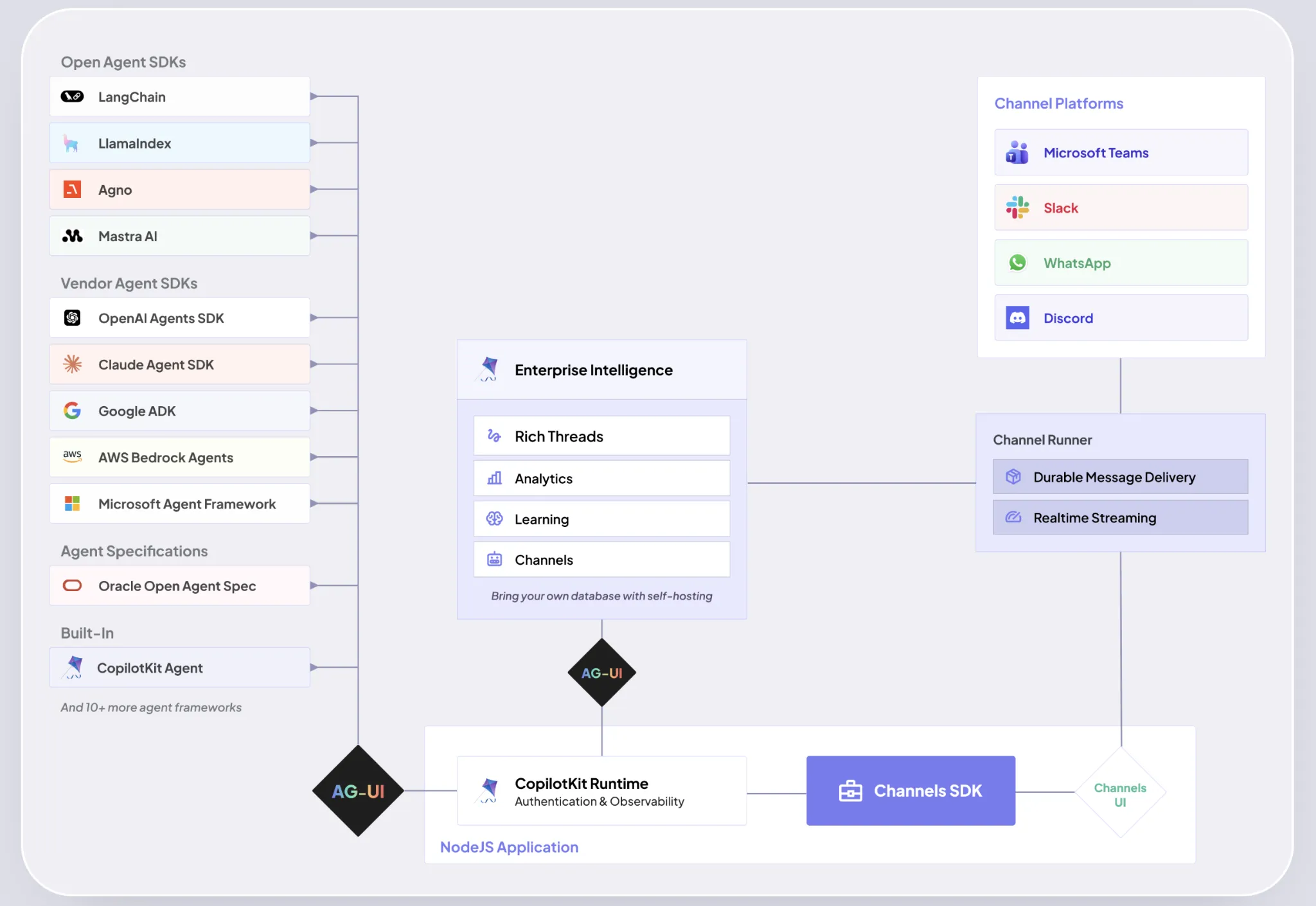
The Channels SDK operates under a specific runtime contract where the runtime itself, rather than the developer’s manual code, owns the activation of the channel. This design choice ensures that connection management, health checks, and reconnections are handled automatically. The SDK introduces a createCopilotNodeListener which initiates the connection to the messaging platform.
A standard "turn" or interaction cycle within the SDK follows a structured path:
- The messaging platform (e.g., Slack) sends an ingress event to the CopilotKit Intelligence layer.
- The Intelligence layer manages credentials and delivers the event to the developer-hosted runtime.
- The runtime triggers the specific agent logic, utilizing the defined models and tools.
- The agent generates a response, which is sent back through the runtime.
- The adapter translates the response into the platform’s native format (e.g., Adaptive Cards) and delivers it back to the user.
This separation of concerns is vital for enterprise security and scalability. The developer retains full control over the agent’s logic, model credentials, and application state, while the SDK manages the "plumbing" of platform-specific delivery and credentialed ingress. Furthermore, the SDK includes a channels.ready() method to ensure that configuration errors—such as invalid API keys or mismatched permissions—are identified at startup rather than during active user sessions.
Human-in-the-Loop and Enterprise Governance Patterns
One of the most significant features of the Channels SDK is its support for "Human-in-the-Loop" (HITL) workflows. In an enterprise context, autonomous agents are often restricted from performing high-stakes actions—such as modifying a CRM entry or deleting a project in Notion—without explicit human approval.
The Channels SDK facilitates this through a "confirm_write" pattern. For instance, in the "OpenTag" demonstration provided by the CopilotKit team, any mutation request to platforms like Linear or Notion is intercepted by the code before the request is executed. The interceptor emits a confirmation request to the user within the messaging thread. The agent only proceeds with the action after receiving an interactive approval from the user. This pattern ensures that while the agent can perform reads and rendering autonomously, any state-changing mutations are gated by human oversight.
Additionally, the SDK supports multi-agent orchestration within a single thread. This allows complex tasks to be handed off between specialized agents—such as a "Research Agent" and a "Summary Agent"—all while maintaining a coherent conversation history for the human participant.
Market Context and Strategic Implications
The release of the Channels SDK comes at a time when the enterprise messaging market is experiencing unprecedented growth. Microsoft Teams reported over 320 million monthly active users as of late 2023, while Slack remains a dominant force in the developer and startup ecosystems with over 30 million active users. As companies increasingly look to integrate AI into their daily workflows, the ability to deploy agents directly into these pre-existing hubs is a competitive necessity.
Industry analysts suggest that the "agentization" of software is the next logical step following the initial wave of generative AI chatbots. According to market data, the global autonomous AI agent market is projected to grow at a compound annual growth rate (CAGR) of over 40% through 2030. Tools that lower the barrier to entry for cross-platform agent deployment, like the Channels SDK, are expected to play a pivotal role in this expansion.
By open-sourcing the SDK under the MIT license, CopilotKit is positioning itself as a foundational layer in the AI infrastructure stack. This move encourages community contribution and ensures that the protocol remains transparent—a key requirement for security-conscious enterprise IT departments.
Roadmap and Future Development
While the Channels SDK currently provides early access support for Slack and Microsoft Teams, CopilotKit has outlined an aggressive roadmap for future expansions. Integrations for Discord and Google Chat are currently in the planning stages, which will further extend the reach of the AG-UI protocol.
The SDK also includes advanced options for developers to customize the user experience, including sanitizeAgentEvents for data privacy, showToolStatus for transparency in agent reasoning, and replyContinuation for maintaining long-running asynchronous tasks. The ability to register named JSX components ensures that even if a system restarts, interactive handlers for messages posted prior to the restart remain functional, preventing the "expired action" errors common in simpler bot implementations.
Conclusion
The CopilotKit Channels SDK represents a significant step toward the standardization of AI agent deployment. By decoupling the intelligence of the agent from the specifics of the communication platform, it allows developers to focus on building more capable and reliable AI systems. As the ecosystem for AI agents continues to mature, the focus will increasingly shift from "what the agent can do" to "where the agent can do it." With its focus on native rendering, human-in-the-loop governance, and open-source transparency, the Channels SDK provides a robust framework for bringing the power of autonomous AI into the heart of enterprise collaboration.