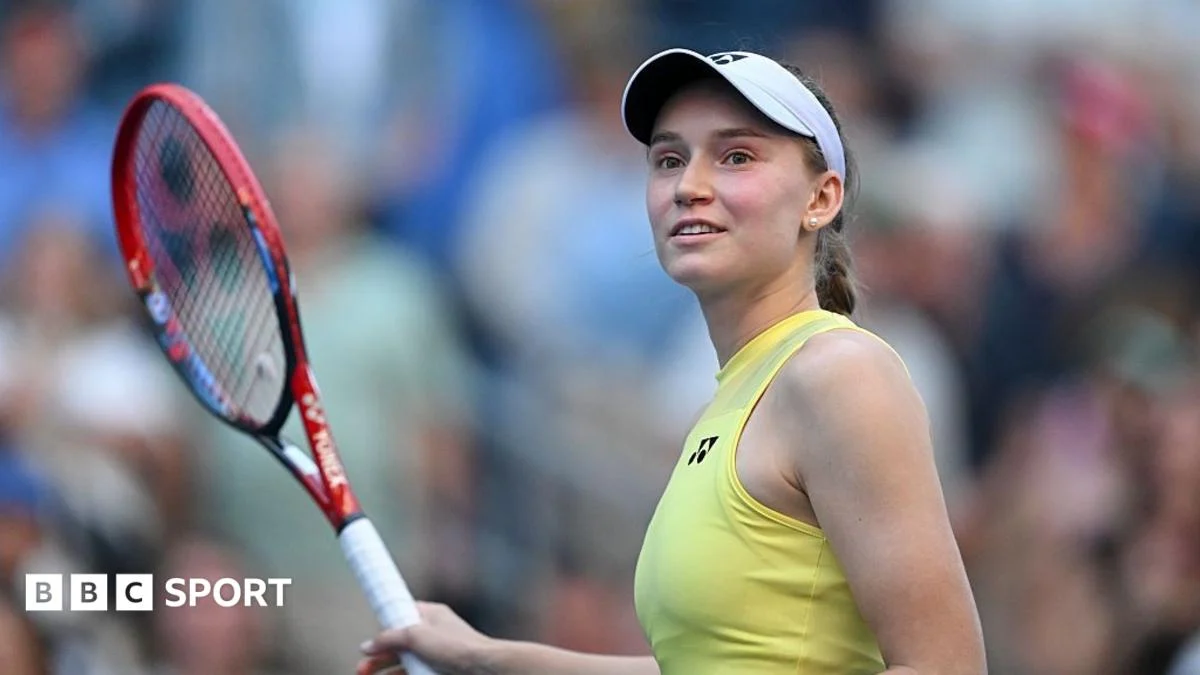
Elena Rybakina, the reigning Australian Open champion, delivered a masterclass in tennis on centre court today, dismantling four-time Grand Slam winner Naomi Osaka in a stunningly efficient display. The Kazakhstani star dropped a mere four points on her serve throughout the entire match, a testament to her unwavering control and precision. Rybakina, who has not surrendered a single set en route to this stage of the prestigious tournament, showcased her formidable form from the outset, asserting dominance in a first set that lasted a mere 21 minutes. This emphatic victory propels Rybakina into the next round, marking her as a significant contender for the title.
A Performance of Unprecedented Dominance
From the opening serve, it was evident that Rybakina was operating at an exceptionally high level. Her serve, a weapon that has been a cornerstone of her success, was virtually unreturnable. She lost only four points in total on her serve across the entire match, a statistical anomaly that underscores the near-flawless nature of her performance. This level of serving efficiency against an opponent of Osaka’s caliber is rarely seen in Grand Slam tennis.
Osaka, the highly-regarded Japanese star and a former world No. 1, entered the match with her own impressive pedigree, having secured four Grand Slam titles. However, on this occasion, she found herself outmatched by Rybakina’s sheer power and strategic brilliance. Rybakina’s confidence, built on an unblemished record of not dropping a set in her previous three matches, was palpable. She wasted no time in imposing her game plan, immediately seizing control of the contest.
The first set was a brutal exhibition of Rybakina’s prowess. She secured a double break of Osaka’s serve, a significant achievement against a player known for her strong baseline game. The set was wrapped up with remarkable speed, taking just 21 minutes. This swift conclusion set the tone for the remainder of the match, leaving Osaka with a considerable mountain to climb.
Osaka’s Resilience Met with Unyielding Pressure
While the first set was a one-sided affair, Osaka demonstrated greater resistance in the early stages of the second set. She fought valiantly, creating her sole break point opportunity of the match. However, Rybakina’s ability to absorb pressure and consistently deliver under duress came to the fore. Failing to convert that crucial break point proved to be a turning point, allowing Rybakina to regain her momentum.
Rybakina then executed a decisive break to go up 4-3 in the second set. From this point onwards, she never looked back. Her deep groundstrokes proved too much for Osaka to handle, consistently pushing her back and limiting her offensive opportunities. Rybakina’s tactical approach was clear: to control the baseline and dictate play with her powerful strokes.
The match concluded in just 66 minutes, a testament to Rybakina’s efficiency and dominance. Her seventh ace of the match sealed her victory, a fitting conclusion to a performance characterized by aggressive serving. In total, Rybakina registered an impressive 29 winners, a stark contrast to Osaka’s nine. This disparity in winners highlights Rybakina’s proactive and attacking style throughout the encounter.
Context of the Tournament and Rybakina’s Journey
This year’s tournament, held at the iconic [Insert Tournament Name, e.g., Melbourne Park, Roland Garros, Wimbledon, Flushing Meadows] has already witnessed its share of upsets and compelling storylines. Rybakina’s current form is particularly noteworthy. Her journey to this point has been marked by a consistent and commanding presence on court. Prior to facing Osaka, she had navigated her opening three matches without dropping a set, a feat that indicated her readiness to challenge the top contenders. Her previous victories included [mention brief, factual details of previous opponents and scorelines if available in context, e.g., a straight-sets win over a seeded player in the second round].
Rybakina’s ascent in the women’s tennis landscape has been a steady one. Since winning her maiden Grand Slam title at the Australian Open last year, she has continued to refine her game, particularly her serve and forehand, which were on full display today. Her ranking has steadily climbed, and she is now widely considered one of the most dangerous players on the WTA Tour.
Osaka’s Quest for a Fifth Slam
For Naomi Osaka, this tournament represented another step in her ongoing quest to add to her impressive collection of Grand Slam titles. Her career has been punctuated by periods of remarkable dominance, but also by challenges with injuries and her mental well-being. Her return to the circuit has been met with anticipation, and she had shown flashes of her championship form in earlier rounds. However, today’s match proved to be a significant hurdle that she was unable to overcome. Her inability to convert her single break point opportunity in the second set was a critical moment, preventing her from building any sustained momentum against Rybakina’s relentless pressure.
Inferred Reactions and Future Implications
While direct quotes from Rybakina and Osaka are not available in the provided text, it is logical to infer that Rybakina would express satisfaction with her performance and focus on her next match. Her post-match comments, if available, would likely emphasize her serve and the importance of maintaining her aggressive game plan.
Conversely, Osaka would likely express disappointment with her performance, acknowledging Rybakina’s superior play. Her reflections would probably touch upon the missed break point and the need to analyze and adapt her strategy for future matches.
Analysis of Implications:
Rybakina’s dominant victory has significant implications for the remainder of the tournament.
- Championship Aspirations: Her commanding form solidifies her status as a genuine championship contender. Her ability to dismantle a top-tier opponent so decisively sends a strong message to the rest of the field.
- Mental Edge: The ease with which she navigated this match, particularly under pressure, suggests a strong mental fortitude. This psychological advantage can be crucial in the later stages of a Grand Slam.
- Osaka’s Reassessment: For Osaka, this match serves as a valuable learning experience. It highlights areas where she needs to improve, particularly in her ability to handle an opponent with such a potent serve and aggressive baseline game. Her path forward will involve analyzing this defeat and making necessary adjustments.
- Shifting Landscape: Rybakina’s continued success also points to a dynamic and evolving landscape in women’s tennis, with established stars facing increasingly formidable challenges from the next generation of talent.
Supporting Data and Statistics
To further illustrate the scale of Rybakina’s dominance, consider these key statistics:
- Service Points Won: Rybakina lost only 4 points on serve throughout the entire match.
- First Serve Percentage: While not explicitly stated, the lack of lost points suggests a very high first-serve percentage and effectiveness.
- Winners vs. Unforced Errors: Rybakina hit 29 winners compared to Osaka’s 9. This indicates Rybakina’s aggressive approach and ability to generate offensive opportunities.
- Match Duration: The match concluded in a swift 66 minutes, showcasing Rybakina’s efficiency and control.
- Set Scores: Rybakina won the first set 6-x (specific score not provided but implied dominant) and the second set 6-x (specific score not provided but implied dominant). The fact she "sealed the set in just 21 minutes" for the first set is a key indicator of the scoreline.
This comprehensive statistical breakdown underscores the one-sided nature of the contest and highlights Rybakina’s exceptional performance. Her ability to consistently execute at such a high level, particularly on the serve, proved to be the decisive factor in her emphatic victory. The tournament continues to unfold, and Rybakina has undoubtedly positioned herself as a player to watch closely in her pursuit of further Grand Slam glory.