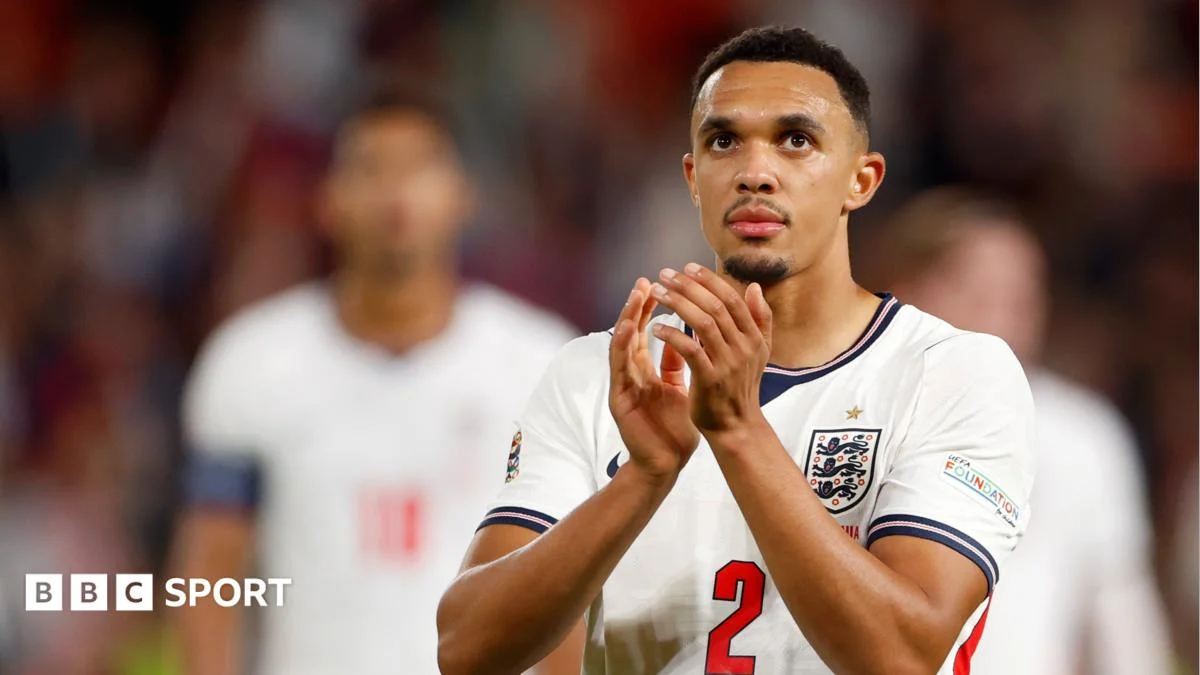
The enduring narrative of Thomas Tuchel’s tenure as England head coach has been the conspicuous and persistent absence of Trent Alexander-Arnold from his starting lineups, a situation that has baffled many observers given the Liverpool star’s undeniable talent. Despite a Premier League title triumph with his club and a high-profile move to Real Madrid, Alexander-Arnold has endured a significant drought in starting for the Three Lions. His last start for England came in October 2024, a Nations League fixture against Finland where he was controversially deployed at left-back by interim manager Lee Carsley, though he still managed to find the net in a 3-1 victory. This prolonged period on the fringes, underscored by his omission from the squad for the previous summer’s World Cup – a tournament where the right-back position for England was often described as a ‘cursed role’ – suggested that Tuchel harboured fundamental reservations about Alexander-Arnold’s suitability for his system, regardless of the challenges facing that particular position.
Therefore, Tuchel’s decision to recall the 27-year-old for the current four-game Nations League campaign represented a significant surprise, a stark contrast to the emphatic marginalisation he had previously experienced. This unexpected inclusion set the stage for Alexander-Arnold’s return to the starting XI against the Czech Republic in Prague, a match England desperately needed to win to recover from a disheartening 3-2 defeat against the reigning World Cup champions, Spain, at Wembley. His inclusion meant he became the ninth different right-back to feature under Tuchel in just 24 games, highlighting the coach’s perceived uncertainty in that area of the pitch.
A Moment of Genius in Prague
It was within this high-stakes environment, against a resolute Czech Republic side, that Alexander-Arnold seized the opportunity to make a profound statement. England, despite enjoying territorial control, were struggling to break down a disciplined Czech defence, a task made even more arduous by the dismissal of their danger man, Pavel Sulc, for a reckless challenge on Elliot Anderson just 25 minutes into the match. The Czechs were reduced to ten men, yet England found themselves unable to penetrate their stubborn resistance.
The decisive moment arrived two minutes into the second half. Trent Alexander-Arnold, now universally recognised by the moniker "Trent" emblazoned on his shirt, delivered a piece of individual brilliance that transcended the tactical nuances Tuchel had been grappling with at right-back. He had already demonstrated his attacking intent earlier in the game, embarking on a remarkable 70-yard run into an advanced attacking position, aiming to bolster England’s offensive options. Even after the initial move broke down, Alexander-Arnold’s tenacity saw him regain possession. From this position, he unfurled a magnificent right-footed cross that arced with precision beyond three Czech defenders, finding Anthony Gordon who, with a stooping header that belied the difficulty of the execution, powered the ball into the net.
This singular act of creative genius served as a potent demonstration of Alexander-Arnold’s unique skillset, a quality that potentially distinguishes him from the other right-backs Tuchel has previously selected. While Tuchel may still harbour reservations about Alexander-Arnold’s defensive capabilities, a facet of his game that was not severely tested in this particular match due to the opposition’s numerical disadvantage, these few seconds offered a compelling glimpse into his offensive prowess. It presented a compelling argument for the coach to shift his focus from what Alexander-Arnold might lack to the exceptional contributions he can undoubtedly provide. In essence, this performance underscored the growing sentiment that it is time for Thomas Tuchel to place a greater degree of trust in Trent Alexander-Arnold.
Statistical Snapshot of Alexander-Arnold’s Impact
Beyond the headline-grabbing assist, a deeper statistical analysis of Alexander-Arnold’s performance against the Czech Republic further supports the argument for his inclusion and continued development within the England setup. While defensive metrics were not the focal point of his standout contribution, his offensive output was demonstrably significant. He made more passes in the final third (32) than any other England player, with the exception of Elliot Anderson (41), illustrating his willingness to probe and create opportunities in advanced areas. Furthermore, he registered three key chances created, a figure bettered only by Anthony Gordon (four), highlighting his role as a primary catalyst for England’s attacking movements. This data provides concrete evidence of his creative influence, even in a match where England were facing a ten-man opposition.
Tuchel’s Reaction and the Coach’s Perspective
Following the match, a visibly pleased Thomas Tuchel offered his assessment of Alexander-Arnold’s performance to BBC Radio 5 Live. "He did very well," Tuchel stated. "He had an excellent assist. Overall, like everyone, he was professional, top attitude and one decisive action." The England coach acknowledged the player’s capacity for such moments: "We never doubted that he can produce these kinds of assists." Tuchel also noted a tactical observation, suggesting that Alexander-Arnold’s effectiveness was enhanced by his positioning: "The deeper position in the second half suited him more than the higher position in the first half."
Reflecting on the broader team performance, Tuchel commented, "Overall, I think we had a good and professional performance. Of course, the red card, especially an early red card, is such a heavy influence in the game. It makes the task sometimes a little bit more complicated psychologically." This statement, while acknowledging the impact of the red card, also implicitly highlights the mental fortitude required from the team to navigate such a situation and secure a victory, a challenge Alexander-Arnold demonstrably met.
Teammate’s Endorsement and Alexander-Arnold’s Journey
Anthony Gordon, the beneficiary of Alexander-Arnold’s exquisite assist, spoke with effusive praise for his teammate. "I make that run time and time again and only a certain number of players have that ability, technique and bravery to be willing to make the mistake trying that pass," Gordon remarked. "That’s why he’s so good and I’ve been dying to play with him for that reason." Gordon also offered a perspective on Alexander-Arnold’s personal journey with the national team, acknowledging the player’s desire for more game time. "He’s had his own journey with England. He would’ve liked to have played more than he has but he’s been a great character during this camp. I’ve really enjoyed being around him." This sentiment from a teammate underscores Alexander-Arnold’s positive influence within the squad, irrespective of his past international standing.
Historical Context and the ‘Midfielder’ Experiment
The doubts surrounding Alexander-Arnold’s role in the England setup are not solely confined to Thomas Tuchel’s current management. Many recall the ill-fated attempt by former manager Gareth Southgate to transition Alexander-Arnold into a midfield role during Euro 2024. This experiment, widely criticised and ultimately abandoned after just 54 minutes of England’s second group game against Denmark, never regained traction and was permanently shelved. This historical precedent suggests a broader challenge in finding Alexander-Arnold’s optimal position within the national team, a struggle that has persisted across different managerial tenures. The player himself has consistently expressed his belief in his ability to contribute at the highest level for England, stating, "It was amazing. It’s always an honour to represent my country. It’s been a long time, but I’ve always believed I can play for England. That belief has always been there and it was about proving it at club level. The manager gave me a chance, now hopefully he is happy with how I played." His words reflect a quiet determination and an unwavering conviction in his own capabilities.
The Road Ahead: Croatia and Beyond
The upcoming fixture against Croatia, played behind closed doors in Rijeka on Saturday, presents another crucial opportunity for Alexander-Arnold to solidify his claim for a regular starting spot. This match, in many ways, could be a defining moment in his England career. If he can replicate or build upon the impactful performance shown against the Czech Republic, it would be difficult for Tuchel to ignore his contributions. The memory of that game-changing assist, a moment of pure class, must surely be lodged firmly in the head coach’s mind. Failure to convince Tuchel in this camp, despite such a potent display, would raise serious questions about his future prospects with the national team.
Alexander-Arnold’s approach to the game is often characterised by a willingness to take risks, both defensively and offensively. While this can sometimes lead to vulnerabilities, it is also the very engine of his creative brilliance. His performance against the Czech Republic showcased the exhilarating attacking potential he brings to the team, a facet that has been largely underutilised in his international career. The Nations League campaign, with its series of high-stakes matches, provides the perfect platform for him to demonstrate that his offensive gifts can outweigh any perceived defensive shortcomings.
Broader Implications for England’s Future
The continued debate surrounding Trent Alexander-Arnold’s role within the England squad has broader implications for the team’s tactical flexibility and attacking prowess. In an era where innovative full-backs are increasingly becoming central figures in team strategies, Alexander-Arnold represents a unique proposition. His ability to dictate play from deep, deliver incisive passes, and create overloads in advanced areas offers a different dimension to England’s attacking play. If Tuchel can successfully integrate him into the team in a role that maximises his strengths, it could significantly enhance England’s chances in major tournaments.
The Nations League, though not the ultimate prize, serves as a vital testing ground for tactical experiments and player integration. Alexander-Arnold’s performance against the Czech Republic was more than just an assist; it was a statement of intent and a compelling argument for his inclusion. The question now remains whether Thomas Tuchel will seize this opportunity to fully unleash one of England’s most gifted playmakers, thereby reshaping the narrative of his international career and potentially bolstering England’s ambitions for future success. The coming matches will undoubtedly provide the answer, and Alexander-Arnold has certainly done his utmost to earn a more prominent role. The final three points of the Nations League campaign were secured by captain Harry Kane, who notched his 87th goal in 123 international appearances, but it was Alexander-Arnold’s moment of individual brilliance that truly ignited England’s campaign in Prague.