


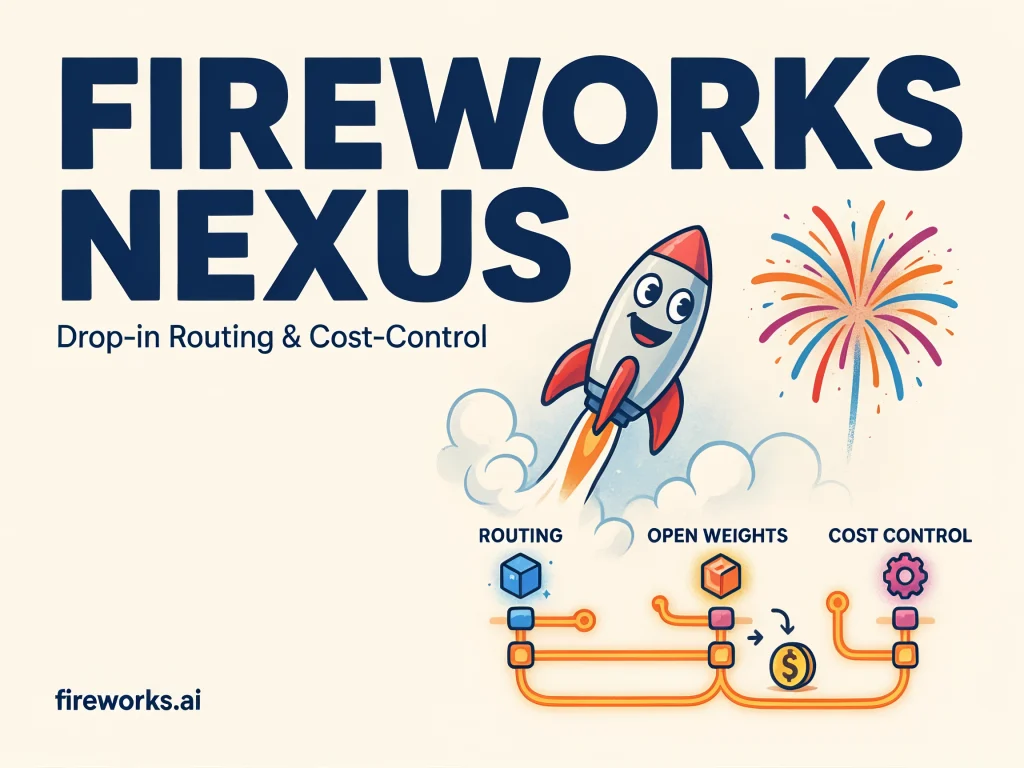
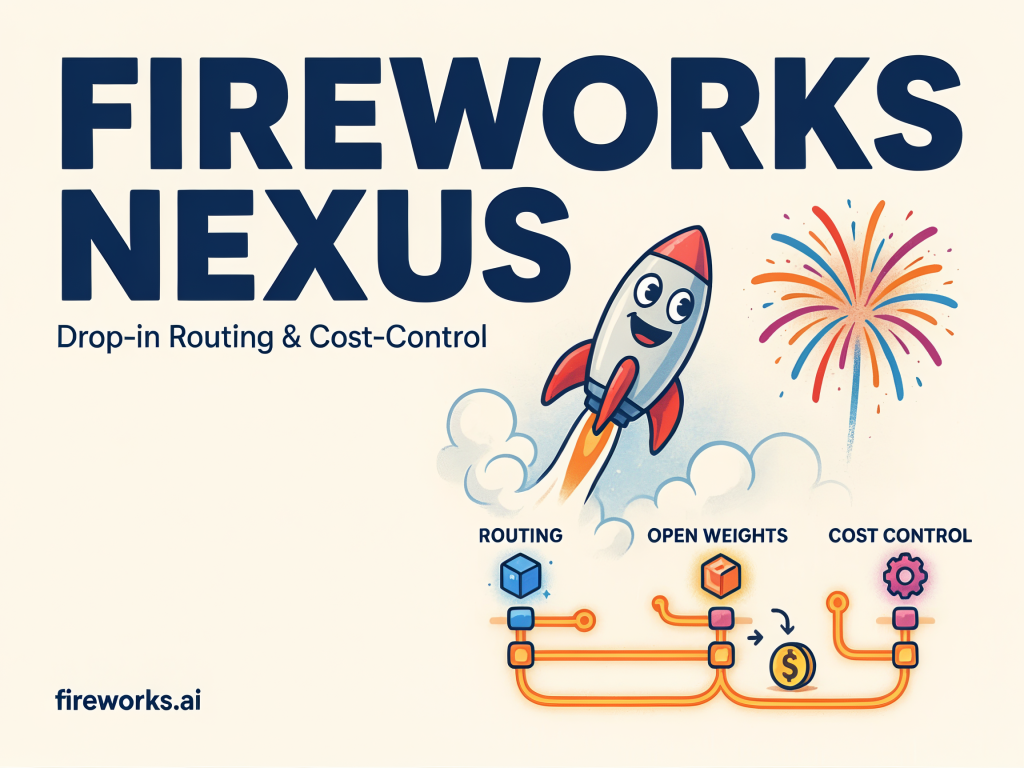
Fireworks AI has officially announced the release of Fireworks Nexus, a comprehensive AI management and routing platform specifically engineered to assist large-scale software development organizations in navigating the escalating costs of generative AI adoption. The platform functions as a managed orchestration layer, bridging the gap between the high-performance coding tools currently utilized by developers and a cost-efficient ecosystem of open-weight models. By providing a centralized interface for model selection, budget enforcement, and performance tracking, Nexus seeks to resolve the growing friction between engineering productivity and corporate fiscal responsibility.
The launch comes at a critical juncture for the technology industry, as the initial excitement surrounding generative AI agents transitions into a period of rigorous cost-benefit analysis. The financial pressures facing modern engineering teams were highlighted in a recent report regarding Uber’s internal AI implementation. According to industry analysis, Uber exhausted its entire 2026 AI budget within just four months of rolling out Claude Code to its workforce. The tool, an agentic coding assistant developed by Anthropic, reached approximately 5,000 engineers following a December rollout. Fireworks AI noted that this rapid exhaustion of funds was driven by an unprecedented surge in agentic adoption, which climbed from roughly one-third of the engineering staff to more than four-fifths in a span of only two months.
Fireworks AI characterizes the underlying issue not as a simple case of overspending, but as a fundamental mismatch between task complexity and model pricing. In the current landscape, many organizations are inadvertently running routine, low-complexity coding tasks at "frontier" prices—the premium rates charged by closed-source labs for their most capable models. While platform teams recognize the potential savings offered by open-weight models, the operational complexity of switching providers, managing multiple API keys, and ensuring workflow continuity has historically made such transitions unattractive. Fireworks Nexus aims to eliminate these barriers through a three-pronged architectural approach.
The Three Pillars of Fireworks Nexus
The Nexus platform is structured around three core components designed to provide enterprise-grade control without sacrificing the speed of development. These components address the administrative, technical, and operational challenges of modern AI integration.
1. Enterprise Controls and Cost Observability
Nexus provides a centralized dashboard where platform teams can establish and enforce granular budget constraints at either the team or the company level. This administrative layer allows for the real-time tracking of Return on Investment (ROI) across various models and tools. Beyond financial metrics, the platform emphasizes security and compliance, a prerequisite for enterprise adoption. Requests processed through Nexus run on the Fireworks production inference platform, which utilizes US-hosted endpoints and maintains a strict policy of zero data retention. The infrastructure is supported by a network of 20 global data centers, ensuring low-latency access and high availability for distributed engineering teams.
2. Workflow Continuity via FireConnect
A primary hurdle in model migration is the potential disruption to established developer workflows. To mitigate this, Fireworks has released FireConnect, an open-source tool licensed under Apache 2.0. FireConnect is a one-line installation that maps the model slots in existing developer harnesses to Fireworks-hosted models. This allows popular tools such as Claude Code, Codex, and OpenCode to remain functional without requiring significant configuration changes from the end-user. FireConnect operates on Fireworks Serverless APIs that are fully compatible with both Anthropic and OpenAI protocols, meaning most development tools can connect simply by updating a base URL and a model ID.
3. Intelligent Traffic Management and Routing
The most technologically advanced aspect of the platform is its intelligent router. This component utilizes a custom-trained model to evaluate the difficulty of each incoming request in real-time. Routine or repetitive coding tasks are automatically routed to cost-effective open-weight models served by Fireworks. Conversely, tasks identified as highly complex or "difficult" are passed through to the organization’s existing frontier model provider (such as Anthropic or OpenAI) using the company’s own API keys. Fireworks maintains that these third-party keys are never stored on their servers, preserving security. Preliminary research indicates that this selective routing typically delivers a three-to-five-fold reduction in total operational costs.
Performance Benchmarking and Real-World Efficacy
To validate the efficacy of the Nexus platform, Fireworks AI’s research team collaborated with several high-profile development organizations, including Notion and Doximity. Initial data from these preview programs suggests a one-third reduction in the cost associated with each merged pull request. Furthermore, the research team reported a blended token rate—the average cost per token across all routed models—that is roughly one-quarter of the rates typically charged by closed-model laboratories.
While vendor-provided figures offer a baseline, the industry has looked toward independent evaluations for a more objective assessment. Two significant studies, conducted by Faros AI and Arize, provide deeper insight into how Nexus performs under real-world conditions.
The Faros AI Evaluation
Faros AI conducted an extensive study involving 211 real-world engineering tasks sourced from 12 different software repositories. These tasks were tested across seven distinct model-and-harness routes. One of the most notable findings involved the comparison between Claude Code running on GLM-5.2 (an open-weight model) and Claude Code running on the frontier Opus 4.8 model.
Using a model-based rubric judge, the GLM-5.2 configuration achieved a score of 0.568, while the Opus 4.8 configuration scored 0.521. Despite the comparable—and in some cases superior—performance of the open-weight model, the cost disparity was stark. The GLM-5.2 route cost $0.92 per task, compared to $1.76 for the Opus route. Faros AI noted that these results were not skewed by caching differences, as the cache share for both models was high (89.7% and 99.7% respectively). However, Faros emphasized that these results are specific to the tasks analyzed and should not be viewed as a universal leaderboard for all coding scenarios.
The Arize Cost-Per-Successful-Task Study
In a joint effort with Fireworks, Arize evaluated 10 different AI models using the Terminal-Bench framework. The study encompassed 40 distinct tasks with six trials each, totaling 2,400 runs and over $600 in API expenditures. The primary metric used was "cost per successful task," which factors in the financial impact of failed attempts and necessary retries.
The Arize study revealed two critical insights that support the Nexus routing philosophy. First, on "easy" tasks, the premium paid for frontier models yielded no performance advantage; for instance, the Kimi K2.6 model achieved a 73% pass rate, surpassing the 69% pass rate of GPT-5.5. Second, on "hard" tasks, the frontier models remained dominant, with GPT-5.5 achieving a 51% success rate compared to Kimi K3’s 32%.
The study concluded that a "simulated routing" strategy—or an escalation ladder—outperformed any single-model approach. A deliberate escalation strategy reached a cost of $0.525 per successful task while solving 32.3 out of 40 tasks. In comparison, using GPT-5.5 exclusively cost $0.636 per task and solved only 25 out of 40. Notably, a "naive" escalation that cycled through all ten models without intelligent routing resulted in a cost of $1.319 per task, demonstrating that the design of the routing logic is as important as the models themselves.
Implementation Strategies for Engineering Teams
Fireworks has designed Nexus to be accessible through three distinct integration paths, allowing organizations to choose the level of intervention that best suits their infrastructure.
The first path, utilizing the FireConnect plugin, is intended for teams seeking the lowest possible friction. The installer requires the Claude Code CLI to be present on the system’s path. Once initiated, it prompts for a Fireworks API key and automatically configures the environment, including the creation of timestamped backups for existing settings. This path provides developers with several command-line tools, such as /fireconnect:on and /fireconnect:off, to toggle the routing functionality.
The second path involves direct API redirection. By setting the ANTHROPIC_BASE_URL to a Fireworks endpoint and providing a Fireworks key, teams can leverage the platform’s infrastructure without installing additional plugins. This method relies on the broad compatibility of Fireworks’ serverless APIs with existing OpenAI and Anthropic client libraries.
The third and most comprehensive path is the use of the Nexus Router itself. Currently available as a research preview, the router acts as a front-end for an organization’s existing frontier model contracts. In its current iteration, the router is configured to manage traffic between models such as Claude Opus 5 and GLM-5.2, or in an all-open configuration, between Kimi K3 and GLM-5.2.
Broader Industry Implications
The introduction of Fireworks Nexus represents a shift in the generative AI market from raw capability to operational efficiency. For the past two years, the industry narrative has been dominated by the "frontier model" race, where the primary goal was to achieve higher scores on reasoning and coding benchmarks. However, the economic reality of deploying these models at scale—exemplified by the budget crises at firms like Uber—has created a demand for sophisticated management tools.
By enabling the seamless use of open-weight models for routine tasks, Fireworks is positioning itself as a critical intermediary in the AI supply chain. This move likely increases the competitive pressure on closed-source providers to lower their prices or increase the "intelligence-per-dollar" of their entry-level models. Furthermore, the success of platforms like Nexus may accelerate the adoption of agentic AI workflows, as organizations find they can scale these tools to their entire engineering staff without the risk of immediate budgetary exhaustion.
As the router moves from research preview to full production, the ability of Fireworks AI to maintain high accuracy in its "difficulty scoring" will be paramount. If the router can reliably identify when a task requires the specialized reasoning of a frontier model versus the efficiency of an open-weight model, it could become the standard operating procedure for enterprise AI deployment. For now, the data from Faros and Arize suggests that the era of "one-size-fits-all" AI implementation is coming to an end, replaced by a more nuanced, multi-model approach.