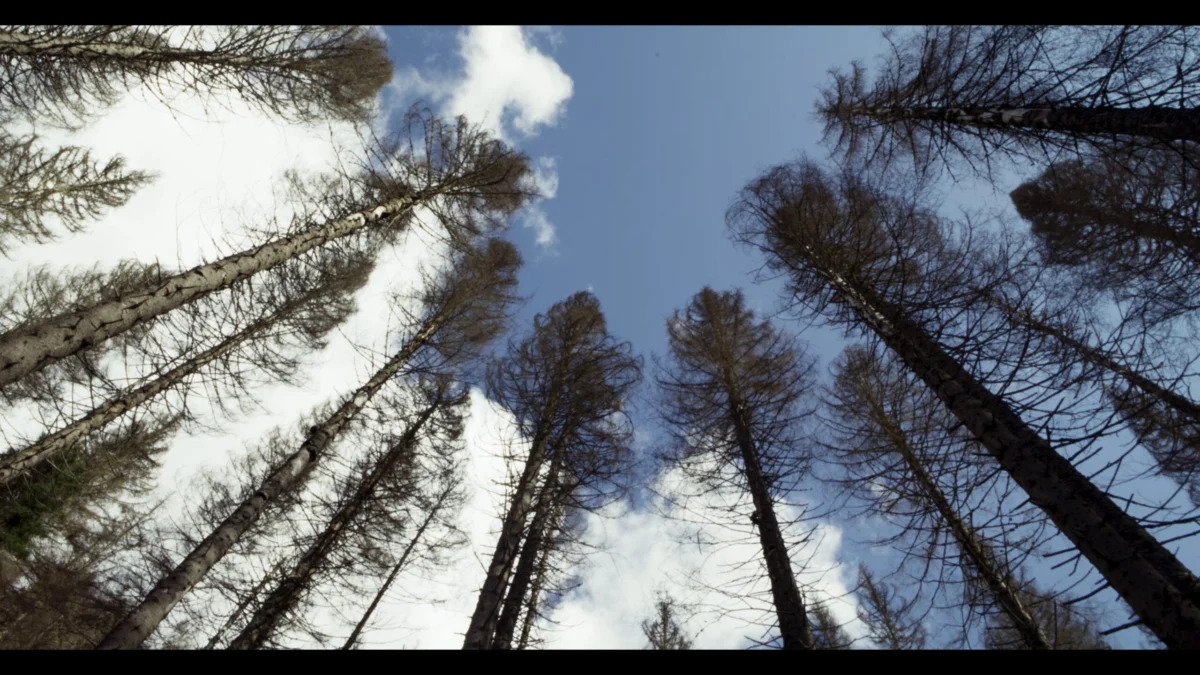
Renowned filmmaker Victor Kossakovsky, celebrated for his profound ability to challenge human perspectives on life, is set to unveil his latest cinematic offering, Holy Wood Dust, at the prestigious Venice Film Festival. This new documentary, scheduled for its world premiere on September 6th in the Venice Open – Out of Competition section, marks a significant collaboration with Italian botanist and author Stefano Mancuso. The film promises to be an immersive journey into the world of trees, urging audiences to reconsider their relationship with the plant kingdom.
Kossakovsky’s directorial career has been characterized by a deep-seated empathy that extends beyond human experience. His 2020 film, Gunda, a wordless and emotionally resonant portrayal of a pig and her piglets, was lauded as the inaugural installment of his "empathy trilogy." This was followed by Trillion last year, another wordless documentary that followed an artist returning fish scales to the ocean, serving as a stark visual representation of the estimated one trillion fish humans harvest from the world’s oceans annually. With Holy Wood Dust, Kossakovsky shifts his focus to the silent, ancient world of trees, seeking to illuminate their complex existence and inherent sentience.
"While art may be powerless to halt the conflicts unfolding around us and cannot stop the bullets of today, I believe that telling stories rooted in empathy can plant the seeds for a more peaceful future," Kossakovsky stated in a director’s note released in conjunction with the Venice Film Festival announcement. This philosophy underpins his entire oeuvre, and Holy Wood Dust appears to be a natural, albeit different, extension of this commitment. The film poses poignant questions: "What happens to a stump the second after a tree is cut down? What does that tree think and feel at that very moment?" The synopsis promises a "radical reimagining of the plant kingdom from a new, groundbreaking perspective."

The genesis of Holy Wood Dust can be traced back to a childhood encounter with his mother, who instilled in him a profound respect for nature. "When I was a kid, I walked with my mom, and I took one leaf from a bush, and my mom said: ‘Why did you do that?’ And I said: ‘Oh, it’s beautiful.’ And she said: ‘If we take out one of your hairs, do you feel pain?’ So I said: ‘Yes, of course.’ My mother said: ‘The bush feels the same. It feels pain. So don’t do that any longer.’" This formative lesson on the interconnectedness of life and the capacity for suffering in all living beings has remained a guiding principle for Kossakovsky.
Later, an encounter with a fallen leaf in Berlin sparked a deeper scientific curiosity. After breaking a dead leaf under a microscope, Kossakovsky observed a phenomenon that mirrored the healing process in humans after injury. This led him to ponder the internal experience of a tree when it is cut. "I remember I was filming and shaking because it’s obvious that something bad happened to the tree, something horrible. It’s confused, suffering, trying to heal and trying to fight," he recounted, describing the immense challenge of visually translating these complex internal processes. The film reportedly captures this experience with a cinematic scope reminiscent of "War and Peace," depicting a tree’s bewilderment and struggle after experiencing trauma.
The collaboration with Stefano Mancuso, a leading figure in plant neurobiology and a vocal advocate for plant rights, was instrumental in bringing Kossakovsky’s vision to fruition. Mancuso’s groundbreaking research suggests that plants possess a complex system of senses and communication far exceeding common understanding. Kossakovsky discovered Mancuso’s work through his assistant during another project. "She told me, ‘You have to read this!’" he recalled. The immediate resonance with Mancuso’s writings led Kossakovsky to reach out, and a remarkably swift and positive response from the botanist cemented their partnership. "He wrote back to me in one minute: ‘I saw a few of your films, so I want to see you as well.’ So, it happened by coincidence that we both needed each other. He is a visionary man. And 15 years ago, I started thinking about this film."
The film’s visual narrative initially explored other arboreal subjects. Kossakovsky considered a film centered on linden trees, appreciating their expansive, cinematic form. However, the challenge of capturing the essence of a Christmas tree, a universally recognized symbol with deep emotional ties, proved irresistible. "With a Christmas tree, it’s just a vertical triangle, which is not cinematic, especially in the film format I like. I like the 2:1 aspect ratio, which makes things very difficult for a Christmas tree," he admitted. Despite the aesthetic challenges, he recognized the universality and emotional resonance of the Christmas tree, aiming to create a film accessible to children and families, akin to a "Christmas carol."

A striking visual moment in Holy Wood Dust features a helicopter transporting a Christmas tree towards the Vatican. This scene is a deliberate and poignant homage to Federico Fellini’s iconic 1960 masterpiece, La Dolce Vita. In Fellini’s film, a similar aerial shot depicts a statue of Jesus Christ being flown over Rome to the Vatican, a juxtaposition of the sacred and the secular. Kossakovsky’s reference serves as a profound tribute to Fellini’s enduring influence. "I really wanted to say my thanks to Fellini because I remember the moment when I first saw one of his films. I was a teenager, and I saw 8½ in a very good cinema in Saint Petersburg," Kossakovsky shared, recounting a deeply personal and transformative cinematic experience. He described being so moved by the film that he remained in the darkened theater, weeping uncontrollably, long after the credits rolled, feeling as though the film was a personal revelation.
The film also features a powerful segment where Stefano Mancuso engages with children, discussing the intrinsic value and importance of trees. This sequence aims to counter the common perception of trees as mere decorative elements. "Yes, [that was] important [because] we consider trees like decoration, right? I took [some experiences] with trees as a sign to do this film. It was like a tree was crying, asking me: ‘Victor, see it. Do it because no one understands. Everyone considers us as decoration. We are not. We are living beings.’"
The title, Holy Wood Dust, itself carries a layered significance, evoking both the sacredness of nature and the ephemeral nature of existence. While Kossakovsky admitted to never being fully satisfied with working titles, he revealed that the initial working title for the film was "Tears for Fears," a stark contrast to the more evocative final choice.
Gunda and Trillion, both executive-produced by Joaquin Phoenix, established the first two parts of Kossakovsky’s "empathy trilogy." While Holy Wood Dust diverges from the silent, black-and-white aesthetic of its predecessors, it continues to explore the theme of empathy, albeit through a different lens. Kossakovsky confirmed that the trilogy is far from complete, with plans for "at least two more" installments, though details remain undisclosed.

The broader implications of Holy Wood Dust extend beyond a simple appreciation of nature. In a world increasingly grappling with climate change and ecological degradation, Kossakovsky’s film serves as a crucial reminder of the intrinsic value of the natural world. The film’s central message is not to condemn human practices but to foster awareness. "I’m not saying, Don’t celebrate Christmas, don’t have a Christmas tree! I’m saying you can do whatever you want to do, but be aware that this is not decoration. The Christmas tree is a living being. It’s a live organism, which has 20 senses, and which can live, if you don’t cut it, for 500 years." He emphasizes the vast sensory capabilities of plants, which possess "at least 20 senses," compared to humans’ five, urging a fundamental shift in our perception and interaction with the plant kingdom.
The film’s production companies include Be Water Film, Solaria Film, RAI Cinema, Oceanika, Allegra Films, and Doppelplusultra Filmproduktion. Be Water Film is handling Italian distribution, with RAI Cinema managing international sales. The cinematography is credited to Gianmarco Donaggio, and the editing to Ainara Vera, further solidifying the creative team behind this ambitious project.
Kossakovsky’s hope for Holy Wood Dust is that it will resonate deeply with audiences, particularly families and children, fostering a more profound and respectful understanding of the living world that sustains us. By presenting the complex inner life of trees, he aims to plant seeds of awareness that may lead to a more compassionate and sustainable future for all beings on Earth. The film’s premiere at Venice, a festival renowned for celebrating cinematic artistry and thought-provoking narratives, provides a fitting platform for Kossakovsky’s latest exploration of empathy and the interconnectedness of life.