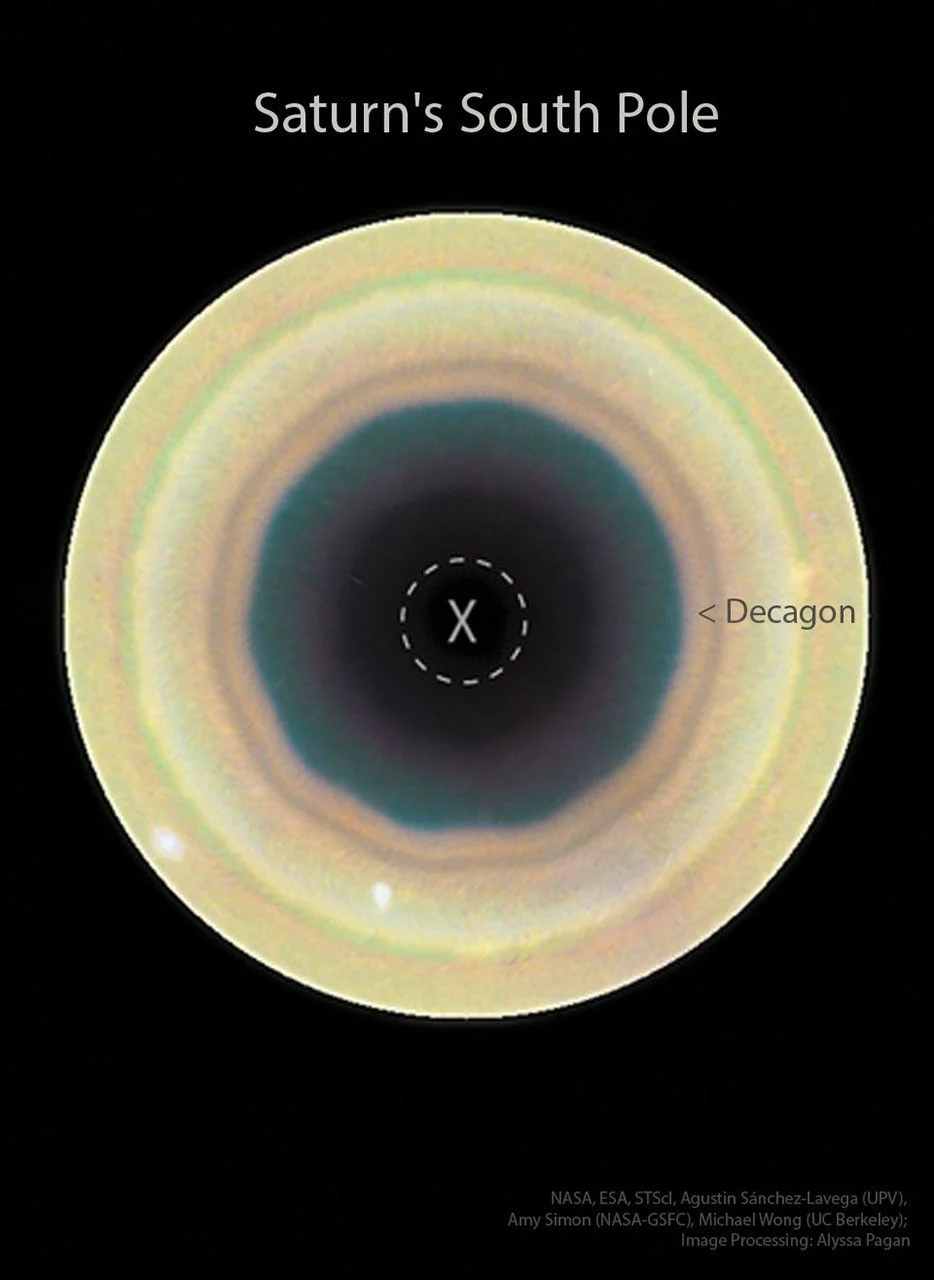
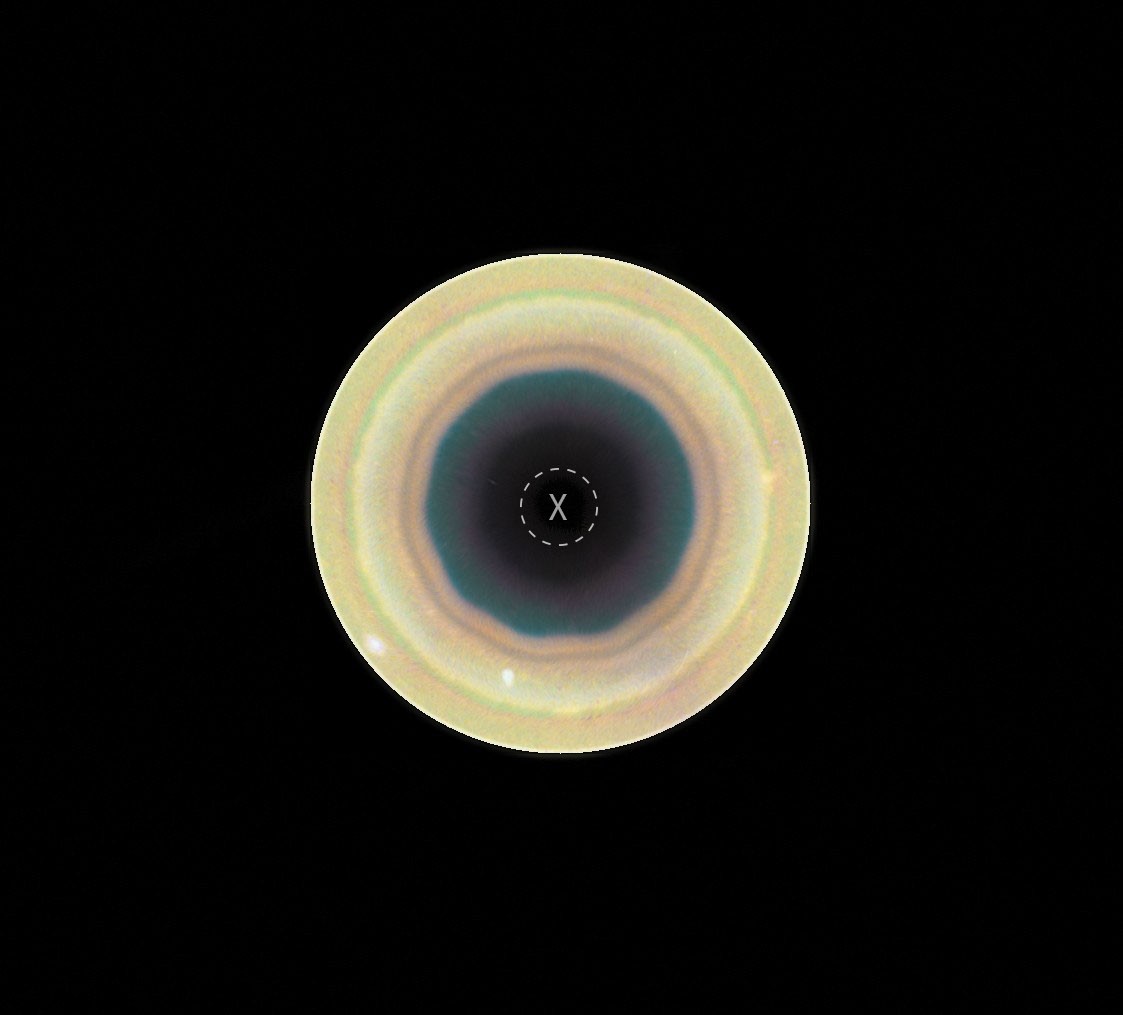
The enigmatic atmosphere of Saturn has once again captured the attention of the scientific community and the public, as the Astronomy Picture of the Day (APOD) for September 8, 2026, highlighted a groundbreaking discovery: a decagonal (10-sided) cloud pattern encircling the gas giant’s South Pole. This revelation, made possible by recent observations from the venerable Hubble Space Telescope, introduces a new layer of complexity to our understanding of planetary atmospheric dynamics, building upon decades of research into Saturn’s previously known hexagonal storm at its North Pole. The featured image composite from Hubble, captured in 2025, vividly displays this unprecedented geometric structure, with a prominent ‘X’ marking the South Pole amidst bands of circulating clouds, revealing the decagon most distinctly in the darker inner regions.
A History of Polar Mysteries: The Hexagon’s Precedent
For nearly four decades, Saturn’s North Pole has been a subject of intense fascination due to its colossal, persistent hexagonal cloud pattern. This six-sided vortex, spanning approximately 20,000 miles (32,000 kilometers) in diameter, was first discovered in 1987 by data transmitted from NASA’s Voyager spacecrafts, which performed swift flybys of the ringed world in the early 1980s. The Voyager missions, primarily designed for reconnaissance, provided the first hints of this extraordinary meteorological phenomenon, a stable and remarkably geometric jet stream that defied conventional atmospheric models.
Subsequent missions, most notably the Cassini-Huygens spacecraft, offered unparalleled long-term observations of the hexagon. From 2004 to 2017, Cassini orbited Saturn, providing detailed imagery and spectroscopic data that allowed scientists to study the hexagon’s structure, dynamics, and evolution across different Saturnian seasons. Cassini’s observations confirmed the hexagon’s incredible stability, demonstrating its resilience over decades despite the planet’s powerful and turbulent atmospheric conditions. The hexagon’s walls are formed by a high-speed jet stream, with winds blowing at speeds of up to 200 miles per hour (320 kilometers per hour), trapping a vast vortex within its confines. Scientists have proposed various theories for its formation, largely centering on the interplay of fluid dynamics, zonal winds, and Rossby waves in the planet’s upper atmosphere. These theories suggest that the hexagon is a standing wave pattern, a stable configuration arising from the specific conditions of Saturn’s atmosphere, akin to ripples in a pond but on a planetary scale.
The hexagon’s persistence and unique geometry have made it a benchmark for studies in fluid mechanics and planetary science, challenging researchers to develop models that can accurately replicate such a long-lived and orderly structure in a chaotic environment. Before the recent Hubble findings, it was often considered a singular anomaly within our solar system, with no analogous features found on other gas giants like Jupiter, which exhibits more turbulent and less geometric polar regions.
The Decagon’s Emergence: Hubble’s Unprecedented View
The latest observations from the Hubble Space Telescope, highlighted in the APOD feature, have now revealed that Saturn’s South Pole is also home to a unique geometric cloud pattern, this time a decagon. While the northern hexagon has been stable for over 40 years, the discovery of a distinct, 10-sided structure at the opposite pole adds a compelling new dimension to Saturnian atmospheric science. The Hubble Space Telescope, a joint project of NASA and ESA, operated by the Space Telescope Science Institute (STScI), has been instrumental in providing long-term, high-resolution views of solar system planets, complementing the close-up data from missions like Voyager and Cassini. Its ability to observe Saturn over extended periods, even from Earth orbit, is crucial for detecting changes and persistent features.
The image composite, credited to NASA, ESA, STScI, and HST, with processing by A. Pagan (STScI) and scientific contributions from A. Sánchez-Lavega (UPV), A. Simon (NASA-GSFC), and M. Wong (UC Berkeley), showcases the decagon’s intricate form. The visual data indicates that this southern decagon, much like its northern counterpart, is defined by bands of circulating clouds, with its geometric boundaries likely shaped by the same fundamental principles of fluid dynamics. The specific conditions, such as temperature, wind shear, and atmospheric composition, at the South Pole likely differ enough from the North Pole to favor a decagonal shape rather than a hexagonal one.
Unraveling the Dynamics: Why Geometric Poles?
The central question posed by both the hexagon and now the decagon is: why are Saturn’s poles geometric? The prevailing scientific explanation, mentioned in the APOD feature, points to "waves when the fast-moving gas away from the poles interacts with slower-moving gas closer to the poles." This refers to a complex interplay of forces within Saturn’s atmosphere. Gas giants like Saturn possess deep atmospheres characterized by powerful zonal winds – high-speed jet streams that blow eastward and westward in bands parallel to the equator. At the poles, these zonal flows converge, and the Coriolis effect (due to the planet’s rotation) becomes highly significant.
In fluid dynamics, under specific conditions of rotation, density stratification, and differential heating, atmospheric flows can spontaneously organize into stable, polygonal patterns. These are often described as standing waves or vortices that become ‘locked’ into a geometric configuration. The interaction between fast-moving jet streams further away from the pole and slower-moving, more chaotic flows closer to the pole can generate shear instabilities. These instabilities, rather than simply dissipating, can stabilize into specific polygonal shapes if the conditions are right, essentially forming a "container" for the polar vortex.
The exact number of sides in such a polygon – six for the north, ten for the south – depends on a delicate balance of factors: the speed and width of the jet streams, the atmospheric density, the depth of the storm system, and the planet’s rotation rate. Differences in these parameters between Saturn’s northern and southern hemispheres could account for the variation in the observed polygonal shapes. For instance, seasonal variations, which are quite pronounced on Saturn (each season lasting approximately seven Earth years), could influence atmospheric temperatures and wind patterns, potentially leading to different stable configurations. While Cassini extensively studied the northern hexagon during varying seasons, Hubble’s observation of the southern decagon provides a new opportunity to compare and contrast these phenomena.
The Missions Behind the Discoveries: A Collaborative Effort
The understanding of Saturn’s polar geometries is a testament to decades of space exploration and the capabilities of various spacecraft:
- Voyager 1 and 2 (NASA): These pioneering probes, launched in 1977, provided the first close-up images of Saturn in 1980 and 1981, respectively. It was their data that first revealed the hexagon at Saturn’s North Pole. Their flybys were brief but revolutionary, opening a new era of planetary science.
- Cassini-Huygens (NASA/ESA/ASI): This mission, active from 2004 to 2017, was an orbiter and lander combination that delivered an unprecedented wealth of data about Saturn, its rings, and its moons. Cassini provided long-term, high-resolution observations of the northern hexagon, mapping its structure, temperature, and wind speeds, and documenting its stability over more than a decade. Its "Grand Finale" dives into Saturn’s atmosphere provided crucial data on the planet’s internal structure and atmospheric composition.
- Hubble Space Telescope (NASA/ESA): Launched in 1990, Hubble continues to be a cornerstone of astrophysics. Its unique position above Earth’s atmosphere allows for incredibly sharp images and spectroscopic observations across various wavelengths. For Saturn, Hubble provides invaluable global views over long periods, essential for monitoring atmospheric changes and detecting new phenomena like the southern decagon, which might be missed by shorter-duration flybys or orbiters focused on other aspects of the planet. The recent decagon discovery underscores Hubble’s continued relevance in planetary science, even as newer telescopes like James Webb come online.
The combined data from these missions forms a comprehensive picture, allowing scientists to piece together the complex puzzle of Saturn’s atmospheric behavior. The shift in APOD’s main NASA site from apod.nasa.gov to science.nasa.gov/apod signifies an ongoing commitment to making these discoveries accessible to a broader audience, emphasizing the educational aspect of NASA’s scientific endeavors.
Implications for Planetary Science and Beyond
The discovery of a decagon at Saturn’s South Pole carries significant implications for our understanding of planetary atmospheres and fluid dynamics:
- Comparative Planetology: The existence of two distinct geometric patterns at Saturn’s poles raises questions about why similar phenomena are not observed on other gas giants in our solar system, such as Jupiter, Uranus, or Neptune. While Jupiter exhibits powerful polar cyclones, they lack the clear polygonal boundaries seen on Saturn. This uniqueness suggests that Saturn possesses a specific combination of atmospheric properties (e.g., density, rotation rate, internal heat flow, and cloud layer depth) that are particularly conducive to the formation and stabilization of these geometric waves.
- Fundamental Fluid Dynamics: Saturn’s polar geometries provide a natural laboratory for studying fundamental principles of fluid mechanics under extreme conditions that are difficult to replicate in terrestrial laboratories. Understanding how these patterns form and persist can lead to advancements in fluid dynamics theory, with potential applications in diverse fields from meteorology on Earth to engineering. The stability of the northern hexagon for over 40 years, and now the observed decagon, challenges existing models and prompts the development of more sophisticated simulations.
- Atmospheric Modeling: The data from these observations will be crucial for refining global circulation models of gas giant atmospheres. Accurately modeling these complex systems requires accounting for phenomena like geometric vortices. The presence of different geometries at opposite poles provides a unique test case for these models, allowing scientists to explore how slight variations in boundary conditions or internal dynamics can lead to vastly different stable states.
- Long-Term Planetary Evolution: The stability and long-lived nature of these polar structures suggest that they are not transient weather events but fundamental features of Saturn’s atmospheric circulation. Studying their evolution over time can offer insights into the long-term processes that shape gas giant atmospheres and potentially reveal clues about the planet’s internal structure and energy transport mechanisms.
The Future of Saturnian Exploration and Research
The stability of the southern decagon will undoubtedly remain a significant topic of research. Scientists will now look to future observations, potentially from Hubble, the James Webb Space Telescope (JWST), or even future dedicated missions to Saturn, to monitor this newly discovered feature. Key questions include:
- Duration and Stability: Will the decagon prove as stable and long-lived as the northern hexagon, or is it a more transient phenomenon? Long-term monitoring will be essential.
- Seasonal Variations: How do Saturn’s seasons affect the decagon’s appearance, size, and dynamics? Cassini showed that the hexagon changed color and visibility with seasons, and similar effects might be expected for the decagon.
- Internal Structure: What do these surface phenomena tell us about the deeper atmospheric layers and even the planet’s interior? The extent to which these geometric patterns penetrate the atmosphere is a crucial area of study.
- Formation Mechanisms: Can refined models accurately predict the formation of both hexagonal and decagonal patterns based on the specific conditions of Saturn’s poles? This will involve complex computational fluid dynamics.
The Astronomy Picture of the Day, through its daily presentation of cosmic wonders, continues to play a vital role in bringing these cutting-edge scientific discoveries to a global audience. The image of Saturn’s decagonal South Pole, alongside its concise explanation by professional astronomers, serves as a powerful reminder of the universe’s endless capacity for surprise and the relentless pursuit of knowledge by scientists around the world. As technology advances, our understanding of distant worlds like Saturn will only deepen, revealing even more spectacular and perplexing phenomena that push the boundaries of human comprehension. The journey of discovery, from Voyager’s initial glimpse to Hubble’s latest revelation, underscores the enduring human quest to "Discover the cosmos!"