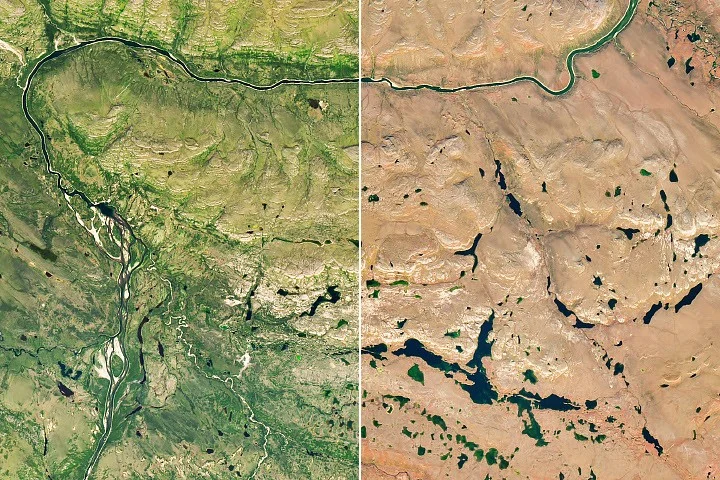
As North America grappled with a summer marked by unprecedented heatwaves and persistent drought conditions across many regions, the concept of crisp autumn air and vibrant fall foliage seemed a distant prospect for much of the continent in early September 2026. Yet, in the far reaches of northern Canada, specifically within the vast, rugged landscapes of Nunavut, the inexorable march of the seasons was already painting the tundra in a breathtaking palette of reds, yellows, and oranges, signaling an early and ephemeral autumn. This striking contrast underscores the unique climatic dynamics of the Arctic and subarctic regions, which often experience seasonal shifts weeks or even months ahead of their southern counterparts. The visible transformation serves as a potent reminder of the Earth’s diverse ecosystems and the subtle, yet profound, ways they respond to the annual cycle of solar radiation and temperature fluctuations.
A Glimpse into Arctic Autumn: Landsat’s View
The vivid signs of this early seasonal shift were captured with remarkable clarity on September 6, 2026, by the Operational Land Imager (OLI) aboard Landsat 9, a cornerstone mission in the joint NASA and U.S. Geological Survey (USGS) Earth observation program. The satellite imagery revealed sweeping expanses of color across the tundra and low-growing shrublands through which the Coppermine River gracefully meanders. This particular snapshot focused on the area upriver from Kugluktuk, a small, predominantly Inuit community situated at the river’s mouth on the Coronation Gulf. For stark comparison, another image from July 27, 2026, of the identical location showcased a predominantly green landscape, reflecting the peak of the brief Arctic summer when vegetation thrived under continuous daylight.
Landsat 9, launched in 2021, continues the invaluable legacy of its predecessors, providing high-resolution, global coverage of Earth’s land surface. Its OLI-2 instrument captures images across nine spectral bands, enabling scientists to monitor changes in land use, vegetation health, water resources, and, crucially, phenological events like the timing of fall foliage. The continuity of the Landsat mission, spanning over five decades, creates an unparalleled archive of Earth’s surface, offering critical data for understanding long-term environmental trends and the impacts of climate change. The precise observation capabilities of OLI-2 allow for the detection of subtle shifts in vegetation pigment concentrations, making it an ideal tool for tracking the onset and progression of autumn colors in remote and otherwise inaccessible regions like Nunavut.
The Science Behind the Spectacle: Why Leaves Change
The annual transformation of green leaves into a vibrant tapestry of reds, oranges, and yellows is a fundamental biological process driven by the interplay of light, temperature, and plant physiology. At its core, the change is a visible manifestation of the plant’s preparation for dormancy during the colder, darker months. Throughout the spring and summer, leaves are dominated by chlorophyll, the green pigment essential for photosynthesis – the process by which plants convert sunlight into chemical energy. Chlorophyll efficiently absorbs red and blue light from the solar spectrum, reflecting the green wavelengths that our eyes perceive. This active synthesis of chlorophyll requires ample sunlight and sufficiently warm temperatures.
As autumn progresses, the decreasing day length and dropping temperatures signal to deciduous plants that the growing season is nearing its end. The plant begins to reduce its production of new chlorophyll. Simultaneously, the existing chlorophyll molecules, which are not stable compounds, start to break down. As the green chlorophyll pigments degrade, their dominant color fades, allowing other pigments that have been present in the leaves all along, but masked by the abundance of chlorophyll, to become visible. These secondary pigments include carotenoids and anthocyanins.
Carotenoids, responsible for the yellow and orange hues, are always present in the leaf cells. They absorb blue-green and blue light, and as chlorophyll diminishes, their vibrant yellows emerge. Anthocyanins, on the other hand, are typically not present during the growing season but are synthesized in the fall in response to bright light and cool temperatures, particularly after the chlorophyll has started to break down. These pigments produce the striking red, purple, and crimson colors. Anthocyanins absorb blue, blue-green, and green light, reflecting red. The specific combination and concentration of these pigments, influenced by genetic factors, local weather conditions (especially temperature, sunlight, and moisture levels in the weeks leading up to and during the change), and soil chemistry, dictate the exact shades and intensity of the fall display. In Nunavut, the region’s characteristic vegetation, including species like willow and birch shrubs, along with ground-cover plants such as blueberries and bearberries, are particularly known for their rich spectrum of red, orange, and yellow hues.
Nunavut’s Unique Phenology: An Early Peak, A Brief Show
The Arctic and subarctic regions of Nunavut exhibit a distinct phenological pattern compared to temperate zones. Phenology, the study of cyclic and seasonal natural phenomena, especially in relation to climate and plant and animal life, reveals that fall arrives exceptionally early in these northern latitudes. A comprehensive analysis conducted by NASA and South Dakota State University, based on seven years of satellite data, precisely tracked the timing of foliage change in this region. Their findings indicate that the vivid transformation of the landscape typically commences in early September, reaching its peak color intensity by mid-month. This makes Nunavut one of the very first locations on the entire North American continent to experience the full splendor of autumn.
However, the early arrival of fall in the Arctic comes with a trade-off: a significantly shorter duration of peak color. The same analysis showed that these far northerly regions often experience a window of peak autumnal beauty lasting a week or less, a stark contrast to many lower-latitude areas where peak foliage can persist for several weeks. This fleeting display is a direct consequence of the rapidly diminishing daylight hours and plummeting temperatures characteristic of the high Arctic as it transitions from its brief summer into the prolonged winter. The rapid onset of severe cold quickly leads to leaf senescence and abscission, where leaves detach from the plant, bringing an abrupt end to the vibrant show. Understanding these specific phenological timings is crucial for climate scientists, as shifts in these patterns can serve as sensitive indicators of broader climatic changes.
A Summer of Extremes: Contextualizing the Early Autumn
The early arrival of fall colors in Nunavut in September 2026 occurred against the backdrop of a summer that had been historically significant for its extreme heat across much of North America and, indeed, globally. Reports from the National Oceanic and Atmospheric Administration (NOAA) and the World Meteorological Organization (WMO) had detailed how August 2026 registered among the warmest, if not the warmest, months on record globally, extending a prolonged streak of above-average temperatures. Persistent heat domes, particularly across the southern and western United States, Mexico, and parts of central Canada, led to record-breaking temperatures, intensified wildfires, and placed immense strain on infrastructure and human health. Major metropolitan areas experienced prolonged heat alerts, and agricultural sectors faced unprecedented challenges due to drought and heat stress.
This continental heat anomaly provided a striking contrast to the scene unfolding in Nunavut. While millions in more temperate zones longed for the relief of cooler weather, the Arctic was already well into its autumnal transition. This juxtaposition highlights a key aspect of global climate change: while overall warming trends are observed, their manifestations can be highly regional and varied. The Arctic, in particular, is experiencing "Arctic amplification," warming at a rate two to four times faster than the global average. This accelerated warming influences everything from sea ice extent to permafrost stability and, critically, the timing and duration of seasonal events like plant growth and senescence. The early leaf color change in Nunavut, even amidst a globally hot summer, is a localized phenological response to the specific photoperiod and temperature cycles unique to its high latitude, rather than a direct consequence of the distant heatwaves, though both are part of the larger climate narrative.
The Arctic as a Climate Barometer: Broader Implications
The observations of early fall foliage in Nunavut are more than just a beautiful natural phenomenon; they serve as critical bio-indicators within a rapidly changing Arctic ecosystem. The Arctic is often described as the "canary in the coal mine" for global climate change, as it responds more dramatically and rapidly to rising global temperatures. Changes in vegetation cycles, such as earlier leaf-out in spring or earlier senescence in fall, have profound ecological implications.
For instance, shifts in the timing of plant growth and dormancy can create a mismatch (phenological asynchrony) with other dependent species, such as migratory birds or caribou, whose life cycles are often finely tuned to the availability of specific plant resources. If plants mature or become unavailable earlier, it can impact foraging success and reproductive rates for wildlife. Furthermore, changes in tundra vegetation can alter the surface albedo (reflectivity) of the land. As shrubs expand into previously treeless tundra, or as snow cover diminishes, darker vegetation can absorb more solar radiation, leading to further warming—a positive feedback loop accelerating Arctic warming.
Crucially, the vast expanses of the Arctic tundra sit atop permafrost, ground that remains frozen for at least two consecutive years. Permafrost stores immense quantities of carbon, locked away for millennia. Changes in vegetation cover, soil temperatures, and the timing of freeze-thaw cycles can influence the stability of permafrost. Earlier and potentially warmer autumns could contribute to permafrost thaw, which in turn can release greenhouse gases like carbon dioxide and methane into the atmosphere, creating another potent feedback loop that exacerbates global warming. Monitoring these subtle changes in seasonal plant behavior through satellite imagery and ground observations is therefore indispensable for scientists attempting to model future climate scenarios and understand the complex interactions within the Arctic carbon cycle.
Monitoring Our Changing Planet: The Role of Satellite and Citizen Science
The ongoing monitoring of Earth’s vital signs, from atmospheric composition to land surface changes, is a cornerstone of NASA’s Earth Science program. Missions like Landsat 9 provide the essential long-term, consistent data sets required to detect and understand gradual environmental shifts. The images of Nunavut’s early autumn underscore the value of this continuous satellite observation, allowing scientists to track remote regions and contribute to global databases on ecological change.
Beyond sophisticated satellite technology, citizen science initiatives play an increasingly important role in complementing these high-tech observations with critical ground-level data. The GLOBE North American Phenology Campaign, supported by NASA, actively engages the public in observing and recording leaf color changes during both spring and fall. Participants, often students and educators, contribute invaluable data by documenting the precise timing of leaf-out, full foliage, color change, and leaf drop. This ground-based information helps validate satellite observations and provides a richer, more nuanced understanding of plant responses to local climate and environmental changes. By combining the broad spatial coverage of satellite imagery with the detailed, localized observations of citizen scientists, researchers can build more robust models and gain deeper insights into how ecosystems are adapting, or struggling to adapt, to a warming world. The collective effort of scientists and the public creates a powerful network for monitoring Earth’s dynamic systems.
The Future of Arctic Seasons
The early onset of fall colors in Nunavut in September 2026 serves as a compelling visual narrative of the profound and often rapid environmental changes unfolding in the Arctic. While the specific timing of fall foliage is a natural annual cycle, its consistent monitoring provides crucial data points for understanding larger climatic trends. As global temperatures continue to rise, the Arctic will remain a critical region to watch, with its unique ecosystems acting as sensitive indicators of planetary health.
Scientists emphasize the importance of sustained observation through programs like Landsat and citizen science initiatives like GLOBE. These efforts are not merely about documenting beautiful seasonal displays but about building a comprehensive understanding of Earth’s interconnected systems. The data gathered helps inform climate models, predict future ecological shifts, and ultimately, guide policy decisions aimed at mitigating the impacts of climate change. The vibrant, yet fleeting, autumn in Nunavut is a poignant reminder that while nature’s beauty endures, its rhythms are increasingly influenced by the overarching narrative of a warming planet, demanding continued vigilance and scientific inquiry.
NASA Earth Observatory images by Michala Garrison, using Landsat data from the U.S. Geological Survey. Story by Adam Voiland.